Our licensed engineers, architects, and technical specialists bring deep knowledge of regional requirements and industry best practices, enabling us to deliver customized, high-quality solutions that ...
Our licensed engineers, architects, and technical specialists bring deep knowledge of regional requirements and industry best practices, enabling us to deliver customized, high-quality solutions that ...
Senior Consultant- Architectural Engineering
Manhattan, NY · On-site
$104K - $156K/yr
Our licensed engineers, architects, and technical specialists bring deep knowledge of regional requirements and industry best practices, enabling us to deliver customized, high-quality solutions that ...
Senior Consultant- Architectural Engineering
Manhattan, NY · On-site
$104K - $156K/yr
Our licensed engineers, architects, and technical specialists bring deep knowledge of regional requirements and industry best practices, enabling us to deliver customized, high-quality solutions that ...

AND POSITION REQUIREMENTS The Department of Architectural Engineering at The Pennsylvania State University invites applications for one or more part-time, non-tenure track instructor positions for ...
AND POSITION REQUIREMENTS The Department of Architectural Engineering at The Pennsylvania State University invites applications for one or more part-time, non-tenure track instructor positions for ...
Summer 2027 Internship - Architectural Engineering
Los Angeles, CA · On-site
$28 - $40/hr
About the Role General Matter is seeking an Architectural Engineering Intern to join our Buildings team in Los Angeles. This role offers a unique opportunity to work alongside experienced engineers ...
Summer 2027 Internship - Architectural Engineering
Los Angeles, CA · On-site
$28 - $40/hr
About the Role General Matter is seeking an Architectural Engineering Intern to join our Buildings team in Los Angeles. This role offers a unique opportunity to work alongside experienced engineers ...

Intern, Architectural Engineering (Summer 2027)
Omaha, NE · On-site
$15 - $19.50/hr
Description As an Architectural Engineering Summer Intern you will perform engineering design, modeling, drafting and detailing tasks in support of structural, mechanical, and electrical engineering.
New
Intern, Architectural Engineering (Summer 2027)
Omaha, NE · On-site
$15 - $19.50/hr
Description As an Architectural Engineering Summer Intern you will perform engineering design, modeling, drafting and detailing tasks in support of structural, mechanical, and electrical engineering.
New
Summer 2027 Internship - Architectural Engineering
Los Angeles, CA · On-site
$28 - $40/hr
About the Role General Matter is seeking an Architectural Engineering Intern to join our Buildings team in Los Angeles. This role offers a unique opportunity to work alongside experienced engineers ...
Summer 2027 Internship - Architectural Engineering
Los Angeles, CA · On-site
$28 - $40/hr
About the Role General Matter is seeking an Architectural Engineering Intern to join our Buildings team in Los Angeles. This role offers a unique opportunity to work alongside experienced engineers ...
Principal Consultant- Architectural Engineering
New York, NY · On-site
$130K - $195K/yr
Our licensed engineers, architects, and technical specialists bring deep knowledge of regional requirements and industry best practices, enabling us to deliver customized, high-quality solutions that ...
Principal Consultant- Architectural Engineering
New York, NY · On-site
$130K - $195K/yr
Our licensed engineers, architects, and technical specialists bring deep knowledge of regional requirements and industry best practices, enabling us to deliver customized, high-quality solutions that ...
Principal Consultant- Architectural Engineering
New York, NY · On-site
$130K - $195K/yr
Our licensed engineers, architects, and technical specialists bring deep knowledge of regional requirements and industry best practices, enabling us to deliver customized, high-quality solutions that ...
Principal Consultant- Architectural Engineering
New York, NY · On-site
$130K - $195K/yr
Our licensed engineers, architects, and technical specialists bring deep knowledge of regional requirements and industry best practices, enabling us to deliver customized, high-quality solutions that ...
Intern, Architectural Engineering (Summer 2027)
Omaha, NE · On-site
$15 - $19.50/hr
Job Type Internship Description As an Architectural Engineering Summer Intern you will perform engineering design, modeling, drafting and detailing tasks in support of structural, mechanical, and ...
New
Intern, Architectural Engineering (Summer 2027)
Omaha, NE · On-site
$15 - $19.50/hr
Job Type Internship Description As an Architectural Engineering Summer Intern you will perform engineering design, modeling, drafting and detailing tasks in support of structural, mechanical, and ...
New

Architectural/Engineering Project Manager - NY, NJ or WA
Woodcliff Lake, NJ · On-site
$84K - $113K/yr
Architectural/Engineering Project Manager - NY, NJ or WA Location: Woodcliff Lake, NJ, US Manhattan, NY, US Federal Way, WA, US Requisition ID: 181678 Job Level: Senior Level Home District/Group:
Architectural/Engineering Project Manager - NY, NJ or WA
Woodcliff Lake, NJ · On-site
$84K - $113K/yr
Architectural/Engineering Project Manager - NY, NJ or WA Location: Woodcliff Lake, NJ, US Manhattan, NY, US Federal Way, WA, US Requisition ID: 181678 Job Level: Senior Level Home District/Group:
Intern, Architectural Engineering (Summer 2027)
Omaha, NE · On-site
$15 - $19.50/hr
As an Architectural Engineering Summer Intern you will perform engineering design, modeling, drafting and detailing tasks in support of structural, mechanical, and electrical engineering. You will ...
New
Intern, Architectural Engineering (Summer 2027)
Omaha, NE · On-site
$15 - $19.50/hr
As an Architectural Engineering Summer Intern you will perform engineering design, modeling, drafting and detailing tasks in support of structural, mechanical, and electrical engineering. You will ...
New

Part-Time Lecturers - Civil & Architectural Engineering Dept.
Coral Gables, FL · On-site
$16.75 - $21.50/hr
The Department of Civil and Architectural Engineering is seeking Part-Time Faculty to teach courses at the undergraduate and graduate levels for the period 08/01/2024 through 08/14/2025. Master ...
Part-Time Lecturers - Civil & Architectural Engineering Dept.
Coral Gables, FL · On-site
$16.75 - $21.50/hr
The Department of Civil and Architectural Engineering is seeking Part-Time Faculty to teach courses at the undergraduate and graduate levels for the period 08/01/2024 through 08/14/2025. Master ...

We are seeking an Architectural Engineering Analyst to join our dynamic team. This individual will play a pivotal role in developing innovative and effective solutions for our DoD customers within ...
We are seeking an Architectural Engineering Analyst to join our dynamic team. This individual will play a pivotal role in developing innovative and effective solutions for our DoD customers within ...

Description The University of Texas at Austin Fariborz Maseeh Department of Civil, Architectural and Environmental Engineering (CAEE) invites applications for a full-time non-tenure, professional ...
Description The University of Texas at Austin Fariborz Maseeh Department of Civil, Architectural and Environmental Engineering (CAEE) invites applications for a full-time non-tenure, professional ...

Architectural Project Engineer
Los Angeles, CA · On-site
$60/hr
... design, engineering, and production of custom architectural millwork and woodworking projects. The ideal candidate has strong AutoCAD skills, attention to detail, and experience working with ...
Architectural Project Engineer
Los Angeles, CA · On-site
$60/hr
... design, engineering, and production of custom architectural millwork and woodworking projects. The ideal candidate has strong AutoCAD skills, attention to detail, and experience working with ...

Progressive, dynamic, and growing heathcare-focused architectural and engineering firm located in Southeast Charlotte seeks a Project Coordinator for our corporate headquarters. Main responsibilities ...
Quick apply
Progressive, dynamic, and growing heathcare-focused architectural and engineering firm located in Southeast Charlotte seeks a Project Coordinator for our corporate headquarters. Main responsibilities ...
Senior Architectural Engineer
Philadelphia, PA · On-site
$96K - $131K/yr
Company Description As a global engineering solutions firm that plays a leading role in the areas of plants, architecture and asset management, Hyundai Engineering is expanding into renewable energy ...
Quick apply
Senior Architectural Engineer
Philadelphia, PA · On-site
$96K - $131K/yr
Company Description As a global engineering solutions firm that plays a leading role in the areas of plants, architecture and asset management, Hyundai Engineering is expanding into renewable energy ...
ABOUT YOU - What we're looking for: - 5+ years of architectural or architectural-engineering experience on industrial, mission-critical, or large commercial buildings. - Strong working command of IBC ...
ABOUT YOU - What we're looking for: - 5+ years of architectural or architectural-engineering experience on industrial, mission-critical, or large commercial buildings. - Strong working command of IBC ...
Senior Architectural Engineer
Philadelphia, PA · On-site
$96K - $131K/yr
Company Description As a global engineering solutions firm that plays a leading role in the areas of plants, architecture and asset management, Hyundai Engineering is expanding into renewable energy ...
Senior Architectural Engineer
Philadelphia, PA · On-site
$96K - $131K/yr
Company Description As a global engineering solutions firm that plays a leading role in the areas of plants, architecture and asset management, Hyundai Engineering is expanding into renewable energy ...
Senior Architectural Engineer
Philadelphia, PA · On-site
$96K - $131K/yr
Company Description As a global engineering solutions firm that plays a leading role in the areas of plants, architecture and asset management, Hyundai Engineering is expanding into renewable energy ...
Senior Architectural Engineer
Philadelphia, PA · On-site
$96K - $131K/yr
Company Description As a global engineering solutions firm that plays a leading role in the areas of plants, architecture and asset management, Hyundai Engineering is expanding into renewable energy ...
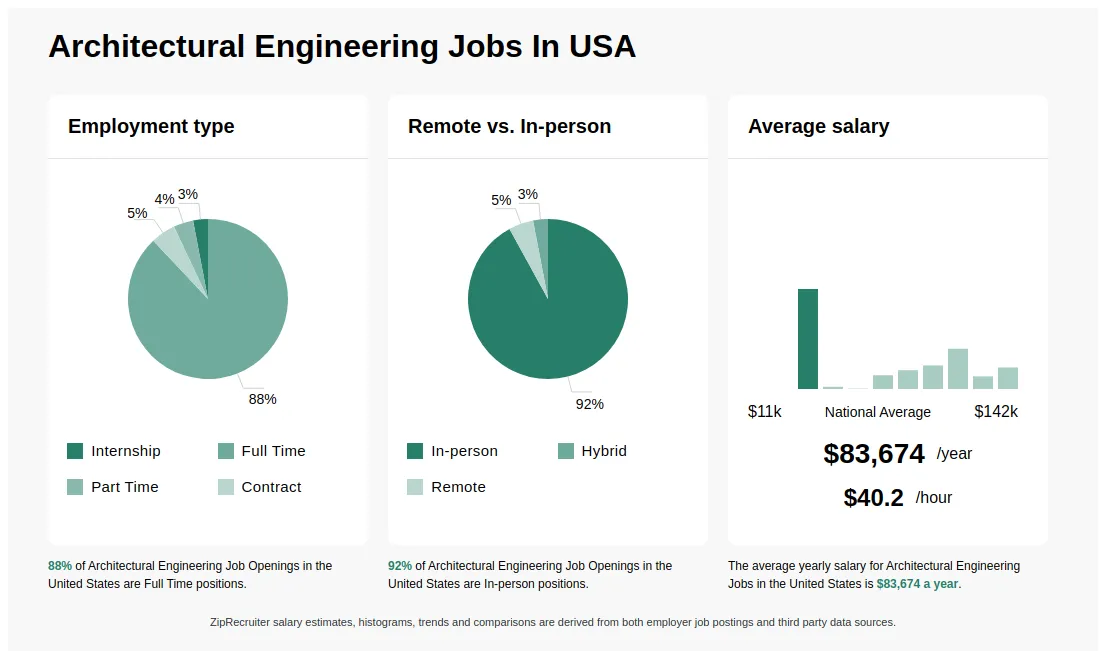
Architectural Engineering information
See salary details
$11K - $22.9K
0% of jobs
$22.9K - $34.8K
0% of jobs
$41.6K is the 25th percentile. Wages below this are outliers.
$34.8K - $46.7K
44% of jobs
$46.7K - $58.6K
0% of jobs
$58.6K - $70.5K
0% of jobs
$70.5K - $82.5K
5% of jobs
The median wage is $83.9K / yr.
$82.5K - $94.4K
8% of jobs
$94.4K - $106.3K
10% of jobs
$111.2K is the 75th percentile. Wages above this are outliers.
$106.3K - $118.2K
18% of jobs
$118.2K - $130.1K
5% of jobs
$130.1K - $142K
9% of jobs
$11K
$83.7K
$142K
How much do architectural engineering jobs pay per year?
As of Sep 12, 2026, the average yearly pay for architectural engineering in the United States is $83,674.00, according to ZipRecruiter salary data. Most workers in this role earn between $45,000.00 and $112,000.00 per year, depending on experience, location, and employer.
What is architectural engineering?
Architectural engineering is a discipline that focuses on the engineering aspects of building design and construction. Architectural engineers collaborate with architects and other professionals to ensure buildings are safe, sustainable, and functional, integrating structural, mechanical, electrical, and plumbing systems. Their work includes designing and analyzing building systems, ensuring code compliance, and addressing environmental and energy efficiency concerns. This field bridges the gap between architecture and engineering, emphasizing both aesthetics and technical performance.
What are the key skills and qualifications needed to thrive as an architectural engineer, and why are they important?
To thrive as an Architectural Engineer, a strong background in mathematics, physics, building design, and engineering principles—typically supported by a bachelor’s degree in architectural engineering—is essential. Familiarity with design software like AutoCAD, Revit, and building information modeling (BIM) systems, as well as licensure such as the Professional Engineer (PE) certification, is often required. Strong problem-solving, teamwork, and communication skills set outstanding professionals apart in this role. These capabilities are vital for ensuring safe, efficient, and innovative building solutions that meet client and regulatory requirements.
How does an architectural engineer typically collaborate with architects and construction teams during a project?
Architectural engineers work closely with architects to ensure that building designs are both aesthetically pleasing and structurally sound. Throughout a project, they participate in design meetings, review architectural plans, and provide input on structural systems, HVAC, and electrical layouts. Collaboration with construction teams is essential to address technical challenges during the build phase and to ensure all systems are implemented according to specifications. This teamwork helps bridge the gap between creative design and practical construction, leading to successful project outcomes.
What is the difference between Architectural Engineering vs Civil Engineering?
| Aspect | Architectural Engineering | Civil Engineering |
|---|---|---|
| Credentials | Bachelor's in Architectural Engineering, PE license (optional) | Bachelor's in Civil Engineering, PE license |
| Work Environment | Designing building systems, collaborating with architects | Designing infrastructure, construction projects |
| Industry Usage | Building design, HVAC, electrical, plumbing systems | Transportation, water resources, structural projects |
Architectural Engineering focuses on building systems and integration within structures, while Civil Engineering covers broader infrastructure projects. Both roles require similar credentials and often work in construction or design industries, but their specific focus areas differ significantly.
Are architectural engineers in demand?
Architectural engineers are in demand due to ongoing construction projects and infrastructure development, especially in regions with active building growth. Employment opportunities are expected to grow as the need for sustainable and energy-efficient building systems increases, requiring skills in design, analysis, and the use of engineering software.
Do architectural engineers get paid well?
Architectural engineers typically earn competitive salaries that reflect their specialized skills in designing and integrating building systems. Salaries vary based on experience, location, and certifications, with many earning above the national average for engineering roles. The profession often offers opportunities for advancement and additional compensation through project management and advanced technical skills.
What can architectural engineers do?
Architectural engineers design and analyze building systems such as structural, mechanical, electrical, and plumbing systems to ensure safety, functionality, and energy efficiency. They collaborate with architects and construction teams, often using tools like CAD software, and may need professional licensure to lead projects and oversee construction processes.
What jobs can you do with an architectural engineering degree?
An architectural engineering degree prepares individuals for roles such as structural engineer, building systems designer, construction manager, or project engineer. These jobs involve designing, analyzing, and overseeing building systems like structural frameworks, HVAC, electrical, and plumbing, often requiring knowledge of CAD software and building codes.
More about Architectural Engineering jobs
What cities are hiring for Architectural Engineering jobs?
Cities with the most Architectural Engineering job openings:
What are the most commonly searched types of Architectural Engineering jobs?
The most popular types of Architectural Engineering jobs are:
What states have the most Architectural Engineering jobs?
States with the most job openings for Architectural Engineering jobs include:
What are popular job titles for Architectural Engineering?
Popular job titles for Architectural Engineering:

Associate Consultant- Architectural Engineering
Manhattan, NY • On-site
Rimkus Consulting Group
• Business Management Consulting • 1 - 5K employees1,001 - 5,000 employees
Other
Medical, Dental, Vision, Life, Retirement, PTO
Posted 29 days ago
Job description
At Rimkus, our Built Environment Solutions teamoperateson a global scale with the advantage of localexpertise. Our licensed engineers, architects, and technical specialists bring deep knowledge of regional requirements and industry best practices, enabling us to deliver customized, high-quality solutions that maximize the success of our clients’ investments. With a comprehensive portfolio that spansnearly everyengineering and architectural discipline, we help organizations plan, build, and manage assets with confidence.
What sets us apart is our forward-thinking approach. We integrate carbon footprint reduction, resiliency, maintainability, and long-term sustainability into everything wedohelping clients not just meet today’s needs but prepare for tomorrow’s challenges. From design and pre-construction through construction, closeout, and ongoing operations, we provide tailored support at every stage. Byidentifyingpotential issues before they arise, we mitigate risks, extend asset life, and reduce costly unplanned repairs. Whether an asset is newly constructed, leased, orpurchased, our innovative solutions empower clients tooperatemore efficiently and sustainably. Joining Rimkus means being part of a teamthat’sshaping the future of the built environment—one smart, resilient solution at a time.
Overview
Rimkus is seeking an Associate Consultant - Architectural Engineering to join our growing team of engineering professionals. This position is ideal for a motivated early-career engineer with experience in structural design and building systems who is interested in working on a diverse portfolio of commercial, residential, industrial, and multifamily projects.
Under the guidance of senior engineers and consultants, the Associate Consultant will assist with the design, assessment, investigation, and construction of buildings nationwide. This role offers exposure to new construction, adaptive reuse projects, forensic evaluations, and remediation efforts involving damage from fire, wind, impact events, and other building-related failures.
The successful candidate will possess design experience with conventional wood framing, masonry, and concrete structures and will support both field and office-based engineering activities.
Essential Responsibilities- Collaborate with licensed engineering professionals in the design, assessment, investigation, and construction of commercial, residential, industrial, and multifamily buildings.
- Assist with engineering projects involving building assessments, maintenance planning, restorations, renovations, and new construction.
- Support evaluations and repair designs for structures impacted by fire, wind, impact events, and other forms of damage.
- Participate in adaptive reuse projects and facility upgrades to accommodate changing building functions, occupancy requirements, and equipment installations.
- Conduct engineering assignments in accordance with approved project scopes, schedules, and budgets.
- Manage multiple projects simultaneously while maintaining quality, accuracy, and responsiveness to client needs.
- Coordinate with internal and external consultants across multiple disciplines to ensure timely delivery of project reports and recommendations.
- Perform engineering calculations and analyses related to structural design and building performance.
- Research and interpret current and historical building codes, standards, and industry guidelines.
- Review product submittals, shop drawings, testing reports, data sheets, mock-ups, samples, and warranty documentation.
- Assist with field investigations and condition assessments of existing structures.
- Evaluate and review field engineering and design changes during construction to verify compliance with project requirements and specifications.
- Perform site inspections that may include working on rooftops, ladders, lifts, scaffolding, confined spaces, and mechanical/electrical/fire protection equipment rooms.
- Prepare technical reports, findings, repair recommendations, proposals, and other project documentation.
- Hands-on experience with AutoCAD, Revit, and/or other Building Information Modeling (BIM) software.
- Strong understanding of structural systems including wood, masonry, and concrete construction.
- Excellent verbal communication and technical writing skills.
- Strong analytical and problem-solving capabilities with exceptional attention to detail.
- Ability to interpret technical reports, engineering documents, specifications, and building codes.
- Ability to prepare scopes of work, budget estimates, schedules, proposals, and technical reports.
- Strong client-service mindset with the ability to effectively communicate with clients, building owners, contractors, and colleagues.
- Ability to manage competing priorities and meet project deadlines in a fast-paced environment.
- Proficiency in Microsoft Office Suite and engineering/design software applications.
- Valid driver's license and reliable transportation required.
- Willingness and ability to travel to project sites as needed.
- Bachelor's degree in Architectural Engineering required.
- Advanced degree is a plus.
- 0-4+ years of structural design, building engineering, or related experience.
- Experience with commercial, residential, multifamily, or industrial building projects preferred.
- Ability to conduct site inspections in various environmental conditions.
- Ability to climb ladders, navigate scaffolding and lifts, access rooftops, and work in confined spaces when necessary.
- Ability to lift and carry equipment associated with field inspections.
At Rimkus, you'll work alongside industry-leading professionals on challenging and rewarding projects that help improve, restore, and protect the built environment. We offer mentorship, professional development opportunities, and exposure to a wide variety of engineering and consulting assignments that support long-term career growth.
The Salary Range for this position is $66,000 - $100,000and is dependent on education, experience,locationand certifications/licensure.
PHYSICAL DEMANDS, OVERTIME, AND TRAVEL
Physical Demands –Work will be performed both in an office setting and at outside locations (i.e., Client’s office, industrial, construction, and/or residential sites). Employee is frequently required to stand, sit, climb ladders, bend, balance, stoop, kneel, crouch, talk, hear, and drive a motor vehicle to job sites. Employee may lift and/or move up to 50 pounds. Employee must be attentive, focused, and alert when conducting site inspections, speaking, and interacting with clients, preparing drawings and written reports. Clear vision and depth perception are also necessary.
Overtime –This position is classified as salaried with an exempt FLSA status. Regular working hours are 8:00 a.m. to 5:00 p.m., Monday through Friday, with one hour for lunch. There will be periods where overtime will be required, which the employee will need to comply with in order to meet the demands of the position.
Additional Information:
At Rimkus, we value a diverse and inclusive workplace where all employees feel valued and respected. We are committed to creating a work environment that supports and celebrates the unique perspectives and experiences of all employees. If you share our commitment to diversity and inclusivity and are excited about joining a welcoming and supportive team, we encourage you to apply for our open positions.
Rimkus is an Equal Employment Opportunity (EEO) Employer and will make all employment-related decisions without regard to race, color, religion, sex, sexual orientation, gender identity, genetic information, national origin, disability, or protected veteran status.
THIS JOB DESCRIPTION IS SUBJECT TO CHANGE AND DOES NOT CONSTITUTE A CONTRACT FOR EMPLOYMENT OR A GUARANTEE OF CONTINUED EMPLOYMENT.
- Health Care Plan (Medical, Dental & Vision)
- Retirement Plan (401k, IRA)
- Life Insurance (Basic, Voluntary & AD&D)
- Paid Time Off (Vacation, Sick & Public Holidays)
- Family Leave (Maternity, Paternity)
- Short Term & Long Term Disability
- Training & Development

About Rimkus
Sourced by ZipRecruiter
Industry
Business management consulting
Company size
1,001 - 5,000 Employees
Headquarters location
Houston, TX, US
Year founded
1983