1

Agronomist Jobs (NOW HIRING)

Agronomist

Albion, NE ยท On-site

Job Summary The Agronomist is responsible for developing, implementing, and monitoring agronomic programs that maximize crop yield, crop quality, profitability, and environmental stewardship. This ...

The Sales Agronomist will grow agronomy market and wallet share by actively calling on Key Agronomy accounts, both current and prospective accounts. The Sales Agronomist will also grow agronomy ...

Agronomist

Westfield, IN ยท On-site +1

Description The Holganix team is looking for an Agronomist to empower growers with regenerative agriculture solutions that improve soil vitality, increase yields, and reduce input dependency. At ...

Agronomist

Mount Vernon, IL ยท On-site +1

Description The Holganix team is looking for an Agronomist to empower growers with regenerative agriculture solutions that improve soil vitality, increase yields, and reduce input dependency. At ...

Agronomist

Iowa City, IA ยท On-site +1

Description The Holganix team is looking for an Agronomist to empower growers with regenerative agriculture solutions that improve soil vitality, increase yields, and reduce input dependency. At ...

The Holganix team is looking for an Agronomist to empower growers with regenerative agriculture solutions that improve soil vitality, increase yields, and reduce input dependency. At Holganix, we ...

The Sales Agronomist will grow agronomy market and wallet share by actively calling on Key Agronomy accounts, both current and prospective accounts. The Sales Agronomist will also grow agronomy ...

The Holganix team is looking for an Agronomist to empower growers with regenerative agriculture solutions that improve soil vitality, increase yields, and reduce input dependency. At Holganix, we ...

Agronomist | $ 20-25 per hour | Day Shift, Direct Hire What Matters Most * Competitive Pay of $20-25 per hour * Schedule: Monday-Friday, Day Shift * Location: Albion, NE * Direct Hire Our client is ...

Agronomist

Green Bay, WI ยท On-site +1

Description The Holganix team is looking for an Agronomist to empower growers with regenerative agriculture solutions that improve soil vitality, increase yields, and reduce input dependency. At ...

Technical Agronomist III The Technical Agronomist III (TA) role empowers you to be the agronomic and product leader within your local squad, partnering closely with sales, product management ...

Sales Agronomist

Argyle, MN ยท On-site

$65K - $75K/yr

Are you ready to take your agronomy career to the next level in a role where relationships matter just as much as results? We're partnering with a leading agronomy services provider to find a ...

next page

Showing results 1-20

Agronomist information

See salary details

$11K

$52.4K

$83.5K

How much do agronomist jobs pay per year?

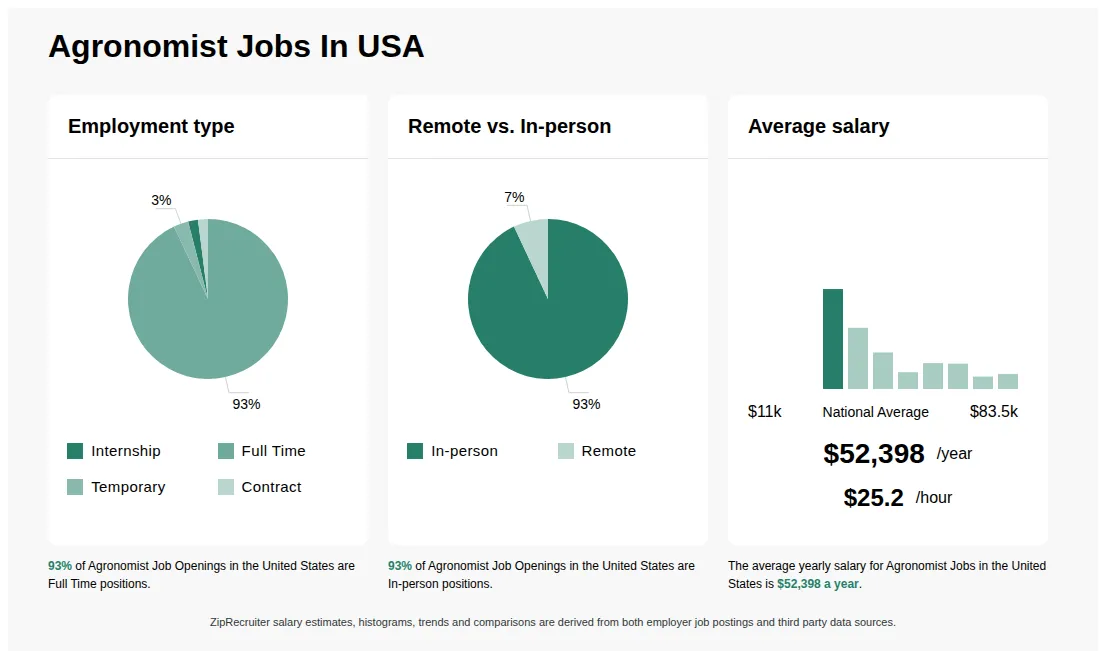
As of Jul 26, 2026, the average yearly pay for agronomist in the United States is $52,398.00, according to ZipRecruiter salary data. Most workers in this role earn between $37,500.00 and $60,500.00 per year, depending on experience, location, and employer.

Which is the highest paid job in agriculture?

In agriculture, senior roles such as Agricultural Managers, Farm Owners, and Agribusiness Executives tend to have the highest salaries. Specialized positions like Agricultural Engineers and Crop Scientists with advanced degrees and certifications can also earn high compensation, especially in large-scale operations or corporate settings.

What Is an Agronomist?

An agronomist performs scientific research to find the best possible uses for plants, including ways to cultivate, genetically enhance, and utilize crops as sources of fuel. The field of agronomy includes the study of crop genetics and physiology, but has also expanded to incorporate elements of agriculture, meteorology, and soil conservation. You may choose to specialize in a particular field, but typical job duties for an agronomist include experimentation with crops to improve their quality and yield, with a primary goal of increasing food stores.

What are some typical challenges agronomists face when working with farmers to implement new crop management practices?

Agronomists often encounter challenges such as resistance to change, limited resources, and varying levels of agricultural knowledge among farmers when introducing new crop management techniques. Building trust and effectively communicating the long-term benefits of these practices are essential for success. Additionally, agronomists must tailor recommendations to specific environmental conditions, regulatory requirements, and market demands, making adaptability and problem-solving key components of the role.

What are agronomists?

Agronomists are scientists who specialize in the study and management of crops and soils. They work to improve the quality and yield of crops by researching soil health, plant genetics, irrigation methods, and pest control. Agronomists often advise farmers on best practices for sustainable agriculture, crop rotation, and the use of fertilizers and pesticides. Their expertise helps ensure efficient and environmentally friendly food production.

What are the key skills and qualifications needed to thrive as an Agronomist, and why are they important?

To thrive as an Agronomist, you need a solid background in plant science, soil management, and crop production, often supported by a degree in agronomy or a related field. Familiarity with precision agriculture technologies, geographic information systems (GIS), and data analysis software is highly valuable. Strong problem-solving abilities, effective communication, and teamwork skills set outstanding agronomists apart. These competencies are crucial for optimizing crop yields, advising farmers, and implementing sustainable agricultural practices.

What jobs can an agronomist do?

An agronomist can work in roles such as crop consultant, soil scientist, research scientist, or farm manager. They analyze soil and crop health, develop sustainable farming practices, and often use tools like GIS and laboratory equipment. These positions are typically found in agricultural companies, research institutions, and government agencies.

Do agronomists make a lot of money?

Agronomists typically earn a median annual salary that is around the national average for scientific and technical roles, with salaries varying based on experience, education, and location. Entry-level positions may pay less, while experienced agronomists with specialized skills or certifications can earn higher wages. The profession often involves fieldwork and requires knowledge of crop science, soil management, and agricultural technology.

What is the difference between Agronomist vs Soil Scientist?

AspectAgronomistSoil Scientist
CredentialsBachelor's or Master's in Agronomy, Agriculture, or related fieldBachelor's or Master's in Soil Science, Geology, or related field
Work EnvironmentFarms, research centers, agricultural companiesLaboratories, research institutions, environmental agencies
Industry UsageCrop production, farm management, agricultural consultingSoil analysis, environmental assessment, land management

Both Agronomists and Soil Scientists work in agriculture-related fields, often with overlapping knowledge of soil and crop health. However, Agronomists focus more on crop production and farm management, while Soil Scientists specialize in soil properties and environmental impacts. Understanding these differences helps in choosing the right career path or job search focus.


What cities are hiring for Agronomist jobs? Cities with the most Agronomist job openings:
What are the most commonly searched types of Agronomist jobs? The most popular types of Agronomist jobs are:
Who are the top companies hiring for Agronomist jobs? The top employers for Agronomist jobs are:
What states have the most Agronomist jobs? States with the most job openings for Agronomist jobs include:
What job categories do people searching Agronomist jobs look for? The top searched job categories for Agronomist jobs are:
Infographic showing various Agronomist job openings in the United States as of July 2026, with employment types broken down into 93% Full Time, 6% Part Time, and 1% Temporary. Highlights an 86% Physical, 1% Hybrid, and 13% Remote job distribution, with an average salary of $52,398 per year, or $25.2 per hour.

Full-time

Posted 9 days ago


Job description

Job Summary

The Agronomist is responsible for developing, implementing, and monitoring agronomic programs that maximize crop yield, crop quality, profitability, and environmental stewardship. This position provides technical expertise and recommendations related to seed fertility programs, crop protection, irrigation management, soil health, nutrient utilization, and integrated pest management.

The Agronomist partners with farm operations personnel to ensure agronomic plans are executed safely, accurately, and efficiently. This role combines crop analysis, field scouting, data analysis, operational support, and regulatory compliance to achieve production goals while promoting continuous improvement throughout the agricultural operation.

Essential Duties and Responsibilities

Safety

  • Comply with all company safety policies, procedures, and training requirements.
  • Promote and model a culture of safety throughout all agricultural operations.
  • Ensure fertilizers, pesticides, herbicides, and other agricultural chemicals are handled, mixed, transported, stored, and applied in accordance with label instructions and all local, state, and federal regulations.
  • Utilize and enforce the proper use of Personal Protective Equipment (PPE) during chemical handling, field inspections, and equipment operations.
  • Conduct field safety observations and identify unsafe conditions, hazards, or practices requiring corrective action.
  • Participate in safety meetings, incident investigations, and corrective action planning.
  • Understanding of OSHA, EPA, Department of Agriculture, and pesticide regulatory requirements applicable to crop production activities.
  • Capable of reading the Safety Data Sheets (SDS) that are involved in chemical use.
  • Evaluate weather conditions and environmental risks to minimize spray drift, runoff, and environmental exposure.
  • Follow safe operating procedures for equipment used in agronomic operations.

Quality

  • Conduct routine crop scouting to evaluate crop health, emergence, stand establishment, weed pressure, insect activity, disease presence, and nutrient deficiencies.
  • Support agronomic recommendations designed to maximize crop yield and quality.
  • Collect and interpret soil samples, tissue samples, manure analyses, and other agronomic data to support sound decision-making.
  • Conduct fertility soil tests, yield goals, crop removal rates, and nutrient requirements.
  • Re appropriate seed varieties and hybrids based on field characteristics and production objectives.
  • Monitor pesticide, fertilizer, and manure applications to ensure accuracy, effectiveness, and compliance with agronomic recommendations.
  • Ensure irrigation practices support optimum crop growth and efficient water utilization.
  • Document accurate and timely records of field observations, applications, and agronomic activities.
  • Evaluate application performance and adjustments to improve effectiveness and consistency.

Productivity

  • Develop annual crop management plans aligned with production goals and operational objectives.
  • Analyze yield data, field performance trends, and production metrics to identify opportunities for increased efficiency and profitability.
  • Utilize precision agriculture technologies including yield mapping, GPS guidance, variable-rate applications, and agronomic software to improve productivity.
  • Coordinate agronomic activities with planting, spraying, irrigation, harvest, and post-harvest schedules.
  • Understand the movement of sprayers, spreaders, planters, and application equipment to ensure operational efficiency.
  • Assist with planning and forecasting seed, fertilizer, crop protection, and agronomic input requirements.
  • Monitor crop development and review based on changing field conditions and weather patterns.
  • Support manure nutrient utilization plans to maximize nutrient value and minimize waste.
  • Operate agricultural equipment to support critical field operations.

Teamwork and Collaboration

  • Work collaboratively with farm managers, equipment operators, feedlot personnel, and leadership teams to achieve operational goals.
  • Communicate field observations, crop concerns, operational priorities, and agronomic recommendations clearly and professionally.
  • Support coworkers during peak workloads and time-sensitive production periods.
  • Develop and maintain positive working relationships with co-workers, consultants, contractors, and regulatory representatives.
  • Participate actively in meetings and contribute ideas for continuous improvement.
  • Demonstrate professionalism, respect, accountability, and a positive attitude in all interactions.
  • Assist with feedlot projects, facility maintenance, or other operational needs during non-peak crop production periods.

Attendance and Reliability

  • Maintain regular, punctual attendance and dependable work performance.
  • Be available to work extended hours, weekends, and holidays during planting, spraying, irrigation, and harvest seasons.
  • Demonstrate flexibility to adjust work schedules based on weather conditions, crop needs, and operational priorities.
  • Respond promptly to urgent agronomic issues requiring immediate attention.
  • Communicate proactively with supervisors regarding scheduling conflicts, delays, or operational concerns.
  • Prioritize responsibilities effectively to ensure deadlines and production objectives are met.
  • Demonstrate commitment, accountability, and reliability during critical periods of the production cycle.
  • Report to work prepared to perform assigned duties and responsibilities.

Minimum Qualifications

Education and Experience

  • Bachelor's degree in Agronomy, Crop Science, Plant Science, Agricultural Systems Technology, Agricultural Business, or a related field required.
  • Minimum of two (2) years of agronomic experience preferred.
  • Experience with crop production systems, and nutrient management preferred.
  • Experience with irrigation systems and precision agriculture technologies preferred.
  • Experience operating agricultural equipment is highly desirable.
  • Commercial Pesticide Applicator License required or the ability to obtain within an established timeframe.
  • Certified Crop Adviser (CCA) designation preferred or willingness to pursue certification.

Knowledge, Skills, and Abilities

  • Strong understanding of agronomic principles related to crop production, soil fertility, weed science, entomology, plant pathology, and irrigation management.
  • Knowledge of integrated pest management (IPM) principles and practices.
  • Understanding of environmental regulations governing pesticide applications and nutrient management.
  • Ability to review soil analyses, tissue tests, manure analyses, yield maps, and agronomic data.
  • Proficiency with precision agriculture technologies and agronomic software systems.
  • Strong analytical, organizational, and problem-solving skills.
  • Excellent verbal, written, and interpersonal communication skills.
  • Mechanical aptitude and understanding of agricultural equipment operations.
  • Ability to prioritize multiple projects and work independently with minimal supervision.
  • Valid driver's license with an acceptable driving record required.
  • Commercial Driver's License (CDL) preferred.

Physical Requirements

  • Ability to walk fields and uneven terrain for extended periods.
  • Ability to lift and carry up to 50 pounds occasionally.
  • Ability to climb ladders and agricultural equipment.
  • Ability to bend, kneel, stoop, crouch, and perform repetitive movements.
  • Ability to work outdoors in varying temperatures, dust, mud, humidity, and adverse weather conditions.
  • Ability to sit, drive, and operate equipment for extended periods.

Work Environment

This position functions in an outdoor agricultural setting. The Agronomist may be exposed to dust, chemicals, moving machinery, livestock environments, noise, and varying weather conditions. Seasonal fluctuations in workload should be expected, including extended hours during planting, spraying, irrigation, and harvest activities.