1

Aerial Firefighting Jobs (NOW HIRING)

Inventory Control Specialist

Belgrade, MT · On-site

$25.50 - $26.50/hr

About Bridger Aerospace Bridger Aerospace is an aerial firefighting company based in Belgrade, Montana, located at the Bozeman Yellowstone Airport (KBZN). It was founded in 2014 to support front-line ...

Inventory Control Specialist

Belgrade, MT · On-site

$25.50 - $26.50/hr

About Bridger Aerospace Bridger Aerospace is an aerial firefighting company based in Belgrade, Montana, located at the Bozeman Yellowstone Airport (KBZN). It was founded in 2014 to support front-line ...

Inventory Control Specialist

Belgrade, MT · On-site

$25.50 - $26.50/hr

About Bridger Aerospace Bridger Aerospace is an aerial firefighting company based in Belgrade, Montana, located at the Bozeman Yellowstone Airport (KBZN). It was founded in 2014 to support front-line ...

S-61 Pilot in Command (PIC) About Coulson Aviation Coulson Aviation is a global leader in aerial firefighting, operating across the United States, Canada, Australia, and South America. Our diverse ...

About Coulson Aviation Coulson Aviation is a global leader in aerial firefighting, operating across the United States, Canada, Australia, and South America. Our diverse fleet of fixed-wing and rotary ...

About Coulson Aviation Coulson Aviation is a global leader in aerial firefighting, proudly operating in Canada, the USA, Australia, and Chile. With a world-class fleet of fixed-wing and rotary-wing ...

About Bridger Aerospace Bridger provides aerial wildfire surveillance, relief and suppression, and aerial firefighting services using next-generation technology and environmentally friendly and ...

About Bridger Aerospace Bridger provides aerial wildfire surveillance, relief and suppression, and aerial firefighting services using next-generation technology and environmentally friendly and ...

About Bridger Aerospace Bridger provides aerial wildfire surveillance, relief and suppression, and aerial firefighting services using next-generation technology and environmentally friendly and ...

Engine Fleet Manager

Tampa, FL · On-site

$140K - $160K/yr

Special Air Missions Group (SAM)  is responsible for developing and delivering Metrea's Intelligence, Surveillance, and Reconnaissance (ISR), Special Mobility, and Aerial Firefighting (AFF ...

Special Air Missions Group (SAM) SAM is responsible for developing and delivering Metrea's Intelligence, Surveillance, and Reconnaissance (ISR), Special Mobility, and Aerial Firefighting (AFF ...

next page

Showing results 1-20

Aerial Firefighting information

See salary details

$28.5K

$59.6K

$100K

How much do aerial firefighting jobs pay per year?

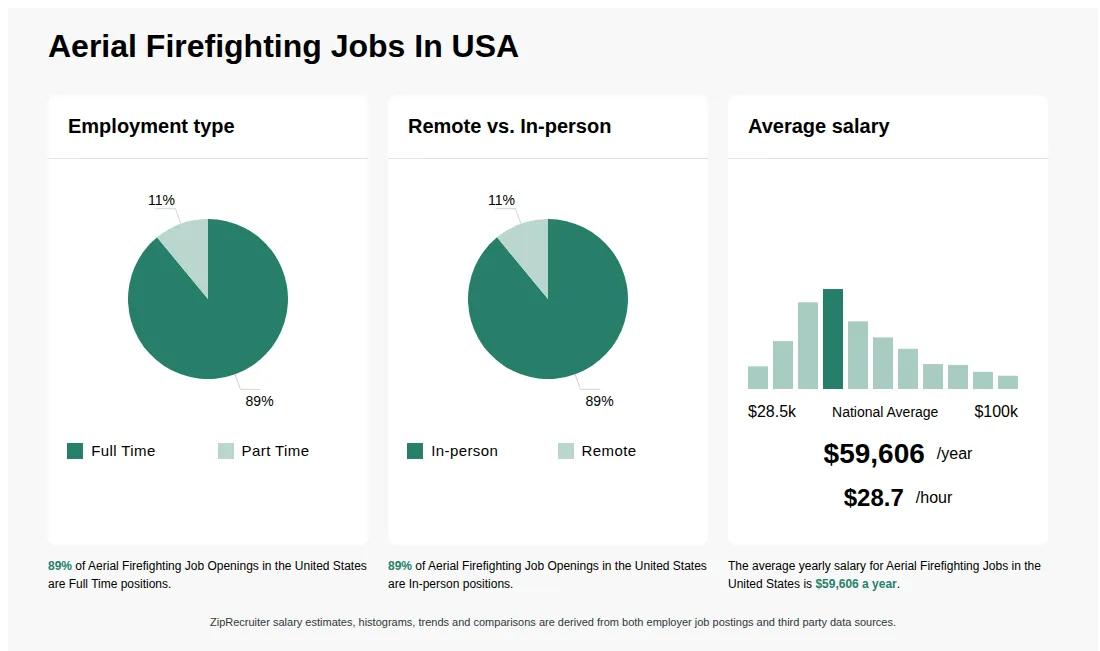
As of Jul 3, 2026, the average yearly pay for aerial firefighting in the United States is $59,606.00, according to ZipRecruiter salary data. Most workers in this role earn between $45,500.00 and $69,000.00 per year, depending on experience, location, and employer.

What is the difference between Aerial Firefighting vs Helicopter Pilot?

AspectAerial FirefightingHelicopter Pilot
Required CertificationsCommercial Pilot License, Firefighting-specific trainingCommercial Pilot License, often with helicopter ratings
Work EnvironmentFire zones, remote areas, often during emergenciesVarious, including transport, surveillance, and firefighting support
Employer & Industry UsageFire departments, government agencies, firefighting contractorsAirlines, charter companies, government agencies, firefighting services

While both roles involve piloting helicopters, aerial firefighting focuses on using aircraft to combat wildfires, requiring specialized firefighting training. Helicopter pilots may work in diverse sectors, including transportation and surveillance, with less emphasis on firefighting-specific skills. Understanding these differences helps clarify career paths and job expectations in the industry.

What Are Aerial Firefighting Jobs?

Aerial firefighting jobs involve flying a plane or helicopter to extinguish wildfires, protect property, and save lives. Pilots fly as part of a crew and drop water or other fire retardants to contain the fire and minimize damage. Some aerial firefighters are “smokejumpers,” which means they parachute or rappel into wildfire areas to combat their spread. As an aerial firefighter, your responsibilities involve preserving woodlands and deserts while protecting the safety of residents and your crew, so these jobs are not for the faint of heart. You must be physically fit and able to endure stressful situations and harsh conditions for extended periods. Additionally, both roles require specialized training.

What is aerial firefighting?

Aerial firefighting is the use of aircraft to combat wildfires from the air. Specialized planes and helicopters drop water or fire retardant chemicals directly onto fires or in strategic locations to slow their spread. These aircraft can also be used for reconnaissance, mapping, and transporting firefighters or equipment to hard-to-reach areas. Aerial firefighting is often coordinated with ground crews to maximize effectiveness and ensure safety. This method is essential in managing large, fast-moving, or remote wildfires.

What are the key skills and qualifications needed to thrive in Aerial Firefighting, and why are they important?

To thrive in aerial firefighting, you need advanced piloting skills, knowledge of fire behavior, and completion of specialized firefighting and aviation training. Experience with aircraft like helicopters or fixed-wing air tankers, FAA certifications, and proficiency in using GPS navigation and radio communication systems are typically required. Outstanding teamwork, decision-making under pressure, and situational awareness are crucial soft skills for this high-risk environment. These abilities are essential to ensure safety, effective wildfire suppression, and coordination with ground crews during complex emergency missions.

What are some of the biggest challenges faced by aerial firefighting crews during wildfire season?

Aerial firefighting crews often contend with unpredictable weather conditions, rapidly changing fire behavior, and challenging terrain that can make flying and water drops both risky and complex. Coordinating with ground teams is essential, as is maintaining constant communication to ensure safety and maximize effectiveness. Additionally, long hours and high-stress situations require strong teamwork and adaptability, making both physical fitness and mental resilience key components of success in this role.
What cities are hiring for Aerial Firefighting jobs? Cities with the most Aerial Firefighting job openings:
What are the most commonly searched types of Aerial Firefighting jobs? The most popular types of Aerial Firefighting jobs are:
What states have the most Aerial Firefighting jobs? States with the most job openings for Aerial Firefighting jobs include:
Infographic showing various Aerial Firefighting job openings in the United States as of June 2026, with employment types broken down into 1% As Needed, 85% Full Time, 10% Part Time, 1% Temporary, 2% Contract, and 1% Nights. Highlights an 99% Physical, and 1% Remote job distribution, with an average salary of $59,606 per year, or $28.7 per hour.

Large Airtanker Pilot - C-130 IA Captain

Coulson Aviation

Portland, OR • On-site

Full-time

Posted 16 days ago


Job description

Large Airtanker Pilot – C-130 Initial Attack

Coulson Aviation

When wildfires ignite, you’re among the first in the air.

Coulson Aviation is seeking exceptional C-130 Initial Attack Airtanker Captains to join our world-class aerial firefighting team. If you bring prior C-130 PIC experience or are USFS Initial Attack (IA) carded as an Airtanker Captain, this is your opportunity to fly one of the most powerful and capable aerial firefighting platforms in service today.

This is a mission-critical role supporting rapid initial attack wildfire suppression, complex fire environments, and large-scale coordinated aerial operations. If you thrive in high-tempo operations, precision low-level flying, and dynamic multi-aircraft environments, this is where your experience truly matters.

Why This Role Matters

Initial attack saves forests, communities, and lives.
As a C-130 Initial Attack Pilot, your decisions and execution in the first hours of a fire can change the outcome entirely. You’ll be entrusted with one of the most capable firefighting aircraft in the world, operating at the sharp end of wildfire response. Supporting ground firefighters is our passion, and we need you to help us help them—so together, we can protect our communities and our state and national forest lands, not only here at home, but internationally as well

The Mission

Conduct time-critical wildfire response missions delivering retardant with our specialized water/retardant dropping tanking systems in the most challenging terrain and congested airspace environments you’ll see as a professional aviator. You’ll work shoulder-to-shoulder with Air Attack, ground resources, and agency partners to slow fire growth when it matters most.

Key Responsibilities

  • Execute initial attack aerial firefighting missions in the C-130 Airtanker with precision, discipline, and professionalism
  • Operate at low level in mountainous and high-threat environments in accordance with approved SOPs and tactics
  • Coordinate closely with Air Attack to manage complex, congested fire traffic areas
  • Identify, assess, and mitigate operational hazards while actively supporting the Safety Management System (SMS)
  • Maintain aircraft and crew readiness for rapid deployment during peak fire activity
  • Complete flight logs, mission records, and required operational documentation
  • Contribute to the continuous improvement of wildfire tactics, SOPs, and operational procedures

Qualifications

Required

  • FAA ATP, or FAA Commercial Pilot Certificate with Instrument Rating appropriate to C-130 operations
  • 2,000+ hours total flight time
  • 1,000+ hours of multi-engine experience
  • 500 hours of IFR experience

Preferred

  • 4,000+ hours total flight time
  • Previous C-130, LAT, or VLAT experience
  • Initial Attack aerial firefighting experience
  • Low-level tactical flying in complex or mountainous terrain
  • Multi-crew, crew-resource-management–intensive cockpit experience

What Sets You Apart

  • Exceptional CRM, threat and error management, and sound aeronautical decision-making
  • Calm, decisive communicator under pressure
  • High situational awareness in rapidly evolving fire environments
  • Safety-driven, mission-focused, and ready for on-call deployment during peak fire seasons

Ready to be first over the fire?

Apply now and join the front line of aerial wildfire suppression with Coulson Aviation.