1

3D Medical Imaging Post Processing Jobs (NOW HIRING)

Radiologist Assistant 2 (100% on-site)

Stanford, CA ยท On-site

$376K - $470K/yr

Work closely with the physician on complex medical imaging procedures, 3D reformations, and post processing procedures. * Participate in the design, development, implementation and execution of ...

Assistant Radiologist

Stanford, CA ยท On-site

$376K - $470K/yr

Work closely with the physician on complex medical imaging procedures, 3D reformations, and post processing procedures. Participate in the design, development, implementation and execution of ...

Radiologist Assistant 2 (100% On-Site)

Stanford, CA ยท On-site

$376K - $470K/yr

Work closely with the physician on complex medical imaging procedures, 3D reformations, and post processing procedures. * Participate in the design, development, implementation and execution of ...

... post-doctoral or industry experience developing AI/ML for medical imaging (CT, MRI, PET) in a ... DICOM I/O, visualization, registration, harmonization, annotation, and segmentation of 3D medical ...

next page

Showing results 1-20

3D Medical Imaging Post Processing information

See salary details

$75K

$121.1K

$170.5K

How much do 3d medical imaging post processing jobs pay per year?

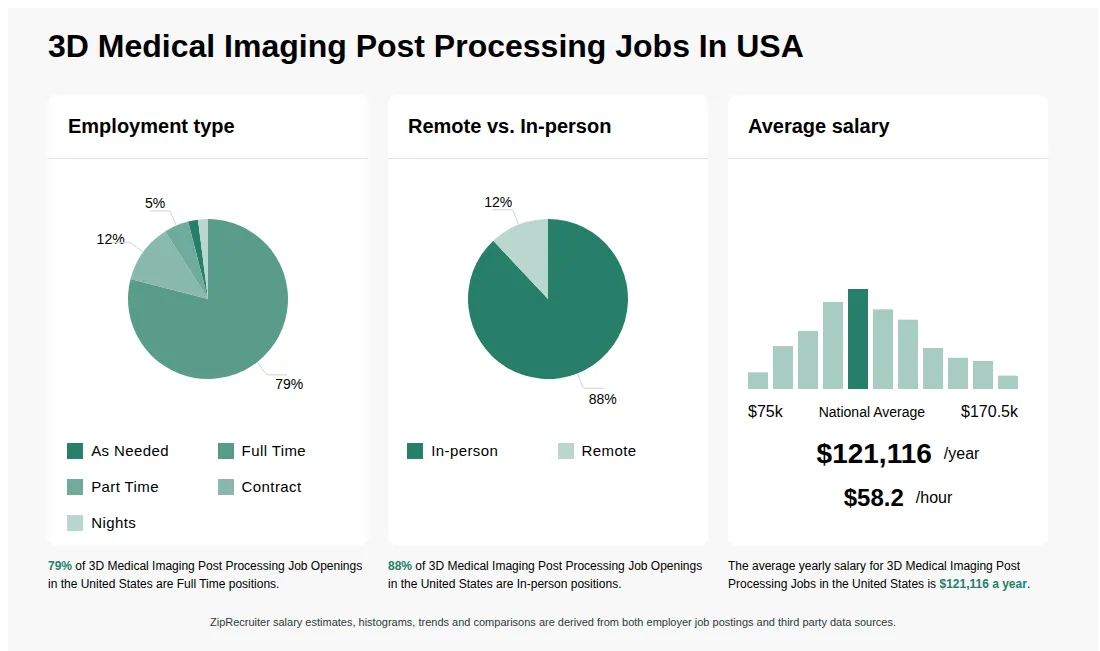
As of Jul 14, 2026, the average yearly pay for 3d medical imaging post processing in the United States is $121,116.00, according to ZipRecruiter salary data. Most workers in this role earn between $104,000.00 and $134,500.00 per year, depending on experience, location, and employer.

What is the highest paying medical imaging career?

In medical imaging, radiologists typically have the highest salaries due to their advanced training and specialization. Other high-paying roles include nuclear medicine physicians and certain interventional radiologists, especially those with subspecialty certifications and extensive experience.

What are some common daily responsibilities for professionals working in 3D Medical Imaging Post Processing?

Professionals in 3D Medical Imaging Post Processing are responsible for reconstructing and enhancing medical images from raw data, creating 3D visualizations to assist radiologists and clinicians with diagnosis and treatment planning. Daily tasks often include processing CT or MRI scans, annotating and segmenting anatomical structures, troubleshooting imaging artifacts, and ensuring image quality. The role frequently involves collaborating closely with radiologists, technologists, and sometimes surgeons, to customize images for specific clinical needs. Staying current with evolving imaging technologies and software updates is also an important part of the job.

Is AI going to take over medical imaging jobs?

For 3D Medical Imaging Post Processing, AI is a tool that enhances efficiency and accuracy but is not expected to fully replace professionals. It automates tasks like segmentation and analysis, allowing specialists to focus on complex decision-making and interpretation. Human expertise remains essential for quality control, diagnosis, and integrating imaging data with clinical context.

What is post processing in medical imaging?

In 3D Medical Imaging Post Processing, post processing refers to the digital manipulation and analysis of raw imaging data, such as CT or MRI scans, to enhance image quality, extract relevant features, and generate detailed 3D models. This process often involves specialized software and technical skills to assist clinicians in diagnosis, treatment planning, and visualization. Accurate post processing is essential for producing clear, precise images that support medical decision-making.

What is 3D post processing?

3D medical imaging post processing involves converting raw data from imaging modalities like CT or MRI into detailed three-dimensional visualizations. This process includes segmentation, rendering, and analysis to assist in diagnosis and treatment planning, often using specialized software and requiring technical skills in image manipulation.

What are the key skills and qualifications needed to thrive in the 3D Medical Imaging Post Processing position, and why are they important?

To thrive in 3D Medical Imaging Post Processing, you need a solid understanding of human anatomy, medical imaging modalities (such as CT, MRI), and expertise in image post-processing techniques, typically supported by education in radiologic technology or biomedical engineering. Familiarity with advanced imaging software like Siemens syngo.via, GE AW, or Philips IntelliSpace Portal, and relevant certifications in medical imaging, are essential. Attention to detail, analytical thinking, and effective communication are key soft skills for producing accurate, clinically relevant 3D visualizations and collaborating with radiologists and clinicians. These competencies are vital for ensuring that processed images meet diagnostic standards and support optimal patient care decisions.

What is a 3D Medical Imaging Post Processing job?

A 3D Medical Imaging Post Processing job involves enhancing and reconstructing medical images, such as CT and MRI scans, to create detailed 3D models for diagnostic and surgical planning. Professionals in this role use specialized software to segment, analyze, and optimize images for improved visualization. Their work aids radiologists, surgeons, and other healthcare professionals in better understanding patient anatomy. This process enhances diagnostic accuracy and supports customized treatment planning. Strong technical skills and knowledge of medical imaging modalities are essential for this role.

What cities are hiring for 3D Medical Imaging Post Processing jobs? Cities with the most 3D Medical Imaging Post Processing job openings:
What are the most commonly searched types of 3D Medical Imaging Post Processing jobs? The most popular types of 3D Medical Imaging Post Processing jobs are:
What states have the most 3D Medical Imaging Post Processing jobs? States with the most job openings for 3D Medical Imaging Post Processing jobs include:
Infographic showing various 3D Medical Imaging Post Processing job openings in the United States as of July 2026, with employment types broken down into 1% As Needed, 86% Full Time, 10% Part Time, and 3% Contract. Highlights an 90% Physical, 3% Hybrid, and 7% Remote job distribution, with an average salary of $121,116 per year, or $58.2 per hour.
3D Technology Scientist

Full-time

Re-posted 2 hours ago


Job description

Missouri Southern State University is seeking candidates for a full-time professional staff on-campus position as a 3D Technology Scientist. The 3D Technology Scientist will provide expertise in 3D printing construction, technical maintenance, and quality assurance within the Missouri 3D Printing Center for Precision Health. This position will work closely with clinical, educational, and research personnel to advance the integration of 3D printing technologies into medical and educational applications. This position is part of the Science to Jobs initiative and will report to the Executive Director of the Missouri 3D Printing Center for Precision Health.
Specific Duties and Responsibilities
Maintain, calibrate, and upgrade 3D printing center equipment, supplies, and technology to ensure optimal functional capacity and currency, collaborating with other offices or entities as applicable.
Ensure high-quality and accurate 3D printing for anatomical models for educational use, medical devices, surgical planning tools, or other medically related printed items.
Ensure all printed models and devices meet regulatory standards and are compliant with relevant medical device regulations (e.g. FDA, ISO) and safety standards as applicable.
Maintain currency on emerging trends, technologies, and applications in 3D printing, and assess their potential integration into the center's operation.
Develop and enforce quality control protocols, ensuring reproducibility, accuracy, and safety of printed products.
Conduct regular audits of lab processes and maintain proper documentation for compliance or other applicable standards (e.g. accreditation).
Troubleshoot and resolve technical issues related to printing processes, equipment, and software.
Manage inventory (equipment and supplies) effectively including inventory control and security procedures.
Ensure 3D printing spaces are clean and safe for workers, visitors, and students.
Design, implement, and evaluate learning and training experiences pertaining to 3D printing systems, software, and applications.
Develop, deliver, and oversee curricula leading to attainable credentials within 3D printing in health-related fields, or other fields as applicable.
Partner with healthcare providers, researchers, and other stakeholders to understand clinical needs and facilitate solutions with 3D printing applications.
Work collaboratively with stakeholders to facilitate 3D printing opportunities across applicable educational and research programs.
Complete professional development and training to ensure necessary skills and knowledge, including all relevant team members.
Complete other tasks as assigned.
Education, Experience, Licenses
Associate's Degree in Additive Manufacturing, Mechanical Engineering, Materials Science, Medical Imaging, Radiology, Radiologic Technology, Biomedical Engineering, Medical Physics, or a related field is required (Bachelor's degree or higher is preferred).
Experience with human anatomy is required.
3D Printing hands-on technical experience is required. Experience with 3D medical printing is preferred.
CT or MRI Technologist experience is preferred.
Applicant must be willing to complete additional trainings or certifications as applicable (may require travel).
Knowledge, Skills, and Abilities
To perform this job successfully, an individual must be able to perform each essential duty satisfactorily. The requirements listed below are representative of the knowledge, skill, and/or ability required. Reasonable accommodations may be made to enable individuals with disabilities to perform the essential functions.
Familiarity with 3D printing technologies (e.g. SLA, FDM), 3D-associated software, and file applications.
Demonstrate competency in the operation of 3D printers, post-processing machines, and related equipment.
Ability to intake and process additive manufacturing requests.
Mechanical skills in assembly and finishing processes of 3D printed items such as sanding, brushing, etc.
Familiarity with FDA and ISO medical device standards is preferred.
Knowledge of human anatomy; cross-sectional anatomy is preferred.
Strong organizational and communication skills (written and verbal).
Strong interpersonal and collaborative skills with the ability to build relationships.
Knowledge pertaining to curriculum design and delivery.
Ability to work effectively with diverse faculty, students, healthcare professionals, and other internal and external constituents.
Ability to work independently, with attention to detail, innovation, and timeliness of work production.
Ability to proficiently use computers, especially Microsoft Office products and web-based applications.
Ability to use (or quickly learn) University data software (Banner) and other software systems.
Ability to use small office equipment, including scanners and copy machines.
This position requires an on-campus presence with the ability to travel occasionally.
Physical Demands/Work Environment
The physical demands described here are representative of those that must be met by an employee to successfully perform the essential functions of this job. Reasonable accommodations may be made to enable individuals with disabilities to perform the essential functions. While performing the duties of this job, the employee is regularly required to stand; walk; use hands to finger, handle, feel or use a computer keyboard; reach with hands and arms; climb or balance; and talk or hear (including the use of a telephone). The employee frequently is required to sit, stoop, or crouch. The employee must be able to stand, walk, and use hands for extended periods of time. The employee must regularly lift and/or move up to 10 pounds, frequently lift and/or move up to 25 pounds, and occasionally lift and/or move up to 30 pounds. Specific vision abilities required by this job include close vision, distance vision, color vision, peripheral vision, depth perception, and ability to adjust focus. Requires the ability to smell and taste. The employee must be able to operate simulation equipment. The noise level in the work environment is usually moderate.
Notice: The above job profile does not include all essential and nonessential duties of this job.
Applicants should provide a detailed letter of application, resume (with names and contact details of three references), and copies of supporting documentation (transcripts, certifications, licensures) as applicable. Submit documents by visiting www.mssu.edu/jobs. Supporting documentation is required 45 days after employment ensues. Review of applications will begin immediately and will continue until the position is filled. Employment is contingent upon a background check. MSSU is an EOE/AA employer with a strong institutional commitment to achievement of excellence and diversity among faculty and staff. MSSU is an E-verify participating employer. Visit our website to learn more about the advantages of employment at MSSU.