1

Sports Analytics Jobs (NOW HIRING)

Sports Management Coach

$17 - $22/hr

... sports analytics, sports law, and brand development. Coaches also help students build these capabilities through consistent, practical skill building, and support the career side of the journey ...

ABOUT US The Sports Media Team at Sportradar builds platforms and products that collect, curate ... Our Analytics Products and Broadcast Solutions are behind the stats and storylines seen by millions ...

Showing results 41-60

sports analytics information

See salary details

$64.5K

$125.3K

$179K

How much do sports analytics jobs pay per year?

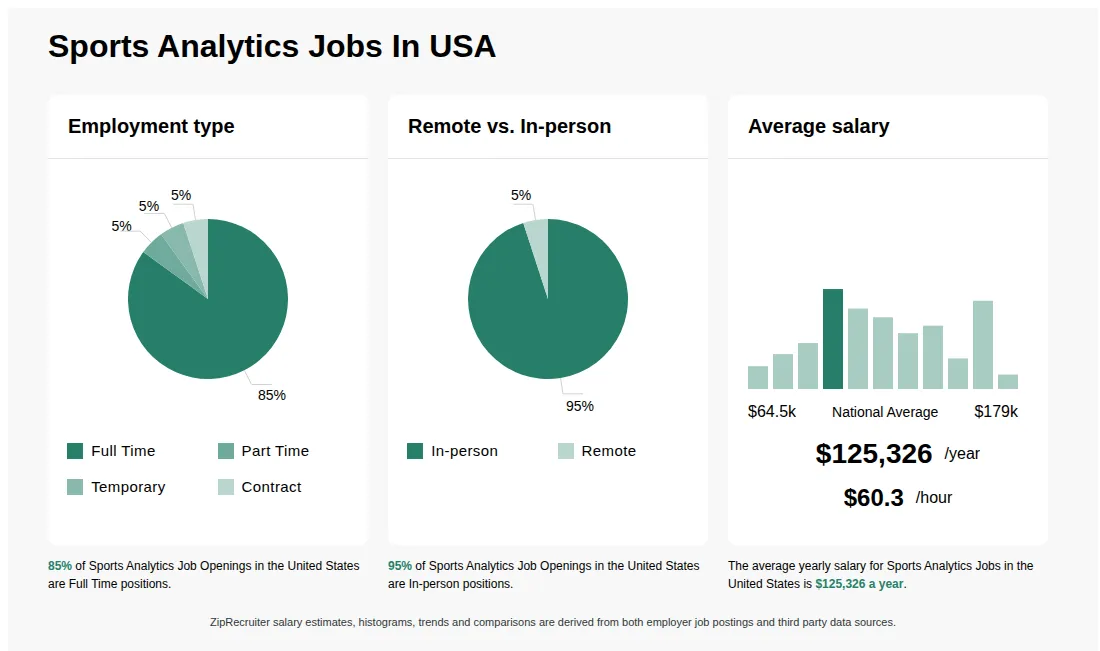
As of Aug 17, 2026, the average yearly pay for sports analytics in the United States is $125,326.00, according to ZipRecruiter salary data. Most workers in this role earn between $100,000.00 and $149,000.00 per year, depending on experience, location, and employer.

What is sports analytics?

Sports analytics is a field of applied statistics that uses past performance data to provide a competitive advantage to a team or individual player. By using data, an analyst can make suggestions on strategies for a given game, monitor the performance of a player, and provide quick analysis of potentially record-setting activities. Sports analytics focuses on two areas: on-field and off-field. The on-field analysis helps improve the tactics and fitness of players, while the off-field analysis focuses on the business and merchandising aspect of sports. Sports analytics is also used in sports gambling to help casinos and similar companies decide on which odds to offer to customers.


What is sports analytics?

Sports analytics refers to the use of data and statistical methods to analyze athletic performance, strategies, and business operations within the sports industry. Professionals in this field collect and interpret data to help teams make informed decisions about player recruitment, game tactics, injury prevention, and fan engagement. The insights gained from sports analytics can provide a competitive edge and drive improvements both on and off the field. With advances in technology, the scope of sports analytics has expanded to include machine learning, video analysis, and wearable devices.

What are the key skills and qualifications needed to thrive as a sports analyst, and why are they important?

To thrive as a Sports Analyst, you need strong statistical analysis skills, a solid understanding of sports rules and strategies, and often a degree in statistics, data science, or a related field. Familiarity with analytics software such as R, Python, SQL, and sports-specific databases is typically expected. Attention to detail, critical thinking, and effective communication help interpret complex data and present actionable insights to coaches and teams. These capabilities are vital for making data-driven decisions that improve team performance and competitive edge.

How does a sports analytics professional typically collaborate with coaches and athletes to influence game strategies?

Sports analytics professionals work closely with coaches and athletes by providing data-driven insights that inform tactical decisions and player development. They often translate complex statistical findings into actionable recommendations, such as identifying strengths and weaknesses or optimizing lineups. Effective collaboration requires strong communication skills and the ability to tailor analyses to the team's goals, ensuring that data supports real-time decision-making and long-term strategy. Regular meetings, presentations, and feedback sessions are common to ensure alignment between analytics staff and on-field personnel.

What is the difference between Sports Analytics vs Sports Data Analyst?

AspectSports AnalyticsSports Data Analyst
CredentialsDegree in statistics, data science, sports managementDegree in statistics, data science, sports management
Work EnvironmentResearch, modeling, strategic planning in sports organizationsData collection, analysis, reporting for teams and organizations
Industry UsageUsed for performance optimization, game strategy, player evaluationUsed for data reporting, insights, and performance tracking

Sports Analytics and Sports Data Analysts share similar educational backgrounds and work environments, focusing on data-driven decision making in sports. While Sports Analytics often involves developing models and strategic insights, Sports Data Analysts primarily focus on collecting and reporting data. Both roles are essential in sports organizations, but Sports Analytics tends to have a broader scope in strategic planning and predictive modeling.

How do I get into sports analytics?

To pursue a career in sports analytics, develop strong skills in statistics, data analysis, and programming languages such as Python or R. Gaining experience through internships, building a portfolio of projects, and understanding sports data sources can improve your prospects; a background in sports management or related fields is also beneficial.

What are careers in sports analytics?

Careers in sports analytics involve analyzing data to evaluate player performance, team strategies, and game outcomes. Professionals typically use statistical software, programming languages like Python or R, and possess strong knowledge of sports and data analysis techniques. Common roles include sports analyst, data scientist, and performance analyst, often requiring a background in statistics, computer science, or related fields.

Will sports analytics jobs be replaced by AI?

Sports analytics jobs involve analyzing data to inform team strategies and player performance, requiring skills in statistics, programming, and domain knowledge. While AI tools can automate data processing and generate insights, human expertise remains essential for interpreting results and making strategic decisions, so these roles are likely to evolve rather than be fully replaced.

What cities are hiring for Sports Analytics jobs?

Cities with the most Sports Analytics job openings:

What are the most commonly searched types of Sports Analytics jobs?

The most popular types of Sports Analytics jobs are:

What states have the most Sports Analytics jobs?

States with the most job openings for Sports Analytics jobs include:

Infographic showing various Sports Analytics job openings in the United States as of August 2026, with employment types broken down into 1% Internship, 93% Full Time, 3% Part Time, and 3% Contract. Highlights an 78% Physical, 7% Hybrid, and 15% Remote job distribution, with an average salary of $125,326 per year, or $60.3 per hour.

$17 - $22/hr

Contractor

Re-posted yesterday


Job description

Leland is building the home for ambition in the age of AI. We connect people with the experts, programs, and communities they need to land the job, get into the school, or upskill for a world being rewritten by AI. We help businesses become AI-native through training, hiring, and infrastructure. Since our founding in 2021, we've helped tens of thousands of people reach their most ambitious goals and raised $19M from world-class investors. Ambition is sacred to us, and we've built a product that takes that seriously.
We're seeking an experienced sports management coach to work with students and professionals pursuing careers in sports business. This role includes teaching core skills in athlete representation, contract negotiation, sponsorship strategy, and sports marketing, as well as event management, facility management, fan engagement, media relations, sports analytics, sports law, and brand development. Coaches also help students build these capabilities through consistent, practical skill building, and support the career side of the journey, including resume review, cover letters, LinkedIn review, interview prep, and salary negotiation, as well as networking strategy and freelancing for those pursuing independent work. Ideal candidates have professional experience in sports management, prior coaching or mentoring experience, and a clear, structured approach to breaking down business and strategic concepts within the sports industry. Coaches set their own hours and rates, host sessions virtually, and partner with our team to deliver a high-quality, supportive experience for every student.
Why Leland?
  • The chance to join a world-class team helping people achieve their career and educational dreams
  • Work in a collaborative, high-energy environment where your contributions have a direct impact
  • Operate in a fast-paced, AI-native environment
  • We don't hire people who merely want to work for a great company; we hire people who want to make a great company

Leland is an equal opportunity employer. We encourage candidates of all backgrounds and demographics to apply.