1

Oil Field Jobs (NOW HIRING)

Crude Oil Driver

Douglas, WY · On-site

$115K - $145K/yr

Communicate effectively with dispatchers, operators, and field personnel * Maintain a clean, well ... Previous experience in crude oil hauling or oilfield trucking strongly preferred * Clean driving ...

Crude Oil Driver

Douglas, WY · On-site

$115K - $145K/yr

Communicate effectively with dispatchers, operators, and field personnel * Maintain a clean, well ... Previous experience in crude oil hauling or oilfield trucking strongly preferred * Clean driving ...

Crude Oil Driver

Douglas, WY · On-site

$115K - $145K/yr

Communicate effectively with dispatchers, operators, and field personnel * Maintain a clean, well ... Previous experience in crude oil hauling or oilfield trucking strongly preferred * Clean driving ...

This role performs mechanical, electrical, hydraulic, and pneumatic repairs on oil field equipment, conducts routine maintenance, and ensures all work is completed according to quality and safety ...

The Oil and Gas Practice Group advises the world's leading oil and gas exploration, development and production companies, oil field services and equipment companies, pipeline and other midstream ...

Be Seen First

TruBlu HR Solutions is seeking a Field Technician with oil field experience. Will be responsible for running jobs by blending and delivery of products to certain job sites. Must be able to work at ...

New

next page

Showing results 1-20

oil field information

See salary details

$14

$24

$38

How much do oil field jobs pay per hour?

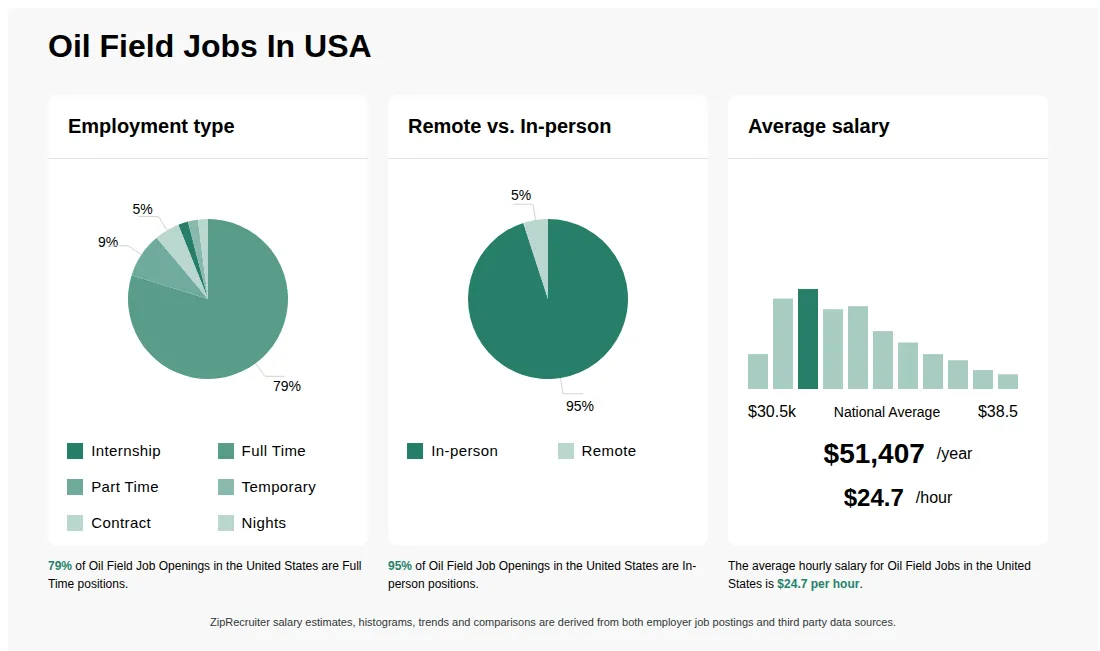
As of Aug 17, 2026, the average hourly pay for oil field in the United States is $24.71, according to ZipRecruiter salary data. Most workers in this role earn between $19.23 and $28.61 per hour, depending on experience, location, and employer.

What are oil field jobs?

Oil field jobs refer to a wide range of positions involved in the exploration, extraction, and production of oil and natural gas. These roles can include drilling engineers, rig operators, geologists, equipment technicians, and support staff who work on-site or at remote drilling locations. Oil field workers are responsible for operating machinery, maintaining equipment, ensuring safety standards, and helping bring oil and gas from underground reservoirs to the surface. The work environment can be physically demanding and often requires working in challenging conditions and remote areas. Oil field jobs are vital for the energy sector and offer various opportunities for career advancement.

What qualifications are required to get an oil field job?

Formal education may not be required to get a job on an oil field, though courses in oil field technology or petroleum training may help boost your job prospects or qualify for more advanced opportunities. Employers typically provide on-the-job training for entry-level positions. You need the physical ability to lift at least 50 pounds at regular intervals throughout the day and operate heavy machinery and equipment. Other qualifications include strong interpersonal and communication skills to work well with your crew and to follow directions. You may also need to relocate to other oil fields to work on different company projects.

What are the key skills and qualifications needed to thrive as an oil field worker, and why are they important?

To thrive as an Oil Field Worker, you need physical stamina, mechanical aptitude, and knowledge of safety protocols, often supported by a high school diploma or technical training. Familiarity with drilling equipment, heavy machinery, and safety certification programs (like H2S or OSHA) is typically required. Attention to detail, teamwork, and strong communication help individuals excel in challenging and hazard-prone environments. These skills and qualities are vital for maintaining safety, operational efficiency, and productivity in oil field operations.

What are some common challenges faced by professionals working in oil fields, and how can they be managed?

Professionals working in oil fields often encounter challenges such as harsh weather conditions, extended shifts, and remote locations, which can impact both safety and work-life balance. Navigating strict safety protocols and collaborating with multidisciplinary teams are also key aspects of the job. To manage these challenges, many employers provide comprehensive safety training, rotational work schedules, and on-site amenities to support their teams. Building strong communication skills and adaptability can help workers thrive and advance in this dynamic environment.

What is the difference between Oil Field vs Oil Rig Worker?

AspectOil FieldOil Rig Worker
CredentialsVaries; often includes safety certifications and technical trainingSafety certifications, technical skills, and sometimes specialized training
Work EnvironmentOn-site at oil extraction locations, including land and offshore sitesOnboard oil rigs or platforms, often in remote offshore locations
Employer & Industry UsageUsed broadly to describe the oil extraction area or workforceRefers specifically to personnel working directly on oil rigs or platforms

In summary, 'Oil Field' is a broad term encompassing the entire oil extraction area and workforce, while 'Oil Rig Worker' specifically refers to personnel working directly on oil rigs or platforms. Both roles require safety certifications and technical skills, but their work environments differ mainly by location, with oil rig workers operating primarily offshore on rigs.


How do you start working in the oil field?

To start working in the oil field, candidates typically need a high school diploma or equivalent and may pursue relevant certifications such as OSHA safety training. Entry-level positions often require physical fitness and the ability to work in challenging environments, with some roles offering on-the-job training or apprenticeships to gain experience.

Is it easy to get a job in an oil field?

Getting a job in an oil field can be competitive and often requires relevant skills, certifications such as H2S or safety training, and physical fitness. Entry-level positions may be available with minimal experience, but higher-skilled roles typically demand technical knowledge and experience in the industry.

What cities are hiring for Oil Field jobs?

Cities with the most Oil Field job openings:

What are the most commonly searched types of Oil Field jobs?

The most popular types of Oil Field jobs are:

What states have the most Oil Field jobs?

States with the most job openings for Oil Field jobs include:

Infographic showing various Oil Field job openings in the United States as of August 2026, with employment types broken down into 100% Full Time. Highlights an 100% In-person job distribution, with an average salary of $51,407 per year, or $24.7 per hour.

Full-time

Posted 11 days ago


Imperative Chemical Partners rating

9.1

Company rating: 9.1 out of 10

Based on 12 frontline employees who took The Breakroom Quiz

4th of 100 rated chemical manufacturers


Job description

SUMMARY:

The Hot Oil Operator drives and operates the Hot Oil Truck. The Hot Oil Truck carries either water or oil that is heated by a heating system that is part of the unit. This heated fluid is used to perform a variety of functions used in oil field operations. These functions may include the heating of flow lines, production tanks, production strings in the well bore, and may be used as a steam cleaner.

ESSENTIAL DUTIES AND RESPONSIBILITIES:

  • Possess a valid CDL A or B driver's license with appropriate endorsements.
  • Basic knowledge of the oil field, trucking, and related equipment.
  • Familiarity with DOT Rules and Regulations.
  • Operate the Hot Oil Unit safely and efficiently.
  • Ability to calculate displacement, volumes, weights, and comply with transportation regulations.

REQUIRED SILLS / ABILITIES:

  • Drive the Hot Oil Unit, operate mechanical controls, and handle the transfer of fluids.
  • Lift and handle pipes, monitor fluid levels, and operate heat conversion equipment safely.
  • Drive the truck following DOT Rules and Regulations, and comply with all relevant Company, Local, State, and Federal requirements.
  • Maintain accurate work tickets, driving logbooks, pre-trip/post-trip inspections, and maintenance files.
  • Perform light to heavy repairs, including brake work, using hand tools and equipment.
  • Complete job-related training, including Company Standard Operating Procedures and regulatory agency requirements.

PHYSICAL REQUIREMENTS:

  • Ability to bend, stretch, kneel, and squat for repairs and inspections.
  • Work safely in a noisy environment with various odors present.
  • Lift up to 50 pounds at a time.
  • Capability of ascending and descending stairs as required.
  • Proficient in handling a 100-pound hose, demonstrating the physical capability required.

DOT REQUIREMENTS

  • DOT Driver Type: Operates Commercial Motor Vehicle (CMV) with a Gross Vehicle Weight Rating (GVWR) of 26,001+ lbs.
    Valid Class A CDL:
    o Minimum of 2 years of verified commercial driving experience required.
    o Valid Medical Certificate (Form 5876): Must maintain a current, valid medical certificate.
    Clear Pre-Employment Screening Program (PSP) Report:
    o All accidents must be reported.
    Clear Motor Vehicle Record (MVR):
    o No more than 3 moving violations within the last 3 years.
    o No DWI/DUI offenses within the past 7 years.
    o Must show a valid Class A CDL.
    Clearinghouse Query:
    o Must show as "Driver Not Prohibited."
    o No active Substance Abuse Program (SAP) or Return to Duty listings.

PRE-EMPLOYMENT REQUIREMENTS

  • Must complete and pass all required pre-employment screenings.

This description reflects management's assignment of essential functions, it does not exclude or restrict the tasks that may be assigned or re-assigned. This job description is subject to change at any time.


What Imperative Chemical Partners employees say

Pay

Benefits

Hours and flexibility

Workplace

Get the full story on Breakroom