Biology/Human Biology Faculty
Tsaile, AZ · On-site
Biology/Human Biology Faculty School of Science, Technology, Engineering, and Mathematics (STEM) Department Academic Affairs Tsaile Campus Duty Schedule: 40 hours per week. Summary/Objective of ...
Tsaile, AZ · On-site
Biology/Human Biology Faculty School of Science, Technology, Engineering, and Mathematics (STEM) Department Academic Affairs Tsaile Campus Duty Schedule: 40 hours per week. Summary/Objective of ...
Tsaile, AZ · On-site
Biology/Human Biology Faculty School of Science, Technology, Engineering, and Mathematics (STEM) Department Academic Affairs Tsaile Campus Duty Schedule: 40 hours per week. Summary/Objective of ...
AZ · On-site
$58K - $62K/yr
Biology/Human Biology Faculty School of Science, Technology, Engineering, and Mathematics (STEM) Department Academic Affairs Tsaile Campus Duty Schedule: 40 hours per week. Summary/Objective of ...
AZ · On-site
$58K - $62K/yr
Biology/Human Biology Faculty School of Science, Technology, Engineering, and Mathematics (STEM) Department Academic Affairs Tsaile Campus Duty Schedule: 40 hours per week. Summary/Objective of ...
Greenville, SC · On-site
D. in an organismal biology field or related discipline, such as veterinary medicine, horticultural science, or ecology, is desired. The faculty member will join a diverse but unified team of ...
Greenville, SC · On-site
D. in an organismal biology field or related discipline, such as veterinary medicine, horticultural science, or ecology, is desired. The faculty member will join a diverse but unified team of ...
Monroe, MI · On-site
$68K - $87K/yr
Main teaching responsibilities include teaching biology courses in and/or related to introductory biology, ecology, environmental science, and marine biology related courses. Other responsibilities ...
Monroe, MI · On-site
$68K - $87K/yr
Main teaching responsibilities include teaching biology courses in and/or related to introductory biology, ecology, environmental science, and marine biology related courses. Other responsibilities ...
Greenville, SC · On-site
D. in an organismal biology field or related discipline, such as veterinary medicine, horticultural science, or ecology, is desired. The faculty member will join a diverse but unified team of ...
Greenville, SC · On-site
D. in an organismal biology field or related discipline, such as veterinary medicine, horticultural science, or ecology, is desired. The faculty member will join a diverse but unified team of ...
North Arlington, NJ · On-site
Position Type: High School Teaching/Science - Biology Date Posted: 7/14/2026 Location: High School Date Available: 09/01/2026 Closing Date: 07/29/2026 *Anticipated Start Date 9/1/2026 High School ...
North Arlington, NJ · On-site
Position Type: High School Teaching/Science - Biology Date Posted: 7/14/2026 Location: High School Date Available: 09/01/2026 Closing Date: 07/29/2026 *Anticipated Start Date 9/1/2026 High School ...
Amarillo, TX · On-site
Biology Department: 10_10_04_401405 - (BIOL) - Biological Sciences Opening Date: 08/03/2026 FLSA: Exempt Grade: FAC Summary At Amarillo College, our mission is: Transforming our community and economy ...
Amarillo, TX · On-site
Biology Department: 10_10_04_401405 - (BIOL) - Biological Sciences Opening Date: 08/03/2026 FLSA: Exempt Grade: FAC Summary At Amarillo College, our mission is: Transforming our community and economy ...
Adjunct (Biology) Apply now Job no: 494751 Work type: Adjunct Location: Topeka Categories: Biology/Chemistry/Physics/Astronomy Position Title: Adjunct (Biology) Department: Biology Campus Location:
Adjunct (Biology) Apply now Job no: 494751 Work type: Adjunct Location: Topeka Categories: Biology/Chemistry/Physics/Astronomy Position Title: Adjunct (Biology) Department: Biology Campus Location:
Odessa, TX · On-site
Position Details Position Information Working Title Biology Faculty Position Status Department School of Health Sciences General Summary The in-person Biology Faculty member is responsible for ...
Odessa, TX · On-site
Position Details Position Information Working Title Biology Faculty Position Status Department School of Health Sciences General Summary The in-person Biology Faculty member is responsible for ...
Berkeley, CA · On-site
$70K - $120K/yr
Our department's emphasis is on organismal biology. Teaching Responsibilities We are seeking outstanding lecturers who can teach/co-teach small, medium, and large size lecture and/or laboratory ...
Berkeley, CA · On-site
$70K - $120K/yr
Our department's emphasis is on organismal biology. Teaching Responsibilities We are seeking outstanding lecturers who can teach/co-teach small, medium, and large size lecture and/or laboratory ...
Baton Rouge, LA · On-site
$55K/yr
HMMA is seeking a knowledgeable, student-focused Biology Teacher to deliver engaging and rigorous science instruction. The ideal candidate will have a strong background in biological sciences, a ...
Baton Rouge, LA · On-site
$55K/yr
HMMA is seeking a knowledgeable, student-focused Biology Teacher to deliver engaging and rigorous science instruction. The ideal candidate will have a strong background in biological sciences, a ...
Biology Teacher REQUIREMENTS: New Jersey Teaching Certification in appropriate area SALARY/STIPEND:As Per Contractual Agreement LOCATION:To Be Announced STARTING DATE:To Be Announced **Please be ...
Biology Teacher REQUIREMENTS: New Jersey Teaching Certification in appropriate area SALARY/STIPEND:As Per Contractual Agreement LOCATION:To Be Announced STARTING DATE:To Be Announced **Please be ...
Elizabethtown, KY · On-site
Biology Adjunct Apply now Job no: 493581 Work type: Part-time Location: Elizabethtown, KY Categories: Adjunct Faculty Title: Biology Adjunct Salary Range: $575.00 per credit hour Contract Term Length:
Elizabethtown, KY · On-site
Biology Adjunct Apply now Job no: 493581 Work type: Part-time Location: Elizabethtown, KY Categories: Adjunct Faculty Title: Biology Adjunct Salary Range: $575.00 per credit hour Contract Term Length:
Elizabethtown, KY · On-site
$575/day
Biology Adjunct Job no: 493581 Work type: Part-time Location: Elizabethtown, KY Categories: Adjunct Faculty Title: Biology Adjunct Salary Range: $575.00 per credit hour Contract Term Length: Not ...
Elizabethtown, KY · On-site
$575/day
Biology Adjunct Job no: 493581 Work type: Part-time Location: Elizabethtown, KY Categories: Adjunct Faculty Title: Biology Adjunct Salary Range: $575.00 per credit hour Contract Term Length: Not ...
Shepherdstown, WV · On-site
Posting Details Posting Information Posting Number F080P Working Title Adjunct - Biology FLSA Exempt Pay Grade Faculty Advertised Salary Position Status Part Time Appointment Length Other Department ...
Shepherdstown, WV · On-site
Posting Details Posting Information Posting Number F080P Working Title Adjunct - Biology FLSA Exempt Pay Grade Faculty Advertised Salary Position Status Part Time Appointment Length Other Department ...
Odessa, TX · On-site
The in-person Biology Faculty member is responsible for delivering high-quality instruction in support of Odessa College's mission to provide accessible, student-centered education and promote ...
Odessa, TX · On-site
The in-person Biology Faculty member is responsible for delivering high-quality instruction in support of Odessa College's mission to provide accessible, student-centered education and promote ...
San Diego, CA · On-site
Lecturer, Biology Apply now Posting #: 5632 Position Status: Faculty, Part-time temporary Location: San Diego Position Type: Faculty, College of Arts and Sciences Position Title & Department:
San Diego, CA · On-site
Lecturer, Biology Apply now Posting #: 5632 Position Status: Faculty, Part-time temporary Location: San Diego Position Type: Faculty, College of Arts and Sciences Position Title & Department:
Wellesley, MA · On-site
$103K/yr
This will include introductory organismal biology and a course in comparative anatomy and physiology of vertebrates. In addition, the successful candidate will develop and offer an advanced course in ...
Wellesley, MA · On-site
$103K/yr
This will include introductory organismal biology and a course in comparative anatomy and physiology of vertebrates. In addition, the successful candidate will develop and offer an advanced course in ...
San Diego, CA · On-site
$2.5K - $2.6K/wk
The Biology Department at the University of San Diego, housed within the College of Arts and Sciences, offers a comprehensive program that exposes undergraduate students to concepts across the ...
San Diego, CA · On-site
$2.5K - $2.6K/wk
The Biology Department at the University of San Diego, housed within the College of Arts and Sciences, offers a comprehensive program that exposes undergraduate students to concepts across the ...
Baton Rouge, LA · On-site
HMMA is seeking a knowledgeable, student-focused Biology Teacher to deliver engaging and rigorous science instruction. The ideal candidate will have a strong background in biological sciences, a ...
Baton Rouge, LA · On-site
HMMA is seeking a knowledgeable, student-focused Biology Teacher to deliver engaging and rigorous science instruction. The ideal candidate will have a strong background in biological sciences, a ...
As the study of life, biology offers many career paths if you’re interested in science and new discoveries. As a research biologist, you can work in health care and experiment with different organisms to find cures and treatments for diseases. Alternatively, your research can focus on the environment and conservation efforts. You can become a biology educator and bring the excitement of science to new generations, or you can combine your science knowledge with another field, like biotechnology, forensics, politics and public policy, or mathematics.
| Aspect | Biology | Marine Biologist |
|---|---|---|
| Required Credentials | Bachelor's or higher in Biology or related field | Bachelor's or higher in Marine Biology, Biology, or related field |
| Work Environment | Laboratories, classrooms, research facilities | Ocean, coastal areas, research vessels |
| Industry Usage | Universities, research institutions, healthcare | Environmental agencies, research organizations, conservation groups |
| Common Search/Comparison | General biology careers and education | Specialized careers in marine environments |
Biology is a broad field covering all living organisms, while Marine Biologists focus specifically on marine life and ocean ecosystems. Both roles require similar educational backgrounds, but Marine Biologists work primarily in aquatic environments, often conducting field research at sea. Understanding these differences helps individuals choose the right career path based on their interests in general biology or marine sciences.
Cities with the most Biology job openings:
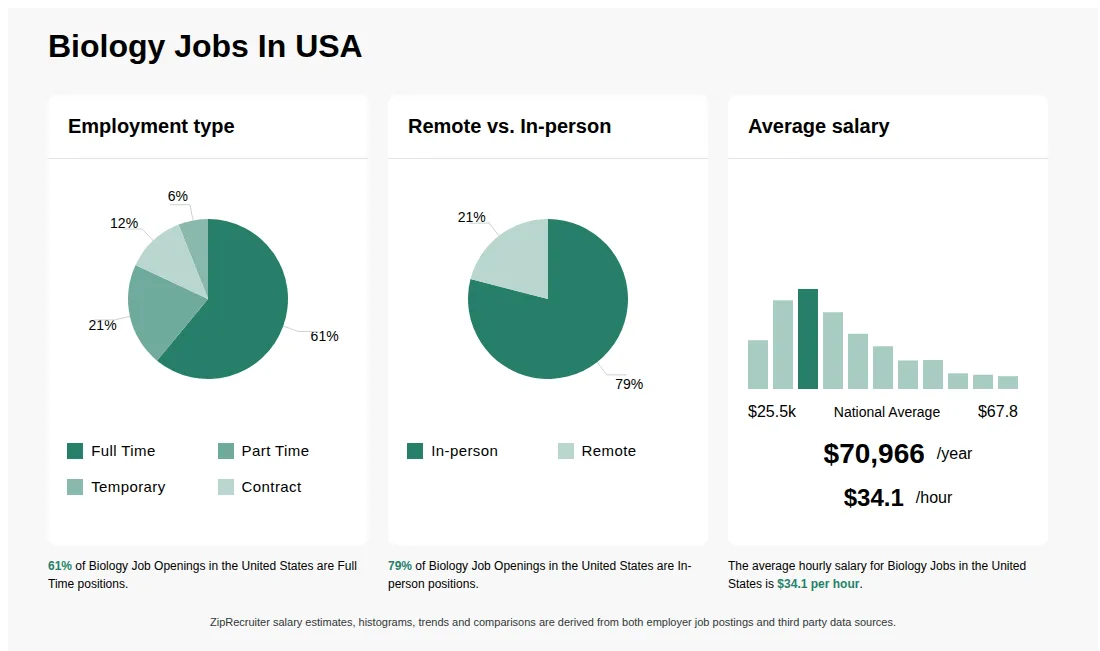
The most popular types of Biology jobs are:
States with the most job openings for Biology jobs include:
The top searched job categories for Biology jobs are:

Tsaile, AZ • On-site
Contractor
Posted 4 days ago
Biology/Human Biology Faculty
School of Science, Technology, Engineering, and Mathematics (STEM) Department
Academic Affairs
Tsaile Campus
Duty Schedule:
40 hours per week.
Summary/Objective of Position:
The Assistant/ Associate/ Professor is a full-time faculty member responsible for contributing to the program's academic, research, and service missions. The successful applicant must have the background and experience to teach courses in Human Anatomy and Physiology, Biology, and Physiology, including Pathophysiology, Developmental Biology, Invertebrate Biology, and majors and non-majors biology. A PhD is preferred, and the ability to mentor graduate-level thesis students is highly recommended.
A college faculty is critical in creating, maintaining, assessing, and reflecting upon a learning environment where academic discipline interweaves with the college's mission to support student learning and Dine Education Philosophy.
Description of Essential Functions of the Position
Disclaimer: This is not necessarily an exhaustive list of all responsibilities, duties, skills, efforts, requirements, or working conditions associated with the job. While this list is intended to reflect the current job accurately, management reserves the right to revise the job or to require that other or different tasks be performed as assigned. Reasonable accommodations may be made to enable individuals with disabilities to perform essential functions.
The School of STEM of Diné College invites applications for a full-time faculty position in the 2026-2027 academic year, beginning January 05, 2026.
QUALIFICATIONS
Education & Experience
Minimum:
Preferred:
Knowledge:
Skills:
Abilities:
Physical Requirements, Work Environment & Travel:
Other Requirement(s):

Sourced by ZipRecruiter
51 - 200 Employees
Tsaile, AZ, US
1968