1

Beekeeping Jobs (NOW HIRING)

... beekeeping. * Provide details and information regarding activities to guests and assist in booking experiences. * This person must have good communication skills and be able to work in a fast-paced ...

Field Technician (FL)

Fort Meade, FL · On-site

$16.50 - $22.50/hr

About the Role We are looking for a motivated, reliable, and hands-on Field Technician to join our Operations team and support the deployment, maintenance, and repair of advanced beekeeping and agri ...

Run beekeeping program, and perform inspections of bee hives for residents applying for beekeeping permits. 13. Prepare and submit rabies specimens or other zoonotic diseases as required by State ...

ENTO 262 Intro to Beekeeping (lecture/lab) * ENTO 304 General Entomology (lecture) * ENTO 350 Advanced Beekeeping (lecture/lab) * ENTO 374 Insect Pest Control (lecture/lab) * Other related courses as ...

ENTO 262 Intro to Beekeeping (lecture/lab) ENTO 304 General Entomology (lecture) ENTO 350 Advanced Beekeeping (lecture/lab) ENTO 374 Insect Pest Control (lecture/lab) Other related courses as needed ...

Showing results 21-40

beekeeping information

See salary details

$30K

$50.5K

$71.5K

How much do beekeeping jobs pay per year?

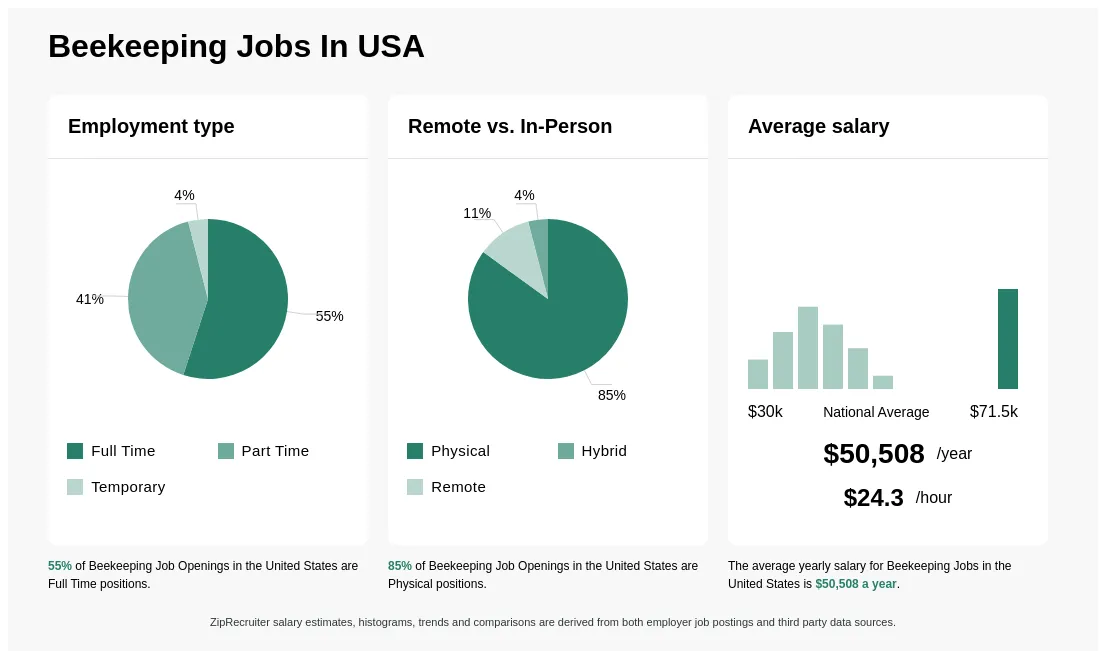
As of Aug 23, 2026, the average yearly pay for beekeeping in the United States is $50,508.00, according to ZipRecruiter salary data. Most workers in this role earn between $38,000.00 and $70,500.00 per year, depending on experience, location, and employer.

What is beekeeping?

A beekeeping job involves managing and caring for beehives to produce honey, beeswax, and other hive products while ensuring the health of the bee colonies. Beekeepers inspect hives, monitor for diseases, provide food when necessary, and maintain hive structures. They may also harvest honey, breed bees, and help with pollination services for agriculture. Some beekeepers work independently, while others are employed by farms or commercial honey producers. It requires knowledge of bee behavior, hive management, and environmental factors that affect bee health.

What skills and qualifications are needed for beekeeping?

To thrive in beekeeping, you need a solid understanding of bee biology, hive management, and seasonal care, typically gained through hands-on experience or agricultural coursework. Familiarity with beekeeping tools such as smokers, hive tools, protective gear, and sometimes honey extraction equipment is advantageous, and certifications in apiary management can be beneficial. Patience, attention to detail, problem-solving, and effective communication are essential soft skills for working safely and sustainably with bees. These competencies are crucial for maintaining healthy bee colonies, ensuring productive hives, and operating a successful beekeeping business.

What are common challenges faced by beekeepers, and how can they be managed?

Beekeepers often face challenges like managing bee health issues, monitoring for pests and diseases, and adapting to changing weather conditions that impact hive productivity. Regular hive inspections, proper pest control measures, and ongoing education are key strategies to address these challenges. Additionally, maintaining good records and staying up to date with local regulations support a healthy and compliant apiary. Teamwork with other beekeepers or agricultural professionals can also provide valuable insights and collaborative support. With preparation and proactive management, many obstacles in beekeeping can be successfully navigated.

Is there a demand for beekeeping?

Beekeeping is a growing field due to increased awareness of pollination and honey production, creating demand for skilled beekeepers. Opportunities exist in agriculture, environmental conservation, and honey production, often requiring knowledge of hive management and certifications. The industry is influenced by factors such as environmental health and agricultural needs.

What cities are hiring for Beekeeping jobs?

Cities with the most Beekeeping job openings:

What are the most commonly searched types of Beekeeping jobs?

The most popular types of Beekeeping jobs are:

What states have the most Beekeeping jobs?

States with the most job openings for Beekeeping jobs include:

Infographic showing various Beekeeping job openings in the United States as of August 2026, with employment types broken down into 29% Full Time, 65% Part Time, and 6% Temporary. Highlights an 94% In-person, and 6% Remote job distribution, with an average salary of $50,508 per year, or $24.3 per hour.

TES - Honey Bee Colony Maintenance Assistant

Auburn University

Auburn University, AL • On-site

$12.50/hr

Full-time

Re-posted 8 days ago


Auburn University rating

6.5

Company rating: 6.5 out of 10

Based on 45 frontline employees who took The Breakroom Quiz

515th of 622 rated colleges and universities


Job description

Overview
The Auburn University Bee Center is looking to hire a temporary employee for a honey bee technician position. The new hire will assist with bee-related research mainly outdoors under typical (hot and humid) Alabama conditions although some laboratory work is also expected. The technician will encounter stinging insects. An interest in insects/plants is preferred. The new hire should have an eagerness to learn new skills and the ability to work in often difficult physical environments.
Responsibilities
  • Travel to field sites around Alabama
  • Assist w/beekeeping tasks such as hive management
  • Build and maintain honey bee boxes
  • Collect/Enter data into spreadsheets
  • Harvest, process, and bottle honey
  • Engage in outreach events with the public

Qualifications
  • High school diploma
  • Interest in Entomology or related discipline
  • Ability to lift up to 60 pounds
  • Ability to multitask in a fast-paced environment

Minimum Knowledge, Skills, and Abilities
Valid U.S. Driver's License
Ability to work outside for long periods
Ability to work independently and as part of a team
Willingness to learn new techniques

What Auburn University employees say

Pay

Benefits

Hours and flexibility

Workplace

Get the full story on Breakroom