AI Governance & Ethics: Establish and champion frameworks for responsible AI, ethics, data privacy ... D. in Computer Science, Machine Learning, Artificial Intelligence, Mathematics, or a related ...
AI Governance & Ethics: Establish and champion frameworks for responsible AI, ethics, data privacy ... D. in Computer Science, Machine Learning, Artificial Intelligence, Mathematics, or a related ...
AI Governance & Ethics: Establish and champion frameworks for responsible AI, ethics, data privacy ... D. in Computer Science, Machine Learning, Artificial Intelligence, Mathematics, or a related ...
AI Governance & Ethics: Establish and champion frameworks for responsible AI, ethics, data privacy ... D. in Computer Science, Machine Learning, Artificial Intelligence, Mathematics, or a related ...

Keeping in mind that this is a leadership program focused on artificial intelligence, minimum ... Ethics/Moral Philosophy * Cultural Studies/Theory * HR/Human Side of Enterprise * Public Affairs ...
Keeping in mind that this is a leadership program focused on artificial intelligence, minimum ... Ethics/Moral Philosophy * Cultural Studies/Theory * HR/Human Side of Enterprise * Public Affairs ...

Artificial Intelligence (AI) Engineer/Policy Location: Bethesda, MD *Clearance: *Active TS/SCI w ... AI development, AI architecture, AI policy, AI engineering, AI ethics & laws, and emerging ...
Artificial Intelligence (AI) Engineer/Policy Location: Bethesda, MD *Clearance: *Active TS/SCI w ... AI development, AI architecture, AI policy, AI engineering, AI ethics & laws, and emerging ...

Administrator of Artificial Intelligence Hiring Range $129,376.00 to $176,800.00 Summary of Job ... ethics, • Data privacy and compliance or, • Enterprise risk management 3. Two (2) years of ...
Administrator of Artificial Intelligence Hiring Range $129,376.00 to $176,800.00 Summary of Job ... ethics, • Data privacy and compliance or, • Enterprise risk management 3. Two (2) years of ...

PT Faculty POOL - Artificial Intelligence
Long Beach, CA · On-site
$77.64 - $99.18/hr
The program is intentionally no-code/low-code first and ethics-forward. Coursework emphasizes the applied, workplace-relevant use of artificial intelligence rather than software engineering and is ...
PT Faculty POOL - Artificial Intelligence
Long Beach, CA · On-site
$77.64 - $99.18/hr
The program is intentionally no-code/low-code first and ethics-forward. Coursework emphasizes the applied, workplace-relevant use of artificial intelligence rather than software engineering and is ...
PT Faculty POOL - Artificial Intelligence
Long Beach, CA · On-site
$77.64 - $99.18/hr
The program is intentionally no-code/low-code first and ethics-forward. Coursework emphasizes the applied, workplace-relevant use of artificial intelligence rather than software engineering and is ...
PT Faculty POOL - Artificial Intelligence
Long Beach, CA · On-site
$77.64 - $99.18/hr
The program is intentionally no-code/low-code first and ethics-forward. Coursework emphasizes the applied, workplace-relevant use of artificial intelligence rather than software engineering and is ...
ARLIS Artificial Intelligence Research Professional
College Park, MD · On-site
$97K - $124K/yr
... in artificial intelligence (AI), machine learning (ML), and data science to join our ... ethics and governance, computer vision, and natural language processing. Positions may include a ...
ARLIS Artificial Intelligence Research Professional
College Park, MD · On-site
$97K - $124K/yr
... in artificial intelligence (AI), machine learning (ML), and data science to join our ... ethics and governance, computer vision, and natural language processing. Positions may include a ...

Developing AI governance frameworks addressing transparency, explainability, ethics, privacy, bias ... Science, Artificial Intelligence, Robotics, or a related technical discipline * 10+ years of ...
Developing AI governance frameworks addressing transparency, explainability, ethics, privacy, bias ... Science, Artificial Intelligence, Robotics, or a related technical discipline * 10+ years of ...

The MS-AAI program is one of the few graduate programs in the nation that emphasizes applied, real-world artificial intelligence, integrating technical depth with ethics, moral responsibility, and AI ...
The MS-AAI program is one of the few graduate programs in the nation that emphasizes applied, real-world artificial intelligence, integrating technical depth with ethics, moral responsibility, and AI ...
Full Time Adjunct Faculty, MS Applied Artificial Intelligence
San Diego, CA · On-site
$5.8K - $7.5K/mo
The MS-AAI program is one of the few graduate programs in the nation that emphasizes applied, real-world artificial intelligence, integrating technical depth with ethics, moral responsibility, and AI ...
Full Time Adjunct Faculty, MS Applied Artificial Intelligence
San Diego, CA · On-site
$5.8K - $7.5K/mo
The MS-AAI program is one of the few graduate programs in the nation that emphasizes applied, real-world artificial intelligence, integrating technical depth with ethics, moral responsibility, and AI ...

Ability to lead a wide range of Business Analytics & Applied Artificial Intelligence courses (e.g., applied AI, AI ethics, business analytics, data visualization, and predictive modeling). * Under ...
Ability to lead a wide range of Business Analytics & Applied Artificial Intelligence courses (e.g., applied AI, AI ethics, business analytics, data visualization, and predictive modeling). * Under ...

ARLIS Artificial Intelligence Research Professional
College Park, MD · On-site
$97K - $124K/yr
... in artificial intelligence (AI), machine learning (ML), and data science to join our ... ethics and governance, computer vision, and natural language processing. Positions may include a ...
ARLIS Artificial Intelligence Research Professional
College Park, MD · On-site
$97K - $124K/yr
... in artificial intelligence (AI), machine learning (ML), and data science to join our ... ethics and governance, computer vision, and natural language processing. Positions may include a ...

Full Time Adjunct Faculty, MS Applied Artificial Intelligence
San Diego, CA · On-site
$5.8K - $7.5K/mo
... ethics, moral responsibility, and AI for social good. Candidates with experience across all areas of artificial intelligence and machine learning will be considered. Preference will be given to ...
Full Time Adjunct Faculty, MS Applied Artificial Intelligence
San Diego, CA · On-site
$5.8K - $7.5K/mo
... ethics, moral responsibility, and AI for social good. Candidates with experience across all areas of artificial intelligence and machine learning will be considered. Preference will be given to ...
Lead the design, implementation and governance of artificial intelligence and machine learning ... Provide recommendations to streamline AI ethics and governance. * Facilitate the creation and ...
Lead the design, implementation and governance of artificial intelligence and machine learning ... Provide recommendations to streamline AI ethics and governance. * Facilitate the creation and ...

Course Instructor Position - Online Master's Degree in Artificial Intelligence
Redmond, WA · On-site
$6.0K/mo
Course Instructor Position - Online Master's Degree in Artificial Intelligence Job Category ... AI Ethics and Responsible AI * Generative AI and Large Language Models * AI for Business ...
Course Instructor Position - Online Master's Degree in Artificial Intelligence
Redmond, WA · On-site
$6.0K/mo
Course Instructor Position - Online Master's Degree in Artificial Intelligence Job Category ... AI Ethics and Responsible AI * Generative AI and Large Language Models * AI for Business ...

Lead the design, implementation and governance of artificial intelligence and machine learning ... Provide recommendations to streamline AI ethics and governance. * Facilitate the creation and ...
Lead the design, implementation and governance of artificial intelligence and machine learning ... Provide recommendations to streamline AI ethics and governance. * Facilitate the creation and ...
$6.0K/mo
Course Instructor Position - Online Master's Degree in Artificial Intelligence Job Category ... AI Ethics and Responsible AI * Generative AI and Large Language Models * AI for Business ...
$6.0K/mo
Course Instructor Position - Online Master's Degree in Artificial Intelligence Job Category ... AI Ethics and Responsible AI * Generative AI and Large Language Models * AI for Business ...

Artificial Intelligence Engineer
Reston, VA · On-site
$59.35 - $77.03/hr
Ensure AI solutions adhere to the organization's security, ethics, and compliance standards. Maintain documentation for models, processes, and decision-making. Stay current with emerging AI ...
Artificial Intelligence Engineer
Reston, VA · On-site
$59.35 - $77.03/hr
Ensure AI solutions adhere to the organization's security, ethics, and compliance standards. Maintain documentation for models, processes, and decision-making. Stay current with emerging AI ...
Course Author Position: Online Master's Degree in Artificial Intelligence
Redmond, WA · On-site
$10K - $10K/mo
Online Master's Degree in Artificial Intelligence Job Category : Faculty Requisition Number ... AI Ethics and Responsible AI * Generative AI and Large Language Models * AI for Business ...
Course Author Position: Online Master's Degree in Artificial Intelligence
Redmond, WA · On-site
$10K - $10K/mo
Online Master's Degree in Artificial Intelligence Job Category : Faculty Requisition Number ... AI Ethics and Responsible AI * Generative AI and Large Language Models * AI for Business ...
artificial intelligence ethics information
See salary details
$25.5K - $43K
11% of jobs
$43K - $60.5K
7% of jobs
$77.4K is the 25th percentile. Wages below this are outliers.
$60.5K - $78K
7% of jobs
$78K - $95.5K
11% of jobs
$95.5K - $113K
8% of jobs
The median wage is $122.6K / yr.
$113K - $130.5K
11% of jobs
$130.5K - $148K
13% of jobs
$156.5K is the 75th percentile. Wages above this are outliers.
$148K - $165.5K
16% of jobs
$165.5K - $183K
9% of jobs
$183K - $200.5K
4% of jobs
$200.5K - $218K
3% of jobs
$25.5K
$121.8K
$218K
How much do artificial intelligence ethics jobs pay per year?
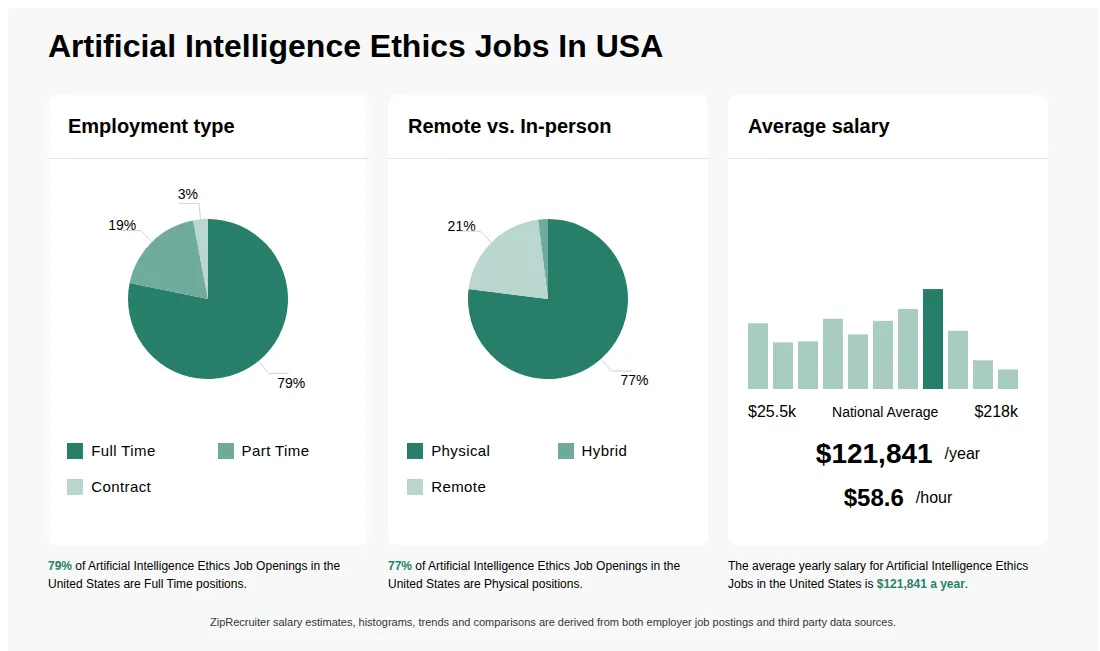
As of Sep 14, 2026, the average yearly pay for artificial intelligence ethics in the United States is $121,841.00, according to ZipRecruiter salary data. Most workers in this role earn between $79,000.00 and $158,000.00 per year, depending on experience, location, and employer.
What is artificial intelligence ethics?
An Artificial Intelligence Ethics job focuses on ensuring AI technologies are developed and used responsibly. Professionals in this field assess AI systems for fairness, transparency, bias, and societal impact. They work with developers, policymakers, and organizations to create ethical guidelines and compliance frameworks. Their goal is to minimize harm, promote accountability, and align AI with human values.
What are the key skills and qualifications needed to thrive in artificial intelligence ethics?
To excel in Artificial Intelligence Ethics, candidates typically require a background in ethics, philosophy, law, or computer science, often supported by an advanced degree in a related field. Familiarity with AI frameworks, data privacy regulations, algorithmic auditing tools, and relevant certifications such as Certified Ethical Emerging Technologist (CEET) is highly valued. Strong communication, analytical thinking, and the ability to facilitate cross-disciplinary dialogue set exceptional professionals apart. These skills are crucial to ensure AI systems are designed and deployed responsibly, transparently, and fairly in real-world applications.
What are some of the common challenges faced by professionals working in artificial intelligence ethics?
Professionals in Artificial Intelligence Ethics often face challenges such as navigating the rapidly evolving landscape of AI technology while ensuring compliance with ethical standards and legal regulations. Balancing innovation with societal impact—such as protecting privacy, preventing bias, and earning stakeholder trust—can be complex and requires ongoing learning. These roles frequently involve collaboration with data scientists, engineers, legal experts, and business leaders to evaluate potential AI risks and solutions. Staying current on best practices and global regulatory changes is essential for addressing new ethical dilemmas as they arise.
How do you become an artificial intelligence ethicist?
To become an artificial intelligence ethicist, individuals typically pursue a relevant degree such as philosophy, computer science, or law, with a focus on ethics and AI. Gaining experience through research, interdisciplinary collaboration, and staying informed about AI developments and ethical frameworks is essential; some professionals also obtain certifications in AI ethics or related fields.
Is artificial intelligence ethics a good career?
Artificial intelligence ethics is a growing field focused on ensuring AI systems are developed and used responsibly, often requiring knowledge of AI technologies, ethics, and policy. Careers in this area can be rewarding for those interested in technology, societal impact, and regulatory frameworks, with opportunities in research, consulting, and corporate ethics teams.
What jobs are available in artificial intelligence ethics?
Jobs in artificial intelligence ethics include roles such as AI ethics researcher, AI policy analyst, machine learning fairness specialist, and AI compliance officer. These positions often require knowledge of AI technologies, ethical frameworks, and sometimes certifications in data ethics or AI governance, working in research institutions, tech companies, or regulatory agencies.
More about artificial intelligence ethics jobs
What cities are hiring for Artificial Intelligence Ethics jobs?
Cities with the most Artificial Intelligence Ethics job openings:
What are the most commonly searched types of Artificial Intelligence Ethics jobs?
The most popular types of Artificial Intelligence Ethics jobs are:
What states have the most Artificial Intelligence Ethics jobs?
States with the most job openings for Artificial Intelligence Ethics jobs include:
What are popular job titles for Artificial Intelligence Ethics?
Popular job titles for Artificial Intelligence Ethics:
- Assistant Artificial Intelligence Ethics
- Artificial Intelligence Robotics
- Artificial Intelligence Pathology
- Artificial Intelligence Dental
- Artificial Intelligence Creative
- Executive Artificial Intelligence Policy
- Ai Ethics Consulting
- Artificial Intelligence Administration
- Data Scientist Ai Ethics
- Op Artificial Intelligence
Senior Director, Machine Learning and Artificial Intelligence
Boca Raton, FL • On-site
ADT
• Personal Services • 10K+ employees10,000+ employees
Full-time
Re-posted yesterday
ADT rating

7.0
Based on 139 frontline employees who took The Breakroom Quiz
Job description
Summary:
The Senior Director of Machine Learning and Artificial Intelligence will be a strategic leader responsible for driving the development and execution of our machine learning and broader artificial intelligence initiatives. This individual will lead a team of machine learning engineers, AI engineers, and researchers to build and deploy cutting-edge ML models and AI solutions that create business value and enhance our products and services.
The ideal candidate will have a strong technical background in machine learning and artificial intelligence, extensive leadership experience, and a proven track record of delivering impactful enterprise-grade AI solutions. This role requires working closely with business partners while understanding and working within the constraints of the business to maintain a competitive technological edge.
Duties and Responsibilities:
- Team Leadership: Lead and mentor a team of machine learning and AI engineers, fostering a culture of innovation, continuous learning, and excellence.
- Strategic Roadmap: Define and execute the comprehensive ML/AI strategy and roadmap, aligning it with the company's overall business objectives and long-term vision.
- End-to-End Deployment: Oversee the end-to-end development and deployment of machine learning and artificial intelligence models, from ideation and experimentation to production and monitoring.
- Cross-Functional Collaboration: Collaborate with product, engineering, data platform, and other cross-functional teams to identify new opportunities for leveraging traditional ML and advanced AI.
- AI Innovation & Adoption: Stay up-to-date with the latest advancements in machine learning and AI (including Generative AI, Large Language Models, and computer vision), and drive the adoption of new technologies and best practices.
- AI Governance & Ethics: Establish and champion frameworks for responsible AI, ethics, data privacy, and compliance across all model deployments.
- Stakeholder Communication: Communicate the complex value and business impact of machine learning and AI initiatives to senior leadership, C-suite executives, and other stakeholders.
- Roadmap Influence: Influence product and operational roadmaps with actionable data insights and active AI deployments.
- Data Strategy: Build a strategic learning roadmap based on data observations, strategic imperatives, and developed hypotheses, while managing robust data and feature pipelines.
- Education: Master's degree or Ph.D. in Computer Science, Machine Learning, Artificial Intelligence, Mathematics, or a related technical field.
- Domain Experience: 10+ years of experience in machine learning and AI, with a proven track record of building, scaling, and deploying production-level models.
- Leadership Experience: 5+ years of experience leading and managing high-performing machine learning or AI engineering and research teams.
- Technical Expertise: Deep expertise in a variety of machine learning and AI techniques, including deep learning, natural language processing (NLP), reinforcement learning, and Generative AI/Large Language Models (LLMs).
- Programming & Frameworks: Strong programming skills in Python and deep experience with ML/AI frameworks such as TensorFlow, PyTorch, or Hugging Face.
- Core Skills: Excellent leadership, communication, and project management skills.
- Organizational Scaling: Demonstrated success in building and scaling ML/AI organizations from the ground up, including hiring, budgeting, and tool/vendor selection.
- Executive Presence: Proven ability to link ML and AI initiatives to P&L outcomes, with experience presenting comprehensive AI strategies to C-suite executives or Board members.
- Infrastructure Knowledge: High-level architectural understanding of MLOps, LLMOps, cloud infrastructure (AWS/GCP/Azure), and the full model development lifecycle (MDLC).
Minimum Qualifications:
Communication Skills:
- Writing, Talking/Hearing on the phone (Continually=67-100% of workday)
Environment Requirements:
- Remote/Home office (Continually=67-100% of the workday)
Travel:
- Occasionally, less than 25%

About ADT
Sourced by ZipRecruiter
At ADT Commercial, we are in the business of helping people and organizations to protect what matters most to them. Building upon ADT's 145-year legacy, we secure the livelihoods and futures of critical commercial environments, retail location, educational campuses, healthcare facilities and financial institutions across the U.S. as an industry-leading security, fire and life safety systems integrator. We strive to have the most experienced and technically trained and talented teams in the industry, driven by excellence at every turn. At ADT Commercial, we truly believe that our people are the difference - for our organization, the customers we serve and the communities we protect. When you're a part of ADT Commercial, you'll have the opportunity to be a part of that difference every day. With more than 300 locations, a deep national presence, and comprehensive portfolio of solutions and services, our employees are always poised for career advancement and growth. For more information, visit www.adtcommercial.com or follow us on LinkedIn and Facebook.
Industry
Personal services
Company size
10,000+ Employees
Headquarters location
Boca Raton, FL, US
Year founded
1874