1

Workforce Development Jobs in Washington, DC (NOW HIRING)

Key Responsibilities Training Needs & Development Planning * Partner with the Talent & Performance Lead to identify learning and development requirements across the workforce. * Assess skills gaps ...

Development Planning * Partner with the Talent amp; Performance Lead to identify learning and development requirements across the workforce. * Assess skills gaps and recommend targeted upskilling ...

Managing workforce development, training operations, or certification programs-preferably within DoD or government cyber organizations. * Knowledge: Familiarity with DoD 8140/8570, NICE Framework ...

Managing workforce development, training operations, or certification programs-preferably within DoD or government cyber organizations. * Knowledge: Familiarity with DoD 8140/8570, NICE Framework ...

next page

Showing results 1-20

Workforce Development information

See Washington, DC salary details

$32.8K

$74.8K

$147.8K

How much do workforce development jobs pay per year?

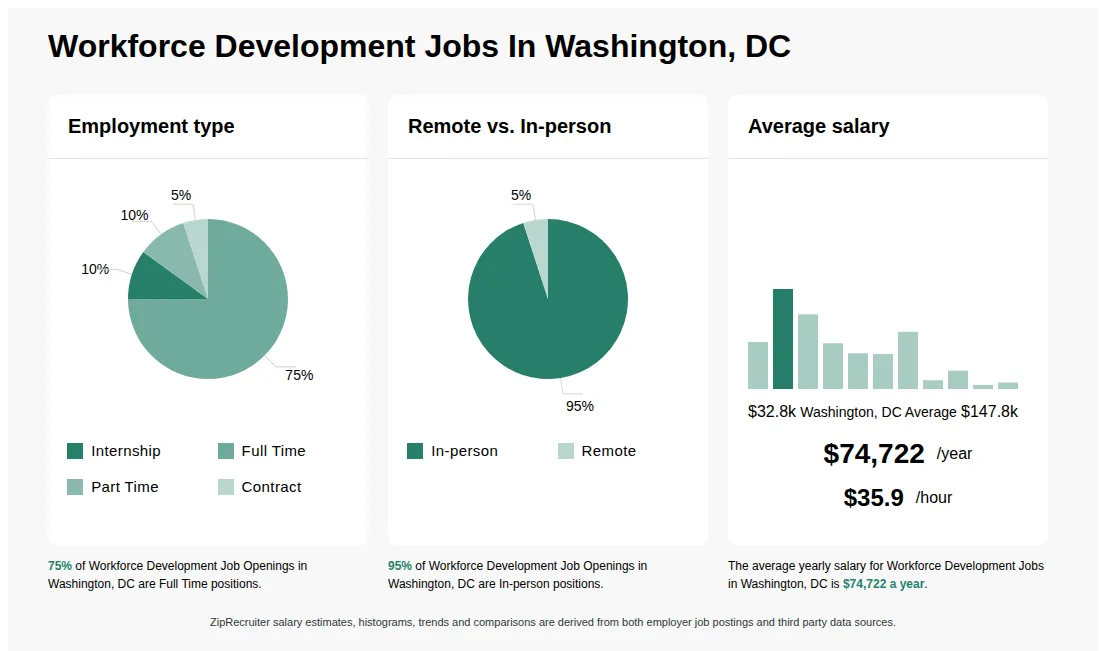
As of Jun 10, 2026, the average yearly pay for workforce development in Washington, DC is $74,750.00, according to ZipRecruiter salary data. Most workers in this role earn between $48,100.00 and $96,800.00 per year, depending on experience, location, and employer.

What is the difference between Workforce Development vs Career Counselor?

AspectWorkforce DevelopmentCareer Counselor
CredentialsVaries; often includes certifications in workforce or employment servicesTypically requires a counseling or career development certification or degree
Work EnvironmentGovernment agencies, community organizations, training centersEducational institutions, private practices, career centers
Employer & Industry UsageUsed by public and nonprofit sectors to improve employment ratesUsed by schools, private firms, and counseling agencies to guide individual careers

While both roles focus on employment and career paths, Workforce Development primarily involves creating programs and policies to improve employment opportunities at a community or organizational level. Career Counselors work directly with individuals to help them identify career goals and develop personal strategies. Understanding these differences helps job seekers and organizations choose the right support for their needs.

What is workforce development?

Workforce development refers to a wide range of activities, policies, and programs designed to create, sustain, and retain a skilled workforce that meets the current and future needs of employers. This field focuses on improving workers’ skills, connecting people to employment opportunities, and supporting career advancement. Workforce development can include job training, education, career counseling, apprenticeships, and collaboration between businesses, educational institutions, and government agencies. Its ultimate goal is to strengthen both individuals’ employability and the overall economic health of communities.

How do Workforce Development professionals typically collaborate with local employers and educational institutions?

Workforce Development professionals often serve as a bridge between local employers, training providers, and educational institutions. They regularly coordinate with businesses to identify current and future hiring needs, then partner with schools and community colleges to develop or enhance training programs that align with those needs. This collaborative approach ensures that job seekers are equipped with relevant skills and that employers have access to a qualified talent pipeline. Effective communication and relationship-building are key parts of the role, making networking and stakeholder management essential daily activities.

What are the key skills and qualifications needed to thrive in Workforce Development, and why are they important?

To excel in Workforce Development, you need expertise in career counseling, labor market analysis, and program management, often supported by a relevant degree or certifications such as CWDP (Certified Workforce Development Professional). Familiarity with workforce information systems, job-matching platforms, and data analysis tools is typically required. Outstanding communication, relationship-building, and problem-solving skills help professionals connect with job seekers and employers effectively. These skills ensure successful program outcomes, foster community partnerships, and enable individuals to achieve employment and career growth.
What are the most commonly searched types of Workforce Development jobs in Washington, DC? The most popular types of Workforce Development jobs in Washington, DC are:
What are popular job titles related to Workforce Development jobs in Washington, DC? For Workforce Development jobs in Washington, DC, the most frequently searched job titles are:
Infographic showing various Workforce Development job openings in Washington, DC as of June 2026, with employment types broken down into 2% As Needed, 82% Full Time, 7% Part Time, 2% Temporary, 6% Contract, and 1% Nights. Highlights an 96% Physical, 1% Hybrid, and 3% Remote job distribution, with an average salary of $74,750 per year, or $35.9 per hour.

AASCE Business Engagement Specialist

Anne Arundel Workforce Development Corp.

Millersville, MD • On-site

$36K - $41K/yr

Full-time

Posted 14 days ago


Job description


The AASCE Business Engagement Specialist plays a key role in connecting local businesses with career exploration opportunities for middle and high school students across Anne Arundel County. This position supports the Student Career Excellence Team by coordinating business participation in school-based events, including career fairs, industry days, mock interviews, classroom presentations, and other related events.

This individual will build and nurture relationships with businesses, chambers, industry associations, and community partners to expand awareness of workforce pathways and enhance students' exposure to real-world careers. The Specialist must be outgoing, organized, and comfortable engaging businesses at all levels while managing multiple events and outreach efforts simultaneously. The ideal candidate brings strong organizational skills, attention to detail, ability to build strong business partnerships and experience in workforce development.

Business Engagement & Outreach

Conduct outreach to local and regional businesses to participate in career exploration events at middle and high schools.

Cultivate and maintain strategic partnerships with businesses, industry groups, and community organizations to support student career programming.

Identify new business partners within the HITCH business sector and create opportunities for them to engage with students through presentations, hands-on demonstrations, panels, tours, and other experiential learning activities.

Collaborate with internal teams and external stakeholders to co-design workforce solutions tailored to business needs and that support college and career readiness pathways.

Deliver business presentations to highlight partnership opportunities, share outcomes, and promote AAWDC initiatives that strengthen business engagement in youth workforce development.
Event Coordination & Support

Coordinate the business side of career exploration events, ensuring businesses are well-informed, prepared, and supported.

Collaborate with the Student Career Excellence Team, school staff, and community partners to plan logistics and ensure smooth execution.

Provide on-site support during school-based events, serving as the primary point of contact for attending businesses.

Support planning and logistics for training, workshops, and events (in-person or virtual).

Communication & Partner Support

Manage communication with businesses, including invitations, follow-up, event guidance, and ongoing relationship management.

Gather business feedback to improve future events and deepen engagement.

Maintain accurate data on business participation, student impact, and event outcomes for reporting purposes.

Administrative & Internal Coordination

Maintain accurate and timely records of business engagement, participant progress, and partnership outcomes using AAWDC's data management systems.

Manages a master calendar that tracks all AASCE events, ensuring accurate scheduling, coordination, and communication with Career Coaches, businesses, and internal team members.

Work collaboratively with internal teams to align outreach strategies with organizational goals.

Support the Communications team's efforts related to business engagement and student programming.

Monitor project timelines and deliverables to ensure timely completion.

Monitor and analyze key business KPIs.

Additional Duties

Participate in community outreach to promote youth workforce initiatives.

Assist in researching local industry needs, career trends, and opportunities for expanding business involvement.

Perform other duties as assigned.


Education and Experience Requirements:

Bachelor's degree in business administration, workforce development, nonprofit management, or a related field preferred.

Minimum of three (3) years of experience in business development required.

Experience working with schools, youth programming, non-profits, or workforce development preferred.

AAWDC Equivalency Formula: 30 undergraduate degree credits (semester hours) or 18 graduate degree credits may substitute for one year of experience. Additional related experience may substitute for required education on the same basis.

For jobs where equivalence is permitted up to two years of non-related college coursework may be applied towards the total minimum education/experience required for the respective job.

Knowledge, Skills, and Abilities:

Ability to work effectively in a positive team environment and a willingness to be coached.

Excellent communication skills, including clear and accurate writing and persuasive oral communication.

Excellent verbal and written communication skills.

Successful candidates must demonstrate a proven track record of accountability in the overall role, showcasing the ability to take ownership of tasks, meet deadlines, and consistently deliver results while effectively managing resources and ensuring adherence to organizational goals.

Exceptional organizational skills and strong attention to detail, ensuring precise coordination, documentation, and follow-through in a fast-paced environment.

Proficiency in Microsoft Office Suite, including Excel, Outlook, and PowerPoint.

Experience with Salesforce preferred.

Strong public speaking and facilitation skills.

Ability to plan and coordinate events on a small and large scale.

Ability to work independently and collaboratively. 
 

Work Quality: Demonstrates a strong commitment to producing high-quality deliverables. Pays close attention to detail and accuracy, meets deadlines, seeks opportunities to improve work processes, and proactively addresses issues that could affect quality.

Problem Solving: Actively looks for opportunities to develop solutions. Breaks down problems into manageable components, simplifies complex issues, and identifies and understands root causes.

Adaptability: Adjusts effectively to changing work needs, priorities, or environments. Maintains an open, flexible, and solution-oriented mindset when circumstances shift.

Initiative: Takes action without waiting to be prompted. Proactively addresses needs or challenges and goes above and beyond standard responsibilities to drive results.

Job Knowledge: Understands job duties and responsibilities thoroughly. Possesses and maintains the necessary technical skills and knowledge to meet performance expectations.

Communication & Collaboration: Communicates clearly and effectively in various formats-including writing, speaking, reading, and active listening. Works collaboratively within and across teams, keeps others informed and contributes to shared goals.

Work Environment and Physical Requirements

Flexible work environment with potential hybrid in-office/remote scheduling based on organizational needs.

Agile to work in a fast-paced work environment and essential skills to manage multiple tasks simultaneously.

This position follows a 35-hour work week.

Position may require evening and weekend hours.

Position may require local, regional, and nationwide travel.

This position requires movement within the office to access files, office machinery, supplies, etc.