Delta Solutions & Strategies is seeking a Workforce Development Analyst to support Headquarters Department of the Air Force arms control workforce management and strategic communications activities ...
Delta Solutions & Strategies is seeking a Workforce Development Analyst to support Headquarters Department of the Air Force arms control workforce management and strategic communications activities ...

The ideal candidate is an accomplished workforce development leader who thrives on building collaborative partnerships, translating complex workforce challenges into practical solutions, and driving ...
New
The ideal candidate is an accomplished workforce development leader who thrives on building collaborative partnerships, translating complex workforce challenges into practical solutions, and driving ...
New
The ideal candidate is an accomplished workforce development leader who thrives on building collaborative partnerships, translating complex workforce challenges into practical solutions, and driving ...
New
Quick apply
The ideal candidate is an accomplished workforce development leader who thrives on building collaborative partnerships, translating complex workforce challenges into practical solutions, and driving ...
New
Workforce Development Manager (Cyber)
Washington, DC · On-site
$143K/yr
This vacancy is for a GS-0301-14, Workforce Development Manager (Cyber) located in the Department of Homeland Security, U.S. Coast Guard, Office of Cyberspace Forces (CG-791) in Washington, District ...
Workforce Development Manager (Cyber)
Washington, DC · On-site
$143K/yr
This vacancy is for a GS-0301-14, Workforce Development Manager (Cyber) located in the Department of Homeland Security, U.S. Coast Guard, Office of Cyberspace Forces (CG-791) in Washington, District ...
The ideal candidate is an accomplished workforce development leader who thrives on building collaborative partnerships, translating complex workforce challenges into practical solutions, and driving ...
New
The ideal candidate is an accomplished workforce development leader who thrives on building collaborative partnerships, translating complex workforce challenges into practical solutions, and driving ...
New

Workforce Development Manager (Cyber)
Washington, DC · On-site
$143K/yr
This vacancy is for a GS-0301-14, Workforce Development Manager (Cyber) located in the Department of Homeland Security, U.S. Coast Guard, Office of Cyberspace Forces (CG-791) in Washington, District ...
Workforce Development Manager (Cyber)
Washington, DC · On-site
$143K/yr
This vacancy is for a GS-0301-14, Workforce Development Manager (Cyber) located in the Department of Homeland Security, U.S. Coast Guard, Office of Cyberspace Forces (CG-791) in Washington, District ...

Business Development & Portfolio Growth Key Responsibilities Strategic & Executive Leadership * Provide national leadership and executive oversight of workforce development programs across federal ...
Business Development & Portfolio Growth Key Responsibilities Strategic & Executive Leadership * Provide national leadership and executive oversight of workforce development programs across federal ...
Position Summary ANSER is seeking an Industrial Workforce Development Analyst to support the Industrial Base Analysis and Sustainment (IBAS) Program within the Office of the Assistant Secretary of ...
Position Summary ANSER is seeking an Industrial Workforce Development Analyst to support the Industrial Base Analysis and Sustainment (IBAS) Program within the Office of the Assistant Secretary of ...

COORDINATOR, CTE WORKFORCE DEVELOPMENT - 250 DAY
Manassas, VA · On-site
$106K - $173K/yr
COORDINATOR, CTE WORKFORCE DEVELOPMENT - 250 DAY ADDITIONAL INFORMATION/REQUIREMENTS: This position will remain open until filled. The first screening of applications will take place at 8 a.m. on ...
COORDINATOR, CTE WORKFORCE DEVELOPMENT - 250 DAY
Manassas, VA · On-site
$106K - $173K/yr
COORDINATOR, CTE WORKFORCE DEVELOPMENT - 250 DAY ADDITIONAL INFORMATION/REQUIREMENTS: This position will remain open until filled. The first screening of applications will take place at 8 a.m. on ...

Coordinator Person-Centered (Workforce Development)
Millersville, MD · On-site
$50K - $58K/yr
Position Summary The Coordinator of Person-Centered Services position (Workforce Development Department) will provide case coordination and advocacy primarily for individuals with disabilities who ...
Coordinator Person-Centered (Workforce Development)
Millersville, MD · On-site
$50K - $58K/yr
Position Summary The Coordinator of Person-Centered Services position (Workforce Development Department) will provide case coordination and advocacy primarily for individuals with disabilities who ...
Position Summary The Coordinator of Person-Centered Services position (Workforce Development Department) will provide case coordination and advocacy primarily for individuals with disabilities who ...
Quick apply
Position Summary The Coordinator of Person-Centered Services position (Workforce Development Department) will provide case coordination and advocacy primarily for individuals with disabilities who ...

The Community Workforce Specialist is a key team member supporting workforce development efforts in Anne Arundel County communities. This role focuses on engaging residents within the community ...
Quick apply
The Community Workforce Specialist is a key team member supporting workforce development efforts in Anne Arundel County communities. This role focuses on engaging residents within the community ...
Position Summary ANSER is seeking a Senior Industrial Workforce Development Analyst to support the Industrial Base Analysis and Sustainment (IBAS) Program within the Office of the Assistant Secretary ...
Position Summary ANSER is seeking a Senior Industrial Workforce Development Analyst to support the Industrial Base Analysis and Sustainment (IBAS) Program within the Office of the Assistant Secretary ...

Manager, Workforce & Education
Reston, VA · On-site
$75 - $85/hr
Influence workforce development, career advancement, leadership growth, and professional practice ... initiatives * Work collaboratively with industry leaders, educators, and volunteers across the ...
Manager, Workforce & Education
Reston, VA · On-site
$75 - $85/hr
Influence workforce development, career advancement, leadership growth, and professional practice ... initiatives * Work collaboratively with industry leaders, educators, and volunteers across the ...

Policy Analyst (workforce development and economic policy)
Washington, DC · On-site
$70 - $85/hr
Policy Analyst (workforce development and economic policy) TITLE : Policy Analyst (workforce development and economic policy) ORGANIZATION : National Governors Association LOCATION : Washington, DC ...
Policy Analyst (workforce development and economic policy)
Washington, DC · On-site
$70 - $85/hr
Policy Analyst (workforce development and economic policy) TITLE : Policy Analyst (workforce development and economic policy) ORGANIZATION : National Governors Association LOCATION : Washington, DC ...
Policy Analyst (workforce development and economic policy)
Washington, DC · On-site
$70K - $85K/yr
TITLE : Policy Analyst (workforce development and economic policy) ORGANIZATION : National Governors Association LOCATION : Washington, DC (onsite) DURATION : Full Time POSITION STATUS : Exempt ...
Policy Analyst (workforce development and economic policy)
Washington, DC · On-site
$70K - $85K/yr
TITLE : Policy Analyst (workforce development and economic policy) ORGANIZATION : National Governors Association LOCATION : Washington, DC (onsite) DURATION : Full Time POSITION STATUS : Exempt ...
TITLE : Policy Analyst (workforce development and economic policy) ORGANIZATION : National Governors Association LOCATION : Washington, DC (onsite) DURATION : Full Time POSITION STATUS : Exempt ...
Quick apply
TITLE : Policy Analyst (workforce development and economic policy) ORGANIZATION : National Governors Association LOCATION : Washington, DC (onsite) DURATION : Full Time POSITION STATUS : Exempt ...

Workforce Development Analyst | Energy Market Economic And Regulatory Analysis [DOEOP104109]
Washington, DC · On-site
ProSidian Seeks a Workforce Development Analyst | Energy Market Economic And Regulatory Analysis [DOEOP104109] - DPLH Est.: 665.6 Hrs. ST | 0 Hrs. OT on a Exempt 1099 Contract: No Overtime Pay ...
Workforce Development Analyst | Energy Market Economic And Regulatory Analysis [DOEOP104109]
Washington, DC · On-site
ProSidian Seeks a Workforce Development Analyst | Energy Market Economic And Regulatory Analysis [DOEOP104109] - DPLH Est.: 665.6 Hrs. ST | 0 Hrs. OT on a Exempt 1099 Contract: No Overtime Pay ...

Business Development & Portfolio Growth Key Responsibilities Strategic & Executive Leadership * Provide national leadership and executive oversight of workforce development programs across federal ...
Business Development & Portfolio Growth Key Responsibilities Strategic & Executive Leadership * Provide national leadership and executive oversight of workforce development programs across federal ...
Business Development & Portfolio Growth Key Responsibilities Strategic & Executive Leadership * Provide national leadership and executive oversight of workforce development programs across federal ...
Quick apply
Business Development & Portfolio Growth Key Responsibilities Strategic & Executive Leadership * Provide national leadership and executive oversight of workforce development programs across federal ...
Workforce Development information
See Washington, DC salary details
$32.1K - $42.3K
10% of jobs
$48.5K is the 25th percentile. Wages below this are outliers.
$42.3K - $52.5K
24% of jobs
The median wage is $61.5K / yr.
$52.5K - $62.7K
18% of jobs
$62.7K - $72.9K
10% of jobs
$72.9K - $83.1K
8% of jobs
$88.2K is the 75th percentile. Wages above this are outliers.
$83.1K - $93.3K
8% of jobs
$93.3K - $103.5K
14% of jobs
$103.5K - $113.7K
2% of jobs
$113.7K - $123.9K
4% of jobs
$123.9K - $134.1K
0% of jobs
$134.1K - $144.3K
1% of jobs
$32.1K
$73K
$144.3K
How much do workforce development jobs pay per year?
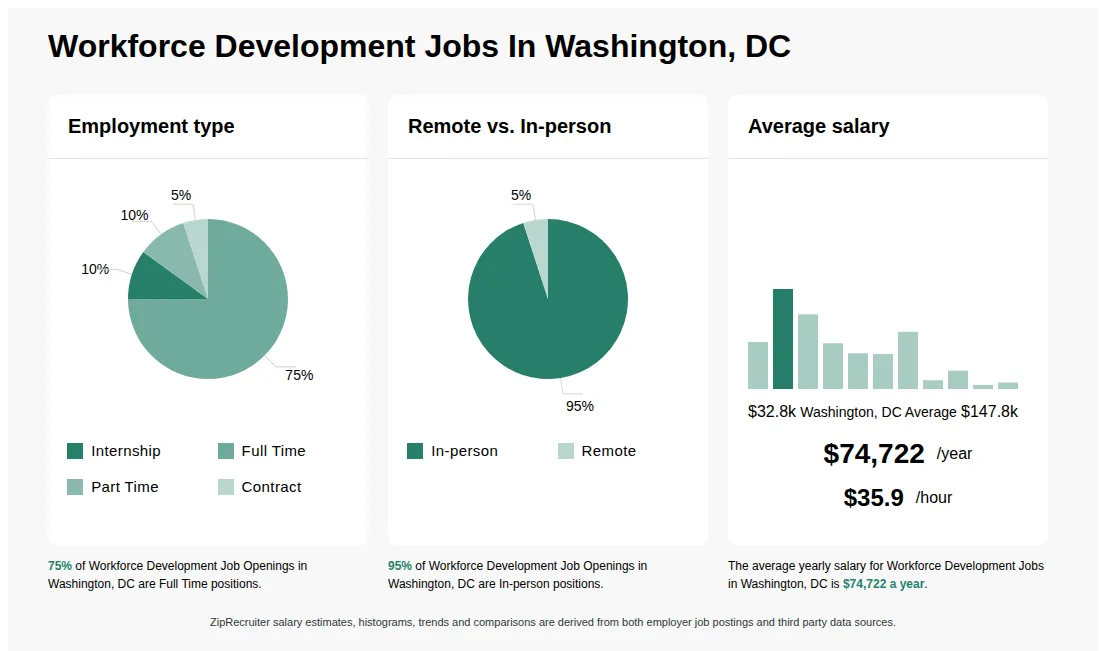
As of Sep 2, 2026, the average yearly pay for workforce development in Washington, DC is $72,963.00, according to ZipRecruiter salary data. Most workers in this role earn between $47,000.00 and $94,500.00 per year, depending on experience, location, and employer.
What is workforce development?
Workforce development refers to a wide range of activities, policies, and programs designed to create, sustain, and retain a skilled workforce that meets the current and future needs of employers. This field focuses on improving workers’ skills, connecting people to employment opportunities, and supporting career advancement. Workforce development can include job training, education, career counseling, apprenticeships, and collaboration between businesses, educational institutions, and government agencies. Its ultimate goal is to strengthen both individuals’ employability and the overall economic health of communities.
How do workforce development professionals typically collaborate with local employers and educational institutions?
Workforce Development professionals often serve as a bridge between local employers, training providers, and educational institutions. They regularly coordinate with businesses to identify current and future hiring needs, then partner with schools and community colleges to develop or enhance training programs that align with those needs. This collaborative approach ensures that job seekers are equipped with relevant skills and that employers have access to a qualified talent pipeline. Effective communication and relationship-building are key parts of the role, making networking and stakeholder management essential daily activities.
What are the key skills and qualifications needed to thrive in workforce development, and why are they important?
To excel in Workforce Development, you need expertise in career counseling, labor market analysis, and program management, often supported by a relevant degree or certifications such as CWDP (Certified Workforce Development Professional). Familiarity with workforce information systems, job-matching platforms, and data analysis tools is typically required. Outstanding communication, relationship-building, and problem-solving skills help professionals connect with job seekers and employers effectively. These skills ensure successful program outcomes, foster community partnerships, and enable individuals to achieve employment and career growth.
What is the difference between Workforce Development vs Career Counselor?
| Aspect | Workforce Development | Career Counselor |
|---|---|---|
| Credentials | Varies; often includes certifications in workforce or employment services | Typically requires a counseling or career development certification or degree |
| Work Environment | Government agencies, community organizations, training centers | Educational institutions, private practices, career centers |
| Employer & Industry Usage | Used by public and nonprofit sectors to improve employment rates | Used by schools, private firms, and counseling agencies to guide individual careers |
While both roles focus on employment and career paths, Workforce Development primarily involves creating programs and policies to improve employment opportunities at a community or organizational level. Career Counselors work directly with individuals to help them identify career goals and develop personal strategies. Understanding these differences helps job seekers and organizations choose the right support for their needs.
Is workforce development a good career?
Workforce development is a growing field focused on improving employment opportunities and skills training. It often involves collaboration with community organizations and government agencies, requiring strong communication and program management skills. The career can offer stability and the chance to make a positive community impact.
What does a workforce development do?
A workforce development professional helps connect individuals with job opportunities, training programs, and skills development to meet labor market needs. They often work with employers, educational institutions, and government agencies to improve employment outcomes and workforce skills.
What are the most commonly searched types of Workforce Development jobs in Washington, DC?
The most popular types of Workforce Development jobs in Washington, DC are:
What are popular job titles related to Workforce Development jobs in Washington, DC?
For Workforce Development jobs in Washington, DC, the most frequently searched job titles are:
What job categories do people searching Workforce Development jobs in Washington, DC look for?
The top searched job categories for Workforce Development jobs in Washington, DC are:
- Training And Development
- Workforce Development Manager
- Entry Level Community Development
- Community Economic Development
- Nonprofit Development Manager
- Training And Development Manager
- Learning And Development Consultant
- Deputy Director Workforce Development
- Director Proposal Development
- Remote Progressive Church

Workforce Development Analyst with Security Clearance
Washington, DC • On-site
Other
Medical, Dental, Vision, Life, Retirement, PTO
Posted 22 days ago
Job description
Delta Solutions & Strategies is seeking a Workforce Development Analyst to support Headquarters Department of the Air Force arms control workforce management and strategic communications activities in the National Capital Region. This position will support the recruitment, management, and professional development of the Department of the Air Force Treaty Compliance Officer workforce. The individual will track arms control billets, review manpower documentation, monitor billet fill and training completion rates, and coordinate workforce initiatives with Headquarters Air Force, Major Commands, and AF/A1. The ideal candidate will have experience with Air Force manpower, personnel, force development, or functional management processes and be able to transform workforce information into accurate reports, briefings, recommendations, and strategic communications products. *Anticipated award/start date September 2026 What you will be doing: * Provide subject matter expertise supporting the recruitment, management, and professional development of the Treaty Compliance Officer workforce. * Track and manage designated Department of the Air Force arms control billets. * Review Unit Manpower Documents and provide analysis and recommendations regarding manpower requirements. * Provide administrative and analytical support for billet transfers between organizations. * Coordinate Treaty Compliance Officer workforce development initiatives. * Liaise with Major Commands, AF/A1, functional managers, and other Department of the Air Force stakeholders on manpower and personnel activities. * Monitor Treaty Compliance Officer billet fill rates, vacancies, and training completion. * Develop quarterly workforce status reports and recommend actions to address identified staffing or training gaps. * Maintain accurate contact lists and workforce records for relevant personnel and organizations. * Prepare and deliver briefings and presentations on manpower, personnel, training, and workforce development topics. * Develop and distribute arms control items-of-interest summaries and topic-specific bulletins. * Develop, update, and maintain collaboration sites and other workforce communication resources. * Coordinate responses to workforce-related taskings and requests for information. * Support meetings, working groups, and senior-leader reviews related to arms control workforce requirements. * Perform other workforce management and strategic communications duties as assigned. What you will need: * Bachelor's degree from an accredited institution in human resources, business administration, management, public administration, or a related field. Relevant experience may be considered in lieu of the education requirement. * Three or more years of relevant experience in workforce development, manpower, personnel, force management, training management, functional management, or management analysis. * Working knowledge of Department of the Air Force manpower, personnel, or force development processes. * Experience tracking billets, authorized positions, vacancies, personnel assignments, or workforce qualifications. * Experience reviewing Unit Manpower Documents or comparable military manpower documentation. * Ability to analyze workforce data and develop clear findings and recommendations. * Experience developing reports, briefings, presentations, correspondence, and executive-level communication products. * Strong written and verbal communication skills. * Strong organizational skills and attention to detail. * Ability to coordinate effectively across Headquarters Air Force, Major Commands, functional communities, and other stakeholder organizations. * Proficiency with Microsoft Office applications, including Word, Excel, PowerPoint, Outlook, and Teams. * Ability to work on site in the National Capital Region with ready access to the Pentagon and/or Joint Base Anacostia-Bolling. * Security Clearance: Active Top Secret clearance with eligibility for Sensitive Compartmented Information, Special Access Program, and Special Access Required programs is required. Desired Skills/Experience: * Five or more years of Air Force manpower, personnel, force development, or functional management experience. * Experience supporting Headquarters Air Force, AF/A1, a Major Command headquarters, or an Air Force functional manager. * Experience managing or supporting a military career-field workforce. * Previous experience supporting the Treaty Compliance Officer community or Department of the Air Force arms control programs. * Familiarity with arms control treaty implementation, compliance, training, or inspection-readiness requirements. * Experience producing workforce status reports, billet-fill analyses, training-completion reports, or workforce gap assessments. * Experience developing and maintaining SharePoint, Teams, or other collaboration sites. * Experience drafting newsletters, bulletins, items-of-interest summaries, or strategic communications products. * Experience supporting general officer, Senior Executive Service, or headquarters-level briefings. * Knowledge of Air Force staff processes and task-management procedures. Delta Solutions & Strategies offers a generous benefits package to include medical, dental, vision, life insurance, 401(k), PTO, paid holidays, parental, military, and jury duty paid leaves. We are an Equal Opportunity Employer. We do not and will not discriminate in employment and personnel practices based on race, sex, age, disability, veteran status, religion, national origin or any other basis prohibited by applicable law. Hiring, transferring, and promotion practices are performed without regard to the above listed items. EEO/AAP, M, F, V, D

About Delta Solutions & Strategies
Sourced by ZipRecruiter
Industry
Engineering professional services
Company size
51 - 200 Employees
Headquarters location
Colorado Springs, CO, US
Year founded
2000