... weather) - 1/3 to 2/3 2. Work near moving mechanical parts - 2/3 3. Risk of radiation - Up to 1/3 4. Infectious Diseases - 1/3 to 2/3 5. Physical +/or Verbal Abusiveness - 2/3 6. Rotating Shifts - Up ...
... weather) - 1/3 to 2/3 2. Work near moving mechanical parts - 2/3 3. Risk of radiation - Up to 1/3 4. Infectious Diseases - 1/3 to 2/3 5. Physical +/or Verbal Abusiveness - 2/3 6. Rotating Shifts - Up ...

... weather) - 1/3 to 2/3 2. Work near moving mechanical parts - 2/3 3. Risk of radiation - Up to 1/3 4. Infectious Diseases - 1/3 to 2/3 5. Physical +/or Verbal Abusiveness - 2/3 6. Rotating Shifts - Up ...
... weather) - 1/3 to 2/3 2. Work near moving mechanical parts - 2/3 3. Risk of radiation - Up to 1/3 4. Infectious Diseases - 1/3 to 2/3 5. Physical +/or Verbal Abusiveness - 2/3 6. Rotating Shifts - Up ...

Space Weather Testbed Scientific Programmer
Boulder, CO · On-site +1
$89K - $109K/yr
The Space Weather Testbed Scientific Programmer selected, will support SWPC Testbed by developing ... Write, refactor, and maintain scientific code for processing observational data, running models ...
Space Weather Testbed Scientific Programmer
Boulder, CO · On-site +1
$89K - $109K/yr
The Space Weather Testbed Scientific Programmer selected, will support SWPC Testbed by developing ... Write, refactor, and maintain scientific code for processing observational data, running models ...
... weather) - 1/3 to 2/3 2. Work near moving mechanical parts - 2/3 3. Risk of radiation - Up to 1/3 4. Infectious Diseases - 1/3 to 2/3 5. Physical +/or Verbal Abusiveness - 2/3 6. Rotating Shifts - Up ...
... weather) - 1/3 to 2/3 2. Work near moving mechanical parts - 2/3 3. Risk of radiation - Up to 1/3 4. Infectious Diseases - 1/3 to 2/3 5. Physical +/or Verbal Abusiveness - 2/3 6. Rotating Shifts - Up ...
... weather) - 1/3 to 2/3 2. Work near moving mechanical parts - 2/3 3. Risk of radiation - Up to 1/3 4. Infectious Diseases - 1/3 to 2/3 5. Physical +/or Verbal Abusiveness - 2/3 6. Rotating Shifts - Up ...
... weather) - 1/3 to 2/3 2. Work near moving mechanical parts - 2/3 3. Risk of radiation - Up to 1/3 4. Infectious Diseases - 1/3 to 2/3 5. Physical +/or Verbal Abusiveness - 2/3 6. Rotating Shifts - Up ...
... weather) - 1/3 to 2/3 2. Work near moving mechanical parts - 2/3 3. Risk of radiation - Up to 1/3 4. Infectious Diseases - 1/3 to 2/3 5. Physical +/or Verbal Abusiveness - 2/3 6. Rotating Shifts - Up ...
... weather) - 1/3 to 2/3 2. Work near moving mechanical parts - 2/3 3. Risk of radiation - Up to 1/3 4. Infectious Diseases - 1/3 to 2/3 5. Physical +/or Verbal Abusiveness - 2/3 6. Rotating Shifts - Up ...
... weather) - 1/3 to 2/3 2. Work near moving mechanical parts - 2/3 3. Risk of radiation - Up to 1/3 4. Infectious Diseases - 1/3 to 2/3 5. Physical +/or Verbal Abusiveness - 2/3 6. Rotating Shifts - Up ...
... weather) - 1/3 to 2/3 2. Work near moving mechanical parts - 2/3 3. Risk of radiation - Up to 1/3 4. Infectious Diseases - 1/3 to 2/3 5. Physical +/or Verbal Abusiveness - 2/3 6. Rotating Shifts - Up ...
Space Weather Testbed Scientific Programmer
Boulder, CO · On-site +1
$89K - $109K/yr
Write, refactor, and maintain scientific code for processing observational data, running models ... The Space Weather Testbed Scientific Programmer selected should have the following: * A Master ...
Space Weather Testbed Scientific Programmer
Boulder, CO · On-site +1
$89K - $109K/yr
Write, refactor, and maintain scientific code for processing observational data, running models ... The Space Weather Testbed Scientific Programmer selected should have the following: * A Master ...
The Space Weather Testbed Scientific Programmer selected, will support SWPC Testbed by developing ... Write, refactor, and maintain scientific code for processing observational data, running models ...
The Space Weather Testbed Scientific Programmer selected, will support SWPC Testbed by developing ... Write, refactor, and maintain scientific code for processing observational data, running models ...

Weather Forecaster I with Security Clearance
Ridgecrest, CA · On-site
$37.32/hr
Observe weather phenomena and analyze climatic regimes, geography, terrain, weather system characteristics, centralized weather products, and surface and upper-air reports to forecast weather ...
Weather Forecaster I with Security Clearance
Ridgecrest, CA · On-site
$37.32/hr
Observe weather phenomena and analyze climatic regimes, geography, terrain, weather system characteristics, centralized weather products, and surface and upper-air reports to forecast weather ...

Construction Observer
Cherry Hill, NJ · On-site
Our client is seeking an experienced Construction Observer to support a wide range of public ... Work may involve exposure to varying weather conditions. Physical requirements include: * Walking ...
Construction Observer
Cherry Hill, NJ · On-site
Our client is seeking an experienced Construction Observer to support a wide range of public ... Work may involve exposure to varying weather conditions. Physical requirements include: * Walking ...
Construction Observer
Cherry Hill, NJ · On-site
Our client is seeking an experienced Construction Observer to support a wide range of public ... Work may involve exposure to varying weather conditions. Physical requirements include: * Walking ...
Construction Observer
Cherry Hill, NJ · On-site
Our client is seeking an experienced Construction Observer to support a wide range of public ... Work may involve exposure to varying weather conditions. Physical requirements include: * Walking ...

Meteorologist
Chicago, IL · On-site
One year'verifiedtraining/experience as a meteorologist, meteorologisttechnicianor weather observer in the operation of upper air sounding equipment and making meteorological observations is ...
Meteorologist
Chicago, IL · On-site
One year'verifiedtraining/experience as a meteorologist, meteorologisttechnicianor weather observer in the operation of upper air sounding equipment and making meteorological observations is ...

Meteorologist
Chicago, IL · On-site
One year'verifiedtraining/experience as a meteorologist, meteorologisttechnicianor weather observer in the operation of upper air sounding equipment and making meteorological observations is ...
Meteorologist
Chicago, IL · On-site
One year'verifiedtraining/experience as a meteorologist, meteorologisttechnicianor weather observer in the operation of upper air sounding equipment and making meteorological observations is ...
Meteorologist Senior
Chicago, IL · On-site
Minimum two years training/experience as a meteorologist, meteorologisttechnicianor weather observer in the operation of upper air sounding equipment and making meteorological observations is ...
Meteorologist Senior
Chicago, IL · On-site
Minimum two years training/experience as a meteorologist, meteorologisttechnicianor weather observer in the operation of upper air sounding equipment and making meteorological observations is ...
AIR TRAFFIC CONTROL SPECIALIST (TERMINAL)
Hurlburt Field, FL · On-site +1
$86K - $111K/yr
The incumbent must accomplish local limited weather observer certification requirements administered by base weather flight. Qualifications CONDITIONS OF EMPLOYMENT (CONT): * This position may be ...
AIR TRAFFIC CONTROL SPECIALIST (TERMINAL)
Hurlburt Field, FL · On-site +1
$86K - $111K/yr
The incumbent must accomplish local limited weather observer certification requirements administered by base weather flight. Qualifications CONDITIONS OF EMPLOYMENT (CONT): * This position may be ...

We are building and operating a weather observation constellation powered by internally developed sensing technologies - transforming how atmospheric data is captured and used worldwide. Tomorrow.io ...
We are building and operating a weather observation constellation powered by internally developed sensing technologies - transforming how atmospheric data is captured and used worldwide. Tomorrow.io ...
Experience deploying mobile instruments, including familiarity with existing fixed and mobile weather radars (preferred), to observe severe and hazardous weather * Familiarity with radar-based ...
Experience deploying mobile instruments, including familiarity with existing fixed and mobile weather radars (preferred), to observe severe and hazardous weather * Familiarity with radar-based ...
$78K - $101K/yr
The incumbent must accomplish local limited weather observer certification requirements administered by base weather flight. Qualifications CONDITIONS OF EMPLOYMENT: * This position may be entitled ...
$78K - $101K/yr
The incumbent must accomplish local limited weather observer certification requirements administered by base weather flight. Qualifications CONDITIONS OF EMPLOYMENT: * This position may be entitled ...
Morning Meteorologist/ Weather Forecaster, KERO
Bakersfield, CA · On-site
$68K - $72K/yr
The role involves analyzing weather data and delivering accurate forecasts to the Bakersfield and ... Gather and verify factual information through interview, observation, and research. * Perform other ...
New
Morning Meteorologist/ Weather Forecaster, KERO
Bakersfield, CA · On-site
$68K - $72K/yr
The role involves analyzing weather data and delivering accurate forecasts to the Bakersfield and ... Gather and verify factual information through interview, observation, and research. * Perform other ...
New
Weather Observer information
See salary details
$21K - $29K
5% of jobs
$29K - $37K
11% of jobs
$38.4K is the 25th percentile. Wages below this are outliers.
$37K - $45K
52% of jobs
$45K - $53K
6% of jobs
$53.8K is the 75th percentile. Wages above this are outliers.
$53K - $61K
5% of jobs
$61K - $69K
6% of jobs
$69K - $77K
5% of jobs
$77K - $85K
3% of jobs
$85K - $93K
3% of jobs
$93K - $101K
1% of jobs
$101K - $109K
1% of jobs
$21K
$53.8K
$109K
How much do weather observer jobs pay per year?
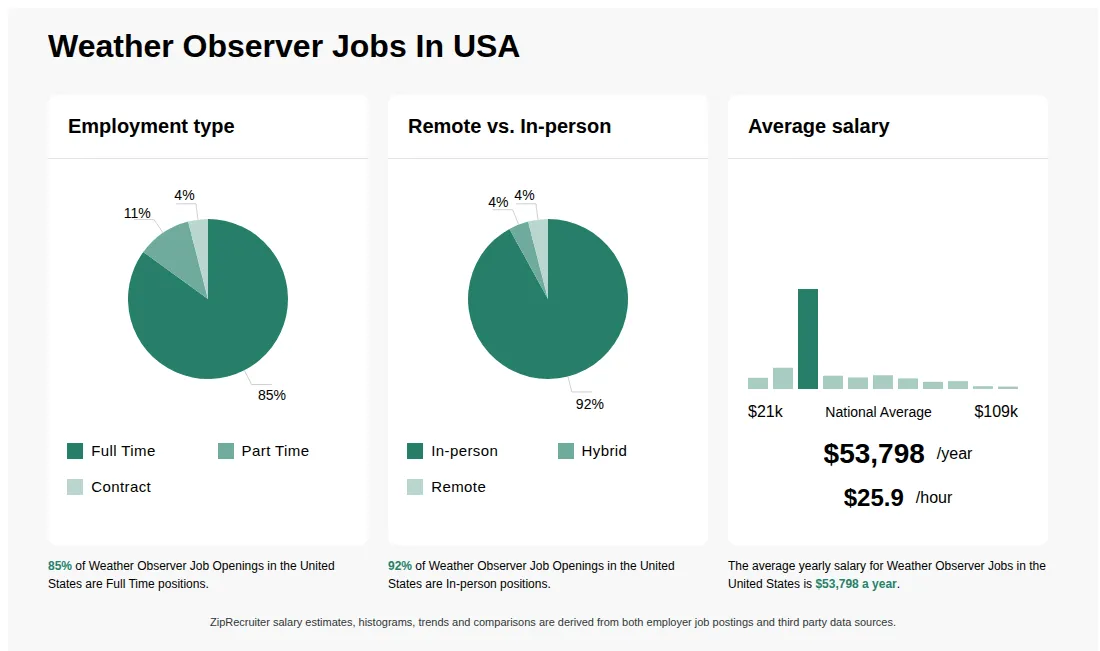
As of Sep 13, 2026, the average yearly pay for weather observer in the United States is $53,798.00, according to ZipRecruiter salary data. Most workers in this role earn between $42,000.00 and $62,500.00 per year, depending on experience, location, and employer.
What does a weather observer do?
A Weather Observer is responsible for monitoring and recording atmospheric conditions such as temperature, humidity, wind speed, and precipitation. They use specialized instruments and equipment to collect accurate weather data, which is then reported to meteorological agencies or used for forecasting purposes. Weather Observers may work at airports, weather stations, or other field locations, and their observations are crucial for aviation safety, public warnings, and climate research.
What does a weather observer do?
As a weather observer, your responsibilities are to collect, record, and analyze weather conditions. In this role, you may research information about your observations, predict changes in prevailing conditions, and help decide whether or not to recommend sending out weather warnings. Many weather observers specialize in particular areas, such as supporting the military or local news stations, and specialization can affect your future career options. Weather observation usually requires monitoring conditions at all times, so employers may ask you to work nights, weekends, or holidays as necessary. You may be asked to go out into poor weather to gather information, so the ability to work in the heat, cold, rain, wind, or other environmental conditions as necessary is essential to this job.
What are the key skills and qualifications needed to thrive as a weather observer, and why are they important?
To thrive as a Weather Observer, you need a solid understanding of meteorological principles, observational techniques, and typically a background in atmospheric sciences or related training. Familiarity with meteorological instruments, data collection systems, and weather reporting software is essential, and certification from organizations like the National Weather Service can be valuable. Attention to detail, analytical thinking, and effective communication are important soft skills for accurately recording and reporting weather data. These skills ensure reliable weather observations that are critical for forecasting, safety, and operational decision-making.
What are some common challenges faced by weather observers during severe weather events?
Weather Observers often encounter significant challenges during severe weather, such as storms or extreme temperatures. These conditions may require extended hours of observation, quick and accurate data recording, and close attention to safety protocols. Additionally, Weather Observers must communicate rapidly with meteorologists and emergency services to ensure timely dissemination of critical weather information. Adaptability and a calm demeanor are essential to perform effectively under pressure.
What is the difference between Weather Observer vs Meteorological Technician?
| Aspect | Weather Observer | Meteorological Technician |
|---|---|---|
| Required Credentials | High school diploma or equivalent; some positions may require certifications in weather observation | Associate's or bachelor's degree in meteorology or related field; certifications may be preferred |
| Work Environment | Outdoor, often in remote or weather-sensitive locations | Indoor and outdoor; may involve equipment maintenance and data analysis |
| Employer & Industry Usage | Federal agencies, weather stations, airports | National Weather Service, research facilities, government agencies |
| Common Search & Comparison Intent | Yes | Yes |
Weather Observers primarily focus on collecting weather data through direct observation, often outdoors in various conditions. Meteorological Technicians typically have more advanced education and handle equipment maintenance, data processing, and analysis. Both roles are essential in weather forecasting and often work together within the same organizations.
More about Weather Observer jobs
What cities are hiring for Weather Observer jobs?
Cities with the most Weather Observer job openings:
What are the most commonly searched types of Weather Observer jobs?
The most popular types of Weather Observer jobs are:
Who are the top companies hiring for Weather Observer jobs?
The top employers for Weather Observer jobs are:
What states have the most Weather Observer jobs?
States with the most job openings for Weather Observer jobs include:
What are popular job titles related to Weather Observer jobs?
For Weather Observer jobs, the most frequently searched job titles are:

Patient Observer 24-hr evenings, Inpatient
Clinton, MA • On-site
U Mass Memorial Health
• Health Care and Social Assistance • 10K+ employees10,000+ employees
Other
Re-posted 7 days ago
Job description
Are you an internal caregiver, student, or contingent worker/agency worker at UMass Memorial Health? CLICK HERE to apply through your Workday account.
Exemption Status:
Non-ExemptHiring Range:
$15.00 - $21.16Please note that the final offer may vary within this range based on a candidate's experience, skills, qualifications, and internal equity considerations.
Schedule Details:
Holidays - Every Other Holiday, Weekends - Every Other WeekendScheduled Hours:
1500-2330Shift:
2 - Evening Shift, 8 Hours (United States of America)Hours:
24Cost Center:
24070 - 0610 Psych Ip GeriatricThis position may have a signing bonus available a member of the Recruitment Team will confirm eligibility during the interview process.
Everyone Is a CaregiverAt UMass Memorial Health, everyone is a caregiver - regardless of their title or responsibilities. Exceptional patient care, academic excellence and leading-edge research make UMass Memorial the premier health system of Central Massachusetts, and a place where we can help you build the career you deserve. We are more than 20,000 employees, working together as one health system in a relentless pursuit of healing for our patients, community and each other. And everyone, in their own unique way, plays an important part, every day.
The Patient Safety Observer is responsible to provide continuous safety observation of patients to which they are assigned. The primary function in this role is to ensure patient safety and comfort. As part of the care team the Patient Observer may be asked to participate in supporting the patients with their activities of daily living, including, but not limited to, ambulating, feeding, and repositioning of patients as directed by nursing. The Patient Safety Observer may engage with the patients if appropriate and can use casual talk, sensory box including cards, coloring books, games. All care is to be documented and communicated through report with the designated staff member. All issues/concerns are to be reported immediately to the licensed clinical charge person.I. Major Responsibilities:
1. Develops and maintains good human relations skills. Introduces self by name to the patient and engages in eye contact. Consistently displays a respectful, empathetic and caring attitude toward both the patients and their family members.
2. Consistently observes for suicidal and/or violent behavior. Stays in close proximity of the patient and keeps them in the visual field at all times. Ensures patient safety at all times including while in the bathroom and when transported to other departments.
3. Monitor visitors to ensure no unsafe materials are shared with the patient (weapons, illicit drugs, sharps).
4. Maintains 15-minute checks with documentation unless otherwise directed.
5. Patient Safety Observers can monitor more than 1 patient if deemed appropriate by the licensed staff in charge.
6. Follow the directions of the nurse in charge.
7. May transport patients if directed by the licensed staff in charge.
8. When not observing a patient the patient safety observer can be used for other ancillary activities as directed by the nursing supervisor (making beds in the ED, stocking, assisting with transporting patients).
9. Functions in a float position and is assigned to the areas with patient needs.
10. Maintains patient dignity at all times and advocates for the patient.
II. Position Qualifications:
License/Certification/Education:
Required:
1. High School diploma or equivalent.
2. CPR Certification within 6 months of hire.
Experience/Skills:
Preferred:
1. Previous position held in a healthcare setting preferred.
Unless certification, licensure or registration is required, an equivalent combination of education and experience which provides proficiency in the areas of responsibility listed in this description may be substituted for the above requirements.
Department-specific competencies and their measurements will be developed and maintained in the individual departments. The competencies will be maintained and attached to the departmental job description. Responsible managers will review competencies with position incumbents.
III. Physical Demands and Environmental Conditions:
On-the-job time is spent in the following physical activities:
1. Stand - 1/3 to 2/3
2. Walk - 1/3 to 2/3
3. Sit - 2/3
4. Talk or hear - 2/3
5. Uses hands to finger, handle or feel - 2/3
6. Push/pull - 1/3 to 2/3
7. Stoop, kneel, crouch or crawl - 1/3 to 2/3
8. Reach with hands and arms - 2/3
This job requires that weight be lifted or force be exerted:
1. Up to 10 pounds - 2/3
2. Up to 25 pounds - 2/3
3. Up to 50 pounds - 2/3
4. Up to 100 pounds - 2/3
5. More than 100 pounds - 2/3
This job requires exposure to the following environmental conditions:
1. Wet, humid conditions (non-weather) - 1/3 to 2/3
2. Work near moving mechanical parts - 2/3
3. Risk of radiation - Up to 1/3
4. Infectious Diseases - 1/3 to 2/3
5. Physical +/or Verbal Abusiveness - 2/3
6. Rotating Shifts - Up to 1/3
7. PPE when indicated - 1/3 to 2/3
All qualified applicants will receive consideration for employment without regard to race, color, religion, sex, sexual orientation, gender identity, national origin, disability or protected veteran status.
We're striving to make respect a part of everything we do at UMass Memorial Health - for our patients, our community and each other. Our six Standards of Respect are: Acknowledge, Listen, Communicate, Be Responsive, Be a Team Player and Be Kind. If you share these Standards of Respect, we hope you will join our team and help us make respect our standard for everyone, every day.
As an equal opportunity and affirmative action employer, UMass Memorial Health recognizes the power of a diverse community and encourages applications from individuals with varied experiences, perspectives and backgrounds. All qualified applicants will receive consideration for employment without regard to race, color, religion, gender, sexual orientation, national origin, age, disability, gender identity and expression, protected veteran status or other status protected by law.
If you are unable to submit an application because of incompatible assistive technology or a disability, please contact us at talentacquisition@umassmemorial.org. We will make every effort to respond to your request for disability assistance as soon as possible.

About UMass Memorial Health Care
Sourced by ZipRecruiter
Industry
Health care and social assistance
Company size
10,000+ Employees
Headquarters location
Worcester, MA, US