Ivy Tech is currently accepting applications for a Building Trades Instructor located at the Plainfield Correctional Facility in Plainfield, IN. Come join our team! General Purpose and Scope of the ...
Ivy Tech is currently accepting applications for a Building Trades Instructor located at the Plainfield Correctional Facility in Plainfield, IN. Come join our team! General Purpose and Scope of the ...

$26.28/hr
PHNS is hiring for the following trades: 1. Shop 11 Shipfitter Lays out, fabricates, installs, removes, and repairs structural parts on ships and support equipment in accordance with blueprints. 2. ...
$26.28/hr
PHNS is hiring for the following trades: 1. Shop 11 Shipfitter Lays out, fabricates, installs, removes, and repairs structural parts on ships and support equipment in accordance with blueprints. 2. ...
CTE Buidling Trades Teacher
Hamlet, IN · On-site
CTE: Trade & Industry: Building Trades/CTE: Trade & Industry: Construction Qualifications:Appropriate Indiana License Working Conditions: Jr/Sr High School, grades 7-12 Application Procedure: Apply ...
CTE Buidling Trades Teacher
Hamlet, IN · On-site
CTE: Trade & Industry: Building Trades/CTE: Trade & Industry: Construction Qualifications:Appropriate Indiana License Working Conditions: Jr/Sr High School, grades 7-12 Application Procedure: Apply ...

Skilled Trade Careers Want to work in Newport News, VA? Are you a skilled craftsman looking for an honest day's work? Have you worked on water or wastewater treatment plants (or similar) before? W ...
Skilled Trade Careers Want to work in Newport News, VA? Are you a skilled craftsman looking for an honest day's work? Have you worked on water or wastewater treatment plants (or similar) before? W ...

The Intro to Construction Trades program will provide teens who are interested in the trades with the opportunity to explore different career pathways in the construction trades and learn from ...
Quick apply
The Intro to Construction Trades program will provide teens who are interested in the trades with the opportunity to explore different career pathways in the construction trades and learn from ...

Building Trades Teacher
Brookings, SD · On-site
$53K/yr
Building Trades Teacher * FT w/benefits * 75% of health & dental insurance premiums paid * Vision & AFLAC coverage available * South Dakota Retirement benefits * Up to $25,000 life insurance policy
Building Trades Teacher
Brookings, SD · On-site
$53K/yr
Building Trades Teacher * FT w/benefits * 75% of health & dental insurance premiums paid * Vision & AFLAC coverage available * South Dakota Retirement benefits * Up to $25,000 life insurance policy

Building Trades Instructor LOCATION: Adirondack Educational Center - Saranac Lake, NY DUTIES: * Assess, plan and provide instruction for students so that they may acquire the necessary skills ...
Building Trades Instructor LOCATION: Adirondack Educational Center - Saranac Lake, NY DUTIES: * Assess, plan and provide instruction for students so that they may acquire the necessary skills ...

$26.28/hr
PHNS is hiring for the following trades: 1. Shop 11 Shipfitter Lays out, fabricates, installs, removes, and repairs structural parts on ships and support equipment in accordance with blueprints. 2. ...
$26.28/hr
PHNS is hiring for the following trades: 1. Shop 11 Shipfitter Lays out, fabricates, installs, removes, and repairs structural parts on ships and support equipment in accordance with blueprints. 2. ...
Salary: Skilled Trade Careers Want to work in Newport News, VA? Are you a skilled craftsman looking for an honest days work? Have you worked on water or wastewater treatment plants (or similar ...
Quick apply
Salary: Skilled Trade Careers Want to work in Newport News, VA? Are you a skilled craftsman looking for an honest days work? Have you worked on water or wastewater treatment plants (or similar ...
Building Trades TeacherFT w/benefits75% of health & dental insurance premiums paidVision & AFLAC coverage availableSouth Dakota Retirement benefitsUp to $25,000 life insurance policyPersonal Leave ...
Building Trades TeacherFT w/benefits75% of health & dental insurance premiums paidVision & AFLAC coverage availableSouth Dakota Retirement benefitsUp to $25,000 life insurance policyPersonal Leave ...
Intro to Construction Trades Instructor
Chicago, IL · On-site
$20 - $27/hr
The Intro to Construction Trades program will provide teens who are interested in the trades with the opportunity to explore different career pathways in the construction trades and learn from ...
Intro to Construction Trades Instructor
Chicago, IL · On-site
$20 - $27/hr
The Intro to Construction Trades program will provide teens who are interested in the trades with the opportunity to explore different career pathways in the construction trades and learn from ...
Intro to Construction Trades Instructor
Chicago, IL · On-site
$20 - $27/hr
The Intro to Construction Trades program will provide teens who are interested in the trades with the opportunity to explore different career pathways in the construction trades and learn from ...
Intro to Construction Trades Instructor
Chicago, IL · On-site
$20 - $27/hr
The Intro to Construction Trades program will provide teens who are interested in the trades with the opportunity to explore different career pathways in the construction trades and learn from ...
The Intro to Construction Trades program will provide teens who are interested in the trades with the opportunity to explore different career pathways in the construction trades and learn from ...
Quick apply
The Intro to Construction Trades program will provide teens who are interested in the trades with the opportunity to explore different career pathways in the construction trades and learn from ...

Posting Details Posting Details Working Title TRADES/UTILITIES SENIOR WORKER Position Number 00414A Department HOUSING MAINTENANCE Location Norfolk, VA Type of Position Classified Type of Job ...
Posting Details Posting Details Working Title TRADES/UTILITIES SENIOR WORKER Position Number 00414A Department HOUSING MAINTENANCE Location Norfolk, VA Type of Position Classified Type of Job ...

Trades Recruiter
$20 - $25/hr
Trades Recruiter ** Location: Pascagoula, Mississippi $20-$25/Hour DOE + Growth Opportunities Full-Time | Fast-Paced | People-Focused Are you passionate about connecting great people with great ...
Quick apply
Trades Recruiter
$20 - $25/hr
Trades Recruiter ** Location: Pascagoula, Mississippi $20-$25/Hour DOE + Growth Opportunities Full-Time | Fast-Paced | People-Focused Are you passionate about connecting great people with great ...
Trades Recruiter
Newport News, VA · On-site
$20 - $25/hr
Trades Recruiter ** Location: Pascagoula, Mississippi $20-$25/Hour DOE + Growth Opportunities Full-Time | Fast-Paced | People-Focused Are you passionate about connecting great people with great ...
Quick apply
Trades Recruiter
Newport News, VA · On-site
$20 - $25/hr
Trades Recruiter ** Location: Pascagoula, Mississippi $20-$25/Hour DOE + Growth Opportunities Full-Time | Fast-Paced | People-Focused Are you passionate about connecting great people with great ...

Construction/Building Trades Teacher
Pearsall, TX · On-site
$65K/yr
Implement and manage the Building Trades program for assigned campus. Provide students with appropriate learning activities and experiences designed to help them fulfill their potential for ...
Construction/Building Trades Teacher
Pearsall, TX · On-site
$65K/yr
Implement and manage the Building Trades program for assigned campus. Provide students with appropriate learning activities and experiences designed to help them fulfill their potential for ...

Temporary Skilled Trades Apply now Work type: Temporary Staff Pool Location: Bellingham, WA Categories: Business and Financial Affairs Position Title Temporary Skilled Trades About the University ...
Temporary Skilled Trades Apply now Work type: Temporary Staff Pool Location: Bellingham, WA Categories: Business and Financial Affairs Position Title Temporary Skilled Trades About the University ...
TRADES/UTILITES SENIOR WORKER
Norfolk, VA · On-site
Posting Details Posting Details Working Title TRADES/UTILITES SENIOR WORKER Position Number 00066A Department HOUSING MAINTENANCE Location Norfolk, VA Type of Position Classified Type of Job ...
TRADES/UTILITES SENIOR WORKER
Norfolk, VA · On-site
Posting Details Posting Details Working Title TRADES/UTILITES SENIOR WORKER Position Number 00066A Department HOUSING MAINTENANCE Location Norfolk, VA Type of Position Classified Type of Job ...

Construction Building Trades Teacher
Auburn, NY · On-site
$56K - $65K/yr
The Cayuga-Onondaga BOCES is seeking a passionate, hands-on educator to lead our Construction & Building Trades program --where students don't just learn about construction, they actually build. This ...
Quick apply
Construction Building Trades Teacher
Auburn, NY · On-site
$56K - $65K/yr
The Cayuga-Onondaga BOCES is seeking a passionate, hands-on educator to lead our Construction & Building Trades program --where students don't just learn about construction, they actually build. This ...
Trades information
See salary details
$13.46 - $15.25
6% of jobs
$15.25 - $17.05
12% of jobs
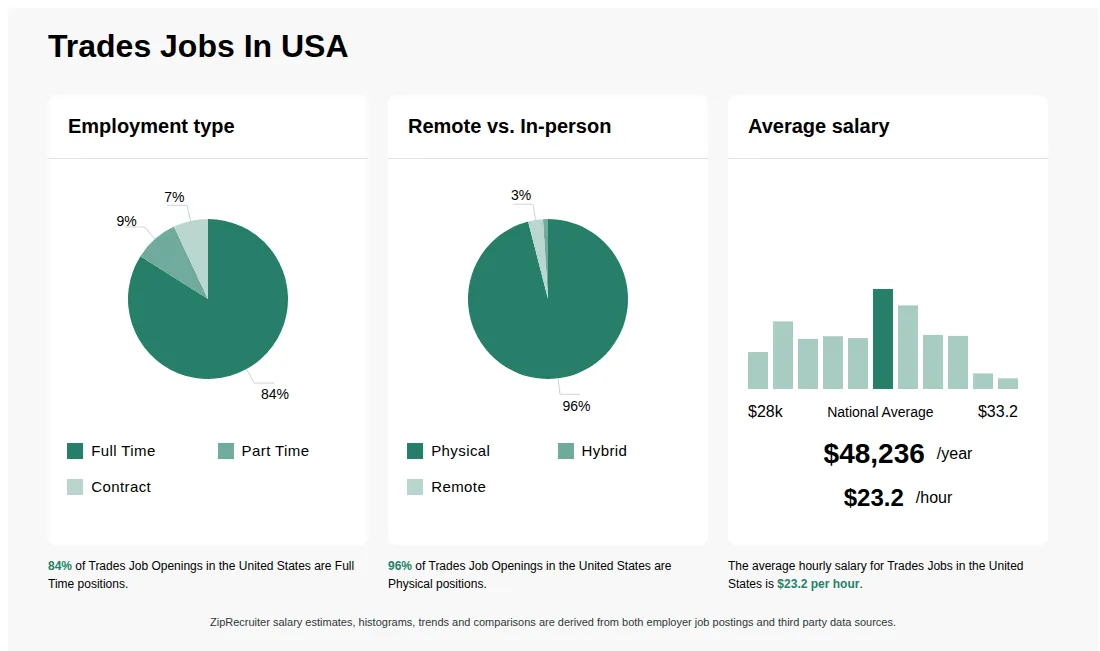
$18.50 is the 25th percentile. Wages below this are outliers.
$17.05 - $18.84
9% of jobs
$18.84 - $20.63
10% of jobs
$20.63 - $22.42
9% of jobs
The median wage is $22.95 / hr.
$22.42 - $24.21
18% of jobs
$25.69 is the 75th percentile. Wages above this are outliers.
$24.21 - $26.01
15% of jobs
$26.01 - $27.80
10% of jobs
$27.80 - $29.59
10% of jobs
$29.59 - $31.38
2% of jobs
$31.38 - $33.17
1% of jobs
$13
$23
$33
How much do trades jobs pay per hour?
As of Jul 16, 2026, the average hourly pay for trades in the United States is $23.19, according to ZipRecruiter salary data. Most workers in this role earn between $18.27 and $26.20 per hour, depending on experience, location, and employer.
What trade makes $100,000 a year?
In the trades, jobs such as electricians, plumbers, and elevator installers can earn $100,000 or more annually, especially with experience, certifications, and overtime. These roles often require specialized skills, apprenticeships, and sometimes union membership to reach higher salary levels.
What jobs pay 4000 a week without a degree?
Trades jobs such as commercial electricians, heavy equipment operators, and specialized construction managers can pay around $4,000 per week, especially with experience and certifications. These roles often require technical skills, apprenticeships, or licensing but do not necessarily require a college degree.
What is the difference between Trades vs Electrician?
| Aspect | Trades | Electrician |
|---|---|---|
| Credentials | Varies by trade, often includes apprenticeships or certifications | Requires specific electrical licenses and certifications |
| Work Environment | Construction sites, factories, maintenance facilities | Residential, commercial, industrial electrical systems |
| Industry Usage | Used across multiple industries like construction, manufacturing, maintenance | Specialized in electrical systems within various industries |
| Common Search/Comparison | Trades | Electrician |
Trades is a broad category encompassing various skilled occupations, including electricians. While trades workers perform diverse tasks across industries, electricians specifically focus on electrical systems, requiring specialized licenses. Understanding these differences helps job seekers find the right career path and certifications.
What are some common challenges trades professionals face when working on construction sites?
Trades professionals often encounter challenges such as coordinating with other trades to avoid scheduling conflicts, adapting to changing project timelines, and maintaining safety standards in dynamic environments. Communication and teamwork are essential, as various trades—like electricians, plumbers, and carpenters—must collaborate closely to ensure projects progress smoothly. Additionally, tradespeople may need to troubleshoot unexpected issues on-site, such as material shortages or design changes, which requires flexibility and problem-solving skills.
What are trades?
Trades refer to skilled manual occupations that typically require specialized training, apprenticeships, or certifications. Examples include electricians, plumbers, carpenters, welders, and HVAC technicians. Trade jobs are essential to building, maintaining, and repairing infrastructure in various industries. These careers often offer good job stability, competitive salaries, and opportunities for advancement without the need for a traditional four-year college degree.
What is a list of trade jobs?
Trade jobs are skilled occupations that typically require specialized training or apprenticeships, such as electricians, plumbers, carpenters, HVAC technicians, welders, and mechanics. These roles often involve working with tools and equipment in construction, maintenance, or manufacturing environments and may require certifications or licenses. Trade jobs are essential for building, repairing, and maintaining infrastructure and facilities.
What are the key skills and qualifications needed to thrive in a skilled trades role, and why are they important?
To thrive in a skilled trades role, you need hands-on technical proficiency, a solid understanding of safety procedures, and often a relevant apprenticeship or certification. Familiarity with specialized tools, machinery, and sometimes industry-specific software (like CAD for certain trades) is essential. Strong problem-solving abilities, attention to detail, and effective communication set top tradespeople apart. These skills ensure high-quality, safe work and efficient collaboration on job sites.
What is the best paying trade job?
The highest paying trade jobs typically include elevator installers and repairers, power plant operators, and petroleum toolpushers, with salaries often exceeding $80,000 annually. These roles usually require specialized skills, certifications, and experience in high-demand industries such as energy and infrastructure. Factors like location, experience, and certifications can influence earning potential.
More about Trades jobs
What cities are hiring for Trades jobs? Cities with the most Trades job openings:
What are the most commonly searched types of Trades jobs? The most popular types of Trades jobs are:
What states have the most Trades jobs? States with the most job openings for Trades jobs include:
What job categories do people searching Trades jobs look for? The top searched job categories for Trades jobs are:
$250/wk
Full-time
Medical, Dental, Vision, Life, Retirement, PTO
Posted 6 days ago
Job description
Looking for a career change and love construction and building trades? Ivy Tech is currently accepting applications for a Building Trades Instructor located at the Plainfield Correctional Facility in Plainfield, IN. Come join our team!
General Purpose and Scope of the Position:
This is a full-time, year-round teaching position located at the Plainfield Correctional Facility. Monday - Friday work schedule.
Help students to learn subject matter which will lead toward fulfillment of their potential intellectual, emotional, and psychological growth. Directs, assesses, and evaluates the learning experiences of students along with assessing the effectiveness of the academic area/s in which he/she is employed to teach. Provide instruction needed for students to qualify for certification in the respective fields.
Carpenters make up the largest building trades occupation in the industry and those with all-around skills are in high demand. This four-level curriculum covers content such as Building Materials, Cabinet Fabrication, and Advanced Wall Systems. This program offers students the skills for entry-level carpentry positions on almost any worksite. This includes onsite safety skills and certification. The certifications students complete the class with also assist students who want to branch out into craft-specific trades.
Major Responsibilities:
Instruct and guide the class in an efficient and effective manner; provide hands-on training
Maintain records of student attendance, academic progress, and grades as required by the correctional facility, Ivy Tech, and the Indiana Department of Corrections
Approach subject matter in a positive and enthusiastic manner.
Begin and end classes on time according to IDOC, Correctional Facility, and Ivy Tech schedules.
Provide education services utilizing the materials and equipment required in the curriculum from the Certifying Agency
Assess student learning according to Indiana Workforce Development Educational Functioning Level Assessment Policy, DWD Policy.
Maintain records as required by the Indiana Department of Correction, the Correctional Facility, and Ivy Tech Community College.
Record student data in a Department of Workforce Development database for National Reporting Purposes.
Establish and maintain cooperative professional relationships with students, peers, and community leaders.
Provide for the care and protection of Ivy Tech and Facility property.
Attend meetings as required.
Minimum Qualifications:
Already hold or agree to obtain facility-provided training for certifications as follows: NCCER Instructor Certification and OSHA Instructor Certification for Building Trades
Preferred Qualifications:
Relevant and documented work experience in the construction/building trades field. Prior work experience in a correctional setting is preferred.
Ivy Tech is committed to supporting the well-being, growth, and financial security of our full-time faculty and staff. Our comprehensive benefits package includes:
Health & Wellness
Multiple medical plan options paired with a Health Savings Account with a generous employer contribution
Dental plan with no-cost preventive services and coverage for orthodontia
Vision plan with low-cost exams and allowances for glasses or contact lenses
Employee Assistance Program offering no-cost confidential counseling sessions, legal consultations, financial planning consultations, and other resources
Wellness program with opportunities to earn $250 in Wellness Rewards
Flexible Spending Accounts for healthcare (limited purpose) and dependent care
Retirement & Financial Security
10% employer retirement contribution, fully vested after two years
Basic life insurance equal to annual salary paid by the College, with optional supplemental coverage
Short-term and long-term disability benefits
Educational Benefits
Fee remission for employees, spouses, and dependent children
Tuition assistance for undergraduate, graduate, and doctoral programs
Paid professional development opportunities
WorkLife Balance
Generous paid time off, including vacation, sick leave, holidays, and winter recess
Flexible work arrangements where available
Paid childbirth recovery leave (8 weeks)
Paid parental leave (4 weeks)
Additional Perks
Eligibility for Public Service Loan Forgiveness
Additional discounts on gym memberships, transportation, and various retail services
Ivy Tech is proud to offer benefits that support your health, your family, and your future-because when our employees thrive, our students and communities thrive too. For more information on Ivy Tech Benefits, visit https://careers.ivytech.edu/benefits.
Note: Employees who re-hire with the College within 180 days of leaving a full-time position with the College may be eligible for additional benefits depending on their bridged seniority date.
Ivy Tech Community College is an accredited, equal opportunity/affirmative action employer. All qualified applicants will receive consideration for employment without regard to race, color, ethnicity, national origin, marital status, religion, sex, gender, sexual orientation, gender identity, disability, age or veteran status. As required by Title IX of the Education Amendments of 1972, Ivy Tech Community College does not discriminate on the basis of sex, including sexual harassment in its educational programs and activities, including employment and admissions. Questions specific to Title IX may be referred to the College's Title IX Coordinator or to the US Department of Education Office of Civil Rights.