Think Tank Inc. (TTI) is a CMMI Level 3 (DEV/SVC) appraised, ISO 9001, 27001, 20000-1, 31000, and 42001 certified provider of scientific, technical, and professional support services to federal ...
Think Tank Inc. (TTI) is a CMMI Level 3 (DEV/SVC) appraised, ISO 9001, 27001, 20000-1, 31000, and 42001 certified provider of scientific, technical, and professional support services to federal ...
Think Tank Inc. (TTI) is a CMMI Level 3 (DEV/SVC) appraised, ISO 9001, 27001, 20000-1, 31000, and 42001 certified provider of scientific, technical, and professional support services to federal ...
Think Tank Inc. (TTI) is a CMMI Level 3 (DEV/SVC) appraised, ISO 9001, 27001, 20000-1, 31000, and 42001 certified provider of scientific, technical, and professional support services to federal ...
Experience supporting post-go-live stabilization Think Tank is an Equal Opportunity Employer. We are committed to creating an inclusive environment for all employees and applicants. All qualified ...
Quick apply
Experience supporting post-go-live stabilization Think Tank is an Equal Opportunity Employer. We are committed to creating an inclusive environment for all employees and applicants. All qualified ...
Experience supporting post-go-live stabilization Think Tank is an Equal Opportunity Employer. We are committed to creating an inclusive environment for all employees and applicants. All qualified ...
Experience supporting post-go-live stabilization Think Tank is an Equal Opportunity Employer. We are committed to creating an inclusive environment for all employees and applicants. All qualified ...
Experience supporting mission-critical systems Think Tank is an Equal Opportunity Employer. We are committed to creating an inclusive environment for all employees and applicants. All qualified ...
Experience supporting mission-critical systems Think Tank is an Equal Opportunity Employer. We are committed to creating an inclusive environment for all employees and applicants. All qualified ...

Think Tank Supervisor Location: Naples, FL Reports to: Food & Beverage Managers Status: Non-Exempt Job Summary: Think Tank Supervisor will be responsible for exceptional service to all guests ...
Quick apply
Think Tank Supervisor Location: Naples, FL Reports to: Food & Beverage Managers Status: Non-Exempt Job Summary: Think Tank Supervisor will be responsible for exceptional service to all guests ...
Proven technical leadership in ERP go-live Think Tank is an Equal Opportunity Employer. We are committed to creating an inclusive environment for all employees and applicants. All qualified ...
Proven technical leadership in ERP go-live Think Tank is an Equal Opportunity Employer. We are committed to creating an inclusive environment for all employees and applicants. All qualified ...
Fisheries GIS Analyst
Silver Spring, MD · On-site
Think Tank Inc. (TTI) is a CMMI Level 3 (DEV/SVC) appraised, ISO 9001, 27001, 20000-1, 31000, and 42001 certified provider of scientific, technical, and professional support services to federal ...
Fisheries GIS Analyst
Silver Spring, MD · On-site
Think Tank Inc. (TTI) is a CMMI Level 3 (DEV/SVC) appraised, ISO 9001, 27001, 20000-1, 31000, and 42001 certified provider of scientific, technical, and professional support services to federal ...
MIRO Think Tank is an Equal Opportunity Employer. We are committed to creating an inclusive environment for all employees and applicants. All qualified candidates will receive consideration for ...
Quick apply
MIRO Think Tank is an Equal Opportunity Employer. We are committed to creating an inclusive environment for all employees and applicants. All qualified candidates will receive consideration for ...
Experience supporting mission-critical systems Think Tank is an Equal Opportunity Employer. We are committed to creating an inclusive environment for all employees and applicants. All qualified ...
Quick apply
Experience supporting mission-critical systems Think Tank is an Equal Opportunity Employer. We are committed to creating an inclusive environment for all employees and applicants. All qualified ...
Senior Quantitative Scientist
Silver Spring, MD · On-site
$94K - $129K/yr
Think Tank Inc. (TTI) is a CMMI Level 3 (DEV/SVC) appraised, ISO 9001, 27001, 20000-1, 31000, and 42001 certified provider of scientific, technical, and professional support services to federal ...
Quick apply
Senior Quantitative Scientist
Silver Spring, MD · On-site
$94K - $129K/yr
Think Tank Inc. (TTI) is a CMMI Level 3 (DEV/SVC) appraised, ISO 9001, 27001, 20000-1, 31000, and 42001 certified provider of scientific, technical, and professional support services to federal ...
Proven technical leadership in ERP go-live Think Tank is an Equal Opportunity Employer. We are committed to creating an inclusive environment for all employees and applicants. All qualified ...
Quick apply
Proven technical leadership in ERP go-live Think Tank is an Equal Opportunity Employer. We are committed to creating an inclusive environment for all employees and applicants. All qualified ...
Think Tank Inc. (TTI) is a CMMI Level 3 (DEV/SVC) appraised, ISO 9001, 27001, 20000-1, 31000, and 42001 certified provider of scientific, technical, and professional support services to federal ...
Think Tank Inc. (TTI) is a CMMI Level 3 (DEV/SVC) appraised, ISO 9001, 27001, 20000-1, 31000, and 42001 certified provider of scientific, technical, and professional support services to federal ...
Senior Quantitative Scientist
Silver Spring, MD · On-site
$94K - $129K/yr
Think Tank Inc. (TTI) is a CMMI Level 3 (DEV/SVC) appraised, ISO 9001, 27001, 20000-1, 31000, and 42001 certified provider of scientific, technical, and professional support services to federal ...
Senior Quantitative Scientist
Silver Spring, MD · On-site
$94K - $129K/yr
Think Tank Inc. (TTI) is a CMMI Level 3 (DEV/SVC) appraised, ISO 9001, 27001, 20000-1, 31000, and 42001 certified provider of scientific, technical, and professional support services to federal ...
MIRO Think Tank is an Equal Opportunity Employer. We are committed to creating an inclusive environment for all employees and applicants. All qualified candidates will receive consideration for ...
MIRO Think Tank is an Equal Opportunity Employer. We are committed to creating an inclusive environment for all employees and applicants. All qualified candidates will receive consideration for ...
Fisheries GIS Analyst
Silver Spring, MD · On-site
Think Tank Inc. (TTI) is a CMMI Level 3 (DEV/SVC) appraised, ISO 9001, 27001, 20000-1, 31000, and 42001 certified provider of scientific, technical, and professional support services to federal ...
Quick apply
Fisheries GIS Analyst
Silver Spring, MD · On-site
Think Tank Inc. (TTI) is a CMMI Level 3 (DEV/SVC) appraised, ISO 9001, 27001, 20000-1, 31000, and 42001 certified provider of scientific, technical, and professional support services to federal ...
Think Tank Inc. (TTI) is a CMMI Level 3 (DEV/SVC) appraised, ISO 9001, 27001, 20000-1, 31000, and 42001 certified provider of scientific, technical, and professional support services to federal ...
Quick apply
Think Tank Inc. (TTI) is a CMMI Level 3 (DEV/SVC) appraised, ISO 9001, 27001, 20000-1, 31000, and 42001 certified provider of scientific, technical, and professional support services to federal ...
Proven ability to manage complex, high-visibility programs Think Tank is an Equal Opportunity Employer. We are committed to creating an inclusive environment for all employees and applicants. All ...
Quick apply
Proven ability to manage complex, high-visibility programs Think Tank is an Equal Opportunity Employer. We are committed to creating an inclusive environment for all employees and applicants. All ...
Clear written and verbal communication skills Think Tank is an Equal Opportunity Employer. We are committed to creating an inclusive environment for all employees and applicants. All qualified ...
Quick apply
Clear written and verbal communication skills Think Tank is an Equal Opportunity Employer. We are committed to creating an inclusive environment for all employees and applicants. All qualified ...
Senior Database Specialist
Gloucester, MA · On-site
SQL Developer, Toad Think Tank is an Equal Opportunity Employer. We are committed to creating an inclusive environment for all employees and applicants. All qualified candidates will receive ...
Quick apply
Senior Database Specialist
Gloucester, MA · On-site
SQL Developer, Toad Think Tank is an Equal Opportunity Employer. We are committed to creating an inclusive environment for all employees and applicants. All qualified candidates will receive ...
Think Tank information
See salary details
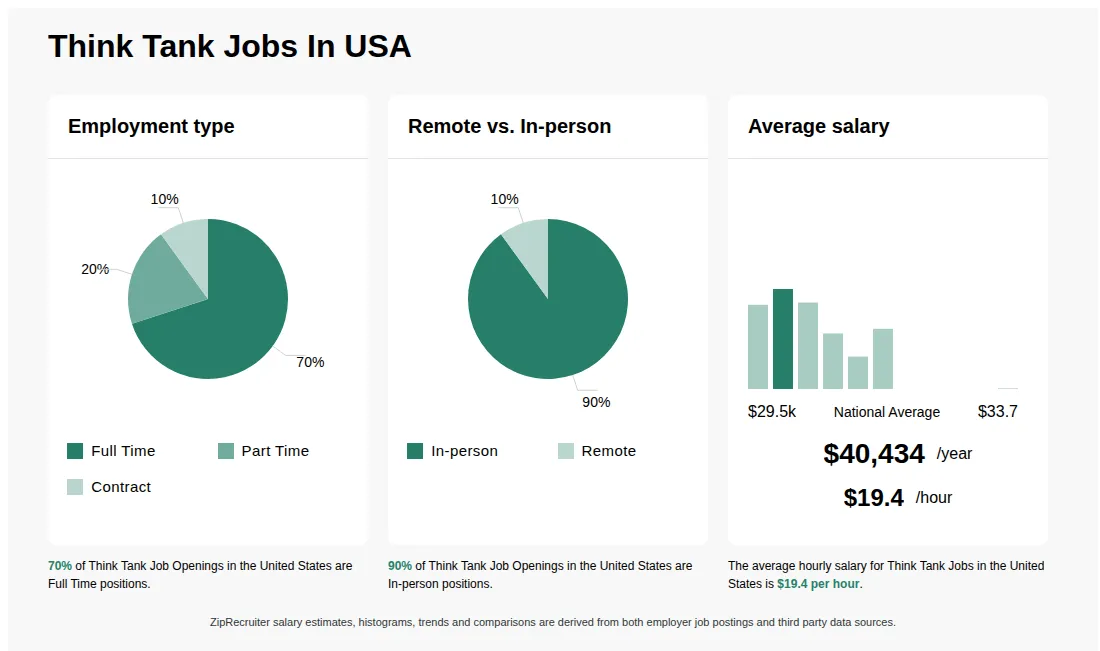
$14.18 - $15.95
21% of jobs
$16.28 is the 25th percentile. Wages below this are outliers.
$15.95 - $17.72
24% of jobs
The median wage is $18.21 / hr.
$17.72 - $19.49
21% of jobs
$20.82 is the 75th percentile. Wages above this are outliers.
$19.49 - $21.26
13% of jobs
$21.26 - $23.03
7% of jobs
$23.03 - $24.80
14% of jobs
$24.80 - $26.57
0% of jobs
$26.57 - $28.34
0% of jobs
$28.34 - $30.11
0% of jobs
$30.11 - $31.88
0% of jobs
$31.88 - $33.65
0% of jobs
$14
$19
$33
How much do think tank jobs pay per hour?
As of Jun 24, 2026, the average hourly pay for think tank in the United States is $19.44, according to ZipRecruiter salary data. Most workers in this role earn between $16.11 and $21.15 per hour, depending on experience, location, and employer.
What are think tanks and what do they do?
Think tanks are organizations dedicated to research and analysis on public policy issues. They gather experts to develop ideas, provide insights, and offer recommendations to policymakers, businesses, and the public. Their work often includes publishing reports, hosting events, and engaging in advocacy to influence decision-making on topics such as economics, security, healthcare, and education. Think tanks can be independent, affiliated with universities, or associated with political parties, and they play a key role in shaping public debate.
What Is a Think Tank?
A think tank is an institute or organization that performs advocacy and research on one or more topics. Think tanks frequently address topics like proposed political and social policies, economic matters, use of technology, and culture. The structure and goals of a think tank often reflect its source of support, which can be anything from a non-profit to a government-, corporation-, or university-sponsored guarantee of support. Think tanks range from large and diversified groups to smaller setups focused on specific and specialized topics. Some think tanks provide help with writing legislation, finding experts on particular issues, determining what topics should be studied, or bringing people together.
What is the difference between Think Tank vs Policy Analyst?
| Aspect | Think Tank | Policy Analyst |
|---|---|---|
| Required Credentials | Advanced degrees in political science, public policy, or related fields | Similar credentials, often with a focus on specific policy areas |
| Work Environment | Research-focused, often non-profit or think tank organizations | Government agencies, NGOs, or consulting firms |
| Employer & Industry Usage | Used for research, policy development, and advocacy | Used for analyzing, developing, and recommending policies |
While both roles require advanced education and involve policy work, a Think Tank primarily conducts research and advocacy within specialized organizations, whereas a Policy Analyst often works within government or consulting firms to analyze and develop policies based on research findings.
How do I get a job at a think tank?
To get a job at a think tank, candidates typically need a strong background in policy, research, or related fields, often demonstrated through relevant degrees or experience. Building expertise in areas such as economics, political science, or public policy, and developing research, analytical, and writing skills are essential. Networking, internships, and staying informed about current issues can also improve chances of employment in this environment.
What jobs pay $10,000 a month without a degree?
In roles related to think tanks or research organizations, high-paying positions such as senior analysts, policy advisors, or research directors can reach or exceed $10,000 per month with extensive experience and specialized skills. These jobs often require strong analytical abilities, expertise in a specific field, and may involve working independently or leading projects, but typically do not require a formal degree if the individual has relevant experience and a proven track record.
What jobs pay 2000 a day?
High-paying roles such as senior management consultants, specialized surgeons, or certain investment bankers can earn around $2,000 per day, often requiring advanced skills, certifications, and significant experience. Freelance professionals like top-tier consultants or contractors in niche fields may also reach this level with the right client base and expertise.
What are some typical challenges faced by professionals working in think tanks, and how can new hires best navigate them?
Professionals in think tanks often face challenges such as tight deadlines for delivering research, the need to balance rigorous analysis with clear communication, and staying current with rapidly evolving policy landscapes. New hires can navigate these challenges by cultivating strong time management skills, actively seeking feedback from senior researchers, and engaging in continuous learning through seminars and networking events. Collaboration is key, as projects often require input from experts in various disciplines, so building relationships within and outside the organization is essential for success.
What are the key skills and qualifications needed to thrive as a Think Tank Researcher, and why are they important?
To thrive as a Think Tank Researcher, you need strong analytical abilities, research expertise, and advanced degrees in relevant fields such as political science, economics, or public policy. Familiarity with data analysis tools, academic databases, and sometimes statistical software like Stata or R is common. Excellent communication, critical thinking, and collaboration skills set standout candidates apart in producing and presenting impactful research. These abilities are crucial for generating credible policy recommendations and influencing decision-makers in fast-evolving policy landscapes.
What jobs are there in a think tank?
Jobs in a think tank include research analyst, policy analyst, program manager, communications specialist, and administrative staff. These roles often require strong analytical skills, expertise in specific policy areas, and proficiency with research tools and data analysis software.
More about Think Tank jobs
What cities are hiring for Think Tank jobs? Cities with the most Think Tank job openings:
What are the most commonly searched types of Think Tank jobs? The most popular types of Think Tank jobs are:
What states have the most Think Tank jobs? States with the most job openings for Think Tank jobs include:
What job categories do people searching Think Tank jobs look for? The top searched job categories for Think Tank jobs are:

Contractor
Posted 11 days ago
Job description
*US Citizenship Required
*Full time Onsite Position at the NWFSC, Seattle, WA or at one of its associated field stations in WA or OR
*Travel is anticipated
*Anticipated Start: 4th quarter FY 2026
*Position is Subject to Contract Award
POSITION DESCRIPTION
The Fisheries Ecologist supports the Northwest Fisheries Science Center (NWFSC) Fish Ecology Division in conducting ecological research and quantitative analyses of marine and anadromous fish species throughout the Pacific Northwest and California. Working collaboratively with interdisciplinary teams of scientists, natural resource managers, and tribal representatives, the Fisheries Ecologist contributes to research that informs fisheries management, conservation, habitat restoration, and sustainable harvest opportunities under the Magnuson-Stevens Fishery Conservation and Management Act (MSA), Endangered Species Act (ESA), and other applicable authorities.
The position combines field research, laboratory work, ecological data analysis, scientific communication, and development of decision-support tools to improve fisheries management and ecosystem understanding. The Fisheries Ecologist plays a key role in collecting and analyzing biological and environmental data, developing reproducible scientific workflows, and disseminating research findings to management agencies and scientific communities.
REQUIREMENTS
- Education – Bachelor's degree, or higher, from an accredited college or university with a major in a field of study related to the requirements of the task order with emphasis in fisheries, ecology, natural sciences, mathematics, statistics, oceanography, or hydrology.
- Experience – Three (3) years of experience related to the task order, including familiarity with the species and habitats managed by NOAA Fisheries in the West Coast region. An Advanced Degree (MS or PhD) in a related field may be substituted for two (2) years of experience.
- Excellent verbal and written communication, and experience writing reports and publishing peer-reviewed articles. Familiarity with common software used in the workplace such as Google Suite and Microsoft Office.
- Strong quantitative skills including familiarity with modeling and data analysis. Familiarity with software such as R, GitHub. etc.
- Ability to manage workload, stay organized, and produce high-quality work products efficiently.
- Ability to work both independently and on interdisciplinary teams.
The proposed personnel must possess and maintain the following skills/certifications and/or credentials during the period of performance: valid driver's license.
DESIRED QUALIFICATIONS
- Advanced degree (MS or PhD) for Tasks 1-3 highly preferred.
- Peer-reviewed publication record in fisheries ecology, quantitative ecology, or related field.
- Collaboration with tribal representatives and regional resource management partners.
- Presenting results at regional and national scientific meetings and conferences.
- Familiarity with Pacific salmon, groundfish, or other NOAA WC managed species.
- Experience with Bayesian or hierarchical modeling approaches.
ABOUT THINK TANK INC.
Think Tank Inc. (TTI) is a CMMI Level 3 (DEV/SVC) appraised, ISO 9001, 27001, 20000-1, 31000, and 42001 certified provider of scientific, technical, and professional support services to federal agencies, including NOAA Fisheries under the ProTech 2.0 Fisheries IDIQ. Learn more at www.ttinc.com.
Think Tank Inc. is an Equal Opportunity Employer. All qualified applicants will receive consideration for employment without regard to race, color, religion, sex, sexual orientation, gender identity, national origin, disability, or status as a protected veteran.

About Think Tank Photo
Sourced by ZipRecruiter
Industry
Photography services
Company size
11 - 50 Employees
Headquarters location
Santa Rosa, CA, US
Year founded
2005