
Overview The Sr. Taxonomy & Ontology Architect serves as a senior technical resource for taxonomy, ontology, metadata, and knowledge graph architecture, providing technical guidance and ...
Overview The Sr. Taxonomy & Ontology Architect serves as a senior technical resource for taxonomy, ontology, metadata, and knowledge graph architecture, providing technical guidance and ...
We are seeking an experienced Information Governance & Taxonomy Specialist to support enterprise information management initiatives. This individual will play a key role in designing, implementing ...
We are seeking an experienced Information Governance & Taxonomy Specialist to support enterprise information management initiatives. This individual will play a key role in designing, implementing ...

Taxonomy Lab Sorter
Mobile, AL · On-site
The Taxonomy Lab Sorter will assist with sorting and identifying research specimens using a microscope and will be responsible for maintaining accurate records and following established laboratory ...
Quick apply
Taxonomy Lab Sorter
Mobile, AL · On-site
The Taxonomy Lab Sorter will assist with sorting and identifying research specimens using a microscope and will be responsible for maintaining accurate records and following established laboratory ...
Taxonomy Lab Sorter
Mobile, AL · On-site
$11 - $13.75/hr
The Taxonomy Lab Sorter will assist with sorting and identifying research specimens using a microscope and will be responsible for maintaining accurate records and following established laboratory ...
Taxonomy Lab Sorter
Mobile, AL · On-site
$11 - $13.75/hr
The Taxonomy Lab Sorter will assist with sorting and identifying research specimens using a microscope and will be responsible for maintaining accurate records and following established laboratory ...
Taxonomy Lab Sorter
Mobile, AL · On-site
$11 - $13.75/hr
The Taxonomy Lab Sorter will assist with sorting and identifying research specimens using a microscope and will be responsible for maintaining accurate records and following established laboratory ...
Taxonomy Lab Sorter
Mobile, AL · On-site
$11 - $13.75/hr
The Taxonomy Lab Sorter will assist with sorting and identifying research specimens using a microscope and will be responsible for maintaining accurate records and following established laboratory ...
Taxonomy Lab Sorter
Mobile, AL · On-site
$11 - $13.75/hr
The Taxonomy Lab Sorter will assist with sorting and identifying research specimens using a microscope and will be responsible for maintaining accurate records and following established laboratory ...
Taxonomy Lab Sorter
Mobile, AL · On-site
$11 - $13.75/hr
The Taxonomy Lab Sorter will assist with sorting and identifying research specimens using a microscope and will be responsible for maintaining accurate records and following established laboratory ...

Governance and Taxonomy Specialist
Washington, DC · On-site
$144K/yr
This role sits at the intersection of data governance, taxonomy design, content migration, customer insights, and digital ecosystem modernization. Working closely with the Technical Engagement ...
New
Governance and Taxonomy Specialist
Washington, DC · On-site
$144K/yr
This role sits at the intersection of data governance, taxonomy design, content migration, customer insights, and digital ecosystem modernization. Working closely with the Technical Engagement ...
New
Governance and Taxonomy Specialist
Washington, DC · On-site
$67K - $144K/yr
This role sits at the intersection of data governance, taxonomy design, content migration, customer insights, and digital ecosystem modernization. Working closely with the Technical Engagement ...
Governance and Taxonomy Specialist
Washington, DC · On-site
$67K - $144K/yr
This role sits at the intersection of data governance, taxonomy design, content migration, customer insights, and digital ecosystem modernization. Working closely with the Technical Engagement ...

$140 - $190/hr
We are looking for a Principal Financial Data Ontologist to design and govern the foundational taxonomy, symbology, and entity models that define how we represent global financial markets. This is a ...
$140 - $190/hr
We are looking for a Principal Financial Data Ontologist to design and govern the foundational taxonomy, symbology, and entity models that define how we represent global financial markets. This is a ...
Veterinary Taxonomy Analyst
Lexington, KY · On-site
Summary We are looking for a curious, detail-oriented Taxonomy Analyst to join our team and help translate complex veterinary clinic data into actionable insights. This role collaborates with ...
Veterinary Taxonomy Analyst
Lexington, KY · On-site
Summary We are looking for a curious, detail-oriented Taxonomy Analyst to join our team and help translate complex veterinary clinic data into actionable insights. This role collaborates with ...

$149 - $223/hr
## Data Architecture, Taxonomy & Modeling Principal Architect (US)Applyremote type: On Sitelocations: Mount Laurel, New Jerseytime type: Full timeposted on: Posted Yesterdaytime left to apply: End Date:
$149 - $223/hr
## Data Architecture, Taxonomy & Modeling Principal Architect (US)Applyremote type: On Sitelocations: Mount Laurel, New Jerseytime type: Full timeposted on: Posted Yesterdaytime left to apply: End Date:

Data Architecture, Taxonomy & Modeling Principal Architect (US)
Mount Laurel, NJ · On-site
$148K - $223K/yr
Taxonomy & Metadata Management * Develop and maintain the enterprise technology taxonomy. * Standardize technology definitions, classifications, hierarchies, and naming conventions. * Establish ...
Data Architecture, Taxonomy & Modeling Principal Architect (US)
Mount Laurel, NJ · On-site
$148K - $223K/yr
Taxonomy & Metadata Management * Develop and maintain the enterprise technology taxonomy. * Standardize technology definitions, classifications, hierarchies, and naming conventions. * Establish ...
Data Architecture, Taxonomy & Modeling Principal Architect (US)
Mount Laurel, NJ · On-site
$148K - $223K/yr
Taxonomy & Metadata Management * Develop and maintain the enterprise technology taxonomy. * Standardize technology definitions, classifications, hierarchies, and naming conventions. * Establish ...
Data Architecture, Taxonomy & Modeling Principal Architect (US)
Mount Laurel, NJ · On-site
$148K - $223K/yr
Taxonomy & Metadata Management * Develop and maintain the enterprise technology taxonomy. * Standardize technology definitions, classifications, hierarchies, and naming conventions. * Establish ...
Data Architecture, Taxonomy & Modeling Principal Architect (US)
Mount Laurel Township, NJ · On-site
$149 - $223/hr
## Data Architecture, Taxonomy & Modeling Principal Architect (US)Applyremote type: On Sitelocations: Mount Laurel, New Jerseytime type: Full timeposted on: Posted Yesterdaytime left to apply: End Date:
Data Architecture, Taxonomy & Modeling Principal Architect (US)
Mount Laurel Township, NJ · On-site
$149 - $223/hr
## Data Architecture, Taxonomy & Modeling Principal Architect (US)Applyremote type: On Sitelocations: Mount Laurel, New Jerseytime type: Full timeposted on: Posted Yesterdaytime left to apply: End Date:

Veterinary Taxonomy Analyst
Chicago, IL · On-site
Summary We are looking for a curious, detail-oriented Taxonomy Analyst to join our team and help translate complex veterinary clinic data into actionable insights. This role collaborates with ...
Veterinary Taxonomy Analyst
Chicago, IL · On-site
Summary We are looking for a curious, detail-oriented Taxonomy Analyst to join our team and help translate complex veterinary clinic data into actionable insights. This role collaborates with ...
Data Architecture, Taxonomy & Modeling Principal Architect (US)
Mount Laurel Township, NJ · On-site
$149 - $223/hr
Taxonomy & Metadata ManagementDevelop and maintain the enterprise technology taxonomy.Standardize technology definitions, classifications, hierarchies, and naming conventions.Establish metadata ...
Data Architecture, Taxonomy & Modeling Principal Architect (US)
Mount Laurel Township, NJ · On-site
$149 - $223/hr
Taxonomy & Metadata ManagementDevelop and maintain the enterprise technology taxonomy.Standardize technology definitions, classifications, hierarchies, and naming conventions.Establish metadata ...
Veterinary Taxonomy Analyst
Portland, ME · On-site
Summary We are looking for a curious, detail-oriented Taxonomy Analyst to join our team and help translate complex veterinary clinic data into actionable insights. This role collaborates with ...
Veterinary Taxonomy Analyst
Portland, ME · On-site
Summary We are looking for a curious, detail-oriented Taxonomy Analyst to join our team and help translate complex veterinary clinic data into actionable insights. This role collaborates with ...
Veterinary Taxonomy Analyst
Chicago, IL · On-site
$70 - $90/hr
Summary We are looking for a curious, detail-oriented Taxonomy Analyst to join our team and help translate complex veterinary clinic data into actionable insights. This role collaborates with ...
Veterinary Taxonomy Analyst
Chicago, IL · On-site
$70 - $90/hr
Summary We are looking for a curious, detail-oriented Taxonomy Analyst to join our team and help translate complex veterinary clinic data into actionable insights. This role collaborates with ...
Veterinary Taxonomy Analyst
Chicago, IL · On-site
Summary We are looking for a curious, detail-oriented Taxonomy Analyst to join our team and help translate complex veterinary clinic data into actionable insights. This role collaborates with ...
Veterinary Taxonomy Analyst
Chicago, IL · On-site
Summary We are looking for a curious, detail-oriented Taxonomy Analyst to join our team and help translate complex veterinary clinic data into actionable insights. This role collaborates with ...

Information Architect (Taxonomy/Metadata expertise) Content management and taxonomy/metadata expertise. Needs to have led projects around metadata and taxonomy design for internal and external ...
Information Architect (Taxonomy/Metadata expertise) Content management and taxonomy/metadata expertise. Needs to have led projects around metadata and taxonomy design for internal and external ...
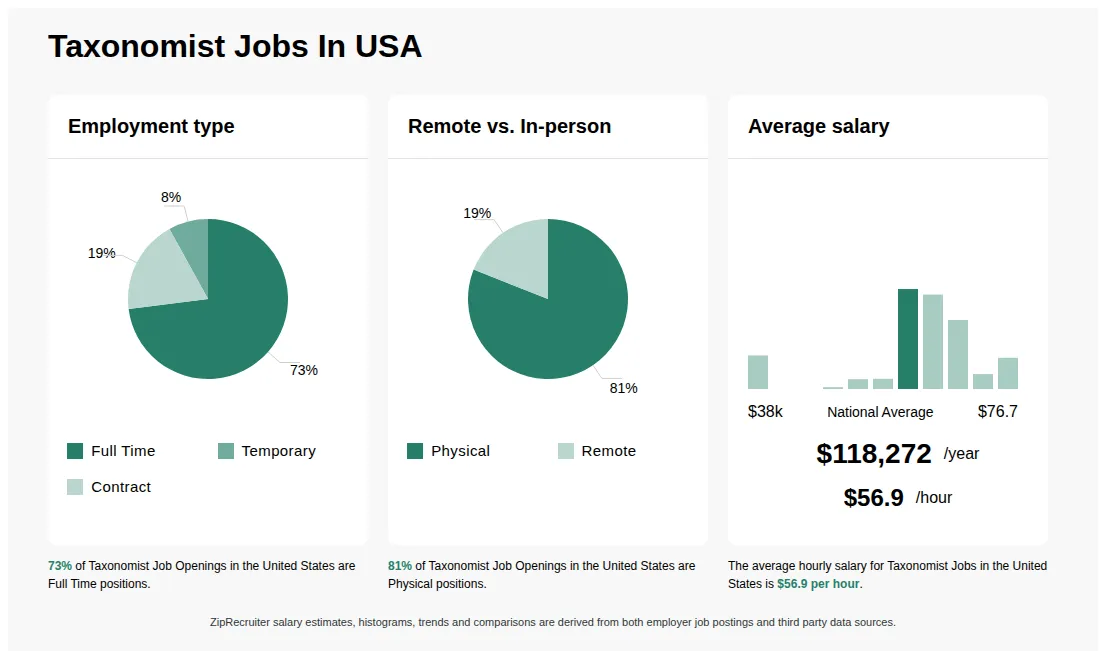
Taxonomist information
See salary details
$18.27 - $23.58
9% of jobs
$23.58 - $28.89
0% of jobs
$28.89 - $34.20
0% of jobs
$34.20 - $39.51
0% of jobs
$39.51 - $44.82
2% of jobs
$44.82 - $50.13
2% of jobs
$52.25 is the 25th percentile. Wages below this are outliers.
$50.13 - $55.44
28% of jobs
The median wage is $57.03 / hr.
$55.44 - $60.75
26% of jobs
$62.60 is the 75th percentile. Wages above this are outliers.
$60.75 - $66.06
19% of jobs
$66.06 - $71.37
4% of jobs
$71.37 - $76.68
8% of jobs
$18
$56
$76
How much do taxonomist jobs pay per hour?
As of Sep 6, 2026, the average hourly pay for taxonomist in the United States is $56.86, according to ZipRecruiter salary data. Most workers in this role earn between $54.81 and $64.18 per hour, depending on experience, location, and employer.
What are some common challenges faced by taxonomists when classifying new species?
Taxonomists are scientists who specialize in classifying and naming living organisms. They study the characteristics, relationships, and evolutionary history of plants, animals, fungi, and other life forms to organize them into groups such as species, genera, and families. Taxonomists play a crucial role in biodiversity research, conservation, and ensuring accurate identification of organisms, which is essential for fields like agriculture, medicine, and ecology.
What are some common challenges faced by taxonomists when classifying new species?
A taxonomist is a scientist that classifies and names living organisms. This job involves gathering, studying, and classifying plant and animal species. Typical duties include analyzing living organisms to determine how to classify them. Taxonomists now use specialized computer software to perform this research on new specimens to compare similarities in their external structures and DNA sequences. Some people in this career work solely in an office or laboratory while others spend time in the field searching for new plants and animals.
What are the key skills and qualifications needed to thrive as a taxonomist, and why are they important?
To thrive as a Taxonomist, you need a solid background in biology, taxonomy, and systematics, often supported by an advanced degree in biological sciences. Familiarity with taxonomic databases, genetic sequencing tools, and data analysis software is commonly required. Attention to detail, analytical thinking, and strong written communication skills help taxonomists accurately classify organisms and share findings. These skills are crucial to ensuring precise species identification, supporting biodiversity research, and informing conservation efforts.
What is the difference between Taxonomist vs Data Analyst?
| Aspect | Taxonomist | Data Analyst |
|---|---|---|
| Required Credentials | Bachelor's degree in biology, library science, or related fields; certifications in taxonomy or data management | Bachelor's degree in statistics, mathematics, or related fields; certifications in data analysis tools |
| Work Environment | Research labs, museums, libraries, or data management teams | Business, finance, healthcare, or tech companies analyzing data sets |
| Employer & Industry Usage | Academic, scientific, or information management sectors | Corporate, consulting, or tech industries |
While both roles involve working with data, a Taxonomist specializes in classifying and organizing information or biological specimens, often in research or scientific settings. A Data Analyst focuses on interpreting data to inform business decisions. The roles share skills in data management but differ in their focus and industry applications.
How much money do taxonomists make?
Taxonomists typically earn a median annual salary of around $60,000 to $70,000, with experienced professionals and those working in specialized fields earning higher. Salaries can vary based on education, experience, industry, and geographic location, and many taxonomists work in research, conservation, or environmental sectors that may require advanced degrees and skills in data management and classification.
What is the job of a taxonomist?
A taxonomist is a professional who classifies and organizes organisms or objects into categories based on shared characteristics. They often work in biology, library science, or data management, using tools like classification systems and databases to create structured hierarchies. Their work supports research, data retrieval, and understanding of complex systems.
More about Taxonomist jobs
What cities are hiring for Taxonomist jobs?
Cities with the most Taxonomist job openings:
What are the most commonly searched types of Taxonomist jobs?
The most popular types of Taxonomist jobs are:
Who are the top companies hiring for Taxonomist jobs?
The top employers for Taxonomist jobs are:
What states have the most Taxonomist jobs?
States with the most job openings for Taxonomist jobs include:
What job categories do people searching Taxonomist jobs look for?
The top searched job categories for Taxonomist jobs are:
What are popular job titles related to Taxonomist jobs?
For Taxonomist jobs, the most frequently searched job titles are:
Job description
About ISACAISACA (www.isaca.org) champions the global workforce advancing trust in technology. For more than 55 years, ISACA has empowered its community of 195,000+ members with the knowledge, credentials, training and network they need to thrive in fields like information security, governance, assurance, risk management, data privacy and emerging tech. With a presence in more than 195 countries and with more than 230 chapters worldwide, ISACA offers resources tailored to every stage of members' careers-helping them to thrive in a rapidly changing digital landscape, drive trusted innovation and ensure a more secure digital world. Through the ISACA Foundation, ISACA also expands IT and education career pathways, fostering opportunities to grow the next generation of technology professionals.Overview
The Sr. Taxonomy & Ontology Architect serves as a senior technical resource for taxonomy, ontology, metadata, and knowledge graph architecture, providing technical guidance and recommendations for the design, implementation, governance, and ongoing improvement of ISACA's knowledge ecosystem. The role contributes to and applies standards, frameworks, and architectural direction that enable knowledge assets to be consistently structured, connected, discovered, and leveraged across ISACA's products, platforms, content experiences, and AI-enabled solutions. The Architect supports the development and maintenance of the knowledge architecture roadmap, helping enhance interoperability across systems and improve search, personalization, content reuse, and scalable digital experiences for members and customers worldwide.
ResponsibilitiesEnterprise Taxonomy, Ontology, and Knowledge Graph Architecture
- Design, maintain, and improve ISACA's taxonomy, ontology, metadata, and knowledge graph architecture practices and solutions. Serve as a senior technical resource for semantic modeling and knowledge representation, utilizing Graphwise Graph Modeling, GraphDB, and human-in-the-loop review methodologies to support the accuracy, scalability, governance, and business relevance of knowledge assets. Contribute to standards, frameworks, and roadmap planning that support AI-powered discovery, content interoperability, personalization, and knowledge reuse across ISACA's digital ecosystem.
Knowledge Graph Architecture and AI Enablement
- Support the design, implementation, and optimization of knowledge graph capabilities leveraging Graphwise Graph Modeling, GraphDB, GraphRAG, semantic standards, and human-in-the-loop validation practices. Partner with AI architects, engineers, product leaders, and other stakeholders to ensure knowledge assets are structured and governed for effective use in search, retrieval, recommendation, personalization, and emerging AI-enabled applications. Contribute to the ongoing evolution of semantic AI capabilities by applying technical expertise, evaluating solution performance, and recommending improvements that strengthen knowledge graph usability and business value.
Cross-Functional Architecture Leadership
- Provide technical guidance and collaborate with content, product, technology, UX, and data stakeholders to support effective knowledge architecture practices. Inform platform requirements, content architecture, integration approaches, and semantic technology decisions to support cross-functional initiatives and business objectives. Translate taxonomy, ontology, metadata, and knowledge graph concepts into clear recommendations that help teams implement consistent, scalable, and user-centered solutions.
Data Integration, Classification, and Semantic Governance
- Support and guide the evaluation, normalization, mapping, classification, and integration of internal and third-party knowledge assets. Apply and help improve governance processes that incorporate human-in-the-loop review to validate automated tagging, ontology expansion, content classification, and semantic enrichment activities. Ensure consistency, interoperability, and quality across content and data sources through hands-on analysis, documentation, stakeholder collaboration, and adherence to established governance practices.
Performance Optimization and Continuous Improvement
- Analyze knowledge platform analytics, search behavior, retrieval performance, and content utilization trends to identify opportunities for improving discoverability, relevance, taxonomy effectiveness, and knowledge architecture maturity. Recommend practical enhancements to taxonomy, ontology, metadata, and knowledge graph structures based on performance data, stakeholder feedback, and evolving business needs.
Knowledge Architecture Governance and Organizational Capability Development
- Serve as a senior technical resource on taxonomy, ontology, knowledge graphs, semantic technologies, Graphwise Graph Modeling, GraphDB, and human-in-the-loop knowledge engineering practices. Provide guidance, documentation, and knowledge-sharing support to stakeholders to promote consistent use of knowledge architecture standards and practices. Contribute input on relevant tools, technologies, and industry practices, and recommend improvements that support ISACA's knowledge architecture maturity and AI-enabled capabilities.
Required Field of Study:
- BA/BS, Library Science, Data or Information Science, computer science, Computational Linguistics, Digital Humanities, English, Communications or related area
Minimum Years of Experience Required:
- 8+ years of progressive experience in taxonomy, ontology, metadata, information architecture, content architecture, knowledge management, semantic modeling, or related knowledge architecture disciplines, including hands-on experience designing, implementing, and supporting governance of structured knowledge assets in complex digital content, search, data, or AI-enabled environments.
Description of Minimum Experience Required:
- Progressive experience designing, implementing, and supporting governance of taxonomies, ontologies, metadata models, knowledge graphs, and semantic architectures within complex content, knowledge management, search, or AI-enabled environments.
- Advanced experience using LLM-assisted and automated methods for taxonomy/ontology development and content classification, with human-in-the-loop review.
- Advanced hands-on experience with Graphwise Graph Modeling, GraphDB, Semantic Analytics, Graph Automation, GraphRAG, PoolParty, and human-in-the-loop review methodologies, including applying and contributing to governance standards and evaluation frameworks for semantic enrichment, automated classification, and knowledge graph development.
- Deep understanding of semantic web and knowledge representation standards, including SKOS, RDF, OWL, and SPARQL, with demonstrated experience applying these technologies to complex knowledge architecture initiatives.
- Experience supporting the architecture, implementation, and governance of knowledge graph initiatives, including evaluation and optimization of automated tagging, classification, entity extraction, semantic enrichment, and retrieval methodologies through both machine learning and symbolic AI approaches.
- Proven ability to collaborate with cross-functional teams and partner with AI architects, search engineers, application developers, UX professionals, product leaders, and business stakeholders to support information architecture standards, semantic strategies, and platform requirements.
- Experience evaluating, adapting, and supporting governance of industry-standard taxonomies and ontologies, such as NICE, ESCO/O*NET, and related frameworks, including content mapping, semantic normalization, and integration of legacy and third-party knowledge assets into machine-readable knowledge structures.
- Demonstrated ability to communicate and support content architecture, content intelligence, and semantic enrichment approaches across complex technology ecosystems and content supply chains.
- Proven success balancing longer-term architectural considerations, governance requirements, and knowledge maturity goals with near-term product milestones, business priorities, and MVP delivery requirements.
- Demonstrated ability to anticipate, analyze, and resolve complex challenges affecting content reuse, discoverability, interoperability, and knowledge governance while supporting alignment across multiple stakeholder groups and platforms.
Preferred Field of Study:
- Advanced degree in library/data/information science, computer science, computational linguistics, knowledge engineering, or related discipline
Preferred Years of Experience:
- 10+ years of progressively responsible experience supporting taxonomy, ontology, metadata, knowledge graph, or semantic architecture initiatives, including experience contributing to standards, collaborating with cross-functional technology and product teams, supporting governance of knowledge ecosystems, and enabling search, personalization, content interoperability, or AI-driven knowledge applications.
Description of Preferred Experience:
- Knowledge management, taxonomy, ontology, semantic architecture, or related certification a plus.
- International experience and/or non-English language competency, such as Spanish, Japanese, or Chinese, a plus.
- Nonprofit, professional association, or volunteer engagement experience a plus.
- Experience participating in Agile programs or projects, especially those involving content supply chain improvement, platform implementation, or content operations.
- Familiarity with architecture and development concepts and terminology, including application modeling, object-oriented concepts, APIs, integration patterns, and structured data.
- Familiarity with content standards, including XML, DITA, JSON, and HTML, and semantic standards such as SKOS, RDF, and OWL.
- General familiarity with content scripting languages and approaches, including XSLT, CSS, Python, or related tools.
- Coursework or applied experience in application development, content architecture, information architecture, data architecture, or scripting languages.
- Vendor management experience a plus.
- Experience with data/information architecture, content analytics and enrichment, content conversion, and search/discovery optimization a plus.
Certification and Licensing Preferred:
- AI/machine learning certifications
Competencies/Skills Required:
- Excellent written and verbal communication skills with strong knowledge of English grammar, spelling, and punctuation
- Ability to function effectively in a collaborative environment and as a strong individual contributor
- Strong organizational skills, attention to detail, and demonstrated ability to manage multiple projects with varied priorities and deadlines simultaneously
This position may require periodic onsite attendance, either currently or in the future, based on business needs. Occasional travel may also be required to attend company-sponsored events, meetings, all-hands gatherings, training sessions, or other activities necessary to support the essential functions of the role.
Equal Opportunity Employer (EEO)ISACA is proud to be an equal opportunity employer. ISACA is committed to building an environment of diversity, equity, and inclusion where equal employment opportunities are available to all applicants and employees without regard to race, color, religion, sex (including pregnancy and gender identity), national origin, age, ancestry, disability, genetic information, citizenship, sexual orientation, veteran status, marital status, familial status, military discharge status, or any other characteristic or status protected by federal, state, or local law. We support an inclusive workplace where employees excel based on merit, qualifications, experience, and ability.Posted Salary RangeUSD $98,679.00 - USD $148,020.00 /Yr.Benefits InformationBenefits Information available below:
ISACA Career Opportunities and Benefits
Employment Type: FULL_TIME
About ISACA
Sourced by ZipRecruiter
Industry
Business associations
Company size
51 - 200 Employees
Headquarters location
Rolling Meadows, IL, US
Year founded
1969