Machine Operator (We'll Train You!) $2,500 Hiring Bonus 2nd Shifts | Monday-Friday | 3:00 PM - 11 ... Learn to operate and set up bindery equipment (cutters, folders, stitchers, and perfect binders)
Machine Operator (We'll Train You!) $2,500 Hiring Bonus 2nd Shifts | Monday-Friday | 3:00 PM - 11 ... Learn to operate and set up bindery equipment (cutters, folders, stitchers, and perfect binders)
Machine Operator (We'll Train You!) $2,500 Hiring Bonus 2nd Shifts | Monday-Friday | 3:00 PM - 11 ... Learn to operate and set up bindery equipment (cutters, folders, stitchers, and perfect binders)
Machine Operator (We'll Train You!) $2,500 Hiring Bonus 2nd Shifts | Monday-Friday | 3:00 PM - 11 ... Learn to operate and set up bindery equipment (cutters, folders, stitchers, and perfect binders)
Machine Operator (We'll Train You!) $2,500 Hiring Bonus 2nd Shifts | Monday-Friday | 3:00 PM - 11 ... Learn to operate and set up bindery equipment (cutters, folders, stitchers, and perfect binders)
Machine Operator (We'll Train You!) $2,500 Hiring Bonus 2nd Shifts | Monday-Friday | 3:00 PM - 11 ... Learn to operate and set up bindery equipment (cutters, folders, stitchers, and perfect binders)
Machine Operator (We'll Train You!) $2,500 Hiring Bonus 2nd Shifts | Monday-Friday | 3:00 PM - 11 ... Learn to operate and set up bindery equipment (cutters, folders, stitchers, and perfect binders)
Machine Operator (We'll Train You!) $2,500 Hiring Bonus 2nd Shifts | Monday-Friday | 3:00 PM - 11 ... Learn to operate and set up bindery equipment (cutters, folders, stitchers, and perfect binders)
Machine Operator (We'll Train You!) $2,500 Hiring Bonus 2nd Shifts | Monday-Friday | 3:00 PM - 11 ... Learn to operate and set up bindery equipment (cutters, folders, stitchers, and perfect binders)
Machine Operator (We'll Train You!) $2,500 Hiring Bonus 2nd Shifts | Monday-Friday | 3:00 PM - 11 ... Learn to operate and set up bindery equipment (cutters, folders, stitchers, and perfect binders)
Machine Operator (We'll Train You!) $2,500 Hiring Bonus 2nd Shifts | Monday-Friday | 3:00 PM - 11 ... Learn to operate and set up bindery equipment (cutters, folders, stitchers, and perfect binders)
Machine Operator (We'll Train You!) $2,500 Hiring Bonus 2nd Shifts | Monday-Friday | 3:00 PM - 11 ... Learn to operate and set up bindery equipment (cutters, folders, stitchers, and perfect binders)
Machine Operator (We'll Train You!) $2,500 Hiring Bonus 2nd Shifts | Monday-Friday | 3:00 PM - 11 ... Learn to operate and set up bindery equipment (cutters, folders, stitchers, and perfect binders)
Machine Operator (We'll Train You!) $2,500 Hiring Bonus 2nd Shifts | Monday-Friday | 3:00 PM - 11 ... Learn to operate and set up bindery equipment (cutters, folders, stitchers, and perfect binders)
Machine Operator (We'll Train You!) $2,500 Hiring Bonus 2nd Shifts | Monday-Friday | 3:00 PM - 11 ... Learn to operate and set up bindery equipment (cutters, folders, stitchers, and perfect binders)
Machine Operator (We'll Train You!) $2,500 Hiring Bonus 2nd Shifts | Monday-Friday | 3:00 PM - 11 ... Learn to operate and set up bindery equipment (cutters, folders, stitchers, and perfect binders)
Machine Operator (We'll Train You!) $2,500 Hiring Bonus 2nd Shifts | Monday-Friday | 3:00 PM - 11 ... Learn to operate and set up bindery equipment (cutters, folders, stitchers, and perfect binders)
Machine Operator (We'll Train You!) $2,500 Hiring Bonus 2nd Shifts | Monday-Friday | 3:00 PM - 11 ... Learn to operate and set up bindery equipment (cutters, folders, stitchers, and perfect binders)
Machine Operator (We'll Train You!) $2,500 Hiring Bonus 2nd Shifts | Monday-Friday | 3:00 PM - 11 ... Learn to operate and set up bindery equipment (cutters, folders, stitchers, and perfect binders)
Machine Operator (We'll Train You!) $2,500 Hiring Bonus 2nd Shifts | Monday-Friday | 3:00 PM - 11 ... Learn to operate and set up bindery equipment (cutters, folders, stitchers, and perfect binders)
Machine Operator (We'll Train You!) $2,500 Hiring Bonus 2nd Shifts | Monday-Friday | 3:00 PM - 11 ... Learn to operate and set up bindery equipment (cutters, folders, stitchers, and perfect binders)
Machine Operator (We'll Train You!) $2,500 Hiring Bonus 2nd Shifts | Monday-Friday | 3:00 PM - 11 ... Learn to operate and set up bindery equipment (cutters, folders, stitchers, and perfect binders)
Machine Operator (We'll Train You!) $2,500 Hiring Bonus 2nd Shifts | Monday-Friday | 3:00 PM - 11 ... Learn to operate and set up bindery equipment (cutters, folders, stitchers, and perfect binders)
Machine Operator (We'll Train You!) $2,500 Hiring Bonus 2nd Shifts | Monday-Friday | 3:00 PM - 11 ... Learn to operate and set up bindery equipment (cutters, folders, stitchers, and perfect binders)
Machine Operator (We'll Train You!) $2,500 Hiring Bonus 2nd Shifts | Monday-Friday | 3:00 PM - 11 ... Learn to operate and set up bindery equipment (cutters, folders, stitchers, and perfect binders)
Machine Operator (We'll Train You!) $2,500 Hiring Bonus 2nd Shifts | Monday-Friday | 3:00 PM - 11 ... Learn to operate and set up bindery equipment (cutters, folders, stitchers, and perfect binders)
Machine Operator (We'll Train You!) $2,500 Hiring Bonus 2nd Shifts | Monday-Friday | 3:00 PM - 11 ... Learn to operate and set up bindery equipment (cutters, folders, stitchers, and perfect binders)
Machine Operator (We'll Train You!) $2,500 Hiring Bonus 2nd Shifts | Monday-Friday | 3:00 PM - 11 ... Learn to operate and set up bindery equipment (cutters, folders, stitchers, and perfect binders)
Machine Operator (We'll Train You!) $2,500 Hiring Bonus 2nd Shifts | Monday-Friday | 3:00 PM - 11 ... Learn to operate and set up bindery equipment (cutters, folders, stitchers, and perfect binders)
Machine Operator (We'll Train You!) $2,500 Hiring Bonus 2nd Shifts | Monday-Friday | 3:00 PM - 11 ... Learn to operate and set up bindery equipment (cutters, folders, stitchers, and perfect binders)
Machine Operator (We'll Train You!) $2,500 Hiring Bonus 2nd Shifts | Monday-Friday | 3:00 PM - 11 ... Learn to operate and set up bindery equipment (cutters, folders, stitchers, and perfect binders)
Machine Operator (We'll Train You!) $2,500 Hiring Bonus 2nd Shifts | Monday-Friday | 3:00 PM - 11 ... Learn to operate and set up bindery equipment (cutters, folders, stitchers, and perfect binders)
Machine Operator (We'll Train You!) $2,500 Hiring Bonus 2nd Shifts | Monday-Friday | 3:00 PM - 11 ... Learn to operate and set up bindery equipment (cutters, folders, stitchers, and perfect binders)
Machine Operator (We'll Train You!) $2,500 Hiring Bonus 2nd Shifts | Monday-Friday | 3:00 PM - 11 ... Learn to operate and set up bindery equipment (cutters, folders, stitchers, and perfect binders)
Machine Operator (We'll Train You!) $2,500 Hiring Bonus 2nd Shifts | Monday-Friday | 3:00 PM - 11 ... Learn to operate and set up bindery equipment (cutters, folders, stitchers, and perfect binders)
Machine Operator (We'll Train You!) $2,500 Hiring Bonus 2nd Shifts | Monday-Friday | 3:00 PM - 11 ... Learn to operate and set up bindery equipment (cutters, folders, stitchers, and perfect binders)
Machine Operator (We'll Train You!) $2,500 Hiring Bonus 2nd Shifts | Monday-Friday | 3:00 PM - 11 ... Learn to operate and set up bindery equipment (cutters, folders, stitchers, and perfect binders)
Machine Operator (We'll Train You!) $2,500 Hiring Bonus 2nd Shifts | Monday-Friday | 3:00 PM - 11 ... Learn to operate and set up bindery equipment (cutters, folders, stitchers, and perfect binders)
Machine Operator (We'll Train You!) $2,500 Hiring Bonus 2nd Shifts | Monday-Friday | 3:00 PM - 11 ... Learn to operate and set up bindery equipment (cutters, folders, stitchers, and perfect binders)
Machine Operator (We'll Train You!) $2,500 Hiring Bonus 2nd Shifts | Monday-Friday | 3:00 PM - 11 ... Learn to operate and set up bindery equipment (cutters, folders, stitchers, and perfect binders)
Stitcher Operator information
See salary details
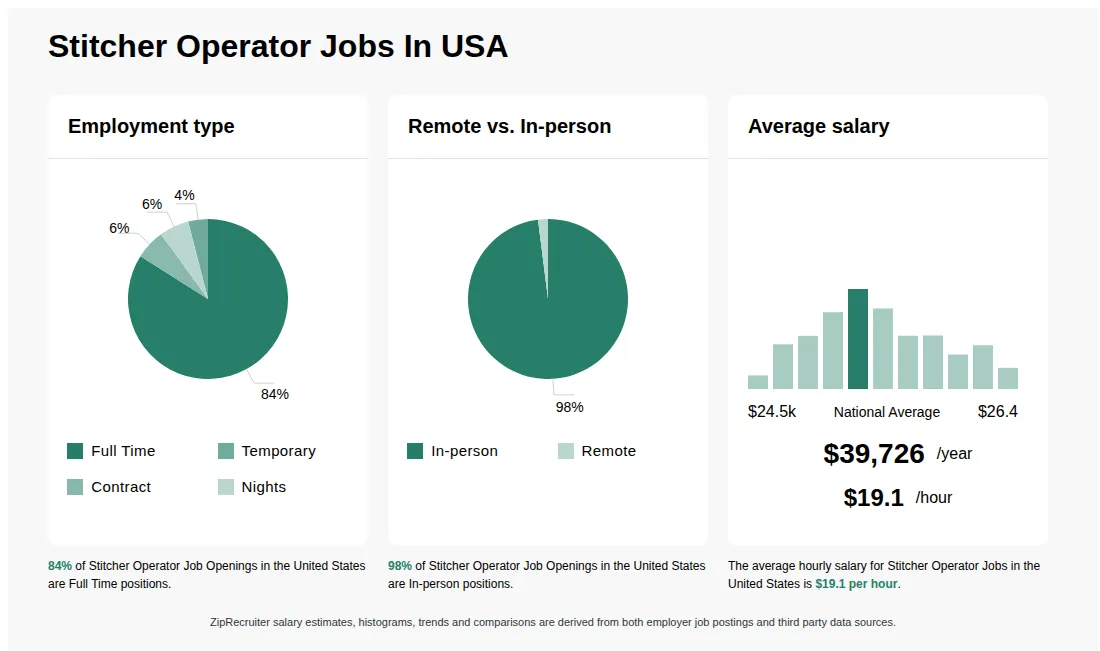
$11.78 - $13.11
2% of jobs
$13.11 - $14.44
7% of jobs
$14.44 - $15.78
9% of jobs
$16.37 is the 25th percentile. Wages below this are outliers.
$15.78 - $17.11
14% of jobs
The median wage is $18.40 / hr.
$17.11 - $18.44
18% of jobs
$18.44 - $19.78
15% of jobs
$19.78 - $21.11
9% of jobs
$21.15 is the 75th percentile. Wages above this are outliers.
$21.11 - $22.44
9% of jobs
$22.44 - $23.78
5% of jobs
$23.78 - $25.11
7% of jobs
$25.11 - $26.44
3% of jobs
$11
$19
$26
How much do stitcher operator jobs pay per hour?
As of Sep 5, 2026, the average hourly pay for stitcher operator in the United States is $19.10, according to ZipRecruiter salary data. Most workers in this role earn between $16.35 and $21.63 per hour, depending on experience, location, and employer.
What does a stitcher operator do?
A Stitcher Operator is responsible for operating and maintaining stitching machines used in the binding and finishing process of printed materials, such as books, magazines, and brochures. They set up the machine, load materials, monitor the production process, and troubleshoot any issues that arise to ensure products are properly stitched and meet quality standards. Stitcher Operators also perform routine maintenance on the machines and may adjust settings for different jobs based on client specifications.
What are the key skills and qualifications needed to thrive as a stitcher operator, and why are they important?
To thrive as a Stitcher Operator, you need a solid understanding of mechanical operations, attention to detail, and experience with bindery or finishing equipment, often supported by a high school diploma or equivalent. Familiarity with industrial stitcher machines, maintenance tools, and safety procedures is typically required. Strong problem-solving abilities, manual dexterity, and teamwork are key soft skills that help you excel in this role. These competencies are crucial for ensuring efficient, high-quality production and maintaining a safe work environment in print manufacturing settings.
What are some typical challenges a stitcher operator may face during a production run, and how can they be managed?
Stitcher Operators often encounter challenges such as machine jams, inconsistent stitching, or material feeding issues during production runs. Addressing these requires quick troubleshooting skills and a thorough understanding of the stitcher machine’s mechanics. Regular maintenance, keeping the machine clean, and promptly addressing minor issues help minimize downtime and maintain product quality. Operators also collaborate closely with quality control and maintenance teams to ensure smooth workflow and adherence to safety standards.
What is the difference between Stitcher Operator vs Sewing Machine Operator?
| Aspect | Stitcher Operator | Sewing Machine Operator |
|---|---|---|
| Required Credentials | High school diploma or equivalent; some certifications in sewing or textile work | High school diploma or equivalent; training in sewing techniques |
| Work Environment | Factories, textile plants, garment manufacturing facilities | Factories, apparel production, upholstery manufacturing |
| Industry Usage | Primarily in textile and garment industries | Wider use across apparel, upholstery, and industrial sewing |
The main difference between a Stitcher Operator and a Sewing Machine Operator lies in their specific roles. Stitcher Operators typically focus on sewing large sections or specific types of seams in textile production, often requiring specialized skills. Sewing Machine Operators may handle various sewing tasks across different products. Both roles require similar credentials and work in comparable environments, but Stitcher Operators usually work on more specialized or heavy-duty sewing equipment.
More about Stitcher Operator jobs
What states have the most Stitcher Operator jobs?
States with the most job openings for Stitcher Operator jobs include:
What job categories do people searching Stitcher Operator jobs look for?
The top searched job categories for Stitcher Operator jobs are:

Full-time, Other
Medical, Dental, Vision, Retirement, PTO
Posted 18 days ago
Job description
Machine Operator (We’ll Train You!) $2,500 Hiring Bonus
2nd Shifts | Monday–Friday | 3:00 PM – 11:00 PM
Full-Time | Competitive Pay + Overtime Opportunities
Schedule is Monday – Friday, 3:00 PM to 11:00 PM – 40 hours/week
- Overtime pays time and a half after 40 hours per week
- 2nd Shift pays an extra 8% shift incentive on hours worked!
- Eligible for $2,500 hiring bonus after 12 weeks!
Build Something You Can Hold in Your Hands
At Sheridan New Hampshire, your work doesn’t disappear into a spreadsheet—it becomes books, catalogs, and printed materials people use every day. If you’ve worked with machines, enjoy hands-on work, and take pride in quality, we’ll train you to run high-speed bindery equipment.
We’re hiring 4 team members ready to learn, grow, and build a long-term career in print manufacturing.
What You’ll Do
- Learn to operate and set up bindery equipment (cutters, folders, stitchers, and perfect binders)
- Keep machines running smoothly by making adjustments and monitoring quality
- Work as part of a team to hit daily production goals
- Inspect finished products to ensure they meet quality standards
- Troubleshoot minor issues and keep production moving
- Follow safety procedures and help maintain a clean, organized workspace
What We’re Looking For
No bindery experience? No problem—we’ll train you.
We’re looking for people who:
- Have experience operating machinery in any industry (manufacturing, warehouse, trades, etc.)
- Are mechanically inclined and comfortable using basic tools
- Can read basic job instructions and measurements (decimals, sizes, etc.)
- Take pride in doing quality work
- Show up reliably and work well with a team
It’s a plus if you have:
- Print, bindery, or finishing experience
- Experience setting up or adjusting production equipment
Physical & Work Environment
- On your feet for most of the shift
- Fast-paced, team-oriented production floor
- Lift up to 20 lbs. occasionally
Why Join Sheridan?
- Stable, full-time career with a growing company (part of CJK Group)
- Comprehensive benefits after 30 days (medical, dental, vision, 401k)
- Vacation time + holidays
- Overtime opportunities
- Referral bonuses & employee discounts
- Safety-first culture (PPE provided, shoe reimbursement)
- Real opportunity to learn skilled equipment and advance
About Us
Sheridan New Hampshire is part of the Sheridan Group, a leader in print manufacturing. We produce high-quality printed materials for publishers and organizations nationwide—and we invest in the people who make it happen.
Apply Today
If you’re ready to learn a skilled trade and build a career, we want to hear from you.
Sheridan is an Equal Opportunity employer. All qualified applicants will receive consideration for employment without regard to sex, gender identity, sexual orientation, race, color, religion, national origin, disability, protected Veteran status, age, or any other characteristic protected by law.
If you need assistance or a reasonable accommodation to apply for employment, please contact Michael, at