1

Statistical Programmer Jobs (NOW HIRING)

The Principal Statistical Programmer works with management to delegate tasks appropriately, track progress, and provide expert technical support to team members. In addition, the Principal ...

Act as primary programming contact for assigned studies, collaborating closely with statisticians, data managers, and medical writers in a fully remote, fast-paced environment.Conduct independent QC ...

Act as primary programming contact for assigned studies, collaborating closely with statisticians, data managers, and medical writers in a fully remote, fast-paced environment.Conduct independent QC ...

next page

Showing results 1-20

Statistical Programmer information

See salary details

$84.5K

$147.3K

$249K

How much do statistical programmer jobs pay per year?

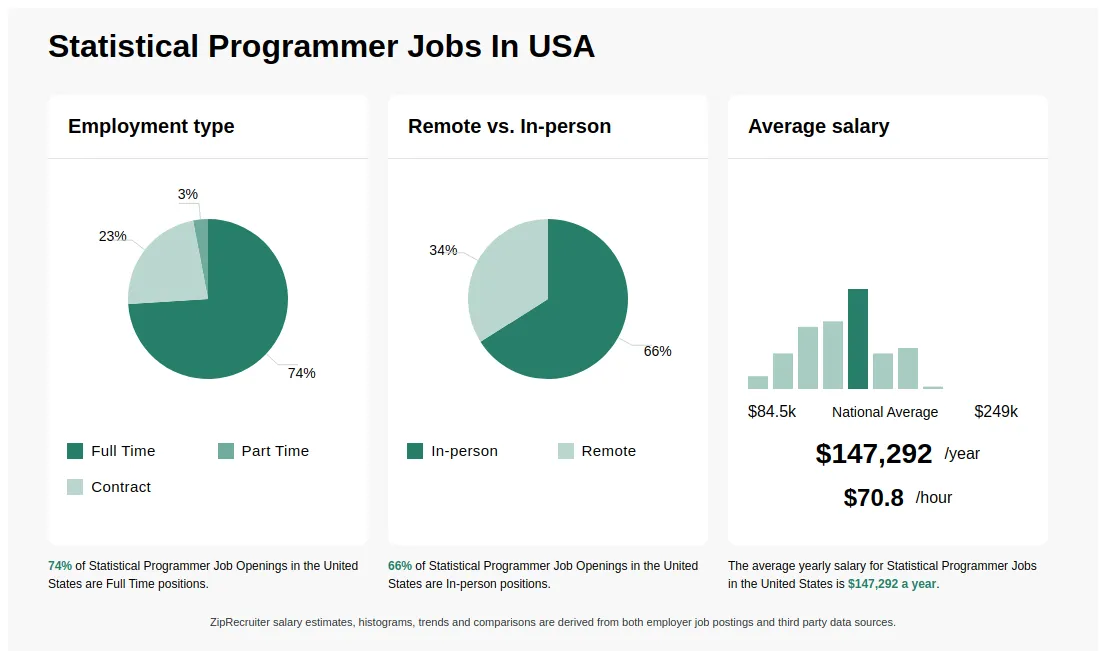
As of Jun 4, 2026, the average yearly pay for statistical programmer in the United States is $147,292.00, according to ZipRecruiter salary data. Most workers in this role earn between $125,000.00 and $160,000.00 per year, depending on experience, location, and employer.

What Does a Statistical Programmer Do?

A statistical programmer creates statistical programming deliverables. You ensure excellent programming of analysis-ready data, tables, and figures. You may use Stata for general purpose statistical analysis or SPSS for interactive or batched statistical analysis. Your responsibilities include developing standard operating procedures and complying with guidelines. Other duties include remaining informed on developments in programming standards and meeting all regulatory requirements. You also create PROC statements that call upon named procedures for analysis. You develop programs for dataset integration, prepare resource plans, and assist with quality control of datasets.

What are the key skills and qualifications needed to thrive as a Statistical Programmer, and why are they important?

To thrive as a Statistical Programmer, you need a strong background in statistics, data analysis, and programming—typically with a degree in statistics, mathematics, computer science, or a related field. Expertise in statistical software such as SAS, R, or Python and familiarity with data management systems like CDISC or SQL are often required, along with relevant certifications. Strong problem-solving abilities, attention to detail, and clear communication skills help you interpret data accurately and collaborate effectively with cross-functional teams. These skills ensure the delivery of high-quality, reproducible statistical analyses crucial for informed decision-making in research and industry settings.

What are some common challenges faced by Statistical Programmers when working on clinical trial data?

Statistical Programmers often encounter challenges such as managing large, complex datasets, ensuring data integrity, and adhering strictly to regulatory standards (like CDISC SDTM and ADaM). They must also collaborate closely with biostatisticians and data managers to accurately translate statistical analysis plans into code. Tight project timelines and shifting priorities can require strong organizational skills and adaptability. Effective communication and attention to detail are essential for navigating these challenges and delivering reliable results.

What are statistical programmers?

Statistical programmers are professionals who use statistical software and programming languages, such as SAS, R, or Python, to manage, analyze, and report data, often in clinical trials, public health, or research settings. They play a crucial role in transforming raw data into meaningful results by writing code for data cleaning, data manipulation, statistical analysis, and generating reports. Statistical programmers often work closely with statisticians, data managers, and researchers to ensure the accuracy and integrity of data analyses. Their work is essential in industries like pharmaceuticals, healthcare, and academia.

Is SAS a good career choice?

A career as a Statistical Programmer using SAS is in demand in industries such as pharmaceuticals, healthcare, and research, where data analysis and reporting are essential. Proficiency in SAS, along with knowledge of programming and statistical methods, can lead to stable employment and opportunities for advancement.

What is the difference between Statistical Programmer vs Data Analyst?

AspectStatistical ProgrammerData Analyst
Required CredentialsBachelor's in Statistics, Biostatistics, or related field; experience with SAS, R, or PythonBachelor's in Statistics, Data Science, or related field; proficiency in Excel, SQL, and visualization tools
Work EnvironmentPharmaceutical, clinical research, or healthcare industries; focus on programming and data managementVarious industries including finance, marketing, healthcare; focus on data interpretation and reporting
Employer & Industry UsageCommon in clinical trials, biotech, pharma companiesUsed across multiple sectors like finance, retail, and healthcare

While both roles handle data, Statistical Programmers primarily focus on programming and managing clinical or research data, whereas Data Analysts interpret data to generate insights across various industries. The roles often overlap in skills like statistical software proficiency but differ in their core responsibilities and industry focus.

What cities are hiring for Statistical Programmer jobs? Cities with the most Statistical Programmer job openings:
What are the most commonly searched types of Statistical Programmer jobs? The most popular types of Statistical Programmer jobs are:
Who are the top companies hiring for Statistical Programmer jobs? The top employers for Statistical Programmer jobs are:
What states have the most Statistical Programmer jobs? States with the most job openings for Statistical Programmer jobs include:
Infographic showing various Statistical Programmer job openings in the United States as of May 2026, with employment types broken down into 5% Internship, 90% Full Time, and 5% Contract. Highlights an 95% In-person, and 5% Remote job distribution, with an average salary of $147,292 per year, or $70.8 per hour.
Senior Statistical Programmer

Senior Statistical Programmer

Redbock - an NES Fircroft company

Manhattan, NY • Remote

$75 - $80/hr

Part-time

Medical, Vision, Retirement

This job post has expired today. Applications are no longer accepted.


Job description

Location: Remote, with flexibility to accommodate urgent deliverables during PT hours, if needed Pay rate: $75-80/hour W2; $80-88 C2C Summary: Our small Oncology client on the West Coast is seeking a Senior Statistical Programmer to support clinical trial submissions. This role will be responsible for SAS programming for SDTM, ADaM, and TLFs, support ISS/ISE and regulatory submissions (including BIMO), and collaborate closely with statisticians, lead programmers, and external vendors. This consultant will need to be comfortable working in a small‐team environment.

Primary Responsibilities: Develop SAS programs to generate and/or validate SDTM, ADaM & TLFs for analyzing clinical trials, supporting registrations, and creating reports for publications and other ad‐hoc analyses. Develop, validate and maintain macros and tools for general use within the Biometrics group to enhance the efficiency and quality of output produced. Draft and/or review data specifications for SDTM, ADaM & TLFs.

Interact with Lead Programmer & Statisticians on status updates, timelines and content of deliverables. Support ISS and NDA including BIMO (datasets, define, reviewers guide). Collaborate with external vendors on Biometrics' deliverables and provide quality oversight.

Experience Required: 10+ years of experience in statistical programming. Strong SAS programming skills, including expertise with CDISC (SDTM and ADaM) & TLF programming. Must have strong experience integrating ISS/ISE data.

Oncology therapeutic area expertise is required. Regulatory submission experience (NDA/BLA, BIMO). Ability to QC programming work from CROs.

Strong communication skills with the ability to interface at all levels & comfortable communicating workload to assist in managing priorities. Knowledge of R is a plus. Benefits: Medical insurance Vision insurance 401(k) Disability insurance #J-18808-Ljbffr