1

Robotics Automation Engineer Jobs (NOW HIRING)

Senior Robotics Automation Engineer

Coraopolis, PA ยท On-site

$99K - $130K/yr

Coy company has an immediate opening for a Senior Robotics Automation Engineer. Candidates will design and implement autonomy solutions across diverse robotic platforms, driving innovation in multi ...

Senior Robotics Automation Engineer

Coraopolis, PA ยท On-site

$99K - $130K/yr

Coy company has an immediate opening for a Senior Robotics Automation Engineer. Candidates will design and implement autonomy solutions across diverse robotic platforms, driving innovation in multi ...

next page

Showing results 1-20

Robotics Automation Engineer information

See salary details

$37K

$107.1K

$163K

How much do robotics automation engineer jobs pay per year?

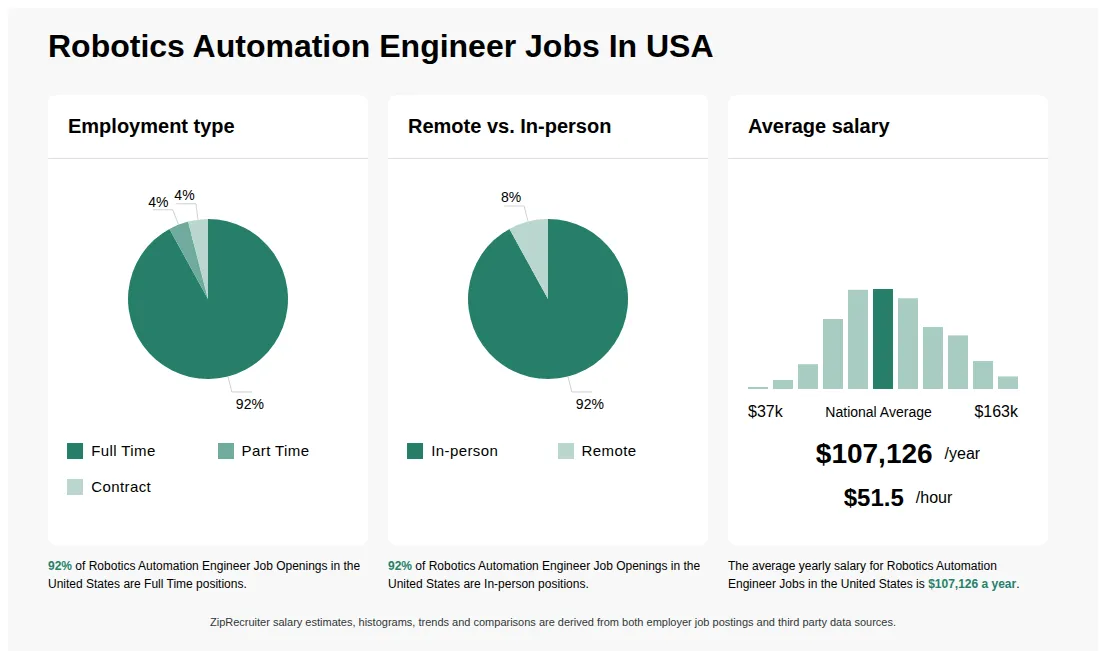
As of Jul 15, 2026, the average yearly pay for robotics automation engineer in the United States is $107,126.00, according to ZipRecruiter salary data. Most workers in this role earn between $86,500.00 and $123,500.00 per year, depending on experience, location, and employer.

What are the key skills and qualifications needed to thrive in the Robotics Automation Engineer position, and why are they important?

To thrive as a Robotics Automation Engineer, you need a strong background in mechanical, electrical, or software engineering, typically with a bachelor's degree or higher, and experience in robotics systems design and programming. Familiarity with PLC programming, robot programming languages (such as RAPID, KRL, or Fanuc TP), CAD software, and certifications like Siemens or FANUC can be valuable. Excellent problem-solving skills, teamwork, adaptability, and strong communication abilities set top candidates apart. These skills ensure you can design, implement, and refine automated systems efficiently while working effectively in multidisciplinary teams.

What does a Robotics Automation Engineer do?

A Robotics Automation Engineer designs, develops, and implements automated robotic systems to improve efficiency, precision, and safety in various industries. They work with hardware and software, integrating sensors, control systems, and AI to create smart machines. Their role involves programming, testing, troubleshooting, and optimizing robotic systems for tasks such as manufacturing, logistics, or healthcare.

What are some typical projects and daily tasks for a Robotics Automation Engineer?

Robotics Automation Engineers are frequently involved in designing, programming, and integrating robotic systems to automate manufacturing or industrial processes. Daily tasks can include programming robots for specific tasks, troubleshooting system issues, collaborating with cross-functional teams such as production and quality, and testing new automation solutions. Engineers also create documentation, provide technical support, and may participate in on-site installation and commissioning of robotic systems. This variety provides opportunities to develop a broad skill set and have a direct impact on operational efficiency.

What cities are hiring for Robotics Automation Engineer jobs? Cities with the most Robotics Automation Engineer job openings:
What are the most commonly searched types of Robotics Automation Engineer jobs? The most popular types of Robotics Automation Engineer jobs are:
What states have the most Robotics Automation Engineer jobs? States with the most job openings for Robotics Automation Engineer jobs include:
Infographic showing various Robotics Automation Engineer job openings in the United States as of July 2026, with employment types broken down into 95% Full Time, 2% Part Time, and 3% Contract. Highlights an 82% Physical, 5% Hybrid, and 13% Remote job distribution, with an average salary of $107,126 per year, or $51.5 per hour.
Senior Robotics Automation Engineer

Senior Robotics Automation Engineer

Daiichi Sankyo, Inc.

San Diego, CA โ€ข On-site

$110K - $144K/yr

Other

Posted 5 days ago

New


Job description

At Daiichi Sankyo, we are united by a single purpose, to improve lives around the world through innovative medicines. With a legacy of innovation since 1899, a presence in more than 30 countries, and more than 19,000 employees, we are advancing breakthrough therapies in oncology, cardiovascular disease, rare diseases, and immune disorders. Guided by our 2030 vision to "be an innovative global healthcare company contributing to the sustainable development of society", we are shaping a healthier, more hopeful future for patients, their families, and society. Job Summary The Senior Robotics Automation Engineer is a highly experienced technical leader responsible for advancing the design, integration, optimization, and long-term operational strategy of robotic and automated laboratory systems within the Smart Research Laboratory. This role requires deep expertise in laboratory automation, engineering principles, scientific workflows, and biopharma research operations, combined with the ability to influence technical direction, guide cross-functional decision-making, and mentor less experienced engineers and scientists. This individual will play a critical role in shaping automation strategy, evaluating emerging technologies, translating scientific needs into scalable automation solutions, and ensuring that robotic systems deliver reliable, precise, and high-quality performance in support of advanced drug discovery and research innovation. In addition to hands-on technical execution, the Senior Robotics Automation Engineer will provide strategic guidance on system architecture, workflow design, vendor selection, platform sustainability, risk mitigation, and continuous improvement of automated laboratory capabilities. The role requires regular on-site presence due to the highly integrated, hands-on nature of laboratory robotics, instrumentation, scientific equipment, and automation workcell operations. Job Description Responsibilities Lead the design, implementation, testing, optimization, and lifecycle management of complex robotic and automated laboratory workcells, including integrated hardware, software, instrumentation, scheduling, and control systems. Serve as a senior technical authority for laboratory automation platforms, providing expert guidance on system architecture, workflow design, equipment selection, integration strategy, operational scalability, and long-term platform reliability. Partner with scientific, engineering, informatics, facilities, IT, and operational stakeholders to translate complex research needs into robust, scalable, and sustainable automated solutions that improve laboratory productivity, data quality, reproducibility, and research throughput. Evaluate, integrate, configure, troubleshoot, and maintain advanced laboratory automation systems, including liquid handlers, dispensers, pipettors, plate movers, robotic arms, plate sealers and desealers, acoustic transfer devices, multimodal assay readers, incubators, storage systems, and related scientific instrumentation. Develop, review, and optimize automation methods using orchestration and instrument-control platforms such as Momentum, Venus, InstinctS, and related automation APIs, ensuring methods are reliable, maintainable, validated, and aligned with scientific requirements. Provide senior-level oversight for method development, hardware integration testing, system validation, risk assessment, troubleshooting, and performance optimization across automated laboratory workflows. Lead or significantly contribute to automation roadmap planning, technology assessments, vendor evaluations, equipment acquisition decisions, and strategic recommendations that shape the future capabilities of the Smart Research Laboratory. Collaborate with external vendors and internal stakeholders to implement advanced robotics capabilities, including motion planning, multi-axis actuation, control systems, autonomous mobile robotics, device communication, and integration of novel automation technologies. Guide the validation, deployment, and continuous improvement of Autonomous Mobile Robot systems and other emerging automation platforms, ensuring safe, reliable, and effective operation within a research laboratory environment. Mentor junior automation engineers, scientists, and cross-functional users by providing technical coaching, training, design review, troubleshooting support, and best-practice guidance for automated workflows and robotic systems. Establish and maintain high-quality technical documentation, including system designs, integration plans, validation records, risk assessments, maintenance procedures, troubleshooting guides, and workflow specifications. Lead complex problem-solving efforts in a fast-paced research environment, balancing immediate operational needs with long-term platform strategy, system sustainability, safety, and scientific impact. Drive continuous improvement initiatives that increase automation reliability, reduce operational bottlenecks, improve assay execution quality, and expand the organizationโ€™s ability to adopt advanced automated research capabilities. Qualifications Education Qualifications Bachelor's Degree in science, engineering, robotics, automation, computer science, life sciences or a related field required Advanced degree (M.S. or Ph.D.) is preferred Experience Qualifications Requires 5-7 years of hands-on experience designing, integrating, programming, validating, maintaining, and optimizing automated laboratory equipment, robotic systems, or complex scientific instrumentation in a research or biopharma environment Prior experience in biopharma, pharmaceutical, biotechnology, drug discovery, translational research, or advanced laboratory automation environment is required Demonstrated ability to lead technically complex automation projects from concept through implementation, including requirements gathering, design evaluation, vendor coordination, installation, integration, testing, validation, documentation, user training, and operational handoff. Advanced experience with laboratory automation platforms and orchestration software such as Hamilton Venus, Thermo Scientific Momentum, InstinctS, or comparable automation-control environments. Strong working knowledge of laboratory robotics, instrument communication, scheduling systems, device APIs, mechanical and electrical integration, liquid handling principles, assay workflow automation, and system-level troubleshooting. Experience developing or supporting software tools, scripts, APIs, or applications using modern programming languages such as Python, Java, C#, or comparable languages to improve automation performance, data handling, system monitoring, or workflow control. Proven ability to partner with scientific teams to identify high-value automation opportunities, evaluate technical feasibility, define requirements, and deliver solutions that support research quality, throughput, reproducibility, and innovation. Experience influencing technical decisions, guiding platform strategy, mentoring colleagues, and providing senior-level recommendations to scientific, operational, and leadership stakeholders. Daiichi Sankyo, Inc. is an equal opportunity/affirmative action employer. Qualified applicants will receive consideration for employment without regard to sex, gender identity, sexual orientation, race, color, religion, national origin, disability, protected veteran status, age, or any other characteristic protected by law. Salary Range: USD$136,080.00 - USD$204,120.00 Download Our Benefits Summary PDF