2

Remote Teacher Jobs (NOW HIRING)

Be Seen First

AIS is seeking certified Teachers of the Visually Impaired (TVIs) to join our team of independent contractors and provide remote services. TVIs serve as itinerant providers, partnering with local ...

next page

Showing results 1-20

Remote Teacher information

See salary details

$23K

$53.5K

$99.5K

How much do remote teacher jobs pay per year?

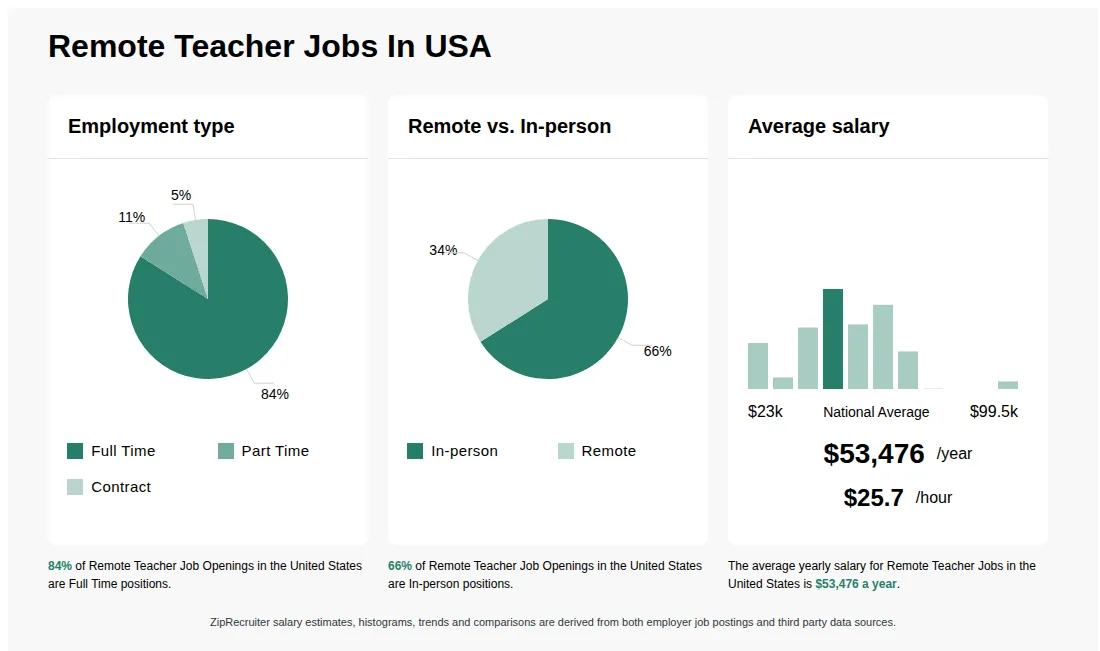
As of Jul 12, 2026, the average yearly pay for remote teacher in the United States is $53,476.00, according to ZipRecruiter salary data. Most workers in this role earn between $43,000.00 and $60,000.00 per year, depending on experience, location, and employer.

How to make an extra $1000 a month as a teacher?

Remote teachers can increase their income by offering private tutoring, creating online courses, or providing specialized lessons in high-demand subjects. Building a strong online presence and utilizing platforms like VIPKid or Teachable can help reach more students and generate additional income. Developing relevant skills and certifications can also enhance earning potential.

What are good remote jobs for teachers?

Remote teaching jobs include online classroom instruction, tutoring, curriculum development, and educational consulting. These roles often require strong communication skills, familiarity with digital learning platforms, and relevant teaching certifications. They offer flexible schedules and the ability to work from home across various education levels and subjects.

How can I make 2000 a week working from home?

Remote teachers can earn $2,000 or more per week by teaching high-demand subjects, working with multiple students or platforms, and maintaining a full schedule. Building a strong reputation, obtaining relevant certifications, and using online teaching tools can help increase earnings, but income varies based on experience, subject, and hours worked.

What are the key skills and qualifications needed to thrive as a Remote Teacher, and why are they important?

To thrive as a Remote Teacher, you need strong subject knowledge, teaching credentials, and experience with online pedagogy. Familiarity with virtual classroom platforms (like Zoom, Google Classroom), learning management systems, and digital content creation tools is essential. Outstanding communication, adaptability, and time management skills help foster student engagement and manage diverse learning needs remotely. These skills ensure effective instruction, student success, and smooth classroom operations in a virtual environment.

What is the difference between Remote Teacher vs Remote Tutor?

AspectRemote TeacherRemote Tutor
CredentialsTypically requires teaching certification or degree in educationMay require subject-specific expertise; certifications vary
Work EnvironmentUsually works with classrooms, schools, or educational institutions remotelyOften works one-on-one or in small groups, usually independently
Employer & IndustrySchools, online education platforms, districtsOnline tutoring companies, freelance platforms, private clients
Search & Comparison IntentLooking for formal teaching roles with curriculum deliverySeeking personalized, subject-specific assistance

Remote Teachers typically work within formal educational settings, delivering curriculum remotely, often requiring teaching credentials. Remote Tutors focus on personalized instruction, usually in specific subjects, and may not need formal teaching certifications. Both roles involve remote work but differ in scope, credentials, and work environment.

What is the 70/30 rule in teaching?

The 70/30 rule in teaching suggests that approximately 70% of instruction should involve active student engagement, such as discussions and hands-on activities, while about 30% involves direct teacher instruction. For remote teachers, balancing interactive methods with lecture can enhance student understanding and participation.

What are some common challenges faced by remote teachers, and how can they be managed effectively?

Remote teachers often encounter challenges such as keeping students engaged in a virtual setting, managing different time zones, and ensuring clear communication without in-person cues. To address these, it's important to incorporate interactive activities, utilize diverse digital tools, and establish clear expectations for participation. Regular check-ins and open communication channels with students and parents can also help foster a supportive learning environment, promoting both academic success and student well-being.

What is a remote teacher?

A remote teacher is an educator who instructs students from a distance, typically using digital platforms and online tools rather than teaching in a traditional classroom setting. They deliver lessons, assign work, and provide feedback using video conferencing software, learning management systems, and other online resources. Remote teachers may work with students of all ages and often adapt their teaching methods to suit virtual environments. This role requires strong communication skills, digital literacy, and the ability to engage students remotely.

What Do Remote Teachers Do?

Remote teachers have similar job duties as a classroom teacher--they instruct students in one or a variety of subjects, depending on their specialty. Specific job duties vary, depending on the grade they teach and the type of school or organization they work for. But the general responsibilities for remote teachers include developing lesson plans that engage students and help them to understand and retain important information, assign and correct homework, and give tests. Because remote teachers provide instruction through live streaming or website portals, many focus on a particular course or subject at a time, though they are able to teach different subjects at different times. For example, a work from home math teacher may teach a virtual course on geometry in the morning but teach algebra in an afternoon session.

What cities are hiring for Remote Teacher jobs? Cities with the most Remote Teacher job openings:
What are the most commonly searched types of Teacher jobs? The most popular types of Teacher jobs are:
Who are the top companies hiring for Remote Teacher jobs? The top employers for Remote Teacher jobs are:
What states have the most Remote Teacher jobs? States with the most job openings for Remote Teacher jobs include:
Infographic showing various Remote Teacher job openings in the United States as of July 2026, with employment types broken down into 38% Full Time, 56% Part Time, and 6% Contract. Highlights an 100% Remote job distribution, with an average salary of $53,476 per year, or $25.7 per hour.
Remote Language Arts Teacher (Part-Time)

Remote Language Arts Teacher (Part-Time)

Think Academy US

San Jose, CA • Remote

$35/hr

Part-time

Posted 22 days ago


Job description

Location: Remote

Job Type: Part-Time (20–30 hours/week, flexible schedule)

Intended Start Date: ASAP


About Think Academy

Think Academy Online is a leading education technology company dedicated to providing high-quality K–12 supplemental learning services through innovative digital instruction. We believe that inspired teaching, thoughtful curriculum, and carefully designed reading experiences empower students to grow academically and confidently. Our programs are designed with research-based pedagogy and delivered by experienced educators.

About This Role

We are seeking passionate English Language Arts Content Teachers to join our online teaching team. The ideal candidates are experienced with elementary English instruction (particularly in the U.S. public/private/charter school context), skilled at teaching Reading, Speaking, and Writing, and committed to nurturing English literacy in young learners. You will help deliver engaging live classes based on Think Academy's ELA curriculum.

Interested in learning more about Think Academy and our ELA programs? Visit our website here: https://www.thethinkacademy.com/english

As an ELA Remote Teacher at Think Academy, your responsibilities include:

  • Teach online ELA classes focusing on Reading & Speaking and Reading & Writing skills.
  • Prepare and deliver well-structured lessons using Think Academy's curriculum resources.
  • Actively engage and manage a virtual classroom of up to ~10 students.
  • Grade student work, provide timely feedback, and track student progress.
  • Communicate professionally with students and parents regarding learning goals and performance.
  • Participate in regular teacher training, curriculum discussions, and professional development.

What We're Looking For:

  • Native-level English speaker with excellent command of American English.
  • U.S. public/private/charter school ELA teaching experience preferred (1st–4th grade focus ideal).
  • Bachelor's degree (any field) required; Education/ELA/English majors preferred.
  • Strong understanding of elementary reading instruction, literacy development, and writing support.
  • Comfortable with online teaching technology and virtual classroom management.
  • Enthusiastic, student-centered, and able to inspire young learners.

Pay & Benefits Structure:

  • Base Pay: Starting from $35 USD per teaching hour.
    • Non-Teaching Fee: $16-20/hour; Includes class preparation and after-class services such as grading homework, replying to parent messages, periodically giving feedback, etc.
  • Retention Bonus: Teachers are eligible for a student retention bonus (performance-based incentive tied to class retention).
  • Additional compensation for lesson planning, training, and teacher development may apply.
  • Flexible schedule suited for educators seeking part-time online work.

Work Schedule:

  • Typically 20–30 hours per week, with classes often scheduled in afternoon/evening hours (U.S. time zones) and weekends.
  • Commitment to at least one full semester (Spring/Summer/Fall) preferred.

Think Academy is an equal opportunity employer. All qualified applicants will receive consideration for employment without regard to race, color, religion, sex, sexual orientation, gender identity, national origin, or protected veteran status and will not be discriminated against on the basis of disability.