2

Remote Hospital Patient Sitter Jobs (NOW HIRING)

$28/hr

This is not an accounts receivable, collections, denial management, payment posting, patient ... Hospital billing experience is required for consideration. Candidates must have experience and a ...

$28/hr

This is not an accounts receivable, collections, denial management, payment posting, patient ... Hospital billing experience is required for consideration. Candidates must have experience and a ...

Virtual Sitter Nights (On-Site)

Vincennes, IN · On-site +1

$13.25 - $16.25/hr

Maintain patient confidentiality and privacy at all times. Qualifications Minimum Qualifications ... Our hospital continues to adhere to the compassionate principles our facility was founded on and ...

Virtual Sitter Nights (On-Site)

Vincennes, IN · On-site +1

$13.25 - $16.25/hr

Maintain patient confidentiality and privacy at all times. Qualifications Minimum Qualifications ... Our hospital continues to adhere to the compassionate principles our facility was founded on and ...

... hospital networks, and health insurance providers. With Mobile Health, DocGo empowers the full ... Remote office work with prolonged periods sitting at a desk and working on a computer * Viewing ...

... hospital networks, and health insurance providers. With Mobile Health, DocGo empowers the full ... Remote office work with prolonged periods sitting at a desk and working on a computer * Viewing ...

next page

Showing results 1-20

Remote Hospital Patient Sitter information

See salary details

$7

$18

$25

How much do remote hospital patient sitter jobs pay per hour?

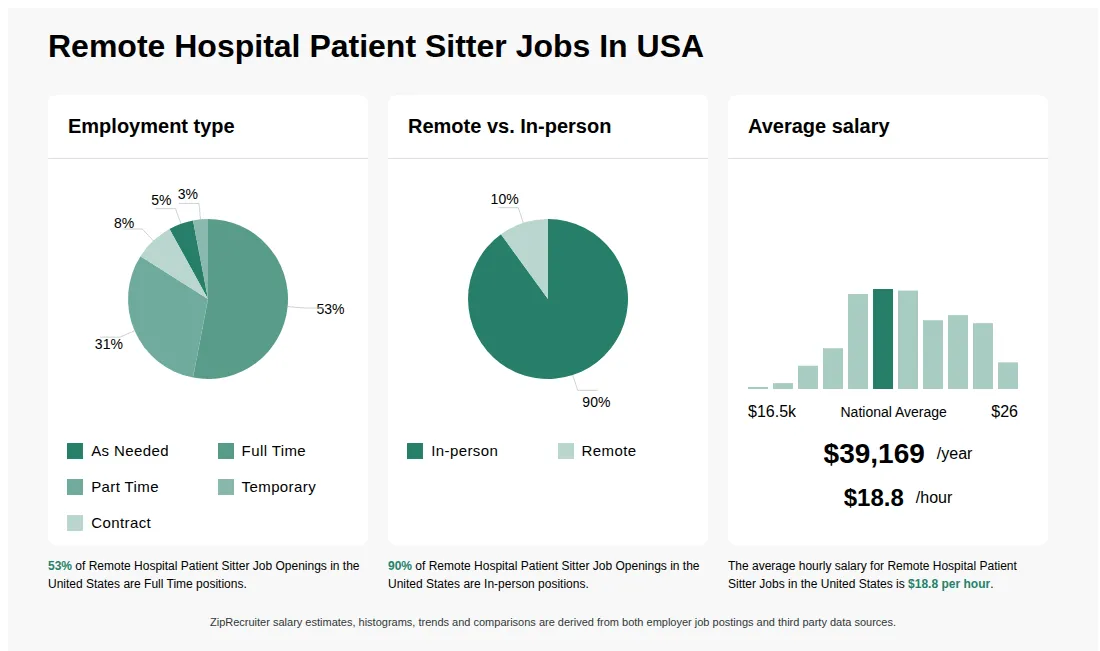
As of Aug 17, 2026, the average hourly pay for remote hospital patient sitter in the United States is $18.83, according to ZipRecruiter salary data. Most workers in this role earn between $15.38 and $21.88 per hour, depending on experience, location, and employer.

What is a remote hospital patient sitter?

A Remote Hospital Patient Sitter is a healthcare worker who monitors patients in a hospital setting using video and audio technology from a remote location. Their main role is to observe patients who may be at risk of falling, wandering, or needing immediate assistance, and alert on-site medical staff if intervention is necessary. This position helps ensure patient safety while allowing hospitals to efficiently use their resources. Remote patient sitters are trained to recognize signs of distress or emergencies and communicate effectively with the healthcare team. They play a crucial role in preventing accidents and ensuring quality care for vulnerable patients.

What are the key skills and qualifications needed to thrive as a remote hospital patient sitter?

To thrive as a Remote Hospital Patient Sitter, you need a strong attention to detail, basic understanding of patient care procedures, and often a high school diploma or equivalent. Familiarity with remote monitoring systems, video conferencing tools, and electronic documentation platforms is typically required. Excellent observation skills, clear communication, and dependability are essential soft skills for providing effective patient oversight and timely reporting. These abilities ensure patient safety, rapid response to incidents, and reliable support for healthcare teams in a virtual environment.

What are some common challenges faced by remote hospital patient sitters, and how can they be managed?

Remote hospital patient sitters often face challenges such as maintaining patient engagement and monitoring safety from a distance. Since observation is typically done via video or audio feeds, it can be difficult to interpret subtle changes in patient behavior or condition. Effective communication with on-site medical staff is essential, as is staying attentive throughout shifts. Utilizing checklists, staying organized, and promptly escalating any concerns to the healthcare team can help overcome these challenges and ensure patient safety.

What is the difference between Remote Hospital Patient Sitter vs Remote Hospital Nursing Assistant?

AspectRemote Hospital Patient SitterRemote Hospital Nursing Assistant
CredentialsMinimal; background in healthcare or caregiving preferredCertified Nursing Assistant (CNA) certification often required
Work EnvironmentRemote monitoring and patient engagement via telehealth platformsRemote or on-site patient care in hospital settings
Employer & Industry UsageHospitals, healthcare providers offering remote patient supervisionHospitals, clinics, healthcare facilities providing direct patient care

Remote Hospital Patient Sitters focus on remote supervision and engagement of patients, often with minimal credentials, while Remote Hospital Nursing Assistants typically require CNA certification and provide direct or remote patient care. Both roles support patient well-being but differ mainly in certification requirements and scope of care.

More about Remote Hospital Patient Sitter jobs

What cities are hiring for Remote Hospital Patient Sitter jobs?

Cities with the most Remote Hospital Patient Sitter job openings:

What are the most commonly searched types of Hospital Patient Sitter jobs?

The most popular types of Hospital Patient Sitter jobs are:

What states have the most Remote Hospital Patient Sitter jobs?

States with the most job openings for Remote Hospital Patient Sitter jobs include:

Infographic showing various Remote Hospital Patient Sitter job openings in the United States as of August 2026, with employment types broken down into 4% As Needed, 71% Full Time, 18% Part Time, and 7% Contract. Highlights an 97% Physical, 1% Hybrid, and 2% Remote job distribution, with an average salary of $39,169 per year, or $18.8 per hour.

Perm - Remote - Hospital Inpatient Coder OOJ

Hatch Global Search

Remote

$22.25 - $26.75/hr

Other

Re-posted 10 days ago


Job description

Perm - Remote - Hospital Inpatient Coder

As a permanent, remote Hospital Inpatient Coder, you will be responsible for accurately coding inpatient medical records, ensuring compliance with coding guidelines, and collaborating with healthcare professionals to maintain data integrity, all while working from home.

Essential Job Functions:

  • Assign ICD10CM and PCS codes to hospital inpatient visits
  • Reviews and analyzes the content of medical records and the autosuggested computer assisted codes (CAC) for the appropriate assignment of ICD diagnosis/procedure codes, present on admission indicators, hierarchical condition categories, complication and comorbidities in the proper sequence in accordance with official coding resources resulting in an accurate DRG assignment.
  • Meets 95% accuracy rate in audits
  • Maintains productivity of 2.75 charts per hour after release from training period.
  • Data Analysis- Hospital Inpatient Coding
  • Accurately reviews and codes patient records in the following clinical areas: hospital inpatient services.
  • Specialized Audit
  • Auditing the accuracy of the CAC software autosuggested codes.
  • Clinical Documentation Analysis 5
  • Reviews clinical documentation to validate accurate representation of the patient's clinical picture, treatment, and diagnoses. Identifies when documentation relevant to the coding process is missing, lacks specificity or is inconsistent and take steps to obtain the documentation.
  • Abstracting Data
  • Identifies and enters data elements for abstracting.
  • Coding Accuracy
  • Meets defined coding accuracy standards
  • Coding Productivity Meets defined coding productivity standards
  • Advanced Information Technology
  • Basic understanding of how natural language processing engine works
  • Subject Matter Expert- Coding
  • Applies broad guidelines to specific coding situations, independently utilizing discretion and a significant level of analytic ability.
  • Subject Matter Expert- Coding
  • Understands how diagnosis and procedure codes, and reimbursement methodologies are used to determine reimbursement, public reporting of outcomes, quality of patient care, financial modeling, strategic planning, and marketing.
  • Subject Matter Expert- Coding
  • Remains current with coding and industry changes through participation in educational opportunities to maintain coding credentials.
  • Subject Matter Expert- Hospital Inpatient Coding
  • Demonstrates a thorough knowledge of hospital inpatient coding

Qualifications

  • Must Have Skills/Experience:
  • Will NOT Consider candidates whose inpatient coding experience is not clearly stated on resume.
  • We need inpatient facility coders who code for hospital reimbursement. A key difference is that Profee Coders use CPT codes for reporting services or procedures performed by physicians, whereas we use ICD-10 PCS codes.
  • 2 years acute inpatient coding experience
  • Certified Coding Specialist credential (CCS)
  • or
  • Registered Health Information Technologist (RHIT)
  • or
  • Registered Health Information Administrator (RHIA)
  • Preferred Skillset/Experience:
  • Associate's degree in Health Information Management
  • Bachelor's degree in Health Information Management

Why is This a Great Opportunity

Great benefits!