2

Remote Editor Jobs in Chicago, IL (NOW HIRING)

Remote Job Overview We are seeking experienced Technical Writers to contribute to an AI benchmark ... Technical Editing * Acceptance Criteria & Rubric Development Preferred Qualifications * 2-4+ years ...

Role can be fully remote, but must work CST hours. * Candidates local to Chicago IL or Houston TX ... Classroom training, video, photo editing, eLearning, new-hire onboarding. Nothing is outsourced ...

Remote Job Overview We are seeking experienced Autodesk Fusion 360 Specialists to contribute their ... D model editing and 10+ years for complex model creation. * Experience with assembly-level ...

Data Journalist

Chicago, IL · On-site +1

$60K - $65K/yr

Close attention to detail and strong editing skills * Proven ability to generate creative ideas that attract attention online Suggested Skills * Experience working and collaborating in a 100% remote ...

Close attention to detail and strong editing skills * Proven ability to generate creative ideas that attract attention online Suggested Skills * Experience working and collaborating in a 100% remote ...

Corporate Counsel (Remote)

Chicago, IL · On-site +1

$15K - $200K/yr

Remote or Hybrid in Chicago Key Responsibilities * Your primary focus will be assisting with ... Editing. Negotiating. Explaining. Advising. Collaborating. The Legal Team handles complex ...

Corporate Counsel (Remote)

Chicago, IL · On-site +1

$15K - $200K/yr

Remote or Hybrid in Chicago Key Responsibilities * Your primary focus will be assisting with ... Editing. Negotiating. Explaining. Advising. Collaborating. The Legal Team handles complex ...

Corporate Counsel (Remote)

Chicago, IL · On-site +1

$15K - $200K/yr

Remote or Hybrid in Chicago Key Responsibilities * Your primary focus will be assisting with ... Editing. Negotiating. Explaining. Advising. Collaborating. The Legal Team handles complex ...

Proficient with Keynote and remote research software Bonus points for: * Experience with video editing (Final Cut, Adobe Premiere and After Effects), Figma, and/or visual storytelling preferred.

This is an hourly paid, fully remote contractor role with flexible work‐from‐anywhere hours ... Native or near‐native Hebrew proficiency with strong writing and editing skills across formal and ...

Showing results 41-60

Remote Editor information

See Chicago, IL salary details

$36.6K

$66K

$110.3K

How much do remote editor jobs pay per year?

As of Sep 4, 2026, the average yearly pay for remote editor in Chicago, IL is $66,014.00, according to ZipRecruiter salary data. Most workers in this role earn between $51,500.00 and $74,700.00 per year, depending on experience, location, and employer.

What is a remote editor?

Remote Editors are professionals who review, revise, and improve written content from a remote location, usually working online rather than in a traditional office setting. Their tasks include checking for grammar, spelling, punctuation, clarity, and consistency in various types of documents such as articles, books, reports, and marketing materials. They often collaborate with writers, publishers, or content teams via digital communication tools. Remote Editors need strong language skills, attention to detail, and proficiency with editing software. This flexible work arrangement allows them to serve clients from anywhere in the world.

What does a remote editor do?

A remote editor’s job is to improve written communication for their employer. Unlike in-house editors, remote editors work from home or another location outside the office. Remote editors work on all types of written formats, such as books, articles, websites, corporate publications, training manuals, legal documents, and scientific papers. The specific tasks of an editor include correcting spelling, grammar, and punctuation errors; fact-checking; and rewriting unclear sentences. Background knowledge in the subject matter of the materials is essential for an editor to be able to take what was written and make it clear, organized, and appropriate for the target audience.

What are the key skills and qualifications needed to thrive as a remote editor?

To thrive as a Remote Editor, you need strong language proficiency, attention to detail, and experience with editing standards, often supported by a degree in English, journalism, or a related field. Familiarity with editing software such as Microsoft Word, Google Docs, and content management systems (CMS) is commonly required. Excellent communication, time management, and self-motivation are important soft skills for managing deadlines and collaborating virtually. These skills ensure high-quality, error-free content and effective teamwork in a remote work environment.

What are some common challenges faced by remote editors, and how can they be managed effectively?

Remote editors often encounter challenges such as coordinating with writers and other team members across different time zones, maintaining clear communication, and managing multiple projects simultaneously. To address these challenges, it’s important to establish regular check-ins, use collaborative editing tools, and set clear expectations regarding deadlines and feedback. Proactive communication and strong organizational skills are key to ensuring projects stay on track and maintaining a positive workflow in a remote environment.

What is the difference between Remote Editor vs Remote Content Writer?

AspectRemote EditorRemote Content Writer
Primary RoleReviewing, editing, and refining content for clarity, accuracy, and styleCreating original content such as articles, blog posts, and marketing copy
Required SkillsStrong editing, grammar, and language skills; attention to detailExcellent writing, research, and creativity skills
Work EnvironmentTypically collaborates with writers and publishers remotelyWorks independently to produce content for websites, blogs, or clients
Common UsageUsed by publishing houses, media companies, and content agenciesUsed by marketing firms, blogs, and online publishers

Remote Editors focus on refining and improving existing content, ensuring quality and consistency. Remote Content Writers create original content from scratch. Both roles often work remotely and require strong language skills, but their core responsibilities differ significantly.

How much do remote editors make?

Remote editors typically earn between $20 and $50 per hour, with annual salaries ranging from approximately $40,000 to $100,000 depending on experience, specialization, and the complexity of editing tasks. Many remote editing roles require strong language skills, attention to detail, and proficiency with editing software or content management systems.

What are the most commonly searched types of Editor jobs in Chicago, IL?

The most popular types of Editor jobs in Chicago, IL are:

What are popular job titles related to Remote Editor jobs in Chicago, IL?

For Remote Editor jobs in Chicago, IL, the most frequently searched job titles are:

What job categories do people searching Remote Editor jobs in Chicago, IL look for?

The top searched job categories for Remote Editor jobs in Chicago, IL are:

What cities near Chicago, IL are hiring for Remote Editor jobs?

Cities near Chicago, IL with the most Remote Editor job openings:

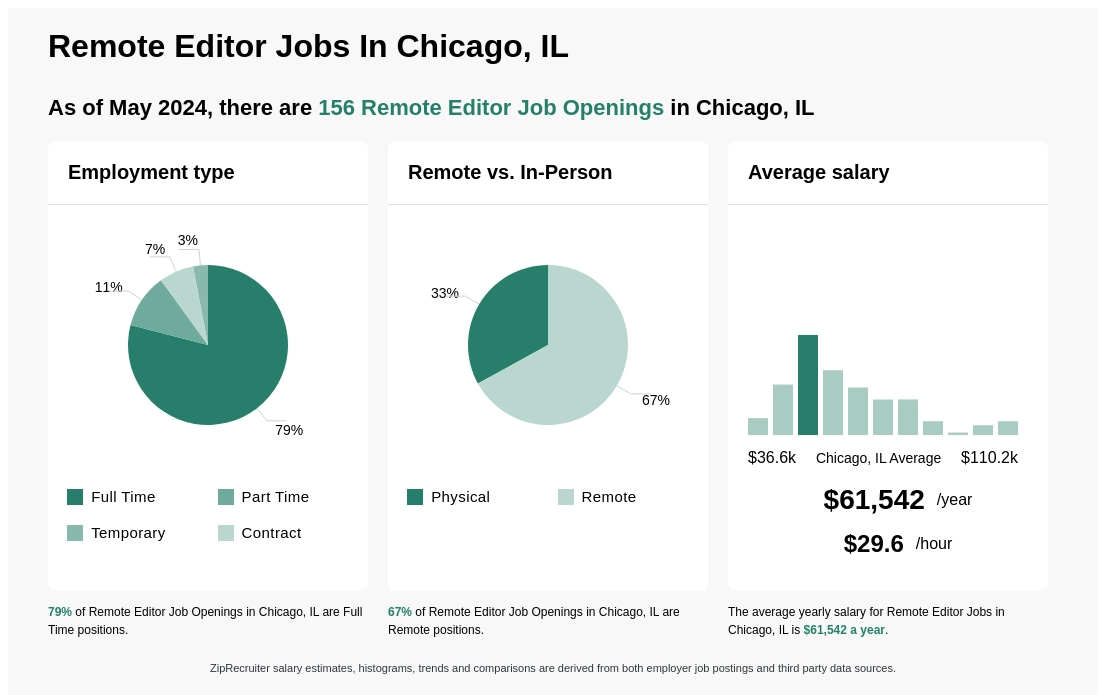
Infographic showing various Remote Editor job openings in Chicago, IL as of August 2026, with employment types broken down into 66% Full Time, 18% Part Time, 3% Temporary, and 13% Contract. Highlights an 100% Remote job distribution, with an average salary of $66,014 per year, or $31.7 per hour.

Technical Writer - Remote

YO AI Labs

Chicago, IL • Remote

$30 - $60/hr

Full-time

Posted 11 days ago


Job description

Technical Writer

Job Type: Contractor
Location: Remote

Job Overview

We are seeking experienced Technical Writers to contribute to an AI benchmark project. You will use your technical writing expertise to create realistic evaluation tasks, develop source materials, and assess AI-generated outputs for accuracy, clarity, and audience alignment.

No prior AI experience is required.

Key Responsibilities
  • Design realistic technical evaluation tasks using CSVs, PDFs, spreadsheets, code samples, and technical documents.
  • Create and curate source materials such as product specifications, SME notes, regulatory documents, and technical references.
  • Define expected solutions, acceptance criteria, and output requirements.
  • Develop detailed 35+ point grading rubrics covering accuracy, precision, testability, and audience alignment.
  • Create documentation tasks including API references, user guides, technical instructions, and compliance documents.
  • Synthesize complex source material into clear, precise, and actionable documentation.
  • Collaborate asynchronously with project teams to refine deliverables.
Required Skills
  • Precision Writing
  • Source Synthesis
  • Audience Calibration
  • Technical Writing
  • Structured Authoring
  • Documentation
  • Analytical Reasoning
  • Technical Editing
  • Acceptance Criteria & Rubric Development
Preferred Qualifications
  • 2–4+ years of technical writing experience with a portfolio in software, hardware, medical devices, or regulated industries.
  • Strong ability to create precise, testable technical documentation and instructions.
  • Experience with style guides, structured authoring, and documentation toolchains.
  • Exceptional written English with the ability to adapt tone and technical depth for different audiences.
  • Strong analytical and synthesis skills.
  • Experience creating acceptance criteria or evaluation rubrics is a plus.
  • Familiarity with technical benchmarking or evaluation methodologies is desirable.
Compensation & Availability

Compensation is output-based, with payment per approved task. Minimum weekly submission requirements apply.

Selected experts should be ready to begin their first tasks within 24–48 hours of completing onboarding. Roles are typically filled within 48 hours.

Screening Questions
  1. How many years of technical writing experience do you have?
  2. What industries have you written technical documentation for?
  3. Can you share examples of technical documentation you have created?
  4. What experience do you have with structured authoring and documentation toolchains?
  5. Have you created acceptance criteria or evaluation rubrics?
  6. How do you adapt technical content for different audiences?
  7. Are you comfortable working with PDFs, spreadsheets, CSVs, and other technical source materials?
  8. How soon can you start?