
Analyzing and monitoring workflows, providing documentation and optimization suggestions * Leading ... PathNet General Lab, PathNet Blood Bank, PathNet Anatomic Pathology, PathNet Microbiology, PathNet ...
Analyzing and monitoring workflows, providing documentation and optimization suggestions * Leading ... PathNet General Lab, PathNet Blood Bank, PathNet Anatomic Pathology, PathNet Microbiology, PathNet ...

Cerner Revenue Cycle Rules Consultant
Orchard Park, NY · Remote
$90/hr
This will also be fully remote and done on an ad hoc, as-needed basis. Job Expectations: * Deliver ... Provide hands-on, activity-based education for analysts with back-to-basics focus. * Develop best ...
Quick apply
Cerner Revenue Cycle Rules Consultant
Orchard Park, NY · Remote
$90/hr
This will also be fully remote and done on an ad hoc, as-needed basis. Job Expectations: * Deliver ... Provide hands-on, activity-based education for analysts with back-to-basics focus. * Develop best ...
Cerner Revenue Cycle Rules Consultant
Orchard Park, NY · Remote
$90/hr
This will also be fully remote and done on an ad hoc, as-needed basis. Job Expectations: * Deliver ... Provide hands-on, activity-based education for analysts with back-to-basics focus. * Develop best ...
Quick apply
Cerner Revenue Cycle Rules Consultant
Orchard Park, NY · Remote
$90/hr
This will also be fully remote and done on an ad hoc, as-needed basis. Job Expectations: * Deliver ... Provide hands-on, activity-based education for analysts with back-to-basics focus. * Develop best ...

JOB SUMMARY: Experienced Epic or Cerner Charge Capture Analyst to support hospitals. This ... This is a remote position - US only ESSENTIAL DUTIES AND RESPONSIBILITIES: Note: The essential ...
JOB SUMMARY: Experienced Epic or Cerner Charge Capture Analyst to support hospitals. This ... This is a remote position - US only ESSENTIAL DUTIES AND RESPONSIBILITIES: Note: The essential ...
JOB SUMMARY: Experienced Epic or Cerner Charge Capture Analyst to support hospitals. This ... This is a remote position - US only ESSENTIAL DUTIES AND RESPONSIBILITIES: Note: The essential ...
JOB SUMMARY: Experienced Epic or Cerner Charge Capture Analyst to support hospitals. This ... This is a remote position - US only ESSENTIAL DUTIES AND RESPONSIBILITIES: Note: The essential ...

Systems Analyst 3 Location: 4601 W Gudalupe St, Austin, Texas 78751. - Remote Description of ... within Cerner Millennium environments. 4. Perform complex data extraction, validation, and ...
Systems Analyst 3 Location: 4601 W Gudalupe St, Austin, Texas 78751. - Remote Description of ... within Cerner Millennium environments. 4. Perform complex data extraction, validation, and ...

Remote - United States I. DESCRIPTION OF SERVICES Understands business objectives and problems ... The Cerner Millennium CCL and Data Transformation Lead will support Electronic Health Record ( EHR ...
Quick apply
Remote - United States I. DESCRIPTION OF SERVICES Understands business objectives and problems ... The Cerner Millennium CCL and Data Transformation Lead will support Electronic Health Record ( EHR ...

Systems Analyst 1699R
Austin, TX · On-site +1
Job Details The Health and Human Services Commission (HHSC) requires the services of one (1) Cerner ... Position will be remote. Program will allow candidates who are any location within the United ...
Systems Analyst 1699R
Austin, TX · On-site +1
Job Details The Health and Human Services Commission (HHSC) requires the services of one (1) Cerner ... Position will be remote. Program will allow candidates who are any location within the United ...
Systems Analyst 3 (529601699R)
Austin, TX · On-site +1
Remote - United States I. DESCRIPTION OF SERVICES Understands business objectives and problems ... The Cerner Millennium CCL and Data Transformation Lead will support Electronic Health Record ( EHR ...
Systems Analyst 3 (529601699R)
Austin, TX · On-site +1
Remote - United States I. DESCRIPTION OF SERVICES Understands business objectives and problems ... The Cerner Millennium CCL and Data Transformation Lead will support Electronic Health Record ( EHR ...
Remote - United States I. DESCRIPTION OF SERVICES Understands business objectives and problems ... The Cerner Millennium CCL and Data Transformation Lead will support Electronic Health Record ( EHR ...
Remote - United States I. DESCRIPTION OF SERVICES Understands business objectives and problems ... The Cerner Millennium CCL and Data Transformation Lead will support Electronic Health Record ( EHR ...
Systems Analyst 1699
Austin, TX · On-site +1
Job Details The Health and Human Services Commission (HHSC) requires the services of one (1) Cerner ... Position will be remote. Program will allow candidates who are any location within the United ...
Systems Analyst 1699
Austin, TX · On-site +1
Job Details The Health and Human Services Commission (HHSC) requires the services of one (1) Cerner ... Position will be remote. Program will allow candidates who are any location within the United ...

Support Analyst (Triage)
WV · On-site +1
$82K - $111K/yr
This position is fully remote! HOW ASUPPORT ANALYST (TRIAGE) WILL MAKE AN IMPACT: * Play a critical role in maintaining the stability and usability of the PATH (Oracle Cerner Millennium) environment ...
Support Analyst (Triage)
WV · On-site +1
$82K - $111K/yr
This position is fully remote! HOW ASUPPORT ANALYST (TRIAGE) WILL MAKE AN IMPACT: * Play a critical role in maintaining the stability and usability of the PATH (Oracle Cerner Millennium) environment ...

Revenue Cycle Billing Analyst
Saint Paul, MN · Remote
$92K - $138K/yr
... Cerner), along with a range of clinical systems. Hours: Monday through Friday, between 7:00 a.m ... This is a primarily remote position with occasional onsite meetings or project work in St. Paul, MN ...
Revenue Cycle Billing Analyst
Saint Paul, MN · Remote
$92K - $138K/yr
... Cerner), along with a range of clinical systems. Hours: Monday through Friday, between 7:00 a.m ... This is a primarily remote position with occasional onsite meetings or project work in St. Paul, MN ...
Revenue Cycle Billing Analyst
Saint Paul, MN · Remote
$92K - $138K/yr
... Cerner), along with a range of clinical systems. Hours: Monday through Friday, between 7:00 a.m ... This is a primarily remote position with occasional onsite meetings or project work in St. Paul, MN ...
Revenue Cycle Billing Analyst
Saint Paul, MN · Remote
$92K - $138K/yr
... Cerner), along with a range of clinical systems. Hours: Monday through Friday, between 7:00 a.m ... This is a primarily remote position with occasional onsite meetings or project work in St. Paul, MN ...

EHRM Operations Support Analyst (Remote Opportunity)
$85K - $95K/yr
Mind Computing is seeking a full-time, 100% remote EHRM Operations Support Analyst to support a ... Experience supporting Oracle Health/Cerner EHRM implementations. * Experience with Mirth Connect ...
EHRM Operations Support Analyst (Remote Opportunity)
$85K - $95K/yr
Mind Computing is seeking a full-time, 100% remote EHRM Operations Support Analyst to support a ... Experience supporting Oracle Health/Cerner EHRM implementations. * Experience with Mirth Connect ...
DBHDS - Data Analyst 4 Location: 1220 Bank Street Richmond Virginia - Remote 100% Remote role but ... Cerner/Oracle Millennium, AVATAR) Nice to have
DBHDS - Data Analyst 4 Location: 1220 Bank Street Richmond Virginia - Remote 100% Remote role but ... Cerner/Oracle Millennium, AVATAR) Nice to have

Manager, Laboratory Services (Information Systems) - Clinical Lab - Full Time 8 Hour Days (Exempt) (
Los Angeles, CA · On-site +1
Req Excellent analytical, problem-solving, planning and evaluation skills. * Req Demonstrates ... Pref Familiarity with HL7, SQL, Co-path, PowerChart, PathNet, and Cerner strongly recommended.
Manager, Laboratory Services (Information Systems) - Clinical Lab - Full Time 8 Hour Days (Exempt) (
Los Angeles, CA · On-site +1
Req Excellent analytical, problem-solving, planning and evaluation skills. * Req Demonstrates ... Pref Familiarity with HL7, SQL, Co-path, PowerChart, PathNet, and Cerner strongly recommended.
Clinical Coding Analyst
Roseville, CA · Remote
$100K - $110K/yr
Clinical Coding Analyst Fully Remote (United States) Direct Hire, $100,000 to $110,000 Our client ... EHR experience (Cerner, Meditech, Epic, or similar). * Prior experience working fully remote.
Quick apply
Clinical Coding Analyst
Roseville, CA · Remote
$100K - $110K/yr
Clinical Coding Analyst Fully Remote (United States) Direct Hire, $100,000 to $110,000 Our client ... EHR experience (Cerner, Meditech, Epic, or similar). * Prior experience working fully remote.

Healthcare Revenue Integrity Analyst - Edits & Charge Capture | Remote | Contract Schedule: Monday ... Experience with Epic Resolute, Epic Revenue Integrity, Cerner, Meditech, or similar hospital ...
Healthcare Revenue Integrity Analyst - Edits & Charge Capture | Remote | Contract Schedule: Monday ... Experience with Epic Resolute, Epic Revenue Integrity, Cerner, Meditech, or similar hospital ...

New York, NY - Remote Let's create our future together at The AES Group! About The AES Group The ... Experience implementing Epic with Sunquest LIS required, Cerner and SofLab LIS a plus Key ...
Quick apply
New York, NY - Remote Let's create our future together at The AES Group! About The AES Group The ... Experience implementing Epic with Sunquest LIS required, Cerner and SofLab LIS a plus Key ...
Remote Cerner Pathnet Analyst information
See salary details
$49K - $55.8K
10% of jobs
$62.1K is the 25th percentile. Wages below this are outliers.
$55.8K - $62.5K
16% of jobs
$62.5K - $69.3K
3% of jobs
$69.3K - $76.1K
8% of jobs
$76.1K - $82.9K
5% of jobs
The median wage is $89.6K / yr.
$82.9K - $89.6K
7% of jobs
$89.6K - $96.4K
5% of jobs
$100.2K is the 75th percentile. Wages above this are outliers.
$96.4K - $103.2K
35% of jobs
$103.2K - $110K
3% of jobs
$110K - $116.7K
2% of jobs
$116.7K - $123.5K
4% of jobs
$49K
$88.6K
$123.5K
How much do remote cerner pathnet analyst jobs pay per year?
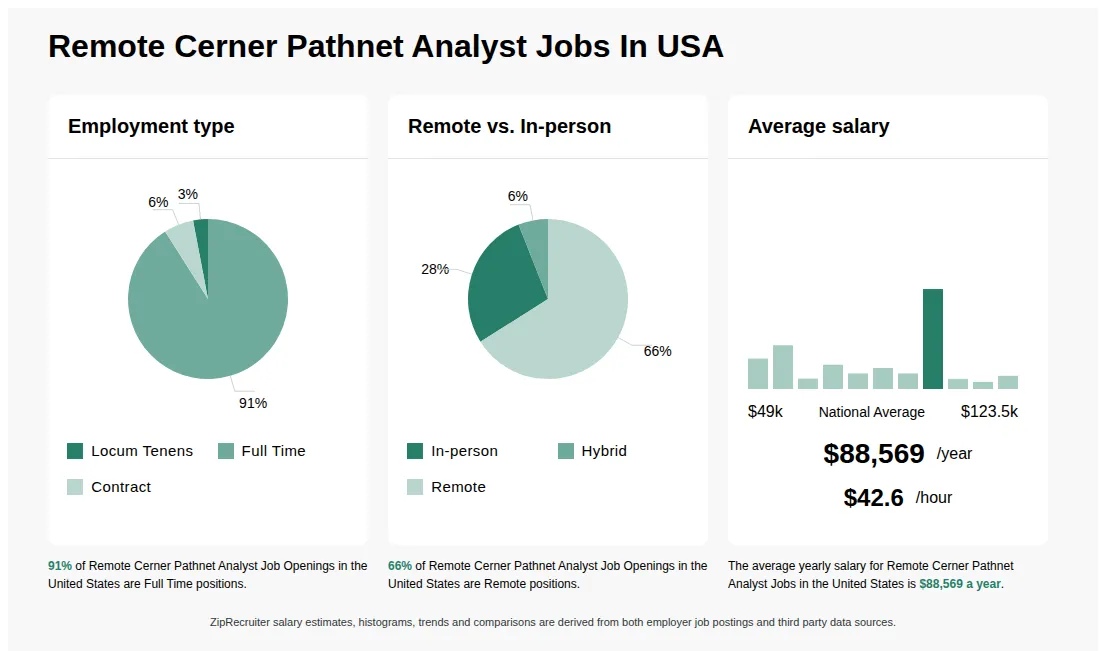
As of Sep 5, 2026, the average yearly pay for remote cerner pathnet analyst in the United States is $88,569.00, according to ZipRecruiter salary data. Most workers in this role earn between $64,000.00 and $99,500.00 per year, depending on experience, location, and employer.
What is a Remote Cerner Pathnet Analyst?
A Remote Cerner Pathnet Analyst is a healthcare IT professional who supports and optimizes the Cerner PathNet laboratory information system while working remotely. They assist with system configuration, troubleshooting, and workflow enhancements to improve laboratory operations. Their role often involves collaborating with medical staff, IT teams, and lab personnel to ensure accurate data processing and compliance with healthcare regulations. Additionally, they may provide user training and technical support to resolve issues efficiently.
What are the key skills and qualifications needed to thrive as a Remote Cerner Pathnet Analyst?
To thrive as a Remote Cerner Pathnet Analyst, you need a robust understanding of laboratory information systems, clinical workflows, and troubleshooting, typically backed by a degree in health informatics or a related field. Familiarity with the Cerner Pathnet system, HL7 messaging, and certifications such as Cerner Certified Professional are commonly expected. Excellent problem-solving abilities, strong communication skills, and an aptitude for remote collaboration help analysts excel in this position. These competencies ensure efficient system support, seamless teamwork, and successful adaptation to rapidly evolving healthcare technology needs.
What are some common challenges faced by Remote Cerner Pathnet Analysts, and how do they overcome them?
Remote Cerner Pathnet Analysts often encounter challenges such as troubleshooting complex laboratory interface issues and ensuring accurate configuration for diverse medical workflows across different facilities. Working remotely can also make it harder to communicate complex issues quickly with onsite staff or to stay updated on day-to-day laboratory operations. Successful analysts overcome these obstacles by leveraging strong documentation practices, utilizing collaborative communication tools, and maintaining proactive relationships with both technical teams and end users. Organizations typically provide access to robust remote support environments and encourage ongoing professional development to ensure analysts can address challenges efficiently.
More about Remote Cerner Pathnet Analyst jobs
What cities are hiring for Remote Cerner Pathnet Analyst jobs?
Cities with the most Remote Cerner Pathnet Analyst job openings:
What are the most commonly searched types of Cerner Pathnet Analyst jobs?
The most popular types of Cerner Pathnet Analyst jobs are:
What states have the most Remote Cerner Pathnet Analyst jobs?
States with the most job openings for Remote Cerner Pathnet Analyst jobs include:
What job categories do people searching Remote Cerner Pathnet Analyst jobs look for?
The top searched job categories for Remote Cerner Pathnet Analyst jobs are:
Key responsibilities
Guide clients through workflows, system changes, upgrades, and ongoing system maintenance.
Troubleshoot, consult, and transfer knowledge related to Oracle Health solutions during client engagements.
Support, configure, upgrade, maintain, and test Oracle Health applications and new technologies.
Job description
Make a difference. Be happy. Grow your career.
Senior Consultant - Oracle Health Lab Solutions
The Senior Consultant provides consulting services to clients on Oracle Health-related projects. You will provide subject matter expertise during client engagements to deliver solutions to achieve defined benefits. Your specific responsibilities may include, but are not limited to: guiding clients through current workflows, upgrades, system changes and enhancements, and ongoing system maintenance; acting as consultant for the client's solution including troubleshooting, consultation, and knowledge transfer; cultivating and sustaining relationships with clients to provide the appropriate escalation of issues, solution knowledge, and engagement support; resolving escalated problems and issues using solution knowledge and expertise; addressing complex client concerns raised during installation, operation, maintenance, or solution application; performing test script execution; and creating and participating in unit and integrated testing.
Key Responsibilities
The Senior Consultant will perform Oracle Health-related consulting and optimization of information technology services for Nordic clients, including, but not limited to
Applying technical expertise to individual client system's builds in order to identify, troubleshoot, and resolve problems
Serving as a subject matter expert in their Oracle domain area(s)
Mentoring client project teams as necessary in project and system build strategy
Tracking and documenting work performed and adhering to status reporting expectations as requested
Working closely with project leadership on documentation of issues and facilitation of solutions
Analyzing and monitoring workflows, providing documentation and optimization suggestions
Leading meetings regarding project status and ongoing work product coordination
Additional specific duties related to the project as may be required and dictated by individual clients; these duties are documented on a per-contract basis in the client's statement of work
Supporting, configuring, upgrading, maintaining, and implementing new and existing business or clinical applications
Responsible for engaging in evaluation and testing of new technologies with emphasis on interoperability
Working with the client's cross-functional internal IT teams and vendors to troubleshoot technical and functional issues to resolution
Ensuring system changes follow change management procedures and protocols, creating and maintaining all documentation for all assigned applications, and developing, planning, and executing testing for supported applications
Utilizing business knowledge to identify opportunities for improvement of existing and/or new information technology that will drive value for clients
Maintaining strong communications with project leader, manager, and team leader as well as other team and staff members, end-users, and vendors to ensure a productive and cooperative environment
May be invited to attend corporate functions as a representative of the company to meet prospective consultants as well as solidify relationships with clients and Nordic co-workers
Working on business operations projects that may be assigned on an ad hoc basis and may assist with other corporate initiatives as necessary, directed, assigned, or requested
Skills and Experience
Must embody Nordic's maxims
Bachelor's degree or equivalent healthcare and technical experience required
3+ years of hands-on practical build and implementation experience within Oracle Health's Lab solutions including but not limited to; PathNet General Lab, PathNet Blood Bank, PathNet Anatomic Pathology, PathNet Microbiology, PathNet Outreach, etc.
Experience with domain validation, package testing, application break/fix resolution, and the design/build/testing system of changes
Strong communication skills, both written and verbal
Highly organized and able to multitask as well as maintain intense focus on individual tasks
Self-starter with the ability to maintain schedule, meet deadlines, and monitor one's own work product
Highly adaptable and able to acclimate quickly to new project assignments, including, but not limited to:
Adapting quickly to new work environments
Working successfully with different teams and co-workers
Client workplace policies and procedures
Varying travel and living arrangements due to project location changes
Aptitude for mentoring and guiding others
Must possess the ability to stay ahead of rapidly changing technologies and to interface the various system components to produce effective and efficient solutions
Possess a strong work ethic and treats others with respect, keeps commitments, inspires the trust of others, works ethically and with integrity, and upholds organizational values
Exceptional level of professionalism
Additional Details
Up to 100% travel may be required; travel and remote work flexibility will be dependent on specific client engagements assigned
Must be accessible and available to perform work functions at any time, including nights and weekends as needed
Nordic is an equal opportunity employer. We are committed to creating an inclusive environment for all employees and applicants. We do not discriminate on the basis of race, color, religion, sex, national origin, age, disability, genetic information, marital or veteran status, or any other protected status under applicable federal, state, or local laws. We encourage individuals of all backgrounds to apply, including women, minorities, individuals with disabilities, and veterans.
#LI-KM1