Position Information Job Title Instructor, Radiography - Adjunct Full Time/Part Time Part-time Guilford Technical Community College (GTCC) is currently the third largest of NC. Community College ...
Position Information Job Title Instructor, Radiography - Adjunct Full Time/Part Time Part-time Guilford Technical Community College (GTCC) is currently the third largest of NC. Community College ...

Radiography Clinical Coordinator
San Francisco, CA · On-site
$80/hr
Radiography Clinical Coordinator 3422661 * Hourly pay: $80/hr * Worksite: Leading medical institution (San Francisco, CA 94158 - Onsite) * W2 Employment, Group Medical, Dental, Vision, Life ...
Quick apply
Radiography Clinical Coordinator
San Francisco, CA · On-site
$80/hr
Radiography Clinical Coordinator 3422661 * Hourly pay: $80/hr * Worksite: Leading medical institution (San Francisco, CA 94158 - Onsite) * W2 Employment, Group Medical, Dental, Vision, Life ...

Radiography Instructor (PT)
Paterson, NJ · On-site
$50/hr
We are seeking a part-time Radiography Instructor who will provide didactic instruction and clinical supervision of radiography students while on clinical assignment. This is a part-time hourly ...
New
Quick apply
Radiography Instructor (PT)
Paterson, NJ · On-site
$50/hr
We are seeking a part-time Radiography Instructor who will provide didactic instruction and clinical supervision of radiography students while on clinical assignment. This is a part-time hourly ...
New

Description The part-time Instructor, Radiography instructs classes and coordinate assigned activities with other college programs, divisions, departments and outside agencies. Assists in the ...
Description The part-time Instructor, Radiography instructs classes and coordinate assigned activities with other college programs, divisions, departments and outside agencies. Assists in the ...

Description Radiography Adjunct/Instructor South College - We are one of the nation's fastest growing institutions of higher learning ... come grow your career with us. In order to fully meet our ...
Description Radiography Adjunct/Instructor South College - We are one of the nation's fastest growing institutions of higher learning ... come grow your career with us. In order to fully meet our ...
Posting Details Position Information Job Title Instructor, Radiography - Adjunct Full Time/Part Time Part-time Guilford Technical Community College (GTCC) is currently the third largest of NC.
Posting Details Position Information Job Title Instructor, Radiography - Adjunct Full Time/Part Time Part-time Guilford Technical Community College (GTCC) is currently the third largest of NC.
Radiography Faculty
Cave Spring, VA · On-site
$53 - $82/hr
Posting SummaryWorking Title Working Title Radiography Faculty Role Title Role Title 9 month-Teaching Faculty Role Code FLSA FLSA FLSA Exempt Pay Band Pay Band 00 Position Number Position Number ...
Radiography Faculty
Cave Spring, VA · On-site
$53 - $82/hr
Posting SummaryWorking Title Working Title Radiography Faculty Role Title Role Title 9 month-Teaching Faculty Role Code FLSA FLSA FLSA Exempt Pay Band Pay Band 00 Position Number Position Number ...

Adjunct Faculty - Radiography
Lexington, KY · On-site
$825/wk
Adjunct Faculty - Radiography Job no: 493303 Work type: Part-time, Temporary Location: Lexington, KY Categories: Adjunct Faculty Title: Adjunct Faculty - Radiography Salary Range: $825 per credit ...
Adjunct Faculty - Radiography
Lexington, KY · On-site
$825/wk
Adjunct Faculty - Radiography Job no: 493303 Work type: Part-time, Temporary Location: Lexington, KY Categories: Adjunct Faculty Title: Adjunct Faculty - Radiography Salary Range: $825 per credit ...
Description Radiography Adjunct/Instructor South College - We are one of the nation's fastest growing institutions of higher learning ... come grow your career with us. In order to fully meet our ...
Description Radiography Adjunct/Instructor South College - We are one of the nation's fastest growing institutions of higher learning ... come grow your career with us. In order to fully meet our ...

Adjunct Instructor - Radiography Job no: 497867 Work type: Faculty - Temporary & Continuing Location: Big Rapids, MI 49307 Categories: Faculty, Part-Time Position Title: Adjunct Instructor ...
Adjunct Instructor - Radiography Job no: 497867 Work type: Faculty - Temporary & Continuing Location: Big Rapids, MI 49307 Categories: Faculty, Part-Time Position Title: Adjunct Instructor ...
Part-Time Instructor, Radiography
Hudson, NC · On-site
$32.23/hr
Provide support to Director, Radiography. Examples of Duties Essential and other responsibilities and duties may include, but are not limited to the following: Essential Functions: * Plan lab ...
Part-Time Instructor, Radiography
Hudson, NC · On-site
$32.23/hr
Provide support to Director, Radiography. Examples of Duties Essential and other responsibilities and duties may include, but are not limited to the following: Essential Functions: * Plan lab ...

Clinical Manager, Radiography
Anaheim, CA · On-site
$98.45 - $142.71/hr
Clinical Manager, Radiography Choose To Make A Difference American Career College, we share a passion for students and transforming healthcare education! As an associate for a certified Great Place ...
Clinical Manager, Radiography
Anaheim, CA · On-site
$98.45 - $142.71/hr
Clinical Manager, Radiography Choose To Make A Difference American Career College, we share a passion for students and transforming healthcare education! As an associate for a certified Great Place ...
Clinical Coordinator, Radiography
Anaheim, CA · On-site
$78K - $113K/yr
Job Posting Title Clinical Coordinator, Radiography Choose To Make A Difference American Career College, we share a passion for students and transforming healthcare education! As an associate for a ...
Clinical Coordinator, Radiography
Anaheim, CA · On-site
$78K - $113K/yr
Job Posting Title Clinical Coordinator, Radiography Choose To Make A Difference American Career College, we share a passion for students and transforming healthcare education! As an associate for a ...
Radiography Adjunct/Instructor South College - We are one of the nation's fastest growing institutions of higher learning ... come grow your career with us. In order to fully meet our Mission to our ...
Quick apply
Radiography Adjunct/Instructor South College - We are one of the nation's fastest growing institutions of higher learning ... come grow your career with us. In order to fully meet our Mission to our ...

Radiography School Shift: Day Working Hours: 0730-1600 Summary: The Assistant Professor of Radiography will assist the Associate Dean/Program Director and Associate Professor/Clinical Coordinator in ...
Radiography School Shift: Day Working Hours: 0730-1600 Summary: The Assistant Professor of Radiography will assist the Associate Dean/Program Director and Associate Professor/Clinical Coordinator in ...
Radiography Adjunct/Instructor South College - We are one of the nation's fastest growing institutions of higher learning ... come grow your career with us. In order to fully meet our Mission to our ...
Radiography Adjunct/Instructor South College - We are one of the nation's fastest growing institutions of higher learning ... come grow your career with us. In order to fully meet our Mission to our ...

Position Information Quick Link Position Title Lab Assistant, Radiography Position Description Lincoln Land Community College is seeking part-time, non-benefited Lab Assistants for the Associate ...
Position Information Quick Link Position Title Lab Assistant, Radiography Position Description Lincoln Land Community College is seeking part-time, non-benefited Lab Assistants for the Associate ...

Adjunct Instructor, Radiography
Manhattan, NY · On-site
$75/hr
Graduate of a Radiography program with Bachelors degree Experience * A minimum of 2 years clinical experience as a radiographer. * Teaching experience * Familiarity with JRCERT standards on education ...
Adjunct Instructor, Radiography
Manhattan, NY · On-site
$75/hr
Graduate of a Radiography program with Bachelors degree Experience * A minimum of 2 years clinical experience as a radiographer. * Teaching experience * Familiarity with JRCERT standards on education ...
Adjunct Instructor, Radiography
Manhattan, NY · On-site
$75/hr
Familiarity with JRCERT standards on education in radiography Maximum Salary USD $75.00/Hr. Minimum Salary USD $50.00/Hr.
Adjunct Instructor, Radiography
Manhattan, NY · On-site
$75/hr
Familiarity with JRCERT standards on education in radiography Maximum Salary USD $75.00/Hr. Minimum Salary USD $50.00/Hr.
Adjunct Instructor - Radiography Apply now Job no: 497867 Work type: Faculty - Temporary & Continuing Location: Big Rapids, MI 49307 Categories: Faculty, Part-Time Position Title: Adjunct Instructor ...
Adjunct Instructor - Radiography Apply now Job no: 497867 Work type: Faculty - Temporary & Continuing Location: Big Rapids, MI 49307 Categories: Faculty, Part-Time Position Title: Adjunct Instructor ...
Radiography information
See salary details
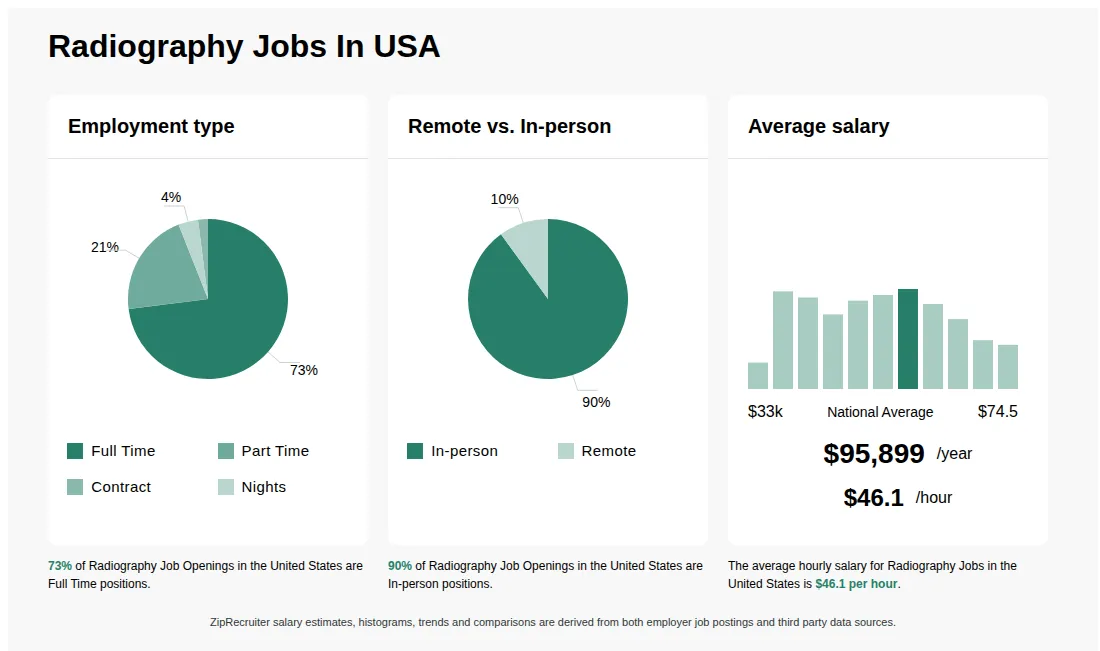
$15.87 - $21.20
3% of jobs
$21.20 - $26.53
12% of jobs
$31.26 is the 25th percentile. Wages below this are outliers.
$26.53 - $31.86
12% of jobs
$31.86 - $37.19
9% of jobs
$37.19 - $42.53
11% of jobs
The median wage is $44.22 / hr.
$42.53 - $47.86
12% of jobs
$47.86 - $53.19
13% of jobs
$55.46 is the 75th percentile. Wages above this are outliers.
$53.19 - $58.52
11% of jobs
$58.52 - $63.85
8% of jobs
$63.85 - $69.19
5% of jobs
$69.19 - $74.52
5% of jobs
$15
$46
$74
How much do radiography jobs pay per hour?
As of Sep 7, 2026, the average hourly pay for radiography in the United States is $46.11, according to ZipRecruiter salary data. Most workers in this role earn between $31.49 and $57.69 per hour, depending on experience, location, and employer.
What is radiography?
Radiography is a branch of medicine that focuses on using radiation or other techniques to create relevant medical images. In this field, you may use imaging equipment that utilizes x-ray, ultrasound, or MRI techniques based on what information doctors think is necessary to make an accurate diagnosis. Radiography is usually used to investigate bones and organs, but several radiography positions exist outside of the medical field. For example, industrial radiography is used to verify the internal structure of assembled products like cars and machines. This can help a company determine whether or not the product is ready to ship. Many radiography machines are safe under normal circumstances but can be dangerous if misconfigured, so technicians must ensure the safe operation of imaging equipment and calling for help if there's a problem with the machine.
What is radiography?
Radiography is a medical imaging technique that uses X-rays to create images of the inside of the body. It is commonly used to help diagnose fractures, infections, and various diseases by providing detailed pictures of bones and certain tissues. Radiography is performed by trained professionals known as radiologic technologists or radiographers, who operate the imaging equipment and ensure patient safety during the procedure. The resulting images, called radiographs or X-rays, are interpreted by radiologists to guide diagnosis and treatment.
What are the key skills and qualifications needed to thrive as a radiographer, and why are they important?
To thrive as a Radiographer, you need a solid understanding of anatomy, radiologic techniques, and safety protocols, typically supported by an accredited radiography degree and certification such as ARRT. Familiarity with imaging equipment, PACS (Picture Archiving and Communication Systems), and digital radiography software is essential. Excellent attention to detail, communication skills, and patient care abilities help you stand out in the role. These skills ensure accurate diagnostic imaging, patient safety, and effective collaboration with healthcare teams.
What are some common challenges faced by radiographers in a fast-paced healthcare environment?
Radiographers often work in busy hospital settings where they must balance a high volume of imaging requests with the need to ensure patient safety and accurate results. Managing time effectively, maintaining clear communication with physicians and nurses, and adapting to rapidly changing priorities are typical challenges. Additionally, radiographers must stay up-to-date with evolving imaging technologies and adhere strictly to safety protocols to minimize radiation exposure for themselves and patients. These challenges can be rewarding, as they foster strong teamwork and continual learning within the radiology department.
What is the difference between Radiography vs MRI Technologist?
| Aspect | Radiography | MRI Technologist |
|---|---|---|
| Credentials | Certification (ARRT), Radiography license | Certification (ARRT), MRI license |
| Work Environment | Hospitals, clinics, imaging centers | Hospitals, imaging centers, specialized clinics |
| Job Duties | Perform X-rays to assist diagnosis | Perform MRI scans for detailed imaging |
| Industry Usage | Common in general radiology | Specialized in MRI imaging |
Radiography and MRI Technologists both work in medical imaging, requiring similar certifications. Radiography focuses on X-ray imaging, while MRI Technologists operate magnetic resonance imaging equipment for detailed body scans. Both roles are vital in healthcare settings, but they differ in technology and specific procedures.
Is radiography a good career path?
Radiography is a stable healthcare career that involves capturing medical images using X-ray machines, often requiring certification and technical skills. It offers opportunities for employment in hospitals, clinics, and diagnostic centers, with a typical work schedule that may include shifts. The profession provides a pathway for advancement and specialization in areas like MRI or CT imaging.
What jobs fall under radiography?
Radiography encompasses various roles such as radiologic technologists, radiographers, and diagnostic imaging technicians who operate imaging equipment like X-ray, MRI, and CT scanners. These professionals typically require certification and work in hospitals, clinics, or diagnostic centers to produce medical images for diagnosis and treatment planning.
More about Radiography jobs
What cities are hiring for Radiography jobs?
Cities with the most Radiography job openings:
What are the most commonly searched types of Radiography jobs?
The most popular types of Radiography jobs are:
What states have the most Radiography jobs?
States with the most job openings for Radiography jobs include:

Part-time
Re-posted 29 days ago
Job description
Position Information
Job Title Instructor, Radiography - Adjunct Full Time/Part Time Part-time Job Description Guilford Technical Community College (GTCC) is currently the third largest of NC. Community College System's 58 institutions. On our six campuses and through our online offerings, we annually serve over 30,000 students, 60% of whom are students of color. We strive to offer programs that provide equitable educational outcomes for all students representing all backgrounds, including, but not limited to, ability, age, gender, race, religion, sexual orientation, and socioeconomic status. At GTCC, we are committed to cultivating a workplace culture of inclusion that welcomes, develops, supports, and empowers employees.
Teaching faculty at Guilford Technical Community College are responsible for supporting student success by creating an optimum learning environment, responding to student needs, managing effective instructional activities, modeling employability skills, demonstrating professionalism, developing cooperative work relationships with other faculty and staff, supporting college administrative requirements, and maintaining competency in their instructional field. He/she will be responsible for quality instruction and for effective participation and interest in the total affairs of the college.
Under general supervision, this individual will be able to prepare for and teach all levels of courses within the Radiography curriculum as needed.
Teaching
Prepare & teach Radiography departmental courses to include:
- developing learner centered lesson plans
- employing teaching strategies and instructional materials for different learning styles
- incorporating, as pedagogically appropriate, current technology in classroom, and laboratory environments
- creating and modeling a quality learning environment that supports a diverse student populations
- preparing, distributing, and utilizing instructional support materials, including course syllabi, supplementary materials, instructional media, and other devices as appropriate
Professional Development
Maintain a professional status that supports the instructional mission by:
- participating in professional development activities to maintain knowledge of changes in field; maintaining current credentials or licensures as required by program or accreditation
- participating in professional development opportunities to advance teaching skills and strategies
Administration
Provide daily & ongoing oversight of facilities, equipment, and student records to include:
- maintaining classroom and laboratory spaces including upkeep of assigned equipment
- providing for the security of facilities, equipment and instructional materials and maintaining safe working conditions
- maintaining student records (e.g., grades and attendance) in accordance with established deadlines using a variety of technology-based programs (e.g., Colleague, Self Service, Canvas, Teams, and Watermark
- complying with all applicable college, state and federal rules and regulations
Student Support
Provide an environment conducive to student success to include:
- addressing student concerns in a timely manner
- promoting retention/persistence by assisting students to develop strategies for success
- referring students to campus and community resources when appropriate
Perform other duties as assigned by supervisor
The faculty member must have the educational background needed to meet accreditation standards.
- Associate degree in Radiography and a Bachelor's degree in a health / science or education related field, or a Bachelor's degree in Radiography from an accredited program and an accredited post-secondary institution.
- Current radiography certification and registration with the American Registry of Radiologic Technologists (ARRT) (JRCERT Requirement)
- Master's degree from an accredited post-secondary institution
- Three years of work in hospital or clinic environment as an ARRT registered radiographer.
- Three years of experience as an ARRT radiographer in hospital or clinical radiography practice.
- Teaching and/or industry training experience.
- Greater than three years of experience in radiography clinical practice.
- Previous teaching experience in an accredited radiography program.
- Teaching experience in radiography topics.
- Experience with assessment of student learning outcomes
- Experience with distance learning and/or alternate instructional delivery systems
The Adjunct Faculty Member shall possess an understanding of and commitment to the nature and role of the Community College, particularly its "open door" policy. He/she shall have demonstrated personal and professional competence for the responsibilities assigned. The Adjunct Faculty Member must be able to:
1. Multi-task
2. Respect Diversity
3. Adapt to changing procedures, protocols, or assignments
4. Create and maintain a learner-centered environment
5. Communicate effectively
6. Effectively implement and apply technology solutions
KSA Preferred Department/Job Specific Requirements 1. Multi-task
2. Respect Diversity
3. Adapt to changing procedures, protocols, or assignments
4. Create and maintain a learner-centered environment
5. Communicate effectively
6. Effectively implement and apply technology solutions
- Model appropriate professionalism.
- Apply principles of radiation safety.
- Reinforce radiographic content published in textbooks.
The following (compliance) training is required and must be completed within the first 30 days of hire with annual refresher training thereafter: (additional training may be added as needed)
- Reporting Requirements
- Anti-Discrimination / Harassment & Title IX
- Safety / Shooter on Campus
- Personal Information Protection Training (PIP)
- Ethics and Social Responsibility
- eLearning Level One in Canvas before the first day of the first semester teaching
- eLearning Level Two in Canvas for instructors who teach online or hybrid delivery methods before the first day of the first semester teaching in that format
- Daily hours vary
- Use technology according to industry standards
- Health requirements for clinic participation
- Criminal history checks with acceptable results, are required
- May include teaching day and evening and/or weekend hours
- Deliver organized and understandable synchronous online lectures using Teams as needed.
- Deliver face-to-face teaching in classrooms and energized labs.
- Safely demonstrate patient care equipment and accessories.
- Manipulate x-ray equipment to demonstrate all radiographic procedures.
- Model appropriate radiation safety.
Posting Detail Information
Posting Number 2024-095-TEMP-P Open Date 10/18/2024 Close Date Open Until Filled Yes Special Instructions to Applicants 
About Guilford Technical Community College
Sourced by ZipRecruiter
Industry
Colleges, universities, and professional schools
Company size
501 - 1,000 Employees
Headquarters location
Jamestown, NC, US
Year founded
1958