1

Process Automation Specialist Jobs (NOW HIRING)

$80 - $100/hr

... Process Automation Specialist to design and deliver AI-driven automation and process improvements across the business. The role focuses on applying large language models and automation tools to ...

Participate as a team member on automation and process improvement projects. * Work directly with hardware/software vendors to troubleshoot and resolve issues. * Comply with all cGMP, EHS, and site ...

next page

Showing results 1-20

Process Automation Specialist information

See salary details

$22.5K

$76.5K

$110.5K

How much do process automation specialist jobs pay per year?

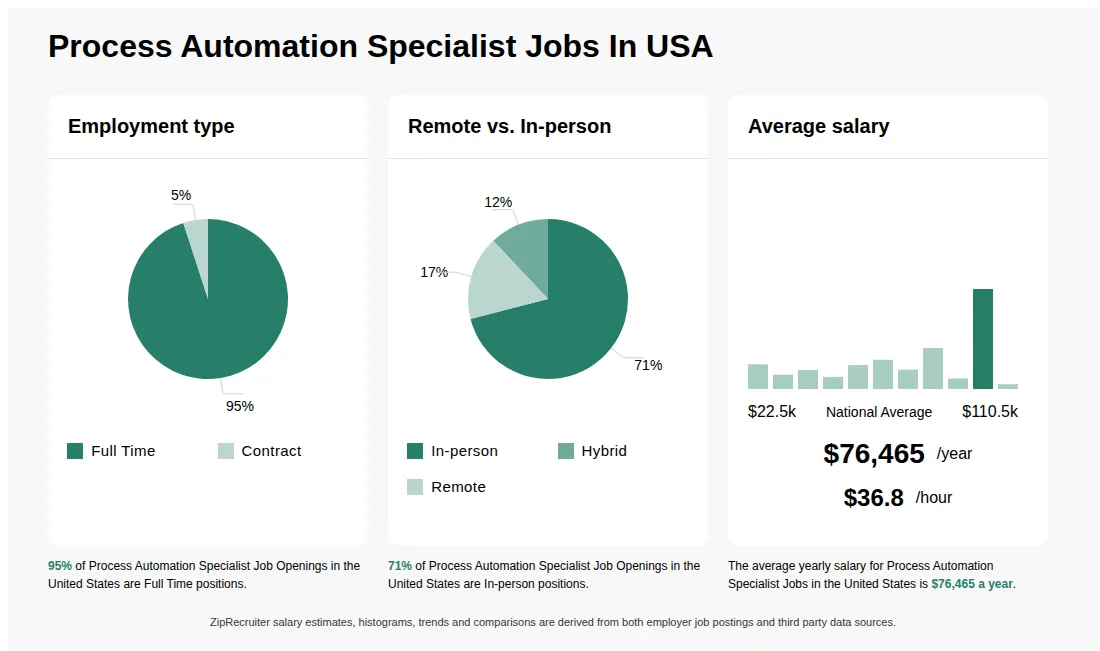
As of Sep 8, 2026, the average yearly pay for process automation specialist in the United States is $76,465.00, according to ZipRecruiter salary data. Most workers in this role earn between $57,000.00 and $98,500.00 per year, depending on experience, location, and employer.

What does a process automation specialist do?

A Process Automation Specialist is responsible for designing, implementing, and maintaining automated systems to streamline business processes. They analyze existing workflows, identify areas for improvement, and use technologies such as robotic process automation (RPA), scripting, or specialized software to automate repetitive tasks. Their goal is to increase efficiency, reduce errors, and save time and costs for the organization. They often collaborate with various departments to ensure automation solutions meet business needs and are integrated smoothly with existing systems.

What are the key skills and qualifications needed to thrive as a process automation specialist, and why are they important?

To thrive as a Process Automation Specialist, you need expertise in process analysis, programming, and a background in engineering or computer science. Familiarity with automation tools like RPA (Robotic Process Automation) platforms, PLC programming, and certifications such as Certified Automation Professional (CAP) are typically required. Strong problem-solving abilities, attention to detail, and effective communication set outstanding professionals apart in this role. These skills ensure efficient automation solutions, streamlined operations, and successful collaboration with cross-functional teams.

How does a process automation specialist typically collaborate with other departments to implement automation solutions?

Process Automation Specialists work closely with various departments, such as IT, operations, and business units, to understand their workflows and identify opportunities for automation. They often lead cross-functional meetings to gather requirements, demonstrate automation prototypes, and address concerns about process changes. Collaboration is key, as specialists must ensure that the solutions align with departmental goals and integrate seamlessly with existing systems. Open communication and regular feedback sessions help facilitate smooth implementation and ongoing support.

What is the difference between Process Automation Specialist vs Robotic Process Automation (RPA) Developer?

AspectProcess Automation SpecialistRobotic Process Automation (RPA) Developer
CredentialsTypically requires certifications in automation tools (e.g., UiPath, Automation Anywhere), and a background in IT or engineeringOften holds similar certifications and programming skills, with a focus on RPA platforms
Work EnvironmentWorks across various departments to identify automation opportunities, often in business or IT settingsPrimarily develops, tests, and maintains RPA bots within a technical environment
Employer & Industry UsageUsed in industries like finance, healthcare, and manufacturing to streamline processesCommonly employed in organizations adopting RPA technology for repetitive task automation

While both roles focus on automation, the Process Automation Specialist typically oversees broader process improvements and integrates various automation tools, whereas the RPA Developer specializes in creating and maintaining RPA bots specifically. The roles often overlap but differ in scope and technical focus.

More about Process Automation Specialist jobs

Who are the top companies hiring for Process Automation Specialist jobs?

The top employers for Process Automation Specialist jobs are:

What states have the most Process Automation Specialist jobs?

States with the most job openings for Process Automation Specialist jobs include:

What are popular job titles related to Process Automation Specialist jobs?

For Process Automation Specialist jobs, the most frequently searched job titles are:

Infographic showing various Process Automation Specialist job openings in the United States as of September 2026, with employment types broken down into 1% As Needed, 79% Full Time, 16% Part Time, 3% Contract, and 1% Nights. Highlights an 90% Physical, 2% Hybrid, and 8% Remote job distribution, with an average salary of $76,465 per year, or $36.8 per hour.

Process Automation Specialist (Contract)

Columbus, OH • On-site, Remote

Blue Star Partners LLC
Business Management Consulting • 11 - 50 employees

$30 - $35/hr

Full-time

Re-posted 23 days ago


Job description

Job Title: Process Automation Specialist

Location: Local Candidates only in Columbus, OH (Hybrid or Fully Remote)

Duration: 1-Year Contract with possible extensions

Rate: $30 - $35/hr

Employment Type: W-2 Contract

Work Authorization: Must be authorized to work in the United States now and in the future without the need for employment-based visa sponsorship. Sponsorship is not available for this position, including H-1B, F-1/OPT, CPT, TN, or other employment-based visa sponsorship.

Position Overview

We are seeking a Process Automation Specialist to design, develop, implement, and support automation solutions that improve operational efficiency and enhance Customer Contact Center performance. This role will work closely with business stakeholders and IT teams to develop automation tools, troubleshoot system issues, and support strategic technology initiatives.

The ideal candidate has experience with application development, process automation, database technologies, and software development practices, along with strong analytical and problem-solving skills.

Required Qualifications
  • Bachelor's Degree in Computer Science, Computer Programming, Information Technology, Management Information Systems, or related field; equivalent certification may be considered
  • 1-3 years of experience developing applications in a corporate environment
  • Experience working with databases and automation technologies
  • Enhanced knowledge of CIS and/or DIS systems
  • Strong analytical, troubleshooting, and problem-solving skills
  • Ability to work independently and collaboratively in a team environment
  • Strong attention to detail and commitment to accuracy
  • Ability to learn new technologies and software tools quickly
  • Experience balancing development, testing, implementation, and support responsibilities
  • Strong interpersonal and communication skills
  • Advanced proficiency with Microsoft 365 applications and database management tools
  • Ability to manage multiple priorities in a fast-paced environment
  • Willingness to support occasional nights, weekends, stand-by, or emergency support activities as needed
Preferred Qualifications
  • 1-3 years of Robotic Process Automation (RPA) development experience
  • 1-3 years of VBA development experience
  • Experience with Visual Studio development
  • Experience working with Microsoft Access and SQL databases
  • Experience supporting Customer Contact Centers or Call Center Operations
  • Lean certification or experience
  • Six Sigma certification or experience
  • Experience developing automated workflows and business process solutions
Key ResponsibilitiesProcess Automation Development
  • Design, develop, test, and implement automation solutions that support Customer Contact Center operations
  • Develop, code, unit test, debug, and deploy Robotic Process Automation (RPA) solutions
  • Create automation tools and applications using technologies such as Visual Studio, Access, SQL databases, VBA, Pega, and related platforms
  • Analyze business processes and identify opportunities for automation and operational improvement
Application Support & Troubleshooting
  • Monitor and support automation applications and tools
  • Troubleshoot technical issues and coordinate resolution efforts with IT teams
  • Act as a liaison between business users and IT to resolve system issues and improve performance
  • Maintain application reliability and support continuous improvement initiatives
Testing & Quality Assurance
  • Support leaders in the development of testing strategies and test plans
  • Conduct validation testing before and after technology changes
  • Ensure applications and automation solutions meet business requirements and quality standards
  • Assist with user acceptance testing (UAT) and production support activities
Analysis & Process Improvement
  • Review organizational needs, business goals, and operational processes to determine impacts on applications and systems
  • Recommend enhancements that improve efficiency, accuracy, and customer service outcomes
  • Support continuous improvement initiatives through automation and process optimization
Collaboration & Communication
  • Partner with Customer Contact Center leadership, operations teams, and IT stakeholders
  • Document technical solutions, business requirements, and support procedures
  • Communicate project status, issues, risks, and recommendations effectively
Technologies & Tools
  • Visual Studio
  • Pega
  • Microsoft Access
  • SQL Databases
  • Microsoft 365
  • VBA
  • Robotic Process Automation (RPA) Tools
  • CIS
  • DIS
Success in This Role
  • Successful implementation of automation solutions that improve operational efficiency
  • Reliable and scalable automation tools that reduce manual effort
  • Effective troubleshooting and support of business-critical applications
  • Strong collaboration between business stakeholders and IT teams
  • Continuous identification of automation opportunities that drive measurable value