PLC Programmer
$74K - $101K/yr
Proven experience as a PLC Programmer or Controls Engineer in industrial or manufacturing environments. Hands-on proficiency with Allen-Bradley (Rockwell) PLC platforms; exposure to Siemens PLCs or ...
$74K - $101K/yr
Proven experience as a PLC Programmer or Controls Engineer in industrial or manufacturing environments. Hands-on proficiency with Allen-Bradley (Rockwell) PLC platforms; exposure to Siemens PLCs or ...
$74K - $101K/yr
Proven experience as a PLC Programmer or Controls Engineer in industrial or manufacturing environments. Hands-on proficiency with Allen-Bradley (Rockwell) PLC platforms; exposure to Siemens PLCs or ...
Be Seen First
Roseville, CA · On-site
$110K - $150K/yr
Position Summary We are seeking an experienced Controls Programmer to design, develop, program, and commission PLC-based control systems for material handling and automation projects. This position ...
Quick apply
Be Seen First
Roseville, CA · On-site
$110K - $150K/yr
Position Summary We are seeking an experienced Controls Programmer to design, develop, program, and commission PLC-based control systems for material handling and automation projects. This position ...
San Jose, CA · On-site
$79K - $108K/yr
PLC Programmer - HMI Location: San Jose, CA Job Functions: Programming and commissioning machines within automated systems and station integration PLC and HMI Mechanical aptitude Powertrain ...
San Jose, CA · On-site
$79K - $108K/yr
PLC Programmer - HMI Location: San Jose, CA Job Functions: Programming and commissioning machines within automated systems and station integration PLC and HMI Mechanical aptitude Powertrain ...
Sunnyvale, CA · On-site
$79K - $108K/yr
Position : PLC Programmer - HMI Location: Sunnyvale, CA Contract : 6 Months Job Functions: Programming and commissioning machines within automated systems and station integration PLC and HMI ...
Sunnyvale, CA · On-site
$79K - $108K/yr
Position : PLC Programmer - HMI Location: Sunnyvale, CA Contract : 6 Months Job Functions: Programming and commissioning machines within automated systems and station integration PLC and HMI ...
San Francisco, CA · On-site
$80K - $109K/yr
PLC Programmer- HMI Location: San Francisco, CA Duration: 6+ Month with extension Job Functions: Programming and commissioning machines within automated systems and station integration PLC and HMI ...
San Francisco, CA · On-site
$80K - $109K/yr
PLC Programmer- HMI Location: San Francisco, CA Duration: 6+ Month with extension Job Functions: Programming and commissioning machines within automated systems and station integration PLC and HMI ...
Bakersfield, CA · On-site
$40 - $60/hr
PLC Programmer / Automation EngineerTwin Electric Inc. Pay: $40.00-$60.00 per hour (DOE) Join One of California's Growing Industrial Automation Contractors Twin Electric Inc. is seeking an ...
Quick apply
Bakersfield, CA · On-site
$40 - $60/hr
PLC Programmer / Automation EngineerTwin Electric Inc. Pay: $40.00-$60.00 per hour (DOE) Join One of California's Growing Industrial Automation Contractors Twin Electric Inc. is seeking an ...
Bakersfield, CA · On-site
$66K - $90K/yr
PLC programming and deployment * OIT application development and deployment * HMI application development and deployment * System commissioning and troubleshooting * Project estimating * Establish ...
Quick apply
Bakersfield, CA · On-site
$66K - $90K/yr
PLC programming and deployment * OIT application development and deployment * HMI application development and deployment * System commissioning and troubleshooting * Project estimating * Establish ...
Bakersfield, CA · On-site
$70K - $95K/yr
PLC programming and deployment * OIT application development and deployment * HMI application development and deployment * System commissioning and troubleshooting * Project estimating * Establish ...
Bakersfield, CA · On-site
$70K - $95K/yr
PLC programming and deployment * OIT application development and deployment * HMI application development and deployment * System commissioning and troubleshooting * Project estimating * Establish ...
Rancho Santa Margarita, CA · On-site
$85K - $135K/yr
Develop, test, and maintain Programmable Logic Controllers (PLC) and Human Machine Interface (HMI) software to ensure intuitive, reliable, and compliant machine control interfaces. * Integrate ...
Rancho Santa Margarita, CA · On-site
$85K - $135K/yr
Develop, test, and maintain Programmable Logic Controllers (PLC) and Human Machine Interface (HMI) software to ensure intuitive, reliable, and compliant machine control interfaces. * Integrate ...
Rancho Santa Margarita, CA · On-site
$85K - $135K/yr
Develop, test, and maintain Programmable Logic Controllers (PLC) and Human Machine Interface (HMI) software to ensure intuitive, reliable, and compliant machine control interfaces. * Integrate ...
Rancho Santa Margarita, CA · On-site
$85K - $135K/yr
Develop, test, and maintain Programmable Logic Controllers (PLC) and Human Machine Interface (HMI) software to ensure intuitive, reliable, and compliant machine control interfaces. * Integrate ...
Rancho Santa Margarita, CA · On-site
$85K - $135K/yr
Develop, test, and maintain Programmable Logic Controllers (PLC) and Human Machine Interface (HMI) software to ensure intuitive, reliable, and compliant machine control interfaces. * Integrate ...
Rancho Santa Margarita, CA · On-site
$85K - $135K/yr
Develop, test, and maintain Programmable Logic Controllers (PLC) and Human Machine Interface (HMI) software to ensure intuitive, reliable, and compliant machine control interfaces. * Integrate ...
Roseville, CA · On-site
$71K - $97K/yr
Position Summary We are seeking a skilled and detail-oriented Controls Programmer to design, develop, and commission PLC-based control systems. This role is responsible for bringing controls projects ...
Roseville, CA · On-site
$71K - $97K/yr
Position Summary We are seeking a skilled and detail-oriented Controls Programmer to design, develop, and commission PLC-based control systems. This role is responsible for bringing controls projects ...
Rancho Santa Margarita, CA · On-site
$85K/yr
Develop, test, and maintain Programmable Logic Controllers (PLC) and Human Machine Interface (HMI) software to ensure intuitive, reliable, and compliant machine control interfaces. * Integrate ...
Rancho Santa Margarita, CA · On-site
$85K/yr
Develop, test, and maintain Programmable Logic Controllers (PLC) and Human Machine Interface (HMI) software to ensure intuitive, reliable, and compliant machine control interfaces. * Integrate ...
San Diego, CA · On-site
As a PLC Engineer, you'll help develop and integrate highly reliable industrial automation and control systems that support ASML's advanced EUV lithography platforms. Your work will contribute to the ...
San Diego, CA · On-site
As a PLC Engineer, you'll help develop and integrate highly reliable industrial automation and control systems that support ASML's advanced EUV lithography platforms. Your work will contribute to the ...
Berkeley, CA · On-site
$80 - $150/hr
Staff / Principal PLC Controls Engineer - Test & IntegrationAbout the Role We are seeking a Staff/Principal-level PLC Controls Engineer to take ownership of PLC programming, controls integration, and ...
Quick apply
Berkeley, CA · On-site
$80 - $150/hr
Staff / Principal PLC Controls Engineer - Test & IntegrationAbout the Role We are seeking a Staff/Principal-level PLC Controls Engineer to take ownership of PLC programming, controls integration, and ...
Sacramento, CA · On-site
$35 - $70/hr
The PLC Applications Engineer is responsible for developing PLC programs, Operator Interface Terminal (OIT/HMI) applications, and software control descriptions used to monitor and control a variety ...
Sacramento, CA · On-site
$35 - $70/hr
The PLC Applications Engineer is responsible for developing PLC programs, Operator Interface Terminal (OIT/HMI) applications, and software control descriptions used to monitor and control a variety ...
Sacramento, CA · On-site
$35 - $70/hr
The PLC Applications Engineer is responsible for developing PLC programs, Operator Interface Terminal (OIT/HMI) applications, and software control descriptions used to monitor and control a variety ...
Sacramento, CA · On-site
$35 - $70/hr
The PLC Applications Engineer is responsible for developing PLC programs, Operator Interface Terminal (OIT/HMI) applications, and software control descriptions used to monitor and control a variety ...
Sacramento, CA · On-site
$35 - $70/hr
The PLC Applications Engineer is responsible for developing PLC programs, Operator Interface Terminal (OIT/HMI) applications, and software control descriptions used to monitor and control a variety ...
Sacramento, CA · On-site
$35 - $70/hr
The PLC Applications Engineer is responsible for developing PLC programs, Operator Interface Terminal (OIT/HMI) applications, and software control descriptions used to monitor and control a variety ...
$35 - $70/hr
The PLC Applications Engineer is responsible for developing PLC programs, Operator Interface Terminal (OIT/HMI) applications, and software control descriptions used to monitor and control a variety ...
Quick apply
$35 - $70/hr
The PLC Applications Engineer is responsible for developing PLC programs, Operator Interface Terminal (OIT/HMI) applications, and software control descriptions used to monitor and control a variety ...
Corona, CA · On-site
SUMMARY Responsible for providing electrical engineering expertise to support the site's electrical ... Experience with Allen Bradley PLC Hardware/Software, Variable speed drives, hydraulics, pneumatics.
Quick apply
Corona, CA · On-site
SUMMARY Responsible for providing electrical engineering expertise to support the site's electrical ... Experience with Allen Bradley PLC Hardware/Software, Variable speed drives, hydraulics, pneumatics.
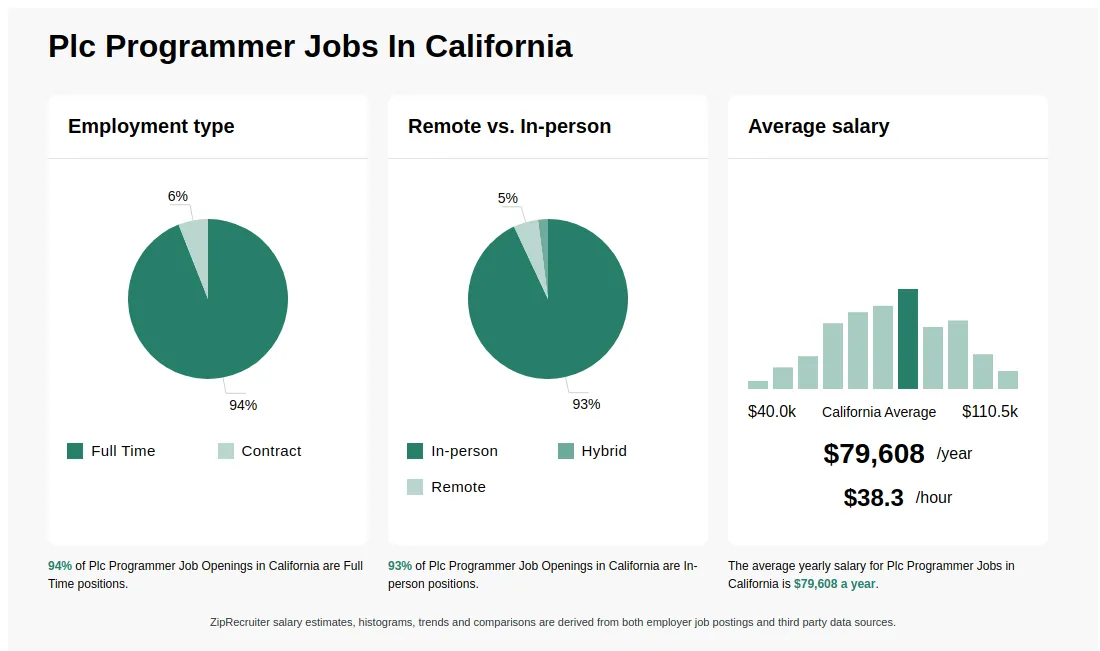
$40K - $46.4K
1% of jobs
$46.4K - $52.8K
3% of jobs
$52.8K - $59.2K
5% of jobs
$59.2K - $65.6K
12% of jobs
$67.4K is the 25th percentile. Wages below this are outliers.
$65.6K - $72K
14% of jobs
The median wage is $78.5K / yr.
$72K - $78.5K
15% of jobs
$78.5K - $84.9K
18% of jobs
$89K is the 75th percentile. Wages above this are outliers.
$84.9K - $91.3K
11% of jobs
$91.3K - $97.7K
12% of jobs
$97.7K - $104.1K
6% of jobs
$104.1K - $110.5K
3% of jobs
$40K
$79.6K
$110.5K
A PLC programmer oversees the programming of various machines functioning on programmable logic controller technology. PLC technology is a digital computer that controls electromagnetic processes, primarily in industrial equipment. As a PLC programmer, you are responsible for the programming and maintenance of these systems. Your duties include developing and programming new machines, reprograming existing machines, and diagnosing and repairing issues with PLC driven systems. You may work in various specialized industries, such as the medical, manufacturing, or agriculture fields. Your job is to create or update computerized machine systems so that the input, output, and control systems function optimally to meet the needs of your employer.
| Aspect | Plc Programmer | Automation Technician |
|---|---|---|
| Credentials | Typically requires a degree in electrical engineering, automation, or related field; certifications in PLC programming are common | Often has technical diploma or associate degree; certifications in PLCs and control systems are beneficial |
| Work Environment | Primarily office-based for programming; on-site for testing and commissioning | Primarily on-site, maintaining and troubleshooting automation systems |
| Industry Usage | Used across manufacturing, process control, and automation industries | Common in manufacturing, industrial maintenance, and plant operations |
While both roles work with automation systems, Plc Programmers focus on developing and testing PLC software, whereas Automation Technicians handle installation, maintenance, and troubleshooting of automation equipment on-site. The roles often collaborate but differ in focus and responsibilities.
The most popular types of Plc Programmer jobs in California are:
For Plc Programmer jobs in California, the most frequently searched job titles are:
The top searched job categories for Plc Programmer jobs in California are:
Cities in California with the most Plc Programmer job openings:
For Plc Programmer jobs in CA, the most frequently searched job titles are:
Fremont, CA
$74K - $101K/yr
Full-time
Posted 19 days ago
Develop, modify, and troubleshoot PLC-based control systems to ensure proper operation and integration.
Interpret electrical schematics, diagnose issues, and verify wiring and control panel integration.
Troubleshoot control system faults on-site, identify root causes, and implement corrective actions.
Job Description Step into a high-impact contract role where your PLC expertise will directly improve reliability, throughput, and safety across complex industrial systems. You'll work with leading manufacturing and process facilities in California, tackling challenging automation projects that demand precise control, robust networking, and disciplined documentation. This is a hands-on opportunity to own critical control logic and keep production running at its best.
About the Role: You will be responsible for developing, modifying, and troubleshooting PLC-based control systems, ensuring that electrical schematics, field instrumentation, and industrial networks are correctly integrated and performing as designed. Working closely with engineering and maintenance teams, you will provide on-site and remote support for commissioning, upgrades, and fault resolution. Your work will underpin stable operations, controlled change management, and clear technical documentation for ongoing system support.
Key Responsibilities: Program, configure, and modify PLC logic (Allen-Bradley, Siemens, and similar platforms) for new installations, upgrades, and process improvements. Interpret and work from electrical schematics to verify wiring, diagnose issues, and ensure correct integration of control panels and field devices. Troubleshoot PLC, HMI, and control system faults on-site, identifying root causes and implementing robust corrective actions.
Configure and support industrial networks (EtherNet/IP, Modbus, Profinet, etc.), including addressing, diagnostics, and communication between PLCs, drives, and instrumentation. Set up, calibrate, and integrate instrumentation and I/O, including analog and digital signals, field devices, and I/O modules. Produce clear project documentation, including logic descriptions, I/O lists, network diagrams, and change logs, aligned with client standards
Implement and adhere to change management processes, ensuring all modifications are tracked, reviewed, and properly version-controlled. Collaborate with site personnel during commissioning and testing to validate system performance and support handover to operations and maintenance teams. Key Requirements: Proven experience as a PLC Programmer or Controls Engineer in industrial or manufacturing environments.
Hands-on proficiency with Allen-Bradley (Rockwell) PLC platforms; exposure to Siemens PLCs or similar systems. Strong ability to read and interpret electrical schematics, wiring diagrams, and control panel layouts. Demonstrated experience troubleshooting PLC-based control systems, instrumentation, and field I/O.
Practical experience with industrial networking protocols such as EtherNet/IP, Modbus, and Profinet in automation applications. Competence in configuring and integrating instrumentation and I/O (analog/digital signals, sensors, actuators, drives). Solid understanding of change management practices for control systems, including version control and documentation standards.
Ability to work independently in the field, manage multiple tasks, and communicate clearly with technical and non-technical stakeholders. Desirable Skills: Experience with HMIs/SCADA systems (e.g., FactoryTalk View, WinCC, Ignition) for visualization and control. Familiarity with safety PLCs, machine safety standards, and functional safety concepts
Background in commissioning new production lines or process systems from design through start-up. Exposure to industrial cybersecurity best practices for control networks. Experience working with OEMs, system integrators, or consulting engineering firms on multi-stakeholder projects.
Qualifications: Associate's or Bachelor's degree in Electrical Engineering, Control Systems, Mechatronics, or a related technical discipline (or equivalent practical experience). Formal training or certification in PLC programming (Allen-Bradley/Rockwell, Siemens, or equivalent) preferred. Coursework or certification related to industrial networking or automation systems is an advantage.
Valid driver's license and ability to travel to client sites within California as required. If you are a hands-on PLC specialist who thrives on solving complex control problems and delivering reliable automation solutions, this contract role offers immediate impact and varied technical challenges-apply now to be considered.


