Penetration Tester
Norfolk, VA · On-site
The Penetration Tester will assist in the development of cyber test plans, execute cyber tests, and ... Testing may be against physical, virtualized, or cloud-based systems. This position shall leverage ...
Norfolk, VA · On-site
The Penetration Tester will assist in the development of cyber test plans, execute cyber tests, and ... Testing may be against physical, virtualized, or cloud-based systems. This position shall leverage ...
Norfolk, VA · On-site
The Penetration Tester will assist in the development of cyber test plans, execute cyber tests, and ... Testing may be against physical, virtualized, or cloud-based systems. This position shall leverage ...
... testing and security compliance activities. Responsibilities : • Perform internal and external ... physical pentests and social engineering analysis. • Perform cyber incident response as needed ...
... testing and security compliance activities. Responsibilities : • Perform internal and external ... physical pentests and social engineering analysis. • Perform cyber incident response as needed ...
Chantilly, VA · On-site
$137K - $244K/yr
MANTECH seeks a motivated, career, and team-oriented Penetration Testing Lead to support a DHS ... Physical Requirements: * Must be able to remain in a stationary position 50% of the time.
Chantilly, VA · On-site
$137K - $244K/yr
MANTECH seeks a motivated, career, and team-oriented Penetration Testing Lead to support a DHS ... Physical Requirements: * Must be able to remain in a stationary position 50% of the time.
Silver Spring, MD · On-site
$125 - $150/hr
A minimum of 5 years of proven penetration testing and ethical hacking experience. * Hands‑on ... Physical Demands: Sitting and working on a computer for long, continuous periods each day ...
Silver Spring, MD · On-site
$125 - $150/hr
A minimum of 5 years of proven penetration testing and ethical hacking experience. * Hands‑on ... Physical Demands: Sitting and working on a computer for long, continuous periods each day ...
San Antonio, TX · On-site
... both physical hardware and virtual systems. In support of this mission, Tharros is seeking a ... Conduct and/or support authorized penetration testing on enterprise network assets * Maintain ...
San Antonio, TX · On-site
... both physical hardware and virtual systems. In support of this mission, Tharros is seeking a ... Conduct and/or support authorized penetration testing on enterprise network assets * Maintain ...
Norfolk, VA · On-site
$85 - $120/hr
... Penetration Tester to support the US Navy with operational test and evaluation support which ... Testing may be against physical, virtualized, or cloud-based systems. This position shall leverage ...
Norfolk, VA · On-site
$85 - $120/hr
... Penetration Tester to support the US Navy with operational test and evaluation support which ... Testing may be against physical, virtualized, or cloud-based systems. This position shall leverage ...
Annapolis, MD · On-site
Perform physical pentests and social engineering analysis. * Perform cyber incident response as ... Must have experience with penetration testing tools. * Must have experience in web development and ...
Annapolis, MD · On-site
Perform physical pentests and social engineering analysis. * Perform cyber incident response as ... Must have experience with penetration testing tools. * Must have experience in web development and ...
The Penetration Tester will assist in the development of cyber test plans, execute cyber tests, and ... Testing may be against physical, virtualized, or cloud-based systems. This position shall leverage ...
The Penetration Tester will assist in the development of cyber test plans, execute cyber tests, and ... Testing may be against physical, virtualized, or cloud-based systems. This position shall leverage ...
San Antonio, TX · On-site
... both physical hardware and virtual systems. In support of this mission, Tharros is seeking a ... Conduct and/or support authorized penetration testing on enterprise network assets * Maintain ...
San Antonio, TX · On-site
... both physical hardware and virtual systems. In support of this mission, Tharros is seeking a ... Conduct and/or support authorized penetration testing on enterprise network assets * Maintain ...
Arlington, VA · On-site
Performing penetration testing and utilizing technical tools for packet capture, configuration ... physical sciences, mathematics, or a related technical discipline * Ability to obtain and maintain ...
Arlington, VA · On-site
Performing penetration testing and utilizing technical tools for packet capture, configuration ... physical sciences, mathematics, or a related technical discipline * Ability to obtain and maintain ...
Washington, DC · On-site
Performing penetration testing and utilizing technical tools for packet capture, configuration ... physical sciences, mathematics, or a related technical discipline * Ability to obtain and maintain ...
Washington, DC · On-site
Performing penetration testing and utilizing technical tools for packet capture, configuration ... physical sciences, mathematics, or a related technical discipline * Ability to obtain and maintain ...
Tharros has an immediate opportunity for a Penetration Tester to support the US Navy with ... Testing may be against physical, virtualized, or cloud-based systems. This position shall leverage ...
Tharros has an immediate opportunity for a Penetration Tester to support the US Navy with ... Testing may be against physical, virtualized, or cloud-based systems. This position shall leverage ...
... both physical hardware and virtual systems. In support of this mission, Tharros is seeking a ... Conduct and/or support authorized penetration testing on enterprise network assets * Maintain ...
... both physical hardware and virtual systems. In support of this mission, Tharros is seeking a ... Conduct and/or support authorized penetration testing on enterprise network assets * Maintain ...
MANTECH seeks a motivated, career, and team-oriented Penetration Testing Lead to support a DHS ... Physical Requirements: * Must be able to remain in a stationary position 50% of the time.
MANTECH seeks a motivated, career, and team-oriented Penetration Testing Lead to support a DHS ... Physical Requirements: * Must be able to remain in a stationary position 50% of the time.
$100K - $180K/yr
We are looking to hire someone with a passion for application security and penetration testing ... physical or mental disability, pregnancy, childbirth, genetic information, military and veteran ...
$100K - $180K/yr
We are looking to hire someone with a passion for application security and penetration testing ... physical or mental disability, pregnancy, childbirth, genetic information, military and veteran ...
Perform physical pentests and social engineering analysis. * Perform cyber incident response as ... Must have experience with penetration testing tools. * Must have experience in web development and ...
Perform physical pentests and social engineering analysis. * Perform cyber incident response as ... Must have experience with penetration testing tools. * Must have experience in web development and ...
Newport News, VA · On-site
$90 - $130/hr
Coordinate in-person social engineering exercises - including tailgating and impersonation - with the Physical Penetration Tester, within approved test plan scope. * Establish a communication plan ...
Newport News, VA · On-site
$90 - $130/hr
Coordinate in-person social engineering exercises - including tailgating and impersonation - with the Physical Penetration Tester, within approved test plan scope. * Establish a communication plan ...
Norfolk, VA · On-site
The Penetration Tester will assist in the development of cyber test plans, execute cyber tests, and ... Testing may be against physical, virtualized, or cloud-based systems. This position shall leverage ...
Norfolk, VA · On-site
The Penetration Tester will assist in the development of cyber test plans, execute cyber tests, and ... Testing may be against physical, virtualized, or cloud-based systems. This position shall leverage ...
... testing, demonstrating vulnerabilities and documenting the results. Minimum Qualifications ... Must have a current/active TS/SCI w/ Poly Physical Requirements: * Must be able to be in a ...
... testing, demonstrating vulnerabilities and documenting the results. Minimum Qualifications ... Must have a current/active TS/SCI w/ Poly Physical Requirements: * Must be able to be in a ...
Haymarket, VA · On-site
$115K - $130K/yr
Experience with cloud and identity-based penetration testing. Experience performing adversary emulation or purple-team activities. Physical Requirements Ability to remain in a stationary position for ...
Haymarket, VA · On-site
$115K - $130K/yr
Experience with cloud and identity-based penetration testing. Experience performing adversary emulation or purple-team activities. Physical Requirements Ability to remain in a stationary position for ...
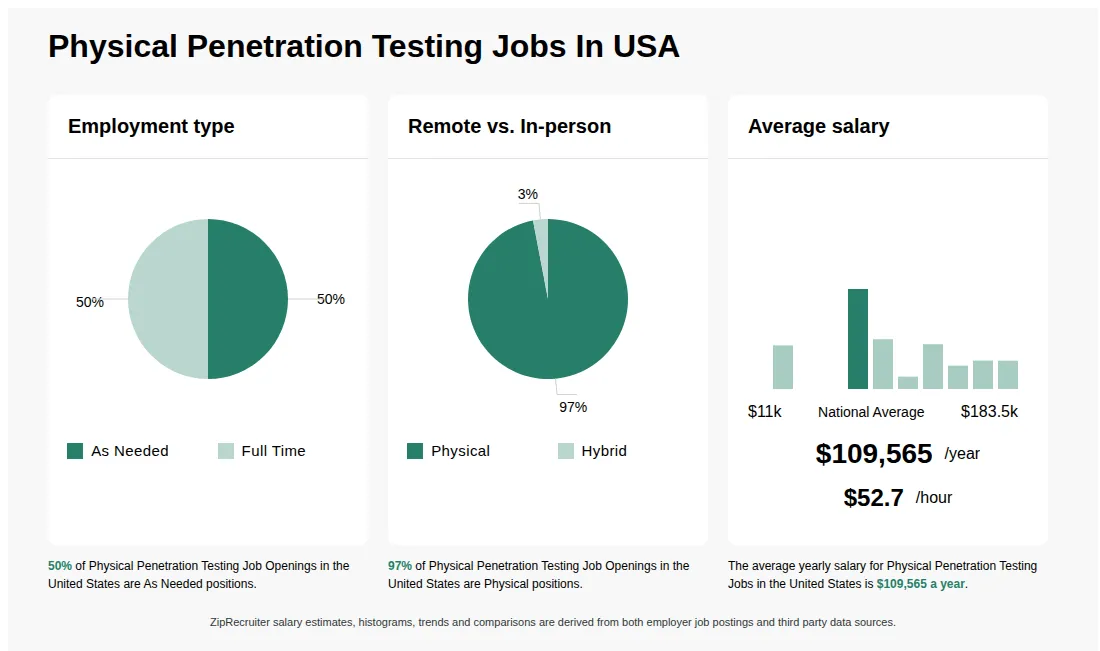
$11K - $26.7K
0% of jobs
$26.7K - $42.4K
13% of jobs
$42.4K - $58K
0% of jobs
$58K - $73.7K
0% of jobs
$79.6K is the 25th percentile. Wages below this are outliers.
$73.7K - $89.4K
31% of jobs
The median wage is $95.2K / yr.
$89.4K - $105.1K
15% of jobs
$105.1K - $120.8K
3% of jobs
$134.9K is the 75th percentile. Wages above this are outliers.
$120.8K - $136.5K
13% of jobs
$136.5K - $152.1K
7% of jobs
$152.1K - $167.8K
8% of jobs
$167.8K - $183.5K
8% of jobs
$11K
$109.6K
$183.5K
A Physical Penetration Testing job involves assessing the security of a facility by simulating real-world intrusion attempts. Testers use tactics like social engineering, lock picking, and bypassing security controls to identify vulnerabilities. The goal is to help organizations strengthen their physical security measures by uncovering weaknesses before malicious actors do. This role requires a combination of technical knowledge, stealth, and problem-solving skills.
A typical day for a Physical Penetration Tester involves planning and executing simulated intrusions to assess and test the effectiveness of an organization's physical security controls. This often includes reconnaissance of target facilities, attempting authorized entry through various methods (such as bypassing locks or circumventing access controls), and documenting discovered vulnerabilities. Testers also collaborate closely with internal security teams and may present their findings through detailed reports and debriefing sessions. The work can be both hands-on and analytical, and it frequently requires flexibility, discretion, and strict adherence to client agreements. You'll gain exposure to a wide range of security environments and play a crucial role in helping organizations improve their overall security posture.
To thrive as a Physical Penetration Tester, you need a strong background in security assessment, physical security systems, and risk analysis, often supported by relevant certifications such as Certified Red Team Professional (CRTP) or Physical Security Professional (PSP). Familiarity with lock picking tools, badge cloning devices, RFID readers, and surveillance avoidance techniques is commonly required. Strong problem-solving, discretion, and clear communication skills set successful testers apart, especially when working under pressure or conveying findings to clients. These skills ensure comprehensive and ethical testing of physical security defenses, enabling organizations to identify and remediate real-world vulnerabilities effectively.
Cities with the most Physical Penetration Testing job openings:
The most popular types of Physical Penetration Testing jobs are:
States with the most job openings for Physical Penetration Testing jobs include:
The top searched job categories for Physical Penetration Testing jobs are:
Part-time
Re-posted 2 days ago
Input Technology Solutions has an immediate opportunity to support the US Navy with operational test and evaluation support. The Penetration Tester will assist in the development of cyber test plans, execute cyber tests, and report cyber test results. In this role you will conduct cyber tests on operational systems, in laboratory environments, or in cyber range environments. Testing may be against physical, virtualized, or cloud-based systems. This position shall leverage all authorized resources and analytic techniques to penetrate/access targeted networks and systems under test in support of OPTEVFOR’s cyber OT&E mission. Team member will perform these duties under the supervision of the 01D Cyber Operations Officer.
Job Duties:
Review and become proficient in OPTEVFOR cyber T&E concept of operations, SOPs, policies and guidance.
Maintain and participate in the development of 01D SOPs and documentation for DCAT authorization established in DoDI 8585.01.
Research, review, prioritize, and submit operational requirements for acquisition of equipment or cyber capabilities, following the 01D tool approval process.
Support development and execution of TTPs for penetration testing or Red Teaming.
Research adversary cyber actors’ TTPs, organizational structures, capabilities, personas, and environments, and integrate findings into cyber survivability test planning and execution.
Participate in OPTEVFOR Cyber Test planning:
Conduct open-source research and system under test documentation review to familiarize with the system’s mission, architecture and interfaces including critical components to identify its attack surface and threat vectors
Participate in check point meetings
Support development of test plan objectives
Review test plans, ensuring that test plans objectives are feasible
Participate in test planning site visits
Participate in test preparation:
Participate in site pre-test coordination visits. Support in-brief to the test site.
Support red team test plan review
Add relevant system technical information to test reference library
Organize and support research presentations for advanced capability development in support of future tests
Prepare OPTEV-RT test assets (Government Furnished)
Execute test events, including Cooperative Vulnerability Penetration Assessments, Adversarial assessments, and Cyber Tabletops, in support of Operational Testing, Developmental Testing, risk reduction events, or other events, as assigned.
Use OPTEVFOR provided and NAO approved commercial and open-source network cyber assessment tools (e.g. Core Impact, Nmap, Burp, Metasploit, and Nessus).
Employee ethical hacking knowledge to exploit discovered vulnerabilities and misconfigurations associated with but not limited to operating systems (Windows, Linux, etc.), protocols (HTTP, FTP, etc.), and network security services (PKI, HTTPS, etc.) to accomplish test objectives
Be able to accomplish testing independently
Ensure tests are conducted safely, in accordance with the test plan, and OPTEVFOR policies are adhered to
Follow Joint Forces Headquarters (JFHQ)-DODIN deconfliction procedures
Verify collected data for accuracy and completeness
Participate in the post-test iterative process, including generation of documents (e.g. deficiency/risk sheets).
Document lessons learned.
Participate in capture the flag events, cyber off sites, external engagements such as red team huddles and red team technical exchange meetings; develop required products and materials in support of these events.
Attend OPTEVFOR required meetings in support of OT&E.
Generate and update documentation to maintain DCAT authorization compliance per DoDI 8585.0.
Process exfiltrated data for analysis and/or dissemination to customers.
Test and evaluate locally developed tools for operational use and implementation.
Requirements:
Minimum 3 years’ experience performing any combination of: penetration testing, red teaming, or exploitation development.
Minimum 3 years’ with proficiency in leading red team operators in penetration testing/red teaming to accomplish assigned test objectives.
Offensive Security Certified Professional (OSCP), OSCE, GX-PT, GXPM, PNPT, or HTB CPTS required.
Proficient in multiple offensive tools, including:
Metasploit, Cobalt Strike, Core Impact, Burp Suite, Nessus, SharpHoundBloodHound
Ability to validate functionality and safety of offensive tools (e.g. exploits) given the source code and document the results.
Ability to detect malicious activity of a program using dynamic analysis techniques and document the results.
Independently operate to conduct penetration testing/red teaming to accomplish assigned test objectives.
Skill in assessing current tools to identify needed improvements.
Skill in knowledge management, including technical documentation techniques (e.g., Wiki page).
Knowledge of current software and methodologies for active defense and system hardening.
Knowledge of encryption algorithms and cyber capabilities/tools (e.g., Transport Layer Security, Pretty Good Privacy).
Knowledge of evasion strategies and techniques.
Knowledge of forensic implications of operating system structure and operations.
Knowledge of host-based security products and how they affect exploitation and vulnerability.
Knowledge of network administration.
Knowledge of network construction and topology.
Knowledge of security hardware and software options, including the network artifacts they induce and their effects on exploitation.
Knowledge of security implications of software configurations.
Knowledge of the fundamentals of digital forensics in order to extract actionable intelligence.
Knowledge of cryptologic capabilities, limitations, and contributions to cyber operations.
Knowledge of Unix/Linux and Windows operating systems structures and internals (e.g., process management, directory structure, installed applications).
Knowledge of network collection procedures to include decryption capabilities/tools, techniques, and procedures.
Process exfiltrated data for analysis and/or dissemination to customers.
Test and evaluate locally developed tools for operational use.
Skill in testing and evaluating tools for implementation.
Proficient in Microsoft Office Suite to include Teams or similar workplace chat and videoconferencing tools.
Excellent written and verbal communication skills.
Clearance:
Top-Secret/SCI