1

Pathologist Assistant Jobs in Pennsylvania (NOW HIRING)

Pathologist Asst Penn Medicine is dedicated to our tripartite mission of providing the highest level of care to patients, conducting innovative research, and educating future leaders in the field of ...

To perform gross examination of selected pathology specimens at the discretion of and under the supervision of the Director of Pathology. Accountabilities : • 1. Gross examination of pathology ...

To perform gross examination of selected pathology specimens at the discretion of and under the supervision of the Director of Pathology. Accountabilities : • 1. Gross examination of pathology ...

S. or M.S. degree from an accredited Pathologist Assistant Program. Certification by the American Association of Pathologist Assistants. EQUAL OPPORTUNITY Redeemer Health is an equal opportunity ...

next page

Showing results 1-20

Pathologist Assistant information

See Pennsylvania salary details

$14

$55

$90

How much do pathologist assistant jobs pay per hour?

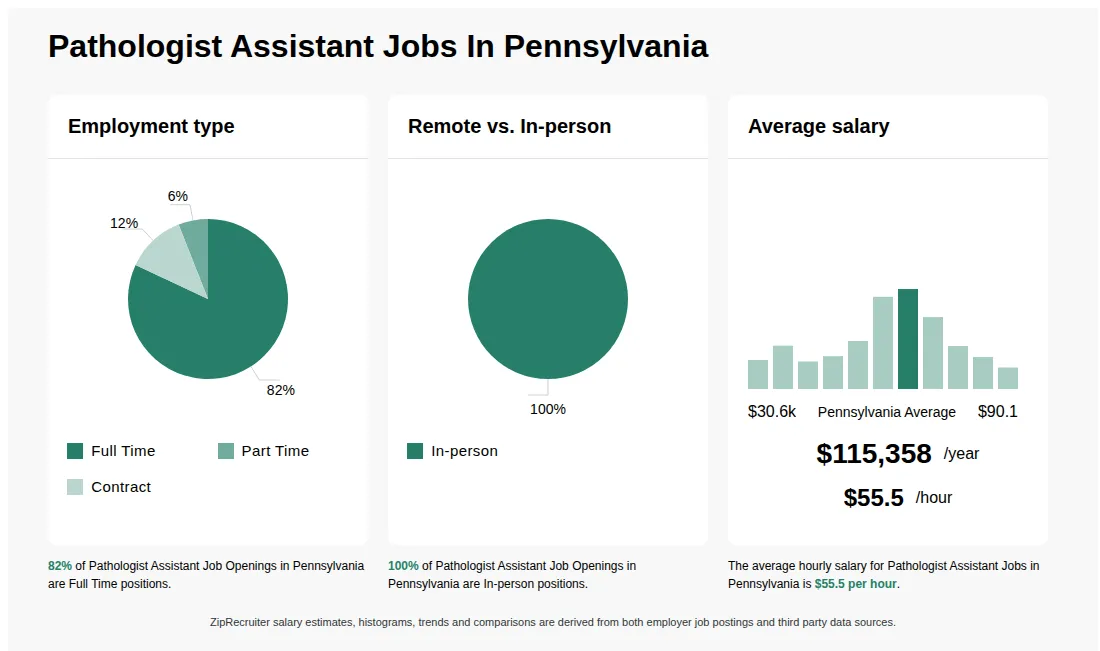
As of Aug 14, 2026, the average hourly pay for pathologist assistant in Pennsylvania is $55.46, according to ZipRecruiter salary data. Most workers in this role earn between $43.61 and $67.45 per hour, depending on experience, location, and employer.

What is a pathologist assistant?

A pathologist assistant is a specialized health care worker who conducts tests on specimen samples and performs surgical autopsies under licensed pathologists. As a pathology assistant, you may work in a research lab, hospital, medical examiner’s office, or you may choose to be self-employed and take on jobs at multiple facilities. You dissect tissue to acquire specimens, such as biopsies, and analyze those samples to help diagnose patients or determine problems within the cells. While you can do the majority of the procedures performed by a pathologist, you are not able to diagnose patients; the pathologist reviews your observations and suggestions and determines a diagnosis.

What are the key skills and qualifications needed to thrive as a pathologist assistant, and why are they important?

To thrive as a Pathologist Assistant, you need a bachelor's degree in a science-related field and graduation from an accredited Pathologists' Assistant program, along with certification such as ASCP-PA. Proficiency with laboratory information systems, specimen dissection tools, and digital imaging equipment is typically required. Strong attention to detail, organizational skills, and effective communication are vital soft skills for collaborating with pathologists and other healthcare professionals. These skills ensure accurate specimen processing, efficient workflow, and high-quality diagnostic support in clinical and research laboratories.

What is the difference between Pathologist Assistant vs Histotechnologist?

AspectPathologist AssistantHistotechnologist
CredentialsMaster's degree, certification (e.g., ASCP-PA)Post-secondary education, certification (e.g., ASCP-HT)
Work EnvironmentPathology labs, hospitals, medical examinersHistology labs, hospitals, research facilities
Job RoleAssist pathologists with autopsies, gross examination, and specimen prepPrepare tissue samples for microscopic analysis

Pathologist Assistants and Histotechnologists both work in pathology settings, but their roles differ. Pathologist Assistants focus on gross examination and autopsies, while Histotechnologists prepare tissue slides for diagnosis. Credentials and work environments overlap, but their specific duties are distinct.

What can a pathologist assistant do?

A pathologist assistant supports pathologists by preparing, examining, and documenting tissue samples, assisting with autopsies, and managing laboratory tasks. They often work in a laboratory setting, requiring knowledge of histology, anatomy, and laboratory safety protocols. Certification and a strong understanding of pathology procedures are typically necessary for this role.

What are some common challenges a pathologist assistant faces when working with large specimen volumes or complex cases?

Pathologist Assistants often encounter challenges such as managing high specimen volume during peak times and ensuring meticulous attention to detail with complex or unusual cases. Balancing efficiency with accuracy is crucial, as errors in specimen processing can impact diagnoses. Additionally, Pathologist Assistants must adapt to evolving lab technologies and protocols, and collaborate closely with pathologists, lab technologists, and surgeons to ensure quality patient care. Developing strong organizational and communication skills can help address these challenges effectively.

What are the most commonly searched types of Pathologist jobs in Pennsylvania?

The most popular types of Pathologist jobs in Pennsylvania are:

What cities in Pennsylvania are hiring for Pathologist Assistant jobs?

Cities in Pennsylvania with the most Pathologist Assistant job openings:

What are popular job titles related to Pathologist Assistant jobs in PA?

For Pathologist Assistant jobs in PA, the most frequently searched job titles are:

Infographic showing various Pathologist Assistant job openings in Pennsylvania as of August 2026, with employment types broken down into 1% As Needed, 73% Full Time, 22% Part Time, 1% Temporary, and 3% Contract. Highlights an 98% Physical, 1% Hybrid, and 1% Remote job distribution, with an average salary of $115,358 per year, or $55.5 per hour.

Sr. Pathologists' Assistant

UPMC Senior Communities

Pittsburgh, PA • On-site

Other

Re-posted 20 days ago


Job description

Pathologists' Assistant / Senior Pathologists' Assistant
Location: Pittsburgh, PA in the UPMC urban pathology labs (Presbyterian, Shadyside, and Magee-Womens Hospitals)
Schedule: Daylight hours with flexible start times between 6:30 AM and 8:30 AM, offering a combination of 8- and 10-hour shifts after initial training completion. Rotating holiday coverage.
Join the supportive and collaborative team at UPMC Presbyterian's Urban Pathology Labs, serving Presbyterian, Shadyside, and Magee facilities in Pittsburgh. Whether you're a new graduate or an experienced Pathologists' Assistant, you'll thrive in an environment that fosters growth and learning. Work alongside world-renowned pathologists and gain exposure to a fascinating case mix, including rare and complex specimens.
One of the greatest benefits of working in a dynamic urban lab environment is the ability to network and collaborate with peers across the entire UPMC system. UPMC supports a robust Pathologists' Assistant network through the UPMC Lab Service Center, fostering teamwork and shared initiatives. By joining us, you will be at the forefront of operational excellence and have ample opportunity to advance your career both within and beyond the organization.
Applicants will be placed into the appropriate job title and salary based on their individual experience and education.
UPMC is currently offering a generous sign-on bonus for Pathologists' Assistants!
Responsibilities:
  • Assist manager or Supervisor with administrative functions as they relate to the Pathologists' Assistant portion of the department including assisting with development of quality assurance monitors, quality control monitors, data gathering and preparations of QA report, input for performance reviews, budget preparation and monitoring, regulatory compliance and continuing education and training.
  • Oversee the proper handling, storage and disposition of all surgical and autopsy tissue while adhering to the regulatory and compliance standards regarding biohazard and safety.
  • Ensure that tests are prepared properly at all stages from specimen collection through results reporting, and performs additional special handling of the specimens if necessary or requested (i.e. radiography, photography, special fixation, cultures and tissue procurement).
  • Competent at operating the Laboratory Information System and Medical Archival Retrieval System relative to the functions of the pathology assistants' team.
  • Perform special projects such as research protocols when required.
  • Provide independent technical leadership, consulting with the Manager or Supervisor on unusual and complex cases, such as oncology cases where the tumor has spread into other organs, cancers that extend into surrounding structures, autopsies on complicated cases, and initial intraoperative examination and tissue banking for uncommon specimens of interest to research such as wide section melanomas and thoracic biopsies. Provides ongoing training and orientation to the pathology assistant team members.
  • Examine and prepare surgical pathology cases for microscopic evaluation by providing gross description, dissection and sections of each case as defined by the Surgical Pathology Manual while maintaining accurate records of all activities.
  • Participate in and performs frozen sections, intraoperative consultations, autopsies and prenatal procedures. File and retrieve surgical and autopsy materials and maintains accurate records of all such activities.
Qualifications:
Senior Pathologist's Assistant:
  • Graduate of a NAACLS accredited, Master's degree pathologist's assistant training program, or Bachelor's degree in Biological Sciences or Medical Technology or a related field and 5 years clinical experience in Anatomic or Clinical Pathology is required.
  • One year working as a certified Pathologist's Assistant preferred.
Pathologist's Assistant:
  • Completion of 4-year degree in Biological Sciences or Medical Technology or meets AAPA requirements for college credits defined in the science disciplines from an accredited institution.
  • Prefer graduate of a NAACLS accredited, master's degree pathologist's assistant training program, or bachelor's degree in Biological Sciences or Medical Technology or a related field and 5 years clinical experience in Anatomic or Clinical Pathology is required.
  • Analytical and technical ability necessary to independently evaluate patient specimens and clinical data to appropriate sample tissue relevant to diagnostic evaluation and recognize organ and tissue anomalies.
  • All procedures or job-related tasks involve an inherent potential for mucous membrane or skin contact with blood, body fluids or tissues.
  • A potential for spills or splashes of biohazard substances does exist. Exposure to normal laboratory lights and noises and occasional exposure to toxic and carcinogenic chemicals.
This position requires regular movement throughout the facility, including walking, standing, and lifting materials or equipment weighing up to 50 lbs. This position requires the ability to accurately distinguish colors.
Licensure, Certifications, and Clearances:
  • ASCP required within 12 months of hire.
  • Act 34

UPMC is an Equal Opportunity Employer/Disability/Veteran