1

Optoelectronics Jobs (NOW HIRING)

Develop and implement testbeds to evaluate the performance of optoelectronic chips, components, and modules * Provide test engineering support for the design, prototyping, and delivery of proof-of ...

Develop and implement testbeds to evaluate the performance of optoelectronic chips, components, and modules * Provide test engineering support for the design, prototyping, and delivery of proof-of ...

Senior Manager of Board Design

Austin, TX · On-site

$225K - $270K/yr

Optoelectronics Board Integration * Lead board-level integration of silicon photonic ICs, laser driver ICs, transimpedance amplifiers (TIAs), and high-speed DAC/ADC circuits that interface directly ...

next page

Showing results 1-20

Optoelectronics information

See salary details

$45.5K

$86.1K

$136K

How much do optoelectronics jobs pay per year?

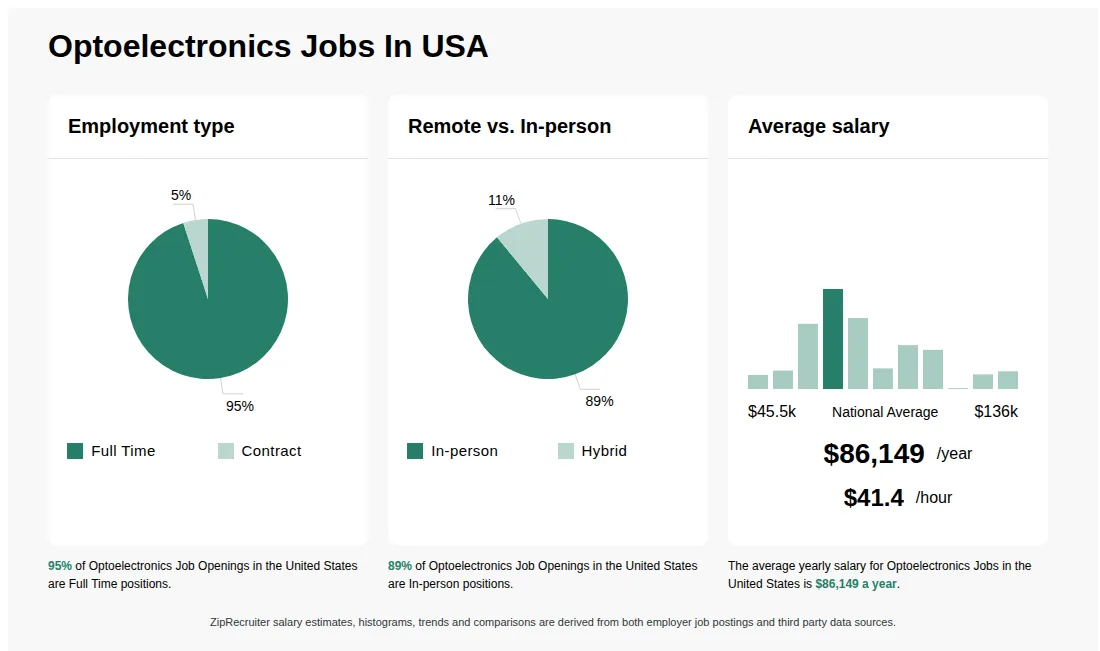
As of Jun 30, 2026, the average yearly pay for optoelectronics in the United States is $86,149.00, according to ZipRecruiter salary data. Most workers in this role earn between $70,000.00 and $100,000.00 per year, depending on experience, location, and employer.

What is the difference between Optoelectronics vs Photonics Engineer?

AspectOptoelectronicsPhotonics Engineer
Required CredentialsBachelor's or higher in Electrical Engineering, Physics, or related fieldsBachelor's or higher in Optical Engineering, Physics, or related fields
Work EnvironmentResearch labs, manufacturing, telecommunicationsResearch and development, fiber optics, laser systems
Industry UsageOptical communication, display technology, sensorsLaser systems, optical sensors, imaging systems

Optoelectronics focuses on devices that convert electrical signals into optical signals and vice versa, such as LEDs and photodetectors. Photonics engineers work on the broader science of light manipulation, including laser systems and optical communications. While overlapping in optical technologies, optoelectronics emphasizes device development, whereas photonics covers the science and engineering of light-based systems.

What are optoelectronics?

Optoelectronics is a branch of electronics that involves devices and systems that source, detect, and control light. This includes technologies such as LEDs, laser diodes, photodetectors, and solar cells, which are used in applications like fiber optic communications, lighting, medical equipment, and imaging systems. Professionals in optoelectronics design, develop, and test these light-based components and systems. The field combines principles from physics, electronics, and materials science to innovate and improve light-based technologies.

What are the key skills and qualifications needed to thrive as an Optoelectronics Engineer, and why are they important?

To thrive as an Optoelectronics Engineer, a strong background in physics, electrical engineering, and optics, often supported by a degree in a related field, is essential. Familiarity with simulation software, optical design tools (such as Zemax or COMSOL), and relevant industry certifications is typically required. Strong problem-solving abilities, attention to detail, and effective teamwork help professionals excel in this highly technical field. These skills are crucial for developing innovative optoelectronic devices and ensuring their reliability and performance in practical applications.

What are some typical challenges faced by professionals working in optoelectronics, and how can they be addressed?

Professionals in optoelectronics often encounter challenges such as rapid technological advancements, the need for precise alignment and calibration of optical components, and stringent quality standards. Keeping up with new materials and fabrication techniques can require continuous learning. Collaboration with multidisciplinary teams—including engineers, physicists, and manufacturing specialists—is vital to address these issues efficiently. Engaging in ongoing training, attending industry conferences, and leveraging simulation tools can help professionals stay ahead and maintain high-quality results in their projects.
More about Optoelectronics jobs
What states have the most Optoelectronics jobs? States with the most job openings for Optoelectronics jobs include:
Infographic showing various Optoelectronics job openings in the United States as of June 2026, with employment types broken down into 100% Full Time. Highlights an 100% In-person job distribution, with an average salary of $86,149 per year, or $41.4 per hour.

Test Engineer,Hardware- Photonics

QCi

On-site

Full-time

Posted 14 days ago


Job description

Test Engineer, Hardware
Location: Cranbury, NJ


About Us


Quantum Computing Inc. (QCi) (Nasdaq: QUBT) is an innovative, integrated photonics company that provides accessible and affordable quantum machines to the world today. QCi products are designed to operate at room temperature and low power at an affordable cost. The Company's portfolio of core technology and products offer unique capabilities in the areas of high-performance computing, artificial intelligence, cyber security as well as remote sensing applications.

Position Description 

QCi is seeking a dynamic Test Engineer with Hardware expertise to be part of a team that develops and produces world class semiconductor-based products for a range of applications, including optical communications, remote sensing (e.g., lidar and laser rangefinding), quantum sensing, and high-performance imaging. Working collaboratively with other members of the team, the successful candidate will play a crucial role in the design, development, and testing of advanced optical and optoelectronic components and modules including state-of-the-art III-V avalanche photodetectors and other compound semiconductor devices. This individual will be responsible for developing test capabilities to support R&D activities, prototype and product characterization, and product reliability. This is a highly cross-functional role requiring the development of innovative test solutions that deliver appropriate levels of precision, efficiency, and automation.

Duties and Responsibilities
  • Develop and implement testbeds to evaluate the performance of optoelectronic chips, components, and modules
  • Provide test engineering support for the design, prototyping, and delivery of proof-of-concept devices for early-stage optoelectronic module development
  • Use design of experiment and failure analysis techniques to identify and resolve issues related to optical device performance
  • Develop and implement strategies for test automation to improve testing accuracy and efficiency, including solutions for testing in a production environment
  • Devise well-organized solutions for test data storage and retrieval
  • Provide analysis of test data related to optical and optoelectronic device performance, including distillation and presentation of key results
  • Take responsibility for engineering change orders related to optical and optoelectronic components
  • Provide technical support and collaborate with product development teams on optical design and product development
  • Contribute to continuous improvement initiatives related to development and production testing
Required Skills and Experience
  • Bachelor's degree in Physics, Electrical Engineering, or a related field
  • 3+ years of experience as a test engineer, with experience in testing optoelectronic devices
  • Experience in developing, scripting, and running test software for optical components and systems, including testbed development and automation
  • Hands-on experience with a wide range of lab equipment and tools related to optoelectronic device testing
  • Strong understanding of design of experiment principles and failure analysis techniques to optimize optical system performance
  • Excellent problem-solving skills, attention to detail, and ability to work effectively in a collaborative team environment
  • Strong communication skills to convey technical information effectively to cross-functional teams and stakeholders
Additional Preferred Skills 
  • A Masters or PhD in Physics, Electrical Engineering, or a related field
  • Experience with testing components related to photodetector technology, particularly avalanche photodiodes
  • Working knowledge of compound semiconductor device physics
  • Proficiency in optical software tools such as Zemax or FRED for designing and analyzing optical systems
  • Experience in designing PCBs for testbed development
  • Familiarity with CAD tools for design and documentation purposes
  • Proficiency in Python scripting
  • Experience with product development involving optoelectronic devices


Incumbent(s) in this position may be required to perform other duties and special assignments not specifically stated above. Statements outlined in this section are designated as essential job functions in accordance with the Americans with Disabilities Act of 1990.


Employment Type: FULL_TIME