The Operating Engineer CL 3 is directly accountable for: * Operating Chalk River Laboratories (CRL) Powerhouse equipment. * Operating heating, ventilation, and air conditioning equipment, including ...
The Operating Engineer CL 3 is directly accountable for: * Operating Chalk River Laboratories (CRL) Powerhouse equipment. * Operating heating, ventilation, and air conditioning equipment, including ...
Can you see yourself as an Operating Engineer, Class 3 , ensuring the safe and efficient operation of critical utility, power generation, and HVAC systems that support site operations? Do you enjoy ...
Can you see yourself as an Operating Engineer, Class 3 , ensuring the safe and efficient operation of critical utility, power generation, and HVAC systems that support site operations? Do you enjoy ...
Senior Project & Operating Engineer
Windsor, ON · On-site
CA$90K - CA$120K/yr
The Operating Engineer plays a critical role in ensuring the efficient and safe operation of the NMP cathode cell Solvent Recovery Plant (SRP), water treatment for anode solvent, Centralized ...
Senior Project & Operating Engineer
Windsor, ON · On-site
CA$90K - CA$120K/yr
The Operating Engineer plays a critical role in ensuring the efficient and safe operation of the NMP cathode cell Solvent Recovery Plant (SRP), water treatment for anode solvent, Centralized ...
Senior Project & Operating Engineer
Windsor, ON · On-site
CA$90K - CA$120K/yr
The Operating Engineer plays a critical role in ensuring the efficient and safe operation of the NMP cathode cell Solvent Recovery Plant (SRP), water treatment for anode solvent, Centralized ...
Senior Project & Operating Engineer
Windsor, ON · On-site
CA$90K - CA$120K/yr
The Operating Engineer plays a critical role in ensuring the efficient and safe operation of the NMP cathode cell Solvent Recovery Plant (SRP), water treatment for anode solvent, Centralized ...
Chief Operating Engineer
London, ON · On-site
$45 - $50/hr
10+ years' experience working in maintenance. 5+ years' experience having direct reports or being a team leader. Class 2 Required or Class 3 with A Refrigeration Post-secondary education in related ...
Chief Operating Engineer
London, ON · On-site
$45 - $50/hr
10+ years' experience working in maintenance. 5+ years' experience having direct reports or being a team leader. Class 2 Required or Class 3 with A Refrigeration Post-secondary education in related ...
4th Class Operating Engineer
Hamilton, ON · On-site
$35.37/hr
Consideration will be given to a 4th Class Operating Engineer who is progressing toward obtaining the 3rd Class certificate within 2 years and has relevant maintenance experience.Must have a ...
4th Class Operating Engineer
Hamilton, ON · On-site
$35.37/hr
Consideration will be given to a 4th Class Operating Engineer who is progressing toward obtaining the 3rd Class certificate within 2 years and has relevant maintenance experience.Must have a ...

2nd Class Operating Engineer Location: Collingwood, Ontario Job Type: Full-Time, Permanent Shift: 12-Hour Shifts - Days & Nights Compensation: $48.74/hour + $2.00 shift prem on nights Position ...
Quick apply
2nd Class Operating Engineer Location: Collingwood, Ontario Job Type: Full-Time, Permanent Shift: 12-Hour Shifts - Days & Nights Compensation: $48.74/hour + $2.00 shift prem on nights Position ...

Operating Engineer - 3rd Class
CA$43.11/hr
Third Class Operating Engineer Certification is required. Valid Ontario Class G driver's license (or equivalent). Experience operating industrial processing equipment, utility systems, or production ...
Operating Engineer - 3rd Class
CA$43.11/hr
Third Class Operating Engineer Certification is required. Valid Ontario Class G driver's license (or equivalent). Experience operating industrial processing equipment, utility systems, or production ...
Operating Engineer - 3rd Class
Hamilton, ON · On-site
CA$43.11/hr
Third Class Operating Engineer Certification is required. * Valid Ontario Class G driver's license (or equivalent). * Experience operating industrial processing equipment, utility systems, or ...
Operating Engineer - 3rd Class
Hamilton, ON · On-site
CA$43.11/hr
Third Class Operating Engineer Certification is required. * Valid Ontario Class G driver's license (or equivalent). * Experience operating industrial processing equipment, utility systems, or ...
3rd Class Operating Engineer
Toronto, ON · On-site
$34 - $35/hr
3rd Class Power Engineering License. 1-3 years of experience working in Manufacturing Industries. Amonia experience would be strong Asset. Food Industry experience would be strong asset. Able to work ...
3rd Class Operating Engineer
Toronto, ON · On-site
$34 - $35/hr
3rd Class Power Engineering License. 1-3 years of experience working in Manufacturing Industries. Amonia experience would be strong Asset. Food Industry experience would be strong asset. Able to work ...
Supervise and mentor operating engineers, maintenance technicians, and contractors. * Coordinate plant shutdowns, capital projects, and equipment installations. * Manage energy usage and utility ...
Quick apply
Supervise and mentor operating engineers, maintenance technicians, and contractors. * Coordinate plant shutdowns, capital projects, and equipment installations. * Manage energy usage and utility ...
Supervise and mentor operating engineers, maintenance technicians, and contractors. * Coordinate plant shutdowns, capital projects, and equipment installations. * Manage energy usage and utility ...
Quick apply
Supervise and mentor operating engineers, maintenance technicians, and contractors. * Coordinate plant shutdowns, capital projects, and equipment installations. * Manage energy usage and utility ...
Refrigeration B Operator
Kitchener, ON · On-site
CA$42/hr
... Operating Engineer for a permanent, full-time position at an industrial facility in the Kitchener area. The successful candidate will work as part of the facility's maintenance team and will be ...
Quick apply
Refrigeration B Operator
Kitchener, ON · On-site
CA$42/hr
... Operating Engineer for a permanent, full-time position at an industrial facility in the Kitchener area. The successful candidate will work as part of the facility's maintenance team and will be ...
Power Engineer 4th Class
Orleans, ON · On-site
Agropur to reimburse employees who hold an Operating Engineer License the annual renewal cost of their license up to 100$. * Social benefits;. * Job security. * Safe, secure and clean environment.
Power Engineer 4th Class
Orleans, ON · On-site
Agropur to reimburse employees who hold an Operating Engineer License the annual renewal cost of their license up to 100$. * Social benefits;. * Job security. * Safe, secure and clean environment.

Power or Stationary Operating Engineer Class 4 (not Required) * Refrigeration Operator Class B (not required) * Building Environmental Systems 1 or 2 (preferred) * Facility Operations Certificate ...
Power or Stationary Operating Engineer Class 4 (not Required) * Refrigeration Operator Class B (not required) * Building Environmental Systems 1 or 2 (preferred) * Facility Operations Certificate ...
Building Operator
Toronto, ON · On-site
Power or Stationary Operating Engineer Class 4 (not Required) * Refrigeration Operator Class B (not required) * Building Environmental Systems 1 or 2 (preferred) * Facility Operations Certificate ...
Building Operator
Toronto, ON · On-site
Power or Stationary Operating Engineer Class 4 (not Required) * Refrigeration Operator Class B (not required) * Building Environmental Systems 1 or 2 (preferred) * Facility Operations Certificate ...
Power or Stationary Operating Engineer Class 4 (not Required) * Refrigeration Operator Class B (not required) * Building Environmental Systems 1 or 2 (preferred) * Facility Operations Certificate ...
Power or Stationary Operating Engineer Class 4 (not Required) * Refrigeration Operator Class B (not required) * Building Environmental Systems 1 or 2 (preferred) * Facility Operations Certificate ...
Your Role & Impact Under the guidance of Chief operating engineer, you will play a key role in addressing the following challenges: Job Summary Operate & maintain various control systems.
Your Role & Impact Under the guidance of Chief operating engineer, you will play a key role in addressing the following challenges: Job Summary Operate & maintain various control systems.

Your Role & Impact Under the guidance of Chief operating engineer, you will play a key role in addressing the following challenges: Job Summary Operate & maintain various control systems.
Your Role & Impact Under the guidance of Chief operating engineer, you will play a key role in addressing the following challenges: Job Summary Operate & maintain various control systems.
Your Role & Impact Under the guidance of Chief operating engineer, you will play a key role in addressing the following challenges: Job Summary Operate & maintain various control systems.
Your Role & Impact Under the guidance of Chief operating engineer, you will play a key role in addressing the following challenges: Job Summary Operate & maintain various control systems.
Operating Engineer information
See Ontario salary details
$20.43 - $25.72
7% of jobs
$25.72 - $31.01
16% of jobs
$31.19 is the 25th percentile. Wages below this are outliers.
$31.01 - $36.30
38% of jobs
$39.36 is the 75th percentile. Wages above this are outliers.
$36.30 - $41.59
23% of jobs
$41.59 - $46.88
10% of jobs
$46.88 - $52.16
1% of jobs
$52.16 - $57.45
0% of jobs
$57.45 - $62.74
0% of jobs
$62.74 - $68.03
0% of jobs
$68.03 - $73.32
3% of jobs
$73.32 - $78.61
1% of jobs
$20
$38
$78
How much do operating engineer jobs pay per hour?
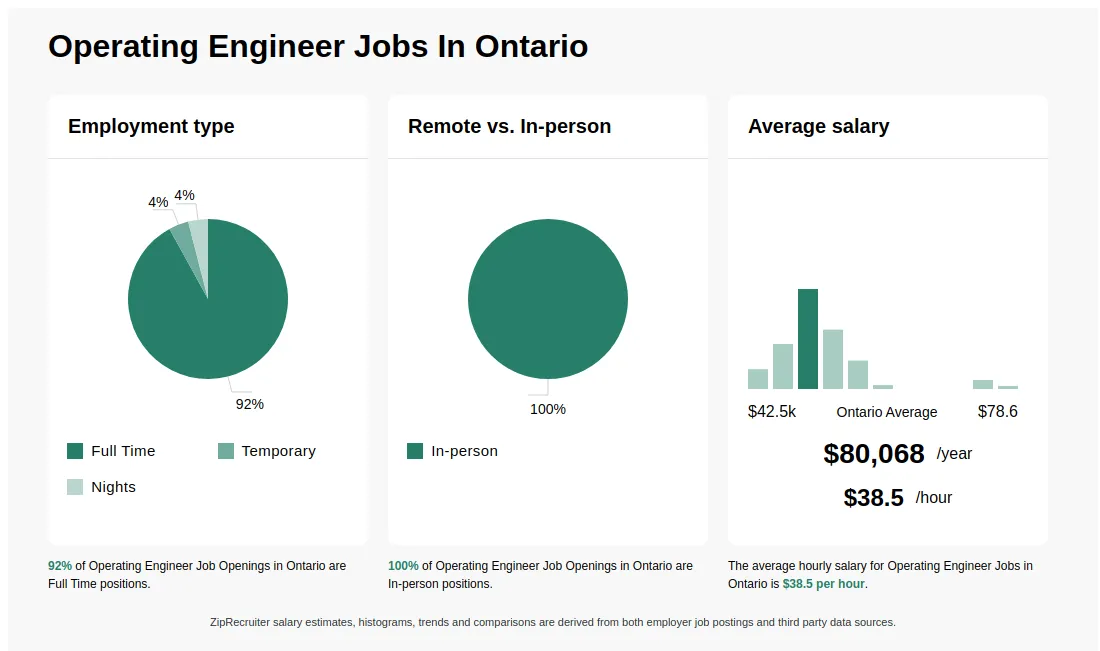
As of Sep 15, 2026, the average hourly pay for operating engineer in Ontario is $38.49, according to ZipRecruiter salary data. Most workers in this role earn between $31.25 and $40.38 per hour, depending on experience, location, and employer.
What is an operating engineer?
Operating Engineers are skilled professionals who operate and maintain heavy machinery and equipment, such as cranes, bulldozers, excavators, and loaders, commonly used on construction sites and in other industrial settings. They are responsible for ensuring the safe and efficient operation of this equipment, performing routine maintenance, troubleshooting issues, and sometimes assisting with repairs. Operating Engineers play a critical role in the successful completion of construction and infrastructure projects by helping move materials, clear land, and perform tasks that require mechanical power.
What are the key skills and qualifications needed to thrive as an operating engineer, and why are they important?
To thrive as an Operating Engineer, you need expertise in operating, maintaining, and repairing complex machinery, often backed by a high school diploma, technical training, and relevant licenses or certifications. Familiarity with control systems, heavy equipment, and safety protocols—such as OSHA standards—is essential. Strong problem-solving abilities, attention to detail, and effective communication are valuable soft skills in this role. These skills ensure safe, efficient operation of equipment, minimize downtime, and help maintain a secure work environment.
What are some common challenges operating engineers face when managing multiple pieces of equipment on a job site?
Operating Engineers often juggle the operation and maintenance of several types of heavy machinery, such as cranes, bulldozers, and excavators, which requires strong multitasking and organizational skills. A common challenge is coordinating equipment use efficiently to avoid downtime and bottlenecks, particularly on busy construction sites with tight schedules. Additionally, they must remain vigilant about safety protocols and equipment inspections to prevent accidents or mechanical failures. Effective communication with site supervisors and other team members is crucial to ensure a smooth workflow and address any issues promptly.
What is the difference between Operating Engineer vs Maintenance Technician?
| Aspect | Operating Engineer | Maintenance Technician |
|---|---|---|
| Credentials | OSHA certifications, state licenses, technical training | OSHA certifications, technical/vocational training |
| Work Environment | Industrial plants, power plants, large facilities | Buildings, manufacturing plants, facilities maintenance |
| Employer & Industry | Construction, utilities, manufacturing | Facilities management, manufacturing, commercial buildings |
Operating Engineers and Maintenance Technicians often share certifications and work in industrial or large facility environments. Operating Engineers focus on operating and maintaining heavy machinery and equipment, while Maintenance Technicians handle repairs and preventive maintenance of building systems. Both roles are essential for facility operations, but their specific duties and focus areas differ.
How much do operating engineers make in the US?
Operating engineers in the US typically earn a median annual wage of around $50,000 to $70,000, depending on experience, location, and specialization. Skilled operators with certifications and experience can earn higher salaries, especially in construction, power plants, or heavy industrial environments.
Is an operating engineer hard to get into?
Becoming an operating engineer typically requires completing technical training, obtaining relevant certifications, and gaining experience with heavy machinery. Entry can be competitive, especially for union positions, but proper training and licensing improve job prospects.
What are popular job titles related to Operating Engineer jobs in Ontario?
For Operating Engineer jobs in Ontario, the most frequently searched job titles are:
What cities in Ontario are hiring for Operating Engineer jobs?
Cities in Ontario with the most Operating Engineer job openings:
What are popular job titles related to Operating Engineer jobs in ON?
For Operating Engineer jobs in ON, the most frequently searched job titles are:
Operating Engineer, Class 3
Chalk River, ON
Canadian Nuclear Laboratories LTD
Full-time
Retirement, PTO
Re-posted 19 days ago
Job description
Are you looking for a role that will challenge you? If you answered yes, then this may be the job for you! Under the supervision of the Chief Operating Engineer or designate, successful candidates will be responsible for performing the duties required of an Operating Engineer CLASS 3 (CL3).
What you will be doing!
The Operating Engineer CL 3 is directly accountable for:
- Operating Chalk River Laboratories (CRL) Powerhouse equipment.
- Operating heating, ventilation, and air conditioning equipment, including ventilating fans, refrigeration compressors, pumps, steam and hot water boilers, both oil and gas, hot water heating systems, chilled water, and DX (Direct Expansion) air conditioning systems.
- Ensuring that the equipment is operated safely and efficiently according to written procedures or verbal instruction and instituting corrective action when necessary.
- Testing operating and safety controls, such as pressure switches, pressure relief valves, thermostats, control valves, traps, etc., to ensure that they are performing properly.
- Adjusting instrument control point settings to maintain proper temperature and humidity.
- Operating and maintaining a DDC (Distributed Digital Control) system including but not limited to monitoring, adjusting, programming, and minor maintenance.
- Recording and maintaining records on energy use: steam, air, water, and electricity.
- Recording temperature, relative humidity, and other operating conditions, as instructed.
- Performing routine patrols of site buildings to check for abnormal conditions in HVAC, sanitary sewer, firewater, service water systems, etc.
- Performing routine checks of the sewage treatment plant.
- Maintaining good housekeeping practices in all work areas, adhering to provincial, federal, and CNL regulations to provide a safe and efficient working environment.
- Attending monthly safety meetings and immediately report any safety concerns and/or infractions. Apply CNL's Event Free Tools procedure throughout the execution of assigned work and model this behavior and knowledge to others.
- Assisting in the training, coaching, and mentoring of new employees in safe practices and procedures.
- Performing water tests to determine water treatment measures needed, maintaining water quality in boilers, open and closed loop heating and cooling systems.
- Maintaining written and electronic logbooks.
- Other duties as assigned by your manager.
What we are looking for:
- Education:
- Grade 12 Secondary School Graduation Diploma
- Experience:
- Qualification as a 3rd Class Operating Engineer in the Province of Ontario (Standardized)
- Valid Class G Ontario Drivers license.
- Knowledge, Skills & Abilities:
- Knowledge of all applicable codes and standards including the Technical Standards and Safety Act - Ontario Regulation #219/01 - Operating Engineers, and all applicable CNL procedures to provide a safe and healthy work environment.
- Demonstrate use and endorsement of Personal Protection Equipment (PPE).
- Knowledge of high-pressure steam boilers and related control systems.
- Written and verbal communication skills to be able to work in multi-trade groups and communicate with CNL staff across a broad range of disciplines.
- Good computer skills and working knowledge of Microsoft Office to update and write procedures, create spreadsheets, input data, and communicate via email.
- Security Clearance Eligibility Required
- Reliability Status with Site Access Security Clearance (SASC), which has aminimum requirement of 3 years of verifiable history in Canada, Australia, New Zealand, the United States and/or the United Kingdom. CNL implements security screeningin accordance withthe Treasury Board of Canada Secretariat's "Standard on Security Screening" and the "Policy on Government Security."
Why CNL?
Does working with a team across Canada to advance nuclear science and technology for a clean and secure world speak to you? We're reinventing ourselves to be the pacesetters so we can lead the charge in solving the problems that matter, like building the next generation of clean nuclear and hydrogen energy solutions, developing new and better-targeted cancer treatments, and continuing to lead the world in environmental remediation.
We offer a complete total rewards package:
- paid time off (vacation, sick, floater & personal);
- benefits effective day one, that's right, no waiting period;
- tuition support
- and a pension!
Do Our Priorities Resonate with You?
- Clean energy for today and tomorrow.
- Restore and protect the Environment.
- Contribute to the health of Canadians.
Location :
CNL's Chalk River Laboratory is nestled in the Ottawa Valley and affords our employees an area that is environmentally pristine with extensive forests, hills, and numerous small lakes, all of which support a variety of wildlife typical to the southern edge of the Canadian Shield. Many surrounding towns, such as Pembroke, Petawawa, and Deep River, provide unparalleled outdoor adventures at your doorstep!
CNL is committed to providing an atmosphere free from barriers that promotes equity, diversity, and inclusion in achieving our mission. CNL welcomes and celebrates employees, stakeholders, and partners of all racial, cultural, and ethnic identities. Read here for more on our DE&I Commitment.
CNL also supports a workplace environment and corporate culture built on our Core Values: Respect, Teamwork, Accountability, Safety, Integrity, and Excellence. These values encourage equitable employment practices and career prospects inclusive of accommodations for all employees.
CNL is committed to being an equal-opportunity employer. If you require accommodation measures during any phase of the hiring process, please indicate via our ATS when applying. All information received regarding accommodation requests will be kept confidential.
The Chalk River Laboratories site is located on the unceded and unsurrendered territory of the Algonquin Anishinaabe people. As an organization, CNL recognizes and appreciates their historic connection to this place. CNL also recognizes the contributions that First Nations, Metis, Inuit and other Indigenous Peoples have made, both in shaping and strengthening this community in particular, and this province and country as a whole.
#LI-ONSITE
Employment Type: Full-Time