Minimum 3 years of field-level Oilfield Cementing experience is required to be considered * Class 1 ... Plan and coordinate rig in; evaluate execution requirements specific to the treatment * Inspect all ...
Minimum 3 years of field-level Oilfield Cementing experience is required to be considered * Class 1 ... Plan and coordinate rig in; evaluate execution requirements specific to the treatment * Inspect all ...
Oilfield safety tickets * Rig in and rig out familiarity * Twins operation experience (Operators) Work Environment This is field-based oilfield work in all weather conditions. The rotation is 15 days ...
Quick apply
Oilfield safety tickets * Rig in and rig out familiarity * Twins operation experience (Operators) Work Environment This is field-based oilfield work in all weather conditions. The rotation is 15 days ...
CA$1 - CA$2/hr
... oilfield sites. * Perform vacuum operations to remove drilling fluids, waste, and spills as per job requirements. * Assist with rig moves, well servicing, and industrial cleaning operations.
Quick apply
CA$1 - CA$2/hr
... oilfield sites. * Perform vacuum operations to remove drilling fluids, waste, and spills as per job requirements. * Assist with rig moves, well servicing, and industrial cleaning operations.
CA$1 - CA$2/hr
... oilfield sites. * Perform vacuum operations to remove drilling fluids, waste, and spills as per job requirements. * Assist with rig moves, well servicing, and industrial cleaning operations.
Quick apply
CA$1 - CA$2/hr
... oilfield sites. * Perform vacuum operations to remove drilling fluids, waste, and spills as per job requirements. * Assist with rig moves, well servicing, and industrial cleaning operations.

The Floorhand is part of a 5-person crew that works on a well service rig and is responsible for performing services on oil and gas wells. Duties of the Floor Hand include assisting in driving ...
The Floorhand is part of a 5-person crew that works on a well service rig and is responsible for performing services on oil and gas wells. Duties of the Floor Hand include assisting in driving ...
The Floorhand is part of a 5-person crew that works on a well service rig and is responsible for performing services on oil and gas wells. Duties of the Floor Hand include assisting in driving ...
The Floorhand is part of a 5-person crew that works on a well service rig and is responsible for performing services on oil and gas wells. Duties of the Floor Hand include assisting in driving ...

... oil and gas industry. Working under the direct supervision of the Field Supervisor, Operators will assist in safely carrying out rig-in/rig-out procedures, accurate data collection, reporting and ...
... oil and gas industry. Working under the direct supervision of the Field Supervisor, Operators will assist in safely carrying out rig-in/rig-out procedures, accurate data collection, reporting and ...
... in, rig-out, and daily operations of well testing equipment * Accurately record flow rates ... Previous experience in well testing or oilfield operations preferred * Water transfer experience is ...
Quick apply
... in, rig-out, and daily operations of well testing equipment * Accurately record flow rates ... Previous experience in well testing or oilfield operations preferred * Water transfer experience is ...
... in, rig-out, and daily operations of well testing equipment * Accurately record flow rates ... Previous experience in well testing or oilfield operations preferred * Water transfer experience is ...
... in, rig-out, and daily operations of well testing equipment * Accurately record flow rates ... Previous experience in well testing or oilfield operations preferred * Water transfer experience is ...
Boiler Operator
Grande Prairie, AB · On-site
Service rig and frac experience is an asset. Responsibilities * Operate and run oilfield equipment (Mobile boilers) * Maintain a high degree of cleanliness and professionalism on site * Work ...
Quick apply
Boiler Operator
Grande Prairie, AB · On-site
Service rig and frac experience is an asset. Responsibilities * Operate and run oilfield equipment (Mobile boilers) * Maintain a high degree of cleanliness and professionalism on site * Work ...
Boiler Operator
Grande Prairie, AB · On-site
Service rig and frac experience is an asset. Responsibilities * Operate and run oilfield equipment (Mobile boilers) * Maintain a high degree of cleanliness and professionalism on site * Work ...
Boiler Operator
Grande Prairie, AB · On-site
Service rig and frac experience is an asset. Responsibilities * Operate and run oilfield equipment (Mobile boilers) * Maintain a high degree of cleanliness and professionalism on site * Work ...
... in the oil and gas industry. We have a significant demand for multi-skilled workers, and we want ... Understanding the various permit requirements for the Rig and Picker * Emergency shut-down ...
... in the oil and gas industry. We have a significant demand for multi-skilled workers, and we want ... Understanding the various permit requirements for the Rig and Picker * Emergency shut-down ...
Truck Driver (Local)
Red Deer, AB · On-site
Experience with chaining up vehicles is considered an asset Previous experience as an operator, coiled tubing, rig, oilfield, oil amp; gas, oil and gas, energy, energy services, driving tractor ...
Truck Driver (Local)
Red Deer, AB · On-site
Experience with chaining up vehicles is considered an asset Previous experience as an operator, coiled tubing, rig, oilfield, oil amp; gas, oil and gas, energy, energy services, driving tractor ...

Shop Hand
Grande Prairie, AB · On-site
Precision Well Servicing is the largest service rig provider in Canada, with an impressive fleet of ... Precision is your first choice for a successful and rewarding career in oil and gas! We thank all ...
Shop Hand
Grande Prairie, AB · On-site
Precision Well Servicing is the largest service rig provider in Canada, with an impressive fleet of ... Precision is your first choice for a successful and rewarding career in oil and gas! We thank all ...
Shop Hand
Grande Prairie, AB · On-site
Precision Well Servicing is the largest service rig provider in Canada, with an impressive fleet of ... Precision is your first choice for a successful and rewarding career in oil and gas! We thank all ...
Quick apply
Shop Hand
Grande Prairie, AB · On-site
Precision Well Servicing is the largest service rig provider in Canada, with an impressive fleet of ... Precision is your first choice for a successful and rewarding career in oil and gas! We thank all ...
Plan and coordinate rig in; evaluate execution requirements specific to the cementing program ... Oilfield Cementing experience is strongly preferred; WCSB experience in a completions related role ...
Plan and coordinate rig in; evaluate execution requirements specific to the cementing program ... Oilfield Cementing experience is strongly preferred; WCSB experience in a completions related role ...
Shop Hand
Cold Lake, AB · On-site
Precision Well Servicing is the largest service rig provider in Canada, with an impressive fleet of ... Precision is your first choice for a successful and rewarding career in oil and gas! We thank all ...
Shop Hand
Cold Lake, AB · On-site
Precision Well Servicing is the largest service rig provider in Canada, with an impressive fleet of ... Precision is your first choice for a successful and rewarding career in oil and gas! We thank all ...
Shop Hand
Cold Lake, AB · On-site
Precision Well Servicing is the largest service rig provider in Canada, with an impressive fleet of ... Precision is your first choice for a successful and rewarding career in oil and gas! We thank all ...
Quick apply
Shop Hand
Cold Lake, AB · On-site
Precision Well Servicing is the largest service rig provider in Canada, with an impressive fleet of ... Precision is your first choice for a successful and rewarding career in oil and gas! We thank all ...
Plan and coordinate rig in; evaluate execution requirements specific to the cementing program ... Oilfield Cementing experience is strongly preferred; WCSB experience in a completions related role ...
Plan and coordinate rig in; evaluate execution requirements specific to the cementing program ... Oilfield Cementing experience is strongly preferred; WCSB experience in a completions related role ...
Plan and coordinate rig in; evaluate execution requirements specific to the cementing program ... Oilfield Cementing experience is strongly preferred; WCSB experience in a completions related role ...
Plan and coordinate rig in; evaluate execution requirements specific to the cementing program ... Oilfield Cementing experience is strongly preferred; WCSB experience in a completions related role ...
Oil Rig information
See Alberta salary details
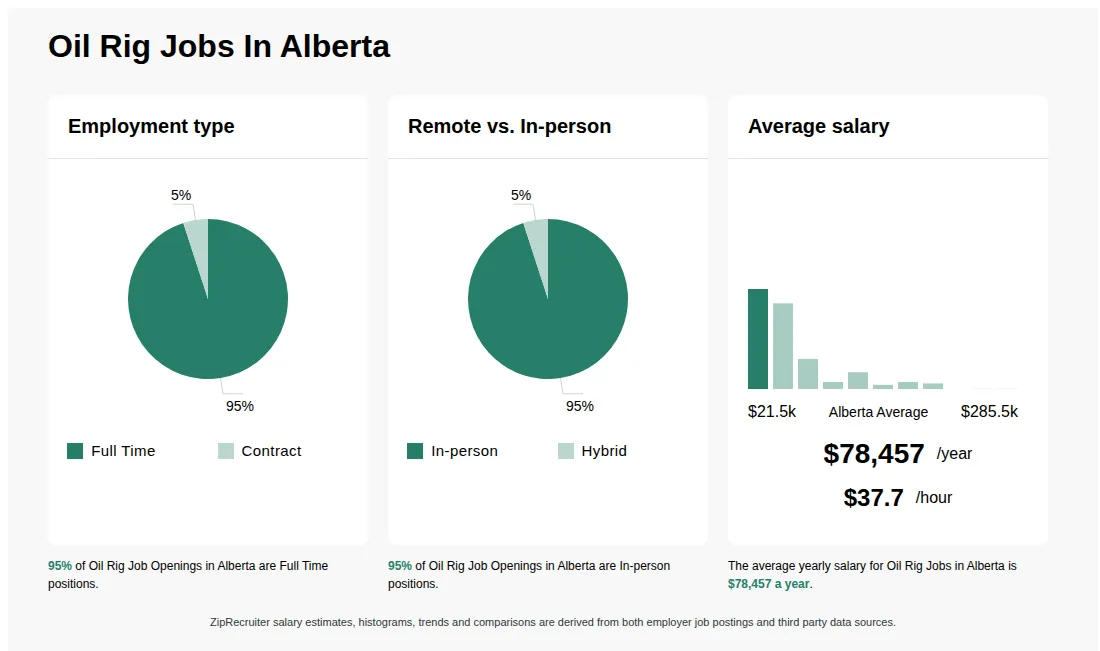
$36.5K is the 25th percentile. Wages below this are outliers.
$21.5K - $45.5K
40% of jobs
The median wage is $52.4K / yr.
$45.5K - $69.5K
35% of jobs
$70K is the 75th percentile. Wages above this are outliers.
$69.5K - $93.5K
12% of jobs
$93.5K - $117.5K
2% of jobs
$117.5K - $141.5K
6% of jobs
$141.5K - $165.5K
1% of jobs
$165.5K - $189.5K
2% of jobs
$189.5K - $213.5K
2% of jobs
$213.5K - $237.5K
0% of jobs
$237.5K - $261.5K
0% of jobs
$261.5K - $285.5K
0% of jobs
$21.5K
$78.5K
$285.5K
How much do oil rig jobs pay per year?
As of Sep 9, 2026, the average yearly pay for oil rig in Alberta is $78,457.00, according to ZipRecruiter salary data. Most workers in this role earn between $39,500.00 and $90,000.00 per year, depending on experience, location, and employer.
What is an oil rig worker?
Oil rig jobs include semi-skilled workers who operate on the rig deck, specialists who work on machinery for drilling, and drillers and assistants who handle the controls of the drill in a control room. On offshore rigs, crews may include medics, mechanics, welders, and cooks. Management-level staff on oil and gas industry rigs include tool pushers, who work in the rig office, and offshore installation managers, whose duties involve overseeing the entire rig operation. Geologists who work on an oil rig collect samples during operations, otherwise known as “mud logging.”
What are some common challenges faced by workers on an oil rig, and how are they addressed?
Working on an oil rig presents unique challenges such as long shifts, remote locations, and exposure to harsh weather conditions. Team members often work in rotating shifts (e.g., two weeks on, two weeks off), which can impact work-life balance. Safety is a top priority, with regular drills and strict protocols to minimize risks from heavy machinery and hazardous materials. Strong teamwork and communication are essential, as crews must collaborate closely to ensure operations run smoothly and safely. Most companies provide thorough training, support services, and modern amenities to help staff manage these challenges.
What is the difference between Oil Rig vs Oil Platform Worker?
| Aspect | Oil Rig | Oil Platform Worker |
|---|---|---|
| Credentials | Certifications in safety, welding, and technical skills | Safety training, technical certifications often required |
| Work Environment | Offshore, mobile, often in harsh weather | Offshore platform, fixed or semi-permanent structures |
| Employer & Industry Usage | Used interchangeably in industry, referring to offshore drilling units | Refers to personnel working on oil platforms |
Both 'Oil Rig' and 'Oil Platform Worker' relate to offshore oil extraction. An oil rig is the structure used for drilling, while an oil platform worker is the personnel operating on these structures. Understanding the distinction helps in job searches and industry comprehension.
How much do you get paid on oil rigs?
Oil rig workers typically earn between $50,000 and $150,000 annually, depending on experience, role, and location. Positions such as roustabouts, roughnecks, and drillers have different pay scales, with specialized roles often commanding higher wages. Overtime, shift differentials, and safety certifications can also impact earnings.
How much does a job on an oil rig pay?
Oil rig workers typically earn between $50,000 and $150,000 annually, depending on experience, role, and location. Positions such as roustabouts, roughnecks, and engineers have varying pay scales, with specialized skills and certifications often leading to higher wages. Overtime, shift differentials, and hazard pay can also increase total compensation.
More about Oil Rig jobs
What are the most commonly searched types of Oil Rig jobs in Alberta?
The most popular types of Oil Rig jobs in Alberta are:
What are popular job titles related to Oil Rig jobs in Alberta?
For Oil Rig jobs in Alberta, the most frequently searched job titles are:
What job categories do people searching Oil Rig jobs in Alberta look for?
The top searched job categories for Oil Rig jobs in Alberta are:
What cities in Alberta are hiring for Oil Rig jobs?
Cities in Alberta with the most Oil Rig job openings:

Experienced Oilfield Cementers (Operators & Supervisors)
Red Deer, AB • On-site
Sanjel Energy Services •
201 - 500 employees201 - 500 employees
Full-time
This job post has expired 3 days ago. Applications are no longer accepted.
Key responsibilities
Accountable for the welfare of the crew and equipment maintenance and repair.
Operate and manage hydraulic pumping equipment to place cement in wells and perform pressure-pumping treatments.
Communicate with management, clients, and crew to plan, coordinate, and execute cementing services.
Job description
Sanjel Energy Servicesis actively recruiting experiencedOilfield Cementing Supervisors and Operators at all base locations: Red Deer,Edmonton, Grande Prairie, Fort St. John, Lac La Biche, Lloydminster, Swift Current, Estevan
- Minimum 3 years of field-level Oilfield Cementing experience is required to be considered
- Class 1 license is preferred, but not required in lieu of field experience (clean abstract required)
- Local candidates will be prioritized; rotational / relocation opportunities for those who qualify
- 15&6 / on-call rotation, permanent roles with opportunities to advance
Sanjel Energy Servicesis a leadingenergy services company specializing in customized well cementing solutions across Canada. Our commitment to innovation, Safety, and service excellence ensures we consistently deliver optimal solutions to our clients.
The Opportunity:
The Supervisor or Operator - Cementingwill report directly to the Manager - District Service Line. The primary function of this position is to be accountable for the welfare and operational excellence of the crew and equipment maintenance and repair.
In this capacity, the Sanjel Professional is accountable for oneself and for their team while keeping work areas clean and maintained, complying with all relevant company policy and regulations related to HSE, promoting teamwork, and to identify opportunities and processes to improve performance.
The Professional is accountable for the safe transportation and operation of specialized hydraulic pumping equipment used to place cement in wells and perform pressure-pumping treatments involving chemicals, sand mixtures, or gases. This is aSafety Sensitiveposition requiring sound operational judgement, demonstrated field competence, and strict compliance with company and regulatory standards.
General Responsibilities:
- Communicate effectively with management, client and crew in the planning, coordination, and execution of Sanjel service
- Meet with our Customers Representative to discuss specific job requirements
- Review treatment programs to ensure they include the proper functions, are error free and are within the capability of the crew and equipment
- Plan and coordinate rig in; evaluate execution requirements specific to the treatment
- Inspect all personnel, equipment, and rig in to ensure they meet Sanjel and customer requirements
- Ensure all equipment is inspected, properly configured and meets treatment requirements
- Assemble and operate pumping systems to pump chemicals, gases, sand, cement and/or other materials
- Complete and submit all required paperwork (i.e. expense account, bonus and fuel sheets, logbooks, pre/post trip inspections, loading tickets); and ensure all paperwork is kept up to date
- Read gauges to monitor pressure, density, rate and/or concentration and adjust pumping procedure as required
- Manage product volumes on location, mix chemicals and cement
- Complete a proper pre-trip inspection, drive well servicing equipment to and from well sites
Qualifications:
- A minimum of 3 years field experience in Oilfield Cementing is required to be considered
- Applicable operational training and experience in Cementing Services
- Class 1 Driver's License is strongly preferred, a clean abstract is required
- Proven oilfield cementing experience operating heavy equipment in off-road oilfield conditions is preferred; direct Western Canadian Sedimentary Basin experience is strongly preferred
- Demonstrated ability to read gauges, follow job programs, recognize changing field conditions, and respond appropriately within established operating procedures
- A consistent record of safe work practices, dependable attendance, professional conduct, and effective performance within a crew-based environment
- Ability to perform physically demanding work for extended periods and in severe outdoor conditions, including variable weather and challenging terrain
- Strong mechanical aptitude, attention to detail, and the ability to identify and report equipment or operational concerns promptly
- Current First Aid, H2S Alive, Oilfield Driver Awareness, and Heavy Hauler certifications are preferred; successful candidates must be willing and able to maintain all required certifications
- Preference will be given to qualified local candidates and experienced applicants who have secured housing or are prepared to relocate
AtSanjel Energy Services,our people drive our success. We're always seeking talented individuals - whether you're an experienced professional or launching your career in the energy services sector.
Our Culture
We believe success starts with people and we strive for a workplace where our employees can shine. That's why we foster an inclusive culture built on teamwork, integrity, service, and excellence.
We value creativity and diversity, ensuring equal opportunities for all and empowering every team member to thrive.
AtSanjel Energy Services, Safety is our priority and is prioritized in every action and decision, from the boardroom to the wellsite. Every team member is empowered to be a steward for safety at work, at home, and in the community.
Why You'll Love Working Here
Sanjel Energy Servicesis a market-leading energy services company specializing in customized well cementing solutions across Canada. Safety is our priority, with a foundation built on integrity and teamwork.
Our commitment to service and excellence ensures we consistently deliver optimal solutions to our clients and a rewarding experience for our team.
Extras That Count
Employee Referral Program, fuel discounts, and other employee-exclusive deals.
Compensation & Benefits
JoinSanjel Energy Servicesand enjoy a Comprehensive Total Rewards package designed to take care of you and your family.

About Sanjel Energy Services
Sourced by ZipRecruiter