Rig Operator Beckman Production is an oilfield well-servicing and trucking company. We are looking for rig hands to help operate the service rigs that we run. It is a several man crew, the operator ...
Quick apply
Rig Operator Beckman Production is an oilfield well-servicing and trucking company. We are looking for rig hands to help operate the service rigs that we run. It is a several man crew, the operator ...
Quick apply
Rig Operator Beckman Production is an oilfield well-servicing and trucking company. We are looking for rig hands to help operate the service rigs that we run. It is a several man crew, the operator ...
$18 - $20/hr
Rig Hand Beckman Production is an oilfield well-servicing and trucking company. We are looking for rig hands to help operate the service rigs that we run. It is a several man crew, the operator ...
Quick apply
$18 - $20/hr
Rig Hand Beckman Production is an oilfield well-servicing and trucking company. We are looking for rig hands to help operate the service rigs that we run. It is a several man crew, the operator ...
Iowa Park, TX · On-site
$24 - $31.75/hr
Responsible for Oil Rig maintenance/repairs in a timely manner and safety. ? Maintain a clean and organized work station/location. ? Perform other related duties as required or assigned. RELOCATION ...
Quick apply
Iowa Park, TX · On-site
$24 - $31.75/hr
Responsible for Oil Rig maintenance/repairs in a timely manner and safety. ? Maintain a clean and organized work station/location. ? Perform other related duties as required or assigned. RELOCATION ...
Iowa Park, TX · On-site
$24 - $31.75/hr
Responsible for Oil Rig maintenance/repairs in a timely manner and safety. Maintain a clean and organized work station/location. Perform other related duties as required or assigned. RELOCATION ...
Iowa Park, TX · On-site
$24 - $31.75/hr
Responsible for Oil Rig maintenance/repairs in a timely manner and safety. Maintain a clean and organized work station/location. Perform other related duties as required or assigned. RELOCATION ...
Iowa Park, TX · On-site
$24 - $31.75/hr
Category Oil & Gas Production Description Diesel / Rig Mechanic Diesel / Rig Mechanic's responsibilities include diagnosing operational problems and making repairs to correct them. Mechanic must also ...
Iowa Park, TX · On-site
$24 - $31.75/hr
Category Oil & Gas Production Description Diesel / Rig Mechanic Diesel / Rig Mechanic's responsibilities include diagnosing operational problems and making repairs to correct them. Mechanic must also ...
Anchorage, AK · On-site
Responsible for proper periodic oil changes and greasing of diesel engines and rig equipment. * Inspects air compressors and compressed air system daily. * Inspects BOP accumulator, AC generators ...
Anchorage, AK · On-site
Responsible for proper periodic oil changes and greasing of diesel engines and rig equipment. * Inspects air compressors and compressed air system daily. * Inspects BOP accumulator, AC generators ...
Houston, TX · On-site
... oil rig and also looks after the drilling activities and equipment. 11. Provides leadership and ensures safety training and practices. 12. Resolves disputes and helps in solving personnel and ...
Houston, TX · On-site
... oil rig and also looks after the drilling activities and equipment. 11. Provides leadership and ensures safety training and practices. 12. Resolves disputes and helps in solving personnel and ...
Houston, TX · On-site
... oil rig and also looks after the drilling activities and equipment. 11. Provides leadership and ensures safety training and practices. 12. Resolves disputes and helps in solving personnel and ...
Houston, TX · On-site
... oil rig and also looks after the drilling activities and equipment. 11. Provides leadership and ensures safety training and practices. 12. Resolves disputes and helps in solving personnel and ...
Anchorage, AK · On-site
Collaborate with the rig manager regarding maintenance, repairs and planning ahead in order to ... Familiarity with oilfield-related equipment, and procedures preferred. * Experience with energy ...
Anchorage, AK · On-site
Collaborate with the rig manager regarding maintenance, repairs and planning ahead in order to ... Familiarity with oilfield-related equipment, and procedures preferred. * Experience with energy ...
Bridgeport, WV · On-site
Diversified Gas & Oil Corporation (DGOC) is an established owner and operator of producing ... The Rig Hand II is considered a fully competent Rig Hand, within limits of experience. They work ...
Bridgeport, WV · On-site
Diversified Gas & Oil Corporation (DGOC) is an established owner and operator of producing ... The Rig Hand II is considered a fully competent Rig Hand, within limits of experience. They work ...
Anchorage, AK · On-site
Collaborate with the rig manager regarding maintenance, repairs and planning ahead in order to ... Familiarity with oilfield-related equipment, and procedures preferred. * Experience with energy ...
Anchorage, AK · On-site
Collaborate with the rig manager regarding maintenance, repairs and planning ahead in order to ... Familiarity with oilfield-related equipment, and procedures preferred. * Experience with energy ...
Geneva, PA · On-site
Diversified Gas & Oil Corporation (DGOC) is an established owner and operator of producing ... The Rig Hand II is considered a fully competent Rig Hand, within limits of experience. They work ...
Geneva, PA · On-site
Diversified Gas & Oil Corporation (DGOC) is an established owner and operator of producing ... The Rig Hand II is considered a fully competent Rig Hand, within limits of experience. They work ...
Rig Hand As a Rig Hand in the Upstream Oil and Gas industry, you will be an essential part of our drilling operations team, responsible for various tasks that contribute to the safe and efficient ...
Rig Hand As a Rig Hand in the Upstream Oil and Gas industry, you will be an essential part of our drilling operations team, responsible for various tasks that contribute to the safe and efficient ...
Rig Hand As a Rig Hand in the Upstream Oil and Gas industry, you will be an essential part of our drilling operations team, responsible for various tasks that contribute to the safe and efficient ...
Rig Hand As a Rig Hand in the Upstream Oil and Gas industry, you will be an essential part of our drilling operations team, responsible for various tasks that contribute to the safe and efficient ...
Diversified Gas & Oil Corporation (DGOC) is an established owner and operator of producing ... The Rig Hand II is considered a fully competent Rig Hand, within limits of experience. They work ...
Diversified Gas & Oil Corporation (DGOC) is an established owner and operator of producing ... The Rig Hand II is considered a fully competent Rig Hand, within limits of experience. They work ...
Bridgeport, WV · On-site
Diversified Gas & Oil Corporation (DGOC) is an established owner and operator of producing ... The Rig Hand I is considered a Rig Hand in training or entry level Rig Hand. They work under the ...
Bridgeport, WV · On-site
Diversified Gas & Oil Corporation (DGOC) is an established owner and operator of producing ... The Rig Hand I is considered a Rig Hand in training or entry level Rig Hand. They work under the ...
Glasgow, MT · On-site
$41.50/hr
This position requires the coordination of the crews that perform different tasks on the oil rig according to the regulations of the oil company, making sure that the work of the crew follows all ...
Glasgow, MT · On-site
$41.50/hr
This position requires the coordination of the crews that perform different tasks on the oil rig according to the regulations of the oil company, making sure that the work of the crew follows all ...
Geneva, PA · On-site
Diversified Gas & Oil Corporation (DGOC) is an established owner and operator of producing ... The Rig Hand I is considered a Rig Hand in training or entry level Rig Hand. They work under the ...
Geneva, PA · On-site
Diversified Gas & Oil Corporation (DGOC) is an established owner and operator of producing ... The Rig Hand I is considered a Rig Hand in training or entry level Rig Hand. They work under the ...
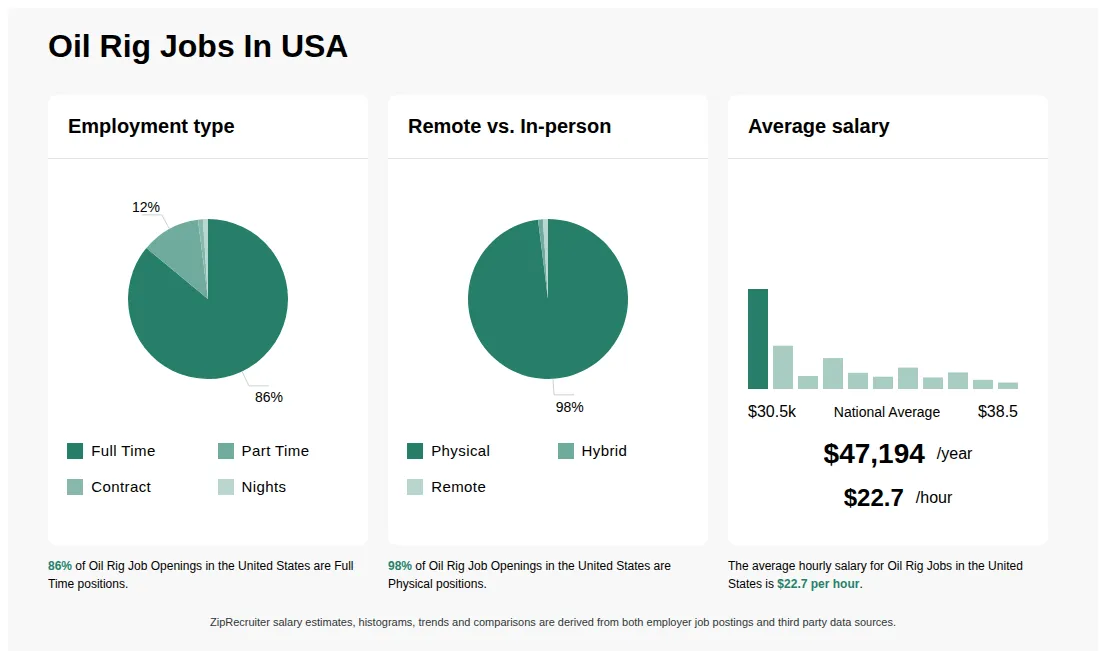
$16.12 is the 25th percentile. Wages below this are outliers.
$14.66 - $16.83
37% of jobs
The median wage is $18.56 / hr.
$16.83 - $18.99
16% of jobs
$18.99 - $21.15
4% of jobs
$21.15 - $23.32
11% of jobs
$23.32 - $25.48
5% of jobs
$26.29 is the 75th percentile. Wages above this are outliers.
$25.48 - $27.64
4% of jobs
$27.64 - $29.81
7% of jobs
$29.81 - $31.97
4% of jobs
$31.97 - $34.13
5% of jobs
$34.13 - $36.30
3% of jobs
$36.30 - $38.46
2% of jobs
$14
$22
$38
Oil rig jobs include semi-skilled workers who operate on the rig deck, specialists who work on machinery for drilling, and drillers and assistants who handle the controls of the drill in a control room. On offshore rigs, crews may include medics, mechanics, welders, and cooks. Management-level staff on oil and gas industry rigs include tool pushers, who work in the rig office, and offshore installation managers, whose duties involve overseeing the entire rig operation. Geologists who work on an oil rig collect samples during operations, otherwise known as “mud logging.”
| Aspect | Oil Rig | Oil Platform Worker |
|---|---|---|
| Credentials | Certifications in safety, welding, and technical skills | Safety training, technical certifications often required |
| Work Environment | Offshore, mobile, often in harsh weather | Offshore platform, fixed or semi-permanent structures |
| Employer & Industry Usage | Used interchangeably in industry, referring to offshore drilling units | Refers to personnel working on oil platforms |
Both 'Oil Rig' and 'Oil Platform Worker' relate to offshore oil extraction. An oil rig is the structure used for drilling, while an oil platform worker is the personnel operating on these structures. Understanding the distinction helps in job searches and industry comprehension.
Cities with the most Oil Rig job openings:
The most popular types of Oil Rig jobs are:
States with the most job openings for Oil Rig jobs include:
The top searched job categories for Oil Rig jobs are:

Kalkaska, MI
Full-time
Posted 8 days ago
Rig Operator
Beckman Production is an oilfield well-servicing and trucking company. We are looking for rig hands to help operate the service rigs
that we run. It is a several man crew, the operator, floor hands, a derrick hand, supervisors, and company men frequently on site.
Safety is a priority at Beckman that includes following directions, being aware of your surroundings, and paying attention to hazards.
Nights and weekends may be required depending on the job. Expect 40-80 hours a week.
Per Diem and Health benefits offered.
Stop in at any one of Beckman locations and complete an application or submit a request to JRMR@Beckmanproduction.com to have an application emailed to you.
Job Type: Full-time
Pay: Based on Experience
Schedule:
Education:
License/Certification:
Work Location: Harrison, MI and Kalkaska, MI
Beckman Production Services Inc.
Beckman Production Services is a well servicing company that operates completion and workover rigs, swabbing units, hot oilers, high pressure pump trucks, anchor setting trucks, wireline units, vacuum trucks, crude oil trucks and tankers licensed to haul non-hazardous liquid waste and crude oil. In addition, the company operates five Class II oilfield brine disposal wells and several mineral brine wells which produce concentrated brine that is sold for dust and ice control.

Sourced by ZipRecruiter


