1

Oil Rig Jobs in Alaska (NOW HIRING)

Well Service Support Technician

Prudhoe Bay, AK · On-site

$24.25 - $33.25/hr

Lynden Oil Field Services, a division of Alaska West Express, Inc., provides support for ... Provide proppant handling services, manifolding rig-up and tanks measurement during the job.

Well Service Support Technician

Prudhoe Bay, AK · On-site

$24.25 - $33.25/hr

Lynden Oil Field Services, a division of Alaska West Express, Inc., provides support for ... Provide proppant handling services, manifolding rig-up and tanks measurement during the job.

Outboard Mechanic

Sitka, AK · On-site

$25 - $41/hr

Perform oil and gear lube changes, spark plug replacement and filter changes. * Perform belt ... Install and rig outboard engines. * Service steering systems (hydraulic and mechanical), gauges ...

... rig clerk, ice road or winter construction administrator, or camp administrator, are well suited to this role * Solid understanding of AFE structure, cost coding, and invoice processing in an oil and ...

next page

Showing results 1-20

Oil Rig information

See Alaska salary details

$15

$24

$41

How much do oil rig jobs pay per hour?

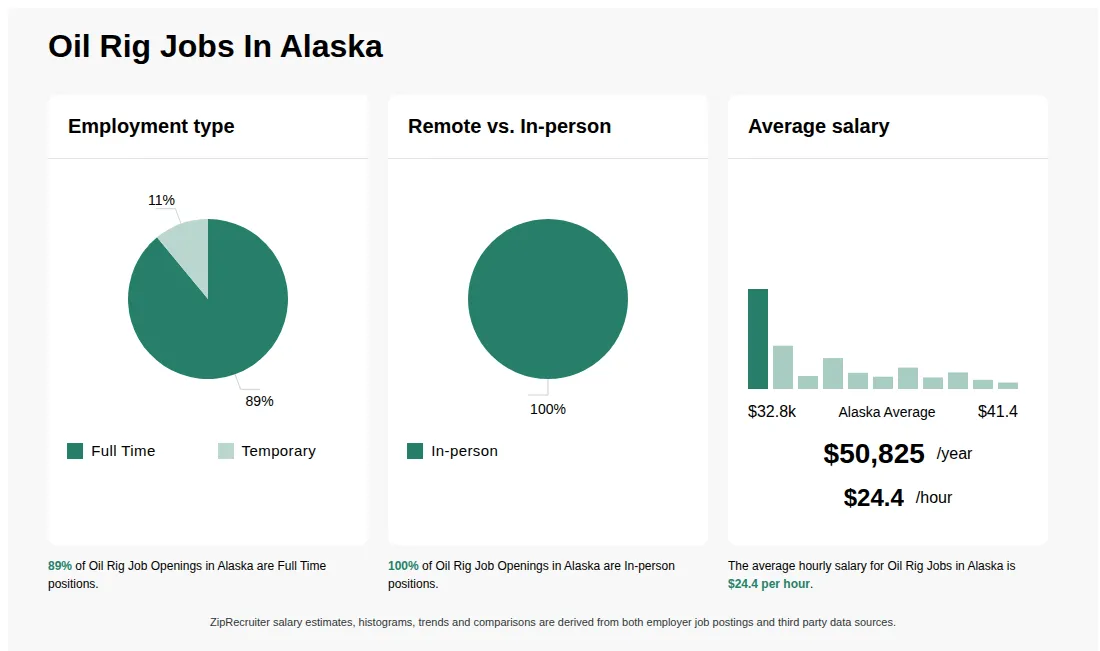
As of Jun 20, 2026, the average hourly pay for oil rig in Alaska is $24.44, according to ZipRecruiter salary data. Most workers in this role earn between $17.07 and $30.82 per hour, depending on experience, location, and employer.

What are some common challenges faced by workers on an oil rig, and how are they addressed?

Working on an oil rig presents unique challenges such as long shifts, remote locations, and exposure to harsh weather conditions. Team members often work in rotating shifts (e.g., two weeks on, two weeks off), which can impact work-life balance. Safety is a top priority, with regular drills and strict protocols to minimize risks from heavy machinery and hazardous materials. Strong teamwork and communication are essential, as crews must collaborate closely to ensure operations run smoothly and safely. Most companies provide thorough training, support services, and modern amenities to help staff manage these challenges.

What are oil rig workers?

Oil rig workers are professionals who operate and maintain the equipment used to drill for oil and gas beneath the earth's surface, often on offshore platforms or onshore drilling sites. Their responsibilities include monitoring drilling operations, ensuring safety protocols are followed, and performing routine maintenance on machinery. Oil rig work can be physically demanding and requires long shifts, sometimes in remote or challenging environments. Many positions on an oil rig, such as roughneck, driller, or derrickhand, each have specific duties that contribute to the overall drilling process.

How much do oil rig workers make?

Oil rig workers' salaries vary based on experience, role, and location, but they typically earn between $50,000 and $150,000 annually. Skilled positions such as drillers and engineers tend to have higher pay, and many workers receive additional compensation for working long shifts and in remote environments.

What is the difference between Oil Rig vs Oil Platform Worker?

AspectOil RigOil Platform Worker
CredentialsCertifications in safety, welding, and technical skillsSafety training, technical certifications often required
Work EnvironmentOffshore, mobile, often in harsh weatherOffshore platform, fixed or semi-permanent structures
Employer & Industry UsageUsed interchangeably in industry, referring to offshore drilling unitsRefers to personnel working on oil platforms

Both 'Oil Rig' and 'Oil Platform Worker' relate to offshore oil extraction. An oil rig is the structure used for drilling, while an oil platform worker is the personnel operating on these structures. Understanding the distinction helps in job searches and industry comprehension.

Do roughnecks make 180k a year?

Roughnecks on oil rigs typically earn between $50,000 and $100,000 annually, with experienced workers in high-paying regions sometimes reaching around $150,000. Earning $180,000 a year is uncommon and usually requires extensive experience, specialized skills, or working in high-cost or offshore environments with additional hazard pay or overtime.

What are the key skills and qualifications needed to thrive as an Oil Rig Worker, and why are they important?

To thrive as an Oil Rig Worker, you need physical stamina, mechanical aptitude, and a high school diploma or equivalent, with specialized safety certifications like H2S and Basic Offshore Safety Induction and Emergency Training (BOSIET) often required. Familiarity with drill machinery, rig safety systems, and tools such as rotary drills and hoisting equipment is essential. Teamwork, problem-solving, and strong communication skills help individuals stand out in this demanding and hazardous environment. These abilities ensure operational efficiency, personal safety, and effective collaboration under challenging offshore conditions.

What job makes $10,000 a month without a degree?

An oil rig worker, such as a roustabout or roughneck, can earn $10,000 or more per month with experience and specialized skills. These roles often require physical fitness, safety certifications, and on-site training, but typically do not require a college degree. High-paying positions are usually found in offshore drilling or deepwater operations.

What Are Jobs on an Oil Rig?

Oil rig jobs include semi-skilled workers who operate on the rig deck, specialists who work on machinery for drilling, and drillers and assistants who handle the controls of the drill in a control room. On offshore rigs, crews may include medics, mechanics, welders, and cooks. Management-level staff on oil and gas industry rigs include tool pushers, who work in the rig office, and offshore installation managers, whose duties involve overseeing the entire rig operation. Geologists who work on an oil rig collect samples during operations, otherwise known as “mud logging.”

How much do you get paid on oil rigs?

Oil rig workers typically earn between $50,000 and $150,000 annually, depending on experience, role, and location. Positions such as roustabouts, roughnecks, and drillers have different pay scales, with specialized roles often earning higher wages. Many workers also receive additional compensation for overtime, hazards, and rotation schedules.
What are the most commonly searched types of Oil Rig jobs in Alaska? The most popular types of Oil Rig jobs in Alaska are:
What are popular job titles related to Oil Rig jobs in Alaska? For Oil Rig jobs in Alaska, the most frequently searched job titles are:
What cities in Alaska are hiring for Oil Rig jobs? Cities in Alaska with the most Oil Rig job openings:
Expression of Interest - ALASKA ELECTRICIAN

Expression of Interest - ALASKA ELECTRICIAN

Nabors Industries Limited

Anchorage, AK • On-site

$27.25 - $35.25/hr

Full-time

Posted 17 days ago


Nabors Industries rating

6.7

Company rating: 6.7 out of 10

Based on 14 frontline employees who took The Breakroom Quiz

43rd of 74 rated oil and gas companies


Job description

Job Description
The Electrician works as a member of the engineering team. This team, consisting of the Mechanic, Electrician, Motorman (where appropriate), and Welder, work under the supervision and direction of the Toolpusher. As such, it is imperative that each member of the team be a self-starter and willing to assist the other worker in the performance of the job when requested to do so.
Location: Alaska
Rotation: 14x14 or 21x21 (days or nights, including weekends and holidays)
Responsibilities
  • The Electrician is responsible for simple repair and general maintenance of deck equipment, including the leg depth indicator, A.C. motors that drive the elevator motor units, skidder gear unit (longitudinal and transverse), raw water tour gear unit, raw water pump, and electric cranes and controls.
  • The Electrician is responsible for simple repair and general maintenance of drilling equipment, including the electrical brake, drilling equipment control console, mud pump control console, A.C. motors that drive the drawworks clutch and brake cooling pump, crane, drawworks drive blower, rotary table drive blower, rig floor hydraulic power unit, bulk air compressor, mud mixer, hopper pump, shale shaker, degasser pump, accumulator unit, desander pump, and D.C. motors that drive the drawworks, rotary table, and top drive.
  • The Electrician is responsible for simple repair and general maintenance of the engine room, including A.C. motors that drive the saltwater pump system, non-portable water pump system, oil pump system, air compressor system, and vent exhaust and supply fans, as well as bus and control circuits, individual feeders, switchboard, A.C. generators, motor generator set, SCR system, tachometer generator, engine alarm system, battery charger, and ventilation system.
  • The Electrician is responsible for simple repair and general maintenance of the living quarters, including the marine range and fry range.
  • Consistently follows established safety procedures.
  • Inspires open communication and fosters team commitment.
  • Strives to perform at the highest level while always keeping customer satisfaction in mind.
  • Effectively plans ahead to meet commitments.
  • Brings forth suggestions or ideas to reduce costs or improve safety, efficiency, and/or effectiveness of work processes and/or operations.
  • Appropriately raises concerns and/or issues to management.
  • Supports change and a positive work environment.
  • Understands duties and responsibilities and has necessary knowledge and skills for the current job.
  • Strives to exceed customer expectations and deliver the highest level of customer satisfaction.
  • Measures and records technical data as tasks are completed.
  • Schedules and organizes work tasks of subordinates (Level 1).
  • Assists in the assembly process with the assistance of drawings and schematics.
  • Assists with part fitting, bolting, connecting, threading, aligning, calibrating, grinding, crimping, and inspecting.
  • Ability to explain the theory of operations of plant electrical component motors.
  • Ability to perform special soldering.
  • Understands basic formulas of electricity.
  • Explains the basic electrical layout.
  • Understands basic circuit elements (source, ground, resistor, capacitor).
  • Understands BOMs (Folder/Process).

Qualifications
  • 2 years experience with equipment similar to that used on the rig being assigned to, with a minimum of 12 months experience with drive systems, if the rig is so equipped, is preferred.
  • Experience with USCG regulations on the electrical systems and wiring requirements if the assigned rig is a MODU classed unit.
  • Ability to wear respiratory protective devices.
  • Licensure/Certificate Required: STOP for Supervisor Program.
  • Repetitively bend, stoop, kneel, twist, and crawl, often while in Personal Protective Equipment (PPE).
  • Ability to work outdoors in extreme Arctic conditions, including subzero temperatures, snow, and ice.
  • Must be able to understand and follow both verbal and written instructions.
  • Must pass all required pre-employment and site-specific drug and fitness-for-duty testing.
  • Must possess a valid Driver's License (no restrictions) - Real ID compliant, suitable for travel to Alaska and the North Slope.

About Us
Nabors is a leading provider of advanced technology for the energy industry. With operations in about 20 countries, Nabors has established a global network of people, technology and equipment to deploy solutions that deliver safe, efficient and responsible hydrocarbon production. By leveraging its core competencies, particularly in drilling, engineering, automation, data science and manufacturing, Nabors aims to innovate the future of energy and enable the transition to a lower carbon world.
Equal Opportunity Employer
Nabors is committed to providing equal employment opportunities to all employees and applicants and prohibiting discrimination and harassment of any type without regard to race, religion, age, color, sex, national origin, disability status, genetics, protected veteran status, sexual orientation, gender identity or expression, or any other characteristic protected by federal, state, or local laws. This applies to all terms and conditions of employment including recruiting, hiring, placement, promotion, termination, layoff, recall, transfer, leave of absence, compensation, and training. To learn more about our Fair Employment practices, please refer to the Nabors Code of Conduct.

What Nabors Industries employees say

Pay

Hours and flexibility

Workplace

Get the full story on Breakroom