1

Oil Rig Mechanic Jobs (NOW HIRING)

Overview The Rig-Up Specialist is responsible for installing, maintaining, and operating lay flat ... The ideal candidate has hands-on oilfield experience, strong mechanical skills, and the ability to ...

Basic mechanical skills and understanding of rig equipment * Physical ability to handle demanding tasks in various environmental conditions. * Strong communication skills and teamwork orientation.

Basic mechanical skills and understanding of rig equipment * Physical ability to handle demanding tasks in various environmental conditions. * Strong communication skills and teamwork orientation.

... the Oil & Gas industry High School Diploma PREFERRED Technical Certificate from accredited ... Strong mechanical aptitude and ability to work with tools and equipment * Understanding of safety ...

next page

Showing results 1-20

Oil Rig Mechanic information

See salary details

$49.5K

$65K

$79K

How much do oil rig mechanic jobs pay per year?

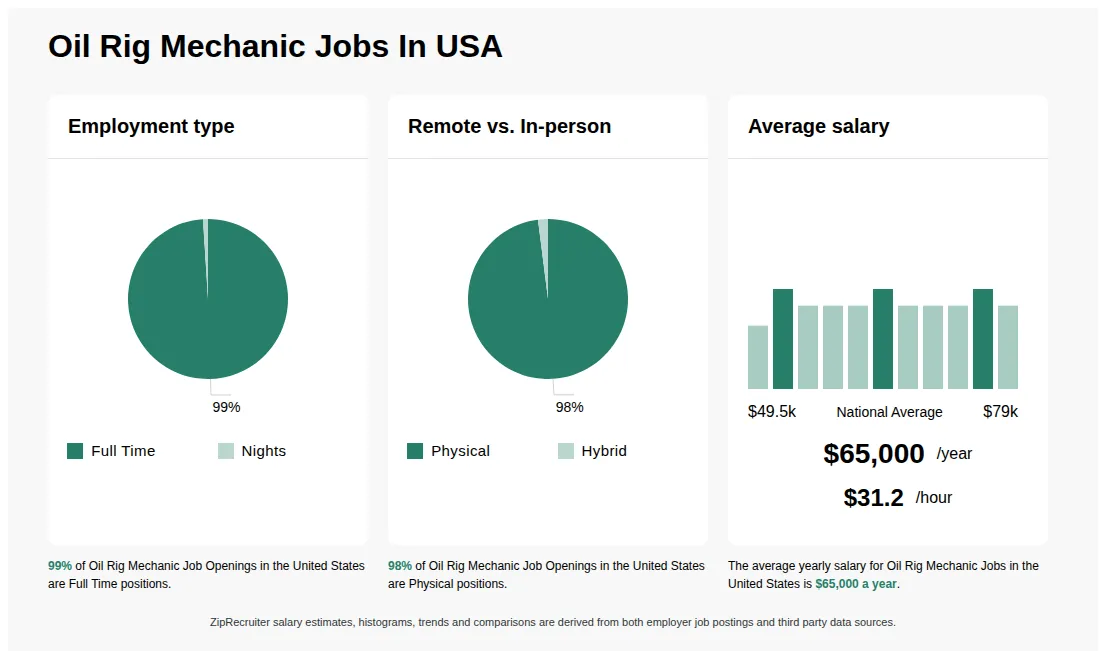
As of Jun 28, 2026, the average yearly pay for oil rig mechanic in the United States is $65,000.00, according to ZipRecruiter salary data. Most workers in this role earn between $57,500.00 and $72,500.00 per year, depending on experience, location, and employer.

What is the difference between Oil Rig Mechanic vs Oil Rig Electrician?

AspectOil Rig MechanicOil Rig Electrician
CertificationsMechanical certifications, such as ASE or equivalentElectrical certifications, such as NABCEP or equivalent
Work EnvironmentMechanical equipment, engines, and hydraulic systems on rigsElectrical systems, wiring, and control panels on rigs
Industry UsageCommonly employed for maintenance and repair of mechanical systemsSpecialized in electrical system installation and troubleshooting

Both Oil Rig Mechanics and Oil Rig Electricians work in offshore environments, maintaining essential equipment on oil rigs. While their roles differ—mechanics focus on mechanical and hydraulic systems, electricians handle electrical systems—they often collaborate to ensure rig safety and efficiency. Understanding these differences helps in choosing the right career path or job search focus within the oil industry.

Do Mechanics work on oil rigs?

Oil rig mechanics, also known as offshore or rig mechanics, work directly on oil rigs to maintain and repair drilling equipment, engines, and hydraulic systems. They typically need specialized training, certifications, and safety knowledge to operate in the challenging offshore environment.

What Does an Oil Rig Mechanic Do?

As an oil rig mechanic, you work with a gas and oil company perform daily maintenance tasks. Your responsibilities are to repair, install, and maintain well equipment used for drilling. You must also know how to work on the operating pump. Your duties may have you working on hydraulic and pneumatic equipment, maintaining accurate maintenance records, and participating in inventory purchase orders. You work in a team environment, so you may handle various sections or focus on a specific part of the rig. You may also mentor junior mechanics. If this is an off-shore rig, you may spend several weeks at a time away from home.

How much does an oilfield mechanic make?

Oilfield mechanics typically earn between $50,000 and $80,000 annually, depending on experience, location, and certifications. Experienced mechanics with specialized skills or certifications can earn higher wages, especially in remote or high-demand areas with challenging working conditions.

How much does a mechanic make on an offshore oil rig?

An offshore oil rig mechanic typically earns between $70,000 and $120,000 annually, depending on experience, certifications, and the specific rig. Overtime, hazard pay, and rotation schedules can also impact total compensation.

What are the key skills and qualifications needed to thrive as an Oil Rig Mechanic, and why are they important?

To thrive as an Oil Rig Mechanic, you need strong mechanical aptitude, technical troubleshooting skills, and a background in industrial or mechanical engineering, often supported by relevant certifications or vocational training. Familiarity with hydraulic systems, heavy machinery, and maintenance management software is typically required, along with certifications such as HAZMAT, H2S, and offshore safety training. Attention to detail, problem-solving ability, and effective teamwork are crucial soft skills for this demanding environment. These skills ensure the safety, reliability, and efficiency of critical equipment on oil rigs, minimizing downtime and hazards.

What does an oil rig mechanic do?

An oil rig mechanic is responsible for maintaining, repairing, and ensuring the safe operation of mechanical equipment on oil rigs, such as engines, pumps, and drilling machinery. They perform regular inspections, troubleshoot mechanical issues, and perform preventative maintenance to minimize downtime. Oil rig mechanics may work on offshore or onshore rigs and must follow strict safety protocols due to the hazardous nature of the environment. Their work is essential for efficient and safe oil extraction operations.

What is the $160,000 mechanic job that Ford can't fill?

The $160,000 mechanic job refers to highly specialized roles such as offshore oil rig mechanics, who maintain and repair complex equipment in challenging environments. These positions require advanced technical skills, certifications, and often involve long shifts and remote locations, making them difficult to fill due to the demanding nature of the work.

What are some common challenges faced by Oil Rig Mechanics, and how can they be addressed on the job?

Oil Rig Mechanics often work in remote, offshore environments where equipment is subjected to extreme conditions like saltwater exposure, high pressure, and vibration. Common challenges include diagnosing complex mechanical failures under tight time constraints and ensuring all repairs meet rigorous safety standards. To address these challenges, mechanics rely on thorough preventive maintenance routines, clear communication with the rig crew, and ongoing training in the latest technologies and safety protocols. Teamwork and adaptability are essential, as the role often requires collaborating with engineers and other specialists to resolve issues quickly and safely.
What cities are hiring for Oil Rig Mechanic jobs? Cities with the most Oil Rig Mechanic job openings:
What are the most commonly searched types of Oil Rig Mechanic jobs? The most popular types of Oil Rig Mechanic jobs are:
What states have the most Oil Rig Mechanic jobs? States with the most job openings for Oil Rig Mechanic jobs include:
Infographic showing various Oil Rig Mechanic job openings in the United States as of June 2026, with employment types broken down into 100% Full Time. Highlights an 100% In-person job distribution, with an average salary of $65,000 per year, or $31.2 per hour.

Rig Foreman- Next LVL Energy

Diversified Gas & Oil Corporation

Meadville, PA • On-site

Full-time

Posted 9 days ago


Job description

COMPANY PROFILE
Diversified Gas & Oil Corporation ("DGOC") is a wholly-owned subsidiary of Diversified Energy Company PLC, a US-based company listed on the New York Stock Exchange (NYSE) and London Stock Exchange (LSE) under the ticker symbol "DEC". Diversified Gas & Oil Corporation (DGOC) is an established owner and operator of producing conventional and unconventional natural gas & oil wells and midstream pipelines and compression stations concentrated in the Appalachian Basin in the United States. Headquartered in Birmingham, AL, our field operations are located throughout the Appalachian Basin in the states of Tennessee, Kentucky, Virginia, West Virginia, Ohio, and Pennsylvania. In 2021, Diversified announced our expansion into our Central Regional Focus Area, which includes producing areas within Louisiana, Texas, Oklahoma, and Arkansas.
POSITION SUMMARY & RESPONSIBILITIES:
Special focus will be placed on:
  • Supervise a minimum of two direct reports (rig hands).
  • Participate in the hiring process for new rig hands.
  • Train and mentor new/inexperienced rig hands as necessary.
  • Ensure the team is on site on time, fulfilling their job duties, and is following all operating procedures.
  • Review and submit time worked for rig hands daily.
  • Complete and submit annual performance evaluations via the company performance evaluation system.
  • Operate service rig, responsible for rigging up/down, tubing tallies, and general operation of all support equipment on site.
  • Rig up and operate triplex pumps and all related piping in a safe manner consistent with safe operating procedures, confirms cement and displacement calculations.
  • Conduct regular JSAs (Job Safety Analysis) with Next LVL and third-party employees; responsible for monitoring and ensuring safe working conditions of the worksite including ensuring all employees on the job site are properly utilizing FR and PPE.
  • Ensure accurate and timely reporting of all near misses, workplace injuries, accidents, or illness, regardless of the severity of the injury or accident.
  • Organize, schedule, and supervise support services (cement, wireline, trucking, and construction) actively working on location.
  • Conduct and track frequent inspections of the rig and rig location, identifying issues regarding safe and efficient operations of the rig, and makes timely recommendations to rectify any noted problems.
  • Perform minor mechanical repairs on equipment and keep maintenance records updated
  • Complete and submit a daily operations report detailing and approving operational activity that occurred on site.
  • Regularly communicate with the Plugging Manager to provide rig and job site updates, issues, and delays. Relay and ensure all expectations regarding safety, performance, job site, maintenance, efficiency, etc. are upheld by the rig crew.
  • Check emails daily and comply with email requests as they are assigned.
  • Perform any other duties as requested or assigned, including occasionally assisting with non-plugging or special projects per direction of management.

POSITION REQUIREMENTS:
  • High School Diploma or equivalent
  • Valid driver's license
  • Class A/B CDL preferred
  • 3 - 5 years' experience in plugging operations and/or gas and oil industry preferred
  • 2+ years' experience as a rig hand preferred
  • Experience with downhole fishing, milling, drilling, etc.
  • Experience with general maintenance on service rig, pumping equipment, and all other equipment
  • Willingness to travel and work out of town on a frequent basis
  • Knowledge with H2S Gas
  • Basic math skills
  • Basic computer skills/proficiency

Physical Requirements and Working Conditions
  • Must be able to move or traverse from one location on the job site to another. This includes the ability to remain in a stationary position for extended periods, frequently positioning oneself (e.g., to stoop, kneel, or squat) to perform tasks, and occasionally ascend/descend (e.g., ladders or uneven terrain)
  • Ability to detect, determine, perceive, identify, recognize, judge, observe, inspect, estimate, and assess driving operations effectively (either naturally or with corrective lenses).
  • Ability to operate a 4X4 vehicle.
  • Must be able to repetitively move or position feet, shoulders, arms, wrists, and back. Constantly operates, uses, and positions hands and fingers in performance of work
  • Must be able to work atop elevated surfaces and traverse various heights
  • Lifts or carries 116 lbs. or more, which falls into the "heavy" category (over 50 pounds).
  • Frequently pushes and pulls with a maximum force of 150 ft./lbs.
  • Constantly works in outdoor weather conditions and is exposed to varying environmental conditions, including well site conditions. The position requires the ability to perform tasks in physically demanding environments, encompassing the essential physical requirements and efforts outline

The Employer retains the right to change or assign other duties to this position.
Driver Requirements:
  • Must possess a valid driver's license and maintain a clean driving record
  • This position involves operating a company vehicle for work-related travel or receiving a stipend for operating a personal vehicle for company use; adherence to all traffic laws and company vehicle policies is required.
  • Candidates must be eligible to be insured under the company's vehicle insurance policy.