1

Nvidia Machine Learning Jobs (NOW HIRING)

What You'll Do * Design and implement scalable machine learning pipelines for large-scale 3D ... We bring deep experience from organizations such as DeepMind, NASA JPL, Boston Dynamics, NVIDIA ...

What You'll Do * Design and implement scalable machine learning pipelines for large-scale 3D ... We bring deep experience from organizations such as DeepMind, NASA JPL, Boston Dynamics, NVIDIA ...

NVIDIA seeks a senior software engineer to join the AI Networking co-design and benchmark R&D team. In this pivotal role, the candidate is responsible for building and productizing machine learning ...

next page

Showing results 1-20

Nvidia Machine Learning information

See salary details

$25.5K

$42.6K

$88K

How much do nvidia machine learning jobs pay per year?

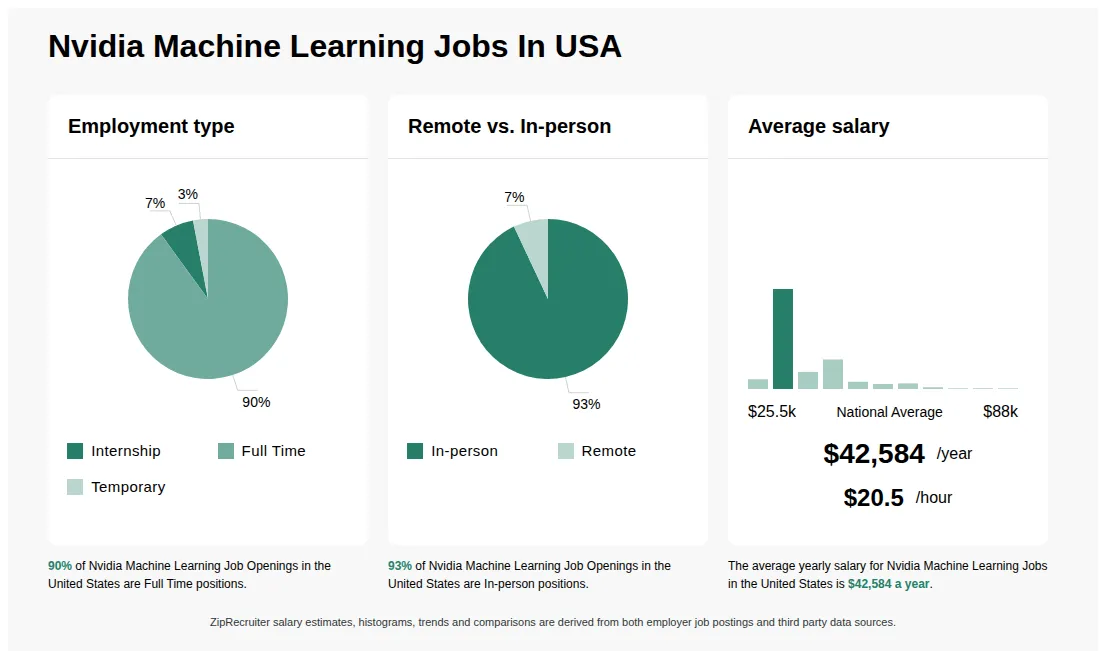
As of Jul 22, 2026, the average yearly pay for nvidia machine learning in the United States is $42,584.00, according to ZipRecruiter salary data. Most workers in this role earn between $32,500.00 and $46,000.00 per year, depending on experience, location, and employer.

How much do NVIDIA machine learning engineers make?

NVIDIA machine learning engineers typically earn between $100,000 and $160,000 annually, depending on experience, location, and skill level. Senior roles or those with specialized expertise in deep learning and GPU programming can earn higher salaries, often exceeding $180,000. Compensation may also include bonuses and stock options in competitive tech environments.

What is a Nvidia Machine Learning job?

A Nvidia Machine Learning job involves developing and optimizing AI models, deep learning frameworks, and GPU-accelerated applications. Engineers in this role work on cutting-edge research, building scalable ML solutions, and improving performance on Nvidia hardware like GPUs and AI accelerators. They collaborate with software and hardware teams to enhance AI capabilities across industries such as gaming, healthcare, and autonomous systems. Strong coding skills in Python, C++, and experience with ML frameworks like TensorFlow or PyTorch are often required.

What are the key skills and qualifications needed to thrive in the Nvidia Machine Learning position, and why are they important?

To thrive in an Nvidia Machine Learning role, a deep understanding of machine learning algorithms, proficiency in programming languages like Python or C++, and a solid background in mathematics or computer science are essential. Experience with Nvidia's CUDA, TensorRT, cuDNN, and familiarity with modern deep learning frameworks such as TensorFlow or PyTorch are highly valued, as are relevant certifications in AI or data science. Strong problem-solving skills, teamwork, and effective communication distinguish top candidates in collaborative, fast-paced environments. These skills are crucial for developing and optimizing AI solutions that leverage Nvidia’s advanced hardware and software platforms.


Does NVIDIA do machine learning?

Nvidia offers extensive tools and platforms for machine learning, including GPUs optimized for training and deploying models. Many machine learning engineers and researchers use Nvidia hardware and software frameworks like CUDA and cuDNN to accelerate AI development. The company also provides AI-focused products and solutions for various industries.

Is it hard to get hired at NVIDIA?

Getting hired for a machine learning role at NVIDIA can be competitive due to the company's focus on advanced technology and innovation. Candidates typically need strong technical skills in deep learning, programming, and relevant experience, along with a solid educational background. The hiring process often involves multiple interviews and technical assessments to evaluate expertise and problem-solving abilities.

What are some common challenges faced by professionals in Nvidia Machine Learning roles?

One common challenge in Nvidia Machine Learning roles is optimizing models to fully leverage GPU architectures for both performance and efficiency, which requires continuous learning as the technology rapidly evolves. Team members often work on complex, large-scale projects that demand close collaboration across software, hardware, and research divisions. Navigating the fast pace of innovation and contributing effectively to cross-functional teams is essential for success. However, these challenges also make the role exciting and offer excellent opportunities for professional growth and hands-on experience with state-of-the-art AI solutions.

Is ML a high paying job?

Machine Learning roles, including positions like Nvidia Machine Learning engineers, are generally well-paid due to high demand for specialized skills in AI, data analysis, and programming. Salaries vary based on experience, location, and company, but these jobs tend to offer above-average compensation compared to many other tech roles.
More about Nvidia Machine Learning jobs
What cities are hiring for Nvidia Machine Learning jobs? Cities with the most Nvidia Machine Learning job openings:
What are the most commonly searched types of Nvidia Machine Learning jobs? The most popular types of Nvidia Machine Learning jobs are:
What states have the most Nvidia Machine Learning jobs? States with the most job openings for Nvidia Machine Learning jobs include:
Infographic showing various Nvidia Machine Learning job openings in the United States as of July 2026, with employment types broken down into 1% As Needed, 72% Full Time, 25% Part Time, 1% Temporary, and 1% Contract. Highlights an 86% Physical, 2% Hybrid, and 12% Remote job distribution, with an average salary of $42,584 per year, or $20.5 per hour.
Senior Machine Learning Engineer

Senior Machine Learning Engineer

TetraMem - Accelerate The World

San Jose, CA • On-site

$122K - $168K/yr

Full-time

Posted 12 days ago


Job description

Job Summary:
TetraMem is a company focused on accelerating the world through innovative technology. They are seeking a Senior Machine Learning Engineer to develop, optimize, and deploy lightweight machine learning models for edge AI applications, particularly in audio processing, while providing technical leadership and mentoring to junior engineers.
Responsibilities:
• Develop, optimize, and deploy lightweight machine learning models for edge AI applications, particularly for audio processing.
• Implement and optimize ML models on embedded platforms, including FPGA and custom ASIC solutions.
• Work closely with hardware and software teams to integrate ML models into production systems.
• Research and implement state-of-the-art ML techniques to enhance model efficiency, latency, and power consumption for embedded AI applications.
• Improve inference efficiency and model compression techniques, including quantization, pruning, and knowledge distillation.
• Collaborate with cross-functional teams to drive innovation and contribute to the overall system architecture.
• Provide technical leadership and mentorship to junior engineers.
• Publish research findings, present at conferences, and contribute to open-source projects when applicable.
Qualifications:
Required:
• 5+ years of relevant industry experience (or a PhD) in Computer Science, Electrical Engineering, Machine Learning, or related fields.
• Must have prior experience managing a team, serving in a Team Lead role, or demonstrating strong technical leadership and cross-functional coordination capabilities.
• Strong hands-on experience in machine learning, with a focus on edge AI, on-device inference, and deploying lightweight models on resource-constrained devices.
• Expertise in modern ML frameworks such as PyTorch, TensorFlow (including TensorFlow Lite), and JAX.
• Proficiency in Python and C/C++, with practical experience in ML model optimization and production deployment.
• Deep experience with model quantization (PTQ/QAT), pruning, knowledge distillation, sparsity, and other compression techniques for efficient edge inference.
• Hands-on experience developing for or integrating with AI chip SDKs, neural accelerators (NPUs/DSPs), or hardware-specific toolchains (e.g., NVIDIA TensorRT, Qualcomm Neural Processing SDK, ARM Ethos, or similar).
• Familiarity with edge inference runtimes (ONNX Runtime, ExecuTorch, TVM) and optimizing models for hardware constraints (latency, memory footprint, power consumption).
Preferred:
• Understanding of ML compiler and runtime design.
• Experience working with tools such as Optimum, ONNX, TensorRT, TFLite/LiteRT, ncnn, or CoreML.
• Familiarity with hardware acceleration techniques.
• Experience in embedded system development.
Company:
TetraMem is developing cutting-edge analog computing solutions for AI applications, offering exceptional performance with ultra-low power consumption. Founded in 2018, the company is headquartered in Newark, USA, with a team of 51-200 employees. The company is currently Growth Stage.