1

Nuclear Physicist Jobs (NOW HIRING)

A successful candidate would have strong background in physics and technology of particle accelerators, nuclear physics, plasma physics, or related field, coupled with solid experience in designing ...

Reactor multi-physics analysis, especially pertaining to transient analysis. * Nuclear analysis software development, verification, and validation. * Other areas of nuclear engineering or nuclear ...

next page

Showing results 1-20

Nuclear Physicist information

See salary details

$39.5K

$94.8K

$226.5K

How much do nuclear physicist jobs pay per year?

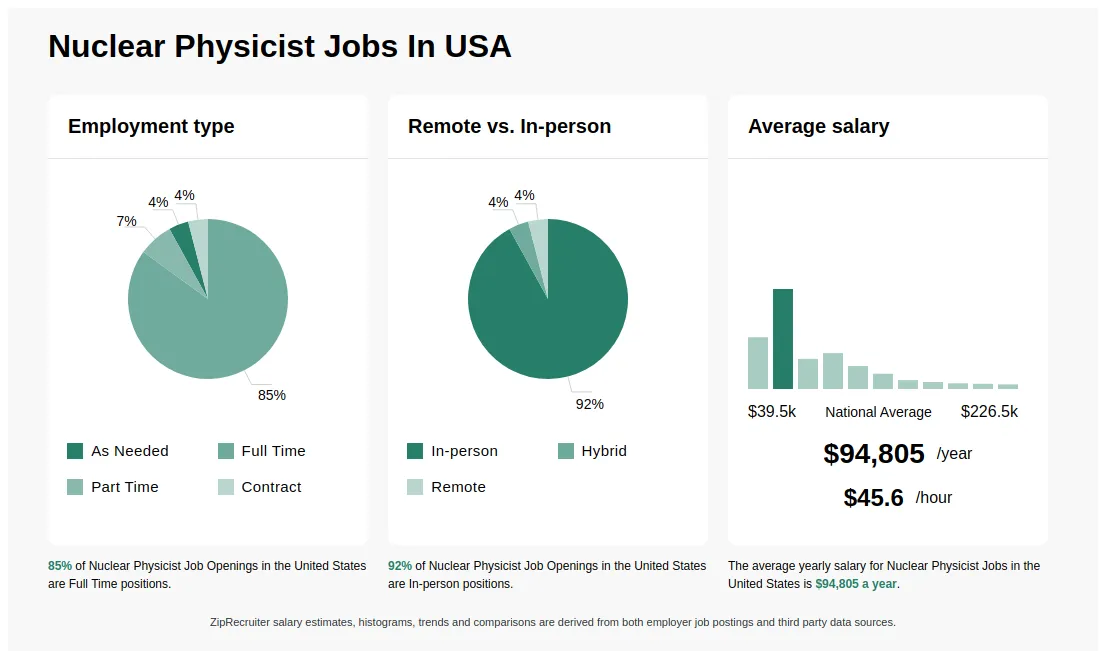
As of Jun 15, 2026, the average yearly pay for nuclear physicist in the United States is $94,805.00, according to ZipRecruiter salary data. Most workers in this role earn between $59,000.00 and $112,000.00 per year, depending on experience, location, and employer.

Is there a demand for nuclear physicists?

Nuclear physicists are in demand in research institutions, government agencies, and the energy sector, particularly for roles involving nuclear energy, safety, and medical applications. Employment opportunities depend on government funding, technological advancements, and industry needs, with positions often requiring advanced degrees and specialized skills in nuclear science and instrumentation.

What are the key skills and qualifications needed to thrive in the Nuclear Physicist position, and why are they important?

To thrive as a Nuclear Physicist, you typically need an advanced degree in physics or nuclear engineering, a solid grasp of nuclear theory, mathematics, and experimental design. Competency in using particle accelerators, radiation detectors, specialized simulation software (such as MCNP or GEANT4), and adherence to safety certifications is essential. Strong analytical thinking, attention to detail, effective communication, and teamwork are standout soft skills for this role. These qualifications ensure safety, accuracy, and successful collaboration on complex scientific research and practical applications in the field.

What does a Nuclear Physicist do?

A Nuclear Physicist studies atomic nuclei, their interactions, and the fundamental forces governing them. They conduct research in areas like nuclear energy, radiation, and particle physics. Their work can be applied in medical imaging, nuclear power, defense, and scientific advancements. Nuclear Physicists often use particle accelerators, nuclear reactors, and advanced mathematical models to analyze atomic behavior. Many work in academic, government, or private research institutions.

What jobs can a nuclear physicist do?

A nuclear physicist can work in research and development, nuclear energy production, medical physics, or government agencies, often utilizing skills in data analysis, modeling, and laboratory techniques. They may work in laboratories, power plants, hospitals, or regulatory bodies, sometimes requiring security clearances or specialized certifications.

What can I do with a degree in nuclear physics?

A nuclear physicist can work in research, nuclear energy, medical imaging, and radiation safety. They analyze atomic nuclei, develop nuclear technologies, and often use specialized tools like particle accelerators and detectors. Careers may involve laboratory work, data analysis, and collaboration with engineers and health professionals.

What are some common challenges faced by Nuclear Physicists and how can I prepare for them?

Nuclear Physicists often tackle complex experimental or theoretical problems requiring both advanced technical knowledge and creative problem-solving. A primary challenge is ensuring strict safety compliance while working with radioactive materials or high-energy equipment, which requires ongoing training and attention to detail. Collaborative research environments may also demand strong teamwork and the ability to communicate findings to both technical and non-technical colleagues. Preparing through hands-on laboratory experience, staying up to date with safety protocols, and developing strong analytical and communication skills will help you navigate the unique demands of the role.

Can you make $500,000 as a nuclear engineer?

Nuclear engineers typically earn a median annual salary around $120,000, with top earners in specialized roles or with extensive experience reaching salaries close to $200,000. Earning $500,000 annually is uncommon and usually requires advanced positions, management roles, or working in high-paying industries such as nuclear power plant management or consulting. Achieving such a high salary often involves additional certifications, advanced degrees, and significant experience.
More about Nuclear Physicist jobs
What cities are hiring for Nuclear Physicist jobs? Cities with the most Nuclear Physicist job openings:
What are the most commonly searched types of Nuclear Physicist jobs? The most popular types of Nuclear Physicist jobs are:
Who are the top companies hiring for Nuclear Physicist jobs? The top employers for Nuclear Physicist jobs are:
What states have the most Nuclear Physicist jobs? States with the most job openings for Nuclear Physicist jobs include:
Infographic showing various Nuclear Physicist job openings in the United States as of June 2026, with employment types broken down into 1% Internship, 7% As Needed, 10% Full Time, 35% Part Time, 46% Contract, and 1% Nights. Highlights an 95% Physical, 1% Hybrid, and 4% Remote job distribution, with an average salary of $94,805 per year, or $45.6 per hour.

Postdoctoral Fellow, Physics (Nuclear / Precision Measurement)

Indiana University Academic Positions

Kokomo, IN โ€ข On-site

$42K - $58K/yr

Other

Posted 3 days ago


Job description

Position Details
Title Postdoctoral Fellow, Physics (Nuclear / Precision Measurement) Appointment Status Non-Tenure Track Department IU Bloomington Cntr For Explor of En & Matter Location Bloomington Position Summary
The IU experimental nuclear physics group has an active program addressing fundamental questions in nuclear physics, particle physics, and astrophysics/cosmology. Group members are leaders in a wide range of experiments, including: investigations of the flavor and spin structure of the nucleon (STAR at RHIC, Belle II at KEK); studies of parity and time reversal violation between nucleons (NIST, SNS, LANSCE, JPARC, JLAB, FRM), measurements of neutrino properties (Fermilab, SNS, SURF, LNGS), neutron decay and neutron interferometry (NIST, LANSCE, SNS, ISIS, ILL), and searches for possible exotic spin-dependent interactions. The group is part of the Center for Exploration of Energy and Matter (CEEM) at IU, which also includes research in theoretical nuclear physics, condensed matter, and radiation effects studies. Group members include professional staff in electronics, mechanical engineering, cryogenic design, and machinists, as well as graduate and undergraduate students. Local facilities include a low-energy neutron source (LENS) available for neutron detector development and testing, high-bay facilities for large-scale fabrication, professional and student machine shops, a polarized 3He lab, a dilution refrigerator, and a vibration isolated lab for weak force measurement. The laboratory possesses infrastructure on a scale which enables us to make major hardware contributions to experiments. Opportunities are available on all major research projects.
Indiana University is an equal opportunity employer and provider of ADA services and prohibits discrimination in hiring. See Indiana University Notice of Non-Discrimination here which includes contact information.
Basic Qualifications

At least 3 years of training in a PhD in experimental subatomic physics or precision measurement is required.
Department Contact for Questions
Professor Walter Pettus (pettus@iu.edu)
Additional Qualifications Salary and Rank Special Instructions
Interested candidates should review the application requirements and submit their application at: https://indiana.peopleadmin.com/postings/31263 Positions are regularly available, and this search will remain open; applications will be reviewed as they are received. Candidates are encouraged to reach out to the search chair or other faculty to inquire about particular needs and timelines. The search chair is Professor Walter Pettus, Department of Physics, Indiana University - IU Center for Exploration of Energy & Matter (CEEM), MES Hall, 2401 N Milo B Sampson Ln, Bloomington IN 47408, email: pettus@iu.edu

Applications for postdoctoral positions are accepted on a continuing basis, and starting dates can be adjusted to suit the candidates.
For Best Consideration Date 04/01/2026 Expected Start Date 07/01/2026 Posting Number IU-101424-2025