1

Nuclear Physicist Jobs (NOW HIRING)

The Nuclear Health Physicist leads and supports radiation protection programs across U.S. nuclear, industrial radiological, or federal operations. The role ensures compliance with U.S. regulatory ...

The Nuclear Health Physicist leads and supports radiation protection programs across U.S. nuclear, industrial radiological, or federal operations. The role ensures compliance with U.S. regulatory ...

next page

Showing results 1-20

Nuclear Physicist information

See salary details

$39.5K

$94.8K

$226.5K

How much do nuclear physicist jobs pay per year?

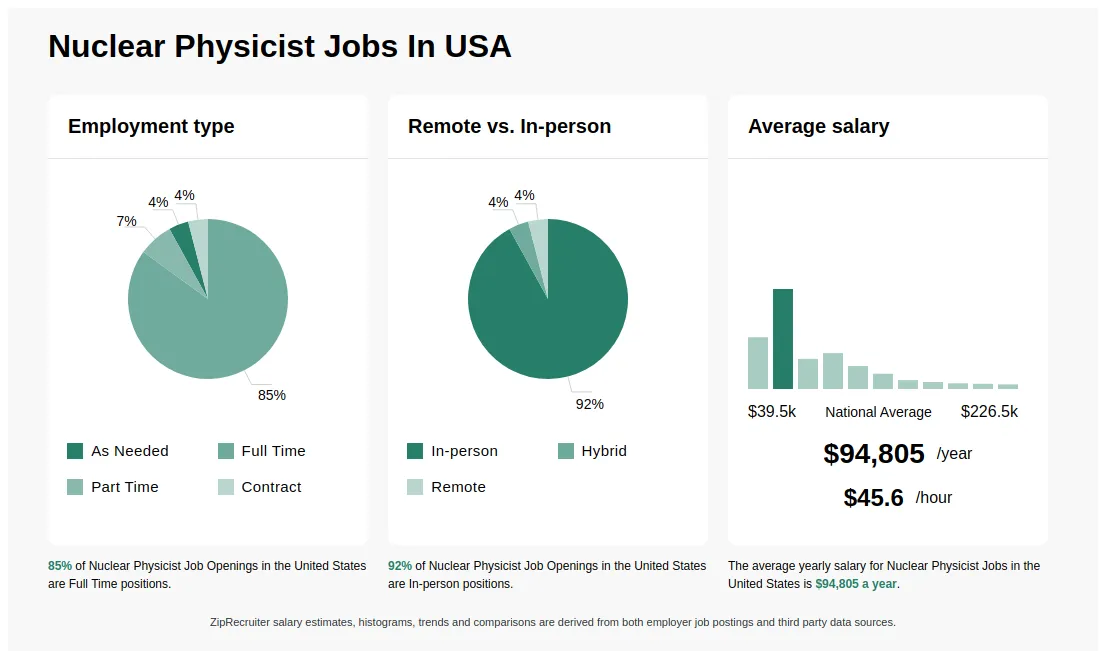
As of Jun 15, 2026, the average yearly pay for nuclear physicist in the United States is $94,805.00, according to ZipRecruiter salary data. Most workers in this role earn between $59,000.00 and $112,000.00 per year, depending on experience, location, and employer.

Is there a demand for nuclear physicists?

Nuclear physicists are in demand in research institutions, government agencies, and the energy sector, particularly for roles involving nuclear energy, safety, and medical applications. Employment opportunities depend on government funding, technological advancements, and industry needs, with positions often requiring advanced degrees and specialized skills in nuclear science and instrumentation.

What are the key skills and qualifications needed to thrive in the Nuclear Physicist position, and why are they important?

To thrive as a Nuclear Physicist, you typically need an advanced degree in physics or nuclear engineering, a solid grasp of nuclear theory, mathematics, and experimental design. Competency in using particle accelerators, radiation detectors, specialized simulation software (such as MCNP or GEANT4), and adherence to safety certifications is essential. Strong analytical thinking, attention to detail, effective communication, and teamwork are standout soft skills for this role. These qualifications ensure safety, accuracy, and successful collaboration on complex scientific research and practical applications in the field.

What does a Nuclear Physicist do?

A Nuclear Physicist studies atomic nuclei, their interactions, and the fundamental forces governing them. They conduct research in areas like nuclear energy, radiation, and particle physics. Their work can be applied in medical imaging, nuclear power, defense, and scientific advancements. Nuclear Physicists often use particle accelerators, nuclear reactors, and advanced mathematical models to analyze atomic behavior. Many work in academic, government, or private research institutions.

What jobs can a nuclear physicist do?

A nuclear physicist can work in research and development, nuclear energy production, medical physics, or government agencies, often utilizing skills in data analysis, modeling, and laboratory techniques. They may work in laboratories, power plants, hospitals, or regulatory bodies, sometimes requiring security clearances or specialized certifications.

What can I do with a degree in nuclear physics?

A nuclear physicist can work in research, nuclear energy, medical imaging, and radiation safety. They analyze atomic nuclei, develop nuclear technologies, and often use specialized tools like particle accelerators and detectors. Careers may involve laboratory work, data analysis, and collaboration with engineers and health professionals.

What are some common challenges faced by Nuclear Physicists and how can I prepare for them?

Nuclear Physicists often tackle complex experimental or theoretical problems requiring both advanced technical knowledge and creative problem-solving. A primary challenge is ensuring strict safety compliance while working with radioactive materials or high-energy equipment, which requires ongoing training and attention to detail. Collaborative research environments may also demand strong teamwork and the ability to communicate findings to both technical and non-technical colleagues. Preparing through hands-on laboratory experience, staying up to date with safety protocols, and developing strong analytical and communication skills will help you navigate the unique demands of the role.

Can you make $500,000 as a nuclear engineer?

Nuclear engineers typically earn a median annual salary around $120,000, with top earners in specialized roles or with extensive experience reaching salaries close to $200,000. Earning $500,000 annually is uncommon and usually requires advanced positions, management roles, or working in high-paying industries such as nuclear power plant management or consulting. Achieving such a high salary often involves additional certifications, advanced degrees, and significant experience.
More about Nuclear Physicist jobs
What cities are hiring for Nuclear Physicist jobs? Cities with the most Nuclear Physicist job openings:
What are the most commonly searched types of Nuclear Physicist jobs? The most popular types of Nuclear Physicist jobs are:
Who are the top companies hiring for Nuclear Physicist jobs? The top employers for Nuclear Physicist jobs are:
What states have the most Nuclear Physicist jobs? States with the most job openings for Nuclear Physicist jobs include:
Infographic showing various Nuclear Physicist job openings in the United States as of June 2026, with employment types broken down into 1% Internship, 7% As Needed, 10% Full Time, 35% Part Time, 46% Contract, and 1% Nights. Highlights an 95% Physical, 1% Hybrid, and 4% Remote job distribution, with an average salary of $94,805 per year, or $45.6 per hour.

Clinical Nuclear Medicine Physicist

Wisconsin

Madison, WI

Other

Retirement, PTO

Posted 5 days ago


Job description

Current Employees: If you are currently employed at any of the Universities of Wisconsin, log in to Workday to apply through the internal application process.Job Category:Academic StaffEmployment Type:RegularJob Profile:Assistant Professor (CHS)Job Summary:

The Department of Radiology offers a unique opportunity for a Clinical Nuclear Medicine Physicist to join the growing Clinical Imaging Physics Section in the Department of Radiology.

The UW Department of Radiology consists of more than 165 faculty across 13 sections, reading over 1,000,000 diagnostic scans per year. We train more than 50 residents and fellows per year and have an extensive presence throughout the medical student curriculum.

  • This position requires work to be performed onsite, at a designated campus work location.

  • Applicants who are interested in joining the Clinical Imaging Physics Section as an Nuclear Medicine Physicist will be considered for the titles listed: Assistant Professor, Associate Professor or Professor on the Clinical Health Sciences (CHS) Track. The title is determined by the experience and qualifications of the finalist.

Key Job Responsibilities:

Clinical Nuclear Medicine Physicist responsibilities cover nuclear medicine clinical support, research and translation and education.

40-70% Provide clinical nuclear medicine physics support

1. Assist in ensuring the nuclear medicine quality assurance (QA) program is in accordance with society guidelines, manufacturer recommendations, and accrediting bodies requirements.

2. Maintain board certification in nuclear medicine physics through continuing education activities.

3. Help support the UW Theranostics program. Work with a team of clinicians, technologists, and physicists to develop and implement theranostics imaging and dosimetry protocols for clinical and research studies.

4. Perform annual surveys and acceptance testing for PET, SPECT, and other nuclear medicine instruments. Participate in the ACR accreditation process.

5. Provide physics support for nuclear medicine-focused clinical trials, including preparatory activities such as custom calibrations for scanners/instruments.

6. Troubleshoot clinical issues on the scanner such as identifying and ameliorating image artifacts and other problems affecting clinical image quality or quantitative accuracy.

7. Help support physicians and technologists in nuclear medicine software (e.g., MIM, Mirada, Cedars QPS, etc.).

8. Assist in developing, reviewing, and implementing clinical and research imaging protocols, including optimization of acquisition and reconstruction settings.

10. Assist in addressing additional nuclear medicine and clinical imaging support needs, as directed by the Section Chief of the Clinical Imaging Physics.

20-50% Conduct research in topics related to nuclear medicine, molecular imaging, theranostics, or radiopharmaceutical therapy

1. Collaborate with other UW faculty and scientists in the Departments of Radiology, investigators in departments and schools across campus, and industrial partners to support research focused on nuclear medicine, molecular imaging, theranostics, and radiopharmaceutical therapy.

2. Build an independent research program.

3. Apply for, and obtain, extramural funding to support research projects focusing on nuclear medicine imaging.

4. Attend scientific conferences and meetings to present scientific research results, moderate sessions, and participate on committees and in working groups.

5. Write and submit manuscripts to professional journals.

6. Work with others in establishing successful collaborations with industrial partners.

10% Teach trainees and technologists.

1. Help teach nuclear medicine physics to nuclear medicine and diagnostic radiology residents and fellows.

2. Serve as an institutional subject matter expert regarding nuclear medicine physics.

3. Help educate and train technologists about the technical principles of nuclear medicine imaging and radiopharmaceutical dosimetry.

4. Mentoring for the Medical Imaging Physics Residency program

Department:

The UW Department of Radiology provides excellence in patient care in an environment that is respectful of others and adaptive to change. We are dedicated to sharing our clinical expertise through regional outreach to the people of Wisconsin and their healthcare providers. We provide an environment for education of our trainees, staff, and healthcare professionals through scholarly conferences and continuing education programs. We improve human health be developing innovative imaging technology through basic and translational research in collaboration with colleagues at UW-Madison and beyond. We support the Wisconsin Idea to improve people's lives beyond our walls by collaborating with industry to translate modern technology into daily clinical practice. We support the economic development of Wisconsin and the financial wellbeing of UW Health. We recruit and develop dedicated faculty and health professionals who inspire their co-workers and students towards lifelong learning, research discovery, service to their community and clinical excellence.

#1 Best Place to Live (Livability, 2022)

#1 City for Most Successful Women Per Capita (Forbes, 2019)

#1 City for Best Work-Life Balance (Smart Asset, 2020)

#7 Best City for STEM Professionals (CEO World, 2020)

#2 Best State to Practice Medicine (WalletHub, 2020)

#2 Best City for Biking (People for Bikes, 2020)

#4 Fittest City in the U.S. (ACSM American Fitness Index, 2020)

#4 Greenest City in the U.S. (Zippia, 2020)

#1 Best Place to Retire (Money, 2020)

#1 Best Place in the U.S. for Raising Children (DiversityDataKids.com, 2020)

#1 Best College Football Town in America (Sports Illustrated, 2019)

Madison's technology economy is growing rapidly, and the region is home to the headquarters of Epic Systems, Exact Sciences, Sub-Zero, and Land's End, as well as many biotech, healthcare IT, and health systems startups. In the Fall of 2023, Wisconsin was designated as a Tech Hub by the Economic Development Administration (EDA), which resulted in a grant award of up to $75 million to help accelerate growth of the state's bio health industry. Phase 2 of the Wisconsin Biotech hub was announced in July 2024, resulting in $49 million in additional funding to help drive transformative medical innovation, workforce development and critical job growth across Wisconsin. One of the three technology projects of this proposal is the Wisconsin Health Data Hub, led by researchers from the University of Wisconsin, School of Medicine and Public Health.

Madison is the second largest city in the state, with a city population of approximately 260,000 and regional population of over 1 million. The city is within easy driving range of Chicago and Milwaukee. Madison is home to one of the strongest local food scenes in the country. From April to October, Capitol Square hosts the largest producer-only farmers market in the country. The city is rich in cultural offerings in the arts.

Compensation:

Negotiable

Employees in this position can expect to receive benefits such as generous vacation, holidays, and sick leave; competitive insurances and savings accounts; retirement benefits.

Required Qualifications:
  • Certified or eligible for certification in Medical Nuclear Physics or Radiological Physics by the American Board of Radiology (ABR); in Nuclear Medicine Physics by the American Board of Medical Physics (ABMP) or the Canadian College of Physicists in Medicine (CCPM); or in Nuclear Medicine Physics and Instrumentation by the American Board of Science in Nuclear Medicine (ABSNM) by start date.

  • Experience in supporting accreditation of clinical nuclear medicine program through annual surveys and acceptance testing on nuclear medicine scanners and instrument testing by start date.

Preferred Qualifications:
  • Experience in performing dosimetry for radiopharmaceutical therapy.

  • Minimum of 5 years of experience in research related to molecular imaging, nuclear medicine, theranostics, or radiopharmaceutical therapies.

  • Evidence of writing or assisting in writing grant applications to secure funding in support of nuclear medicine research.

  • American Board of Radiology (ABR) Medical Physics (DX) certification and/or American College of Radiology (ACR) qualified medical physicist for computed tomography

  • Successful completion of CAMPEP medical imaging physics residency program

  • Excellent communication skills are needed for interacting with a variety of personnel including clinical imaging physicists, technologists, radiologists, residents, fellows and researchers.

Education:

PhD in Physics, Medical Physics, Biomedical Engineering or a closely related field by start date.

How to Apply:

For the best experience completing your application, we recommend using Chrome or Firefox as your web browser.

To apply for this position, select either "I am a current employee" or "I am not a current employee" under Apply Now. You will then be prompted to upload your application materials.

Important: The application has only one attachment field. Upload all required documents in that field, either as a single combined file or as multiple files in the same upload area.

Please upload the following required materials to complete your application:

  • Cover Letter - Detailing how your training and experience align with the required and preferred qualifications listed above.

  • CV

The deadline for assuring full consideration is March 10, 2026; however, the position will remain open, and applications may be considered until the position is filled.

The department will not be able to support a request for a J-1 waiver. If you choose to pursue a waiver and apply for our position, neither the UW nor UWMF will reimburse you for your legal or waiver fees.

Contact Information:

Melissa Kuester, mkuester@uwhealth.org

Relay Access (WTRS): 7-1-1. See RELAY_SERVICE for further information.

Institutional Statement on Diversity:

Diversity is a source of strength, creativity, and innovation for UW-Madison. We value the contributions of each person and respect the profound ways their identity, culture, background, experience, status, abilities, and opinion enrich the university community. We commit ourselves to the pursuit of excellence in teaching, research, outreach, and diversity as inextricably linked goals.
The University of Wisconsin-Madison fulfills its public mission by creating a welcoming and inclusive community for people from every background - people who as students, faculty, and staff serve Wisconsin and the world.

The University of Wisconsin-Madison is an Equal OpportunityEmployer.

Qualified applicants will receive consideration for employment without regard to, including but not limited to, race, color, religion, sex, sexual orientation, national origin, age, pregnancy, disability, or status as a protected veteran and other bases as defined by federal regulations and UW System policies. We promote excellence by acknowledging skills and expertise from all backgroundsand encourage all qualified individuals to apply. For more information regarding applicant and employee rights and to view federal and state required postings, visit the Human Resources Workplace Poster website.

To request a disability or pregnancy-related accommodationfor any step in the hiring process (e.g., application, interview, pre-employment testing, etc.), please contact the Divisional Disability Representative (DDR)in the division you are applying to.Please make your request as soon as possible to help the university respond most effectively to you.

Employment may require a criminal background check. It may also require your references to answer questions regarding misconduct, including sexual violence and sexual harassment.
The University of Wisconsin System will not reveal the identities of applicants who request confidentiality in writing, except that the identity of the successful candidate will be released. See Wis. Stat. sec. 19.36(7).
The Annual Security and Fire Safety Report contains current campus safety and disciplinary policies, crime statistics for the previous 3 calendar years, and on-campus student housing fire safety policies and fire statistics for the previous 3 calendar years. UW-Madison will provide a paper copy upon request; please contact the University of Wisconsin Police Department.