... network infrastructure, including, but not limited LAN, WAN, DNS, DHCP, IDS/IPS and network ... Directs IT Technicians and IT Interns. Manage internal and external IP address space. * Analyzes ...
New
... network infrastructure, including, but not limited LAN, WAN, DNS, DHCP, IDS/IPS and network ... Directs IT Technicians and IT Interns. Manage internal and external IP address space. * Analyzes ...
New
... network infrastructure, including, but not limited LAN, WAN, DNS, DHCP, IDS/IPS and network ... Directs IT Technicians and IT Interns. Manage internal and external IP address space. * Analyzes ...
New
PRINCIPAL NETWORK ENGINEER (STARLINK GROUND NETWORK) At SpaceX we're leveraging our experience in ... Internship/Co-op experience recognized) * Layer-1 experience (Example: transport, DWDM, optical ...
PRINCIPAL NETWORK ENGINEER (STARLINK GROUND NETWORK) At SpaceX we're leveraging our experience in ... Internship/Co-op experience recognized) * Layer-1 experience (Example: transport, DWDM, optical ...
Palo Alto, CA · On-site
$200K - $285K/yr
PRINCIPAL NETWORK ENGINEER (STARLINK GROUND NETWORK) At SpaceX we're leveraging our experience in ... Internship/Co-op experience recognized) * Layer-1 experience (Example: transport, DWDM, optical ...
Palo Alto, CA · On-site
$200K - $285K/yr
PRINCIPAL NETWORK ENGINEER (STARLINK GROUND NETWORK) At SpaceX we're leveraging our experience in ... Internship/Co-op experience recognized) * Layer-1 experience (Example: transport, DWDM, optical ...
Lewiston, ID · On-site
... network infrastructure, including, but not limited LAN, WAN, DNS, DHCP, IDS/IPS and network ... Directs IT Technicians and IT Interns. Manage internal and external IP address space. * Analyzes ...
New
Lewiston, ID · On-site
... network infrastructure, including, but not limited LAN, WAN, DNS, DHCP, IDS/IPS and network ... Directs IT Technicians and IT Interns. Manage internal and external IP address space. * Analyzes ...
New
Our capabilities in cybersecurity, network architecture, reverse engineering, software and hardware ... Summary This is an UNPAID internship through the DoD SkillBridge Program for transitioning active ...
Our capabilities in cybersecurity, network architecture, reverse engineering, software and hardware ... Summary This is an UNPAID internship through the DoD SkillBridge Program for transitioning active ...
Morehead, KY · On-site +1
Provides independent troubleshooting of network issues, executes planned changes, and maintains ... Volunteer work and internships for academic credit are not counted. Certifications & Licensures: N ...
Morehead, KY · On-site +1
Provides independent troubleshooting of network issues, executes planned changes, and maintains ... Volunteer work and internships for academic credit are not counted. Certifications & Licensures: N ...
Provides independent troubleshooting of network issues, executes planned changes, and maintains ... Volunteer work and internships for academic credit are not counted. Certifications & Licensures: N ...
Provides independent troubleshooting of network issues, executes planned changes, and maintains ... Volunteer work and internships for academic credit are not counted. Certifications & Licensures: N ...
Provides independent troubleshooting of network issues, executes planned changes, and maintains ... Volunteer work and internships for academic credit are not counted. Certifications & Licensures: N ...
Provides independent troubleshooting of network issues, executes planned changes, and maintains ... Volunteer work and internships for academic credit are not counted. Certifications & Licensures: N ...
Morehead, KY · On-site +1
Provides independent troubleshooting of network issues, executes planned changes, and maintains ... Volunteer work and internships for academic credit are not counted. Certifications & Licensures: N ...
Morehead, KY · On-site +1
Provides independent troubleshooting of network issues, executes planned changes, and maintains ... Volunteer work and internships for academic credit are not counted. Certifications & Licensures: N ...
The Associate Network Engineer is an entry-level role supporting the design, costing ... Internship, co-op, laboratory, or project experience involving network design, configuration, or ...
The Associate Network Engineer is an entry-level role supporting the design, costing ... Internship, co-op, laboratory, or project experience involving network design, configuration, or ...
The Northrop Grumman Military internship Program is open to all ranks and experience levels ... As a Network Engineer at Northrop Grumman you will have a challenging and rewarding opportunity to ...
The Northrop Grumman Military internship Program is open to all ranks and experience levels ... As a Network Engineer at Northrop Grumman you will have a challenging and rewarding opportunity to ...
... internships, student projects, extracurricular project experience, and professional experience all qualify) PREFERRED SKILLS AND EXPERIENCE: * Demonstrated ability to take initiative, and work both ...
... internships, student projects, extracurricular project experience, and professional experience all qualify) PREFERRED SKILLS AND EXPERIENCE: * Demonstrated ability to take initiative, and work both ...
The Northrop Grumman Military internship Program is open to all ranks and experience levels ... As a Network Engineer at Northrop Grumman you will have a challenging and rewarding opportunity to ...
The Northrop Grumman Military internship Program is open to all ranks and experience levels ... As a Network Engineer at Northrop Grumman you will have a challenging and rewarding opportunity to ...
Seattle, WA · On-site
As a Software Development Engineer, you will be responsible for building software services to ... non-internship) in professional software development - 2+ years of work with networking ...
Seattle, WA · On-site
As a Software Development Engineer, you will be responsible for building software services to ... non-internship) in professional software development - 2+ years of work with networking ...
The Intel Information Security organization is seeking a Network Security Engineer. The candidate ... internship experiences. Minimum Qualifications: U.S. Citizen Active US Government Top Secret (TS ...
The Intel Information Security organization is seeking a Network Security Engineer. The candidate ... internship experiences. Minimum Qualifications: U.S. Citizen Active US Government Top Secret (TS ...
The Intel Information Security organization is seeking a Network Security Engineer. The candidate ... job and or internship experiences. Minimum Qualifications: • U.S. Citizen • Active US ...
The Intel Information Security organization is seeking a Network Security Engineer. The candidate ... job and or internship experiences. Minimum Qualifications: • U.S. Citizen • Active US ...
The Intel Information Security organization is seeking a Network Security Engineer. The candidate ... internship experiences. Minimum Qualifications: U.S. Citizen Active US Government Top Secret (TS ...
The Intel Information Security organization is seeking a Network Security Engineer. The candidate ... internship experiences. Minimum Qualifications: U.S. Citizen Active US Government Top Secret (TS ...
New York, NY · On-site
$113K - $155K/yr
Senior Network Engineer - Infrastructure Location New York Business Area Engineering and CTO Ref ... The Company does not provide benefits directly to contingent workers/contractors and interns.
New York, NY · On-site
$113K - $155K/yr
Senior Network Engineer - Infrastructure Location New York Business Area Engineering and CTO Ref ... The Company does not provide benefits directly to contingent workers/contractors and interns.
Redmond, WA · On-site
$180K - $260K/yr
... internships, student projects, extracurricular project experience, and professional experience all qualify) PREFERRED SKILLS AND EXPERIENCE: * Demonstrated ability to take initiative, and work both ...
Redmond, WA · On-site
$180K - $260K/yr
... internships, student projects, extracurricular project experience, and professional experience all qualify) PREFERRED SKILLS AND EXPERIENCE: * Demonstrated ability to take initiative, and work both ...
Redmond, WA · On-site
$180K - $260K/yr
... internships, student projects, extracurricular project experience, and professional experience all qualify) PREFERRED SKILLS AND EXPERIENCE: * Demonstrated ability to take initiative, and work both ...
Redmond, WA · On-site
$180K - $260K/yr
... internships, student projects, extracurricular project experience, and professional experience all qualify) PREFERRED SKILLS AND EXPERIENCE: * Demonstrated ability to take initiative, and work both ...
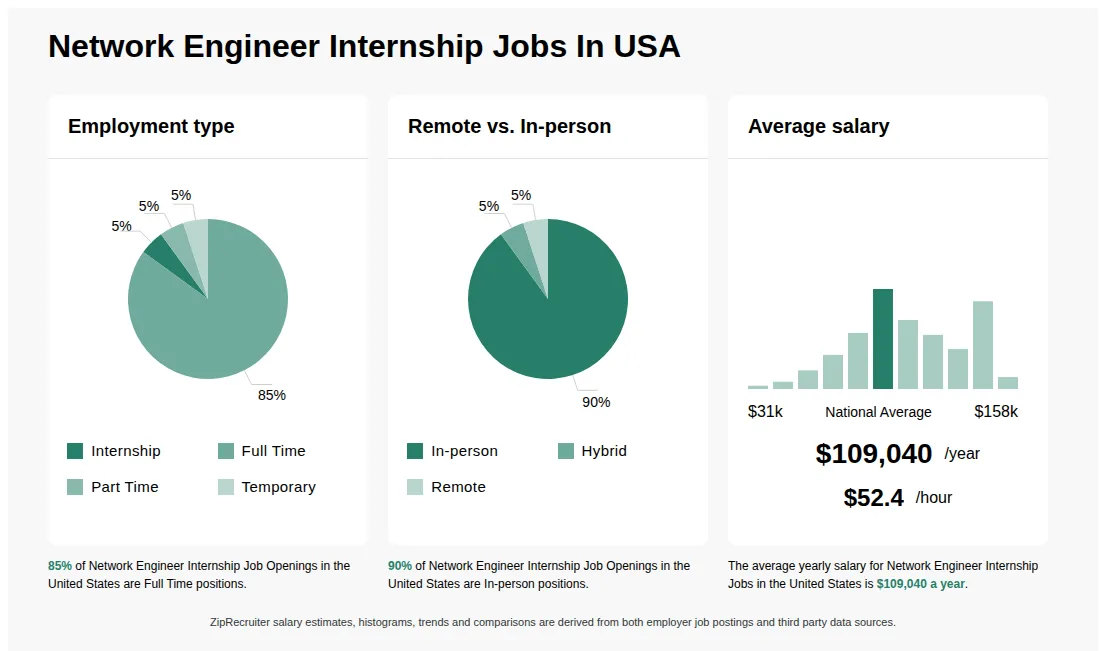
$31K - $42.5K
0% of jobs
$42.5K - $54.1K
1% of jobs
$54.1K - $65.6K
3% of jobs
$65.6K - $77.2K
7% of jobs
$77.2K - $88.7K
12% of jobs
$89.7K is the 25th percentile. Wages below this are outliers.
$88.7K - $100.3K
21% of jobs
The median wage is $104.8K / yr.
$100.3K - $111.8K
15% of jobs
$111.8K - $123.4K
12% of jobs
$129.5K is the 75th percentile. Wages above this are outliers.
$123.4K - $134.9K
8% of jobs
$134.9K - $146.5K
19% of jobs
$146.5K - $158K
2% of jobs
$31K
$109K
$158K
If you are a network engineering, computer science, or information security student, you can get a network engineer internship with a variety of companies in industries ranging from retail sales to software development. As an intern, your duties and responsibilities vary. You may assist in responding to help desk issues, managing a lab, maintaining an inventory of hardware, deploying and configuring networking equipment, and documenting configuration changes. You can also help evaluate and support the organization’s data and infrastructure security efforts, providing analysis of logs and monitoring network status. In some jobs, you also support and troubleshoot email systems and voice over IP phone systems and install and configure software according to company policy.
| Aspect | Network Engineer Internship | Network Administrator |
|---|---|---|
| Required Credentials | Typically pursuing or recent graduate in IT or related field | Relevant certifications like Cisco CCNA, CompTIA Network+ often preferred |
| Work Environment | Internship setting, learning-focused, supervised by senior staff | Full-time role managing network operations, troubleshooting, and maintenance |
| Employer & Industry Usage | Internship programs in tech companies, telecom, or IT departments | Businesses, organizations, and service providers managing networks |
The main difference is that a Network Engineer Internship is an entry-level, learning position designed for students or recent graduates, while a Network Administrator is a full-time role responsible for ongoing network management and troubleshooting. Internships provide hands-on experience, whereas administrators handle daily network operations.
Responsible for the architecture, implementation, documentation, and maintenance of the network infrastructure, including, but not limited LAN, WAN, DNS, DHCP, IDS/IPS and network security infrastructure. Responsible for annual budgets pertaining to designated systems. This includes maintenance contracts, planning, evaluation, and purchases of software and/or hardware to assure reliable performance of these systems.
Major Duties and ResponsibilitiesExperience
1. Background with network technologies including routers, switches, firewalls and IDS. 2. Familiar with Cisco IOS and ASA command line configuration and troubleshooting. 3. Familiar with WireShark to perform packet capture and analysis for troubleshooting network and system issues. 4. Familiar with DNS and DHCP configuration and troubleshooting. 5. Basic familiarity with at least one interpreted programing language (such as PERL, VBS, PHP).
Education/Certifications/Licenses
1. College degree and minimum of 4 years equivalence in progressively responsible industry experience. 2. Cisco router, switches and firewall courses or equivalent training or experience.
Interpersonal Skills
1. Frequent oral conversations, in person and on the telephone. 2. Ability to hear or otherwise receive information, and understand that information, from communications in person and on the telephone.
Other Skills
1. Ability to view a computer monitor for frequent periods of time. 2. Frequent clarity of vision at 20 feet or more. 3. Frequent clarity of vision at 20 inches or less.
ADA RequirementsPhysical Requirements
1. Frequent standing and walking. 2. Frequent sitting. 3. Occasional lifting up to 50 pounds. 4. Occasional pushing, pulling, or carrying up to 50 pounds. 5. Occasional reaching at or below shoulder level. 6. Occasional balancing, climbing in attic and crawl spaces. 7. Occasional handling of insulation materials. 8. Frequent finger manipulation to perform various duties such as typing, writing, data entry in computers, wiring, cabling, pinning, and PC repair.
Working Conditions
1. Occasional travel required. 2. Occasional exposure to extreme noise levels. 3. Frequent extended hours to include evenings and weekends as needed. 4. Frequent exposure to dust. 5. Occasional exposure to electrical hazards.
Mental and/or Emotional Requirements
Must be able to perform job functions independently or with limited supervision and work effectively either on own or as part of a team. Must be able to read and carry out various written instructions and follow oral instructions. Must be able to complete basic mathematical calculations, spell accurately, and understand computer basics. Must be able to speak clearly and deliver information in a logical and understandable sequence. Must be capable of dealing calmly and professionally with numerous different personalities from diverse cultures at various levels within and outside of the organization and demonstrate highest levels of customer service and discretion when dealing with the public. Must be able to perform responsibilities with composure under the stress of deadlines / requirements for extreme accuracy and quality and/or fast pace. Must be able to effectively handle multiple, simultaneous, and changing priorities. Must be capable of exercising highest level of discretion on both internal and external confidential matters.

Sourced by ZipRecruiter
Finance and insurance
51 - 200 Employees
Lewiston, ID, US
1938