
As a member of the team, the qualified individual will be responsible for designing new molds and upgrading/repairing existing molds. This team works very closely with new products engineers and ...
As a member of the team, the qualified individual will be responsible for designing new molds and upgrading/repairing existing molds. This team works very closely with new products engineers and ...

We are looking for highly motivated injection mold Designers for our Team! Our team members enjoy: a comprehensive benefit package, competitive wages, 401k, paid vacation, paid holidays, education ...
We are looking for highly motivated injection mold Designers for our Team! Our team members enjoy: a comprehensive benefit package, competitive wages, 401k, paid vacation, paid holidays, education ...

Liquid Silicone Rubber Injection Mold designer
Brea, CA · On-site
$60K - $80K/yr
We are currently looking for an experienced Liquid Silicone Rubber Injection Mold Designer in the Orange County area. Responsibilities: * Controlled revision changes per Engineering Change Orders
Quick apply
Liquid Silicone Rubber Injection Mold designer
Brea, CA · On-site
$60K - $80K/yr
We are currently looking for an experienced Liquid Silicone Rubber Injection Mold Designer in the Orange County area. Responsibilities: * Controlled revision changes per Engineering Change Orders
Liquid Silicone Rubber Injection Mold designer
Brea, CA · On-site
$60K - $80K/yr
We are currently looking for an experienced Liquid Silicone Rubber Injection Mold Designer in the Orange County area. Responsibilities: * Controlled revision changes per Engineering Change Orders
Quick apply
Liquid Silicone Rubber Injection Mold designer
Brea, CA · On-site
$60K - $80K/yr
We are currently looking for an experienced Liquid Silicone Rubber Injection Mold Designer in the Orange County area. Responsibilities: * Controlled revision changes per Engineering Change Orders
Liquid Silicone Rubber Injection Mold designer
Brea, CA · On-site
$60K - $80K/yr
We are currently looking for an experienced Liquid Silicone Rubber Injection Mold Designer in the Orange County area. Responsibilities: * Controlled revision changes per Engineering Change Orders
Quick apply
Liquid Silicone Rubber Injection Mold designer
Brea, CA · On-site
$60K - $80K/yr
We are currently looking for an experienced Liquid Silicone Rubber Injection Mold Designer in the Orange County area. Responsibilities: * Controlled revision changes per Engineering Change Orders

As a member of the team, the qualified individual will be responsible for designing new molds and upgrading/repairing existing molds. This team works very closely with new products engineers and ...
As a member of the team, the qualified individual will be responsible for designing new molds and upgrading/repairing existing molds. This team works very closely with new products engineers and ...

Mechanical Designer
Emigsville, PA · On-site
Mold Designer The Mold Designer develops high-quality plastic injection molds using advanced 3D CAD tools, ensuring robust, efficient, and manufacturable designs for high-volume production. This role ...
Quick apply
Mechanical Designer
Emigsville, PA · On-site
Mold Designer The Mold Designer develops high-quality plastic injection molds using advanced 3D CAD tools, ensuring robust, efficient, and manufacturable designs for high-volume production. This role ...

Qualifications High school diploma or GED a benefit Previous experience as a tooling person or as a mold designer Mechanical ability to handle repairs, prepare micro switches for plate jobs; make air ...
Qualifications High school diploma or GED a benefit Previous experience as a tooling person or as a mold designer Mechanical ability to handle repairs, prepare micro switches for plate jobs; make air ...
Mold Prep Manager
Milwaukee, WI · On-site
Qualifications • High school diploma or GED a benefit • Previous experience as a tooling person or as a mold designer • Mechanical ability to handle repairs, prepare micro switches for plate ...
Mold Prep Manager
Milwaukee, WI · On-site
Qualifications • High school diploma or GED a benefit • Previous experience as a tooling person or as a mold designer • Mechanical ability to handle repairs, prepare micro switches for plate ...

Be Seen First
Mold Maker/ Tool Maker
Cincinnati, OH · On-site
$31.50 - $47.50/hr
Work closely with engineers to evaluate new mold designs for manufacturability, build and introduce new molds, and troubleshoot mold and molding issues * Ensure all work is undertaken to a high ...
Quick apply
Be Seen First
Mold Maker/ Tool Maker
Cincinnati, OH · On-site
$31.50 - $47.50/hr
Work closely with engineers to evaluate new mold designs for manufacturability, build and introduce new molds, and troubleshoot mold and molding issues * Ensure all work is undertaken to a high ...
Mold Maker
$34 - $45/hr
Interphase with Designers and PM's when areas are unclear * Write programs for machines * Set-up machines * Check shut offs, final fit, and assemble molds KEY RESPONSIBILITIES: * Responsible to build ...
Mold Maker
$34 - $45/hr
Interphase with Designers and PM's when areas are unclear * Write programs for machines * Set-up machines * Check shut offs, final fit, and assemble molds KEY RESPONSIBILITIES: * Responsible to build ...

The Mold Maker works from designs to build and repair thermoplastic and thermoset injection molds to company standards. Our customers are automotive manufacturers and suppliers in one of the fastest ...
The Mold Maker works from designs to build and repair thermoplastic and thermoset injection molds to company standards. Our customers are automotive manufacturers and suppliers in one of the fastest ...
Mold Maker
Auburn Hills, MI · On-site
The Mold Maker works from designs to build and repair thermoplastic and thermoset injection molds to company standards. Our customers are automotive manufacturers and suppliers in one of the fastest ...
Mold Maker
Auburn Hills, MI · On-site
The Mold Maker works from designs to build and repair thermoplastic and thermoset injection molds to company standards. Our customers are automotive manufacturers and suppliers in one of the fastest ...

Experienced Upgrader/Mold Maker
Comstock Park, MI · On-site
$22 - $28/hr
Review mold designs using NX Viewer Unigraphics software.Safely operate overhead cranes to include rigging, transporting, and manipulating molds.Follow established processes where applicable.Use ...
Quick apply
Experienced Upgrader/Mold Maker
Comstock Park, MI · On-site
$22 - $28/hr
Review mold designs using NX Viewer Unigraphics software.Safely operate overhead cranes to include rigging, transporting, and manipulating molds.Follow established processes where applicable.Use ...
Review mold designs using NX Viewer Unigraphics software. * Safely operate overhead cranes to include rigging, transporting, and manipulating molds. * Follow established processes where applicable.
Review mold designs using NX Viewer Unigraphics software. * Safely operate overhead cranes to include rigging, transporting, and manipulating molds. * Follow established processes where applicable.
Mold Maker Part-time
$34 - $45/hr
Interphase with Designers and PM's when areas are unclear * Write programs for machines * Set-up machines * Check shut offs, final fit, and assemble molds KEY RESPONSIBILITIES: * Responsible to build ...
Mold Maker Part-time
$34 - $45/hr
Interphase with Designers and PM's when areas are unclear * Write programs for machines * Set-up machines * Check shut offs, final fit, and assemble molds KEY RESPONSIBILITIES: * Responsible to build ...

Mold Builder
Coon Rapids, MN · On-site
$30 - $40/hr
Read blueprints and analyze data on the computer to execute mold designs accurately. * Communicate effectively with all necessary parties to receive instructions and coordinate activities.
Mold Builder
Coon Rapids, MN · On-site
$30 - $40/hr
Read blueprints and analyze data on the computer to execute mold designs accurately. * Communicate effectively with all necessary parties to receive instructions and coordinate activities.
Mold Maker II
Port Richey, FL · On-site
Interphase with Designers and PM's when areas are unclear * Write programs for machines * Set-up machines * Check shut offs, final fit, and assemble molds KEY RESPONSIBILITIES: (The finer details of ...
Mold Maker II
Port Richey, FL · On-site
Interphase with Designers and PM's when areas are unclear * Write programs for machines * Set-up machines * Check shut offs, final fit, and assemble molds KEY RESPONSIBILITIES: (The finer details of ...
Mold Builder
Coon Rapids, MN · On-site
$30 - $40/hr
Read blueprints and analyze data on the computer to execute mold designs accurately. * Communicate effectively with all necessary parties to receive instructions and coordinate activities.
Mold Builder
Coon Rapids, MN · On-site
$30 - $40/hr
Read blueprints and analyze data on the computer to execute mold designs accurately. * Communicate effectively with all necessary parties to receive instructions and coordinate activities.
Mold Maker II
Port Richey, FL · On-site
Interphase with Designers and PM's when areas are unclear * Write programs for machines * Set-up machines * Check shut offs, final fit, and assemble molds KEY RESPONSIBILITIES: (The finer details of ...
Mold Maker II
Port Richey, FL · On-site
Interphase with Designers and PM's when areas are unclear * Write programs for machines * Set-up machines * Check shut offs, final fit, and assemble molds KEY RESPONSIBILITIES: (The finer details of ...
Mold Designer information
See salary details
$18.99 - $21.42
11% of jobs
$21.42 - $23.84
11% of jobs
$24.49 is the 25th percentile. Wages below this are outliers.
$23.84 - $26.27
15% of jobs
$26.27 - $28.69
6% of jobs
$28.69 - $31.12
0% of jobs
$31.12 - $33.54
0% of jobs
$33.54 - $35.97
6% of jobs
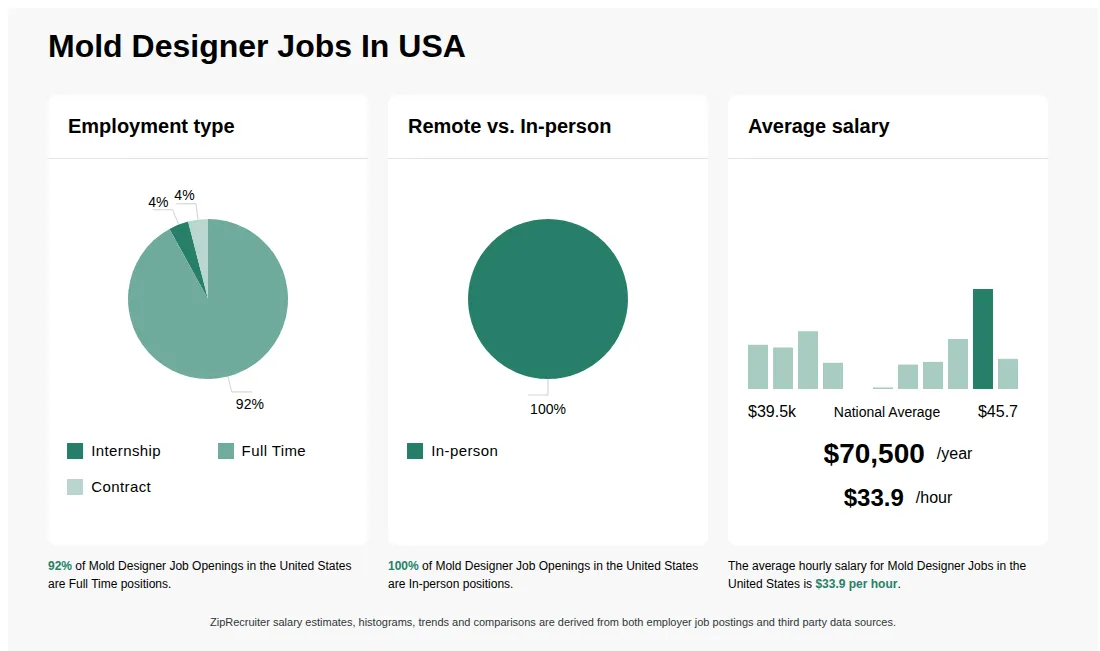
The median wage is $36.58 / hr.
$35.97 - $38.40
6% of jobs
$38.40 - $40.82
13% of jobs
$41.55 is the 75th percentile. Wages above this are outliers.
$40.82 - $43.25
25% of jobs
$43.25 - $45.67
7% of jobs
$18
$33
$45
How much do mold designer jobs pay per hour?
As of Sep 2, 2026, the average hourly pay for mold designer in the United States is $33.89, according to ZipRecruiter salary data. Most workers in this role earn between $24.76 and $41.83 per hour, depending on experience, location, and employer.
What is a mold designer?
Mold designers are professionals who create detailed plans and blueprints for molds used in manufacturing processes, such as injection molding, blow molding, or casting. Their work involves designing molds that shape raw materials into finished products, ensuring efficiency, quality, and precision in production. Mold designers use specialized software like CAD to develop and test their designs before they are manufactured. They often collaborate closely with engineers, machinists, and production teams to optimize mold functionality and manufacturability.
What does a mold designer do?
As a mold designer, you use computer-aided design (CAD) software to create plastic molds for manufacturing processes. Your job duties include designing molds, using CAD software and programs like Pro-E, Unigraphics Drawing, Solidworks, and AutoCAD, and visiting manufacturing facilities to make sure your mold designs work correctly. You can fulfill the majority of your responsibilities in the office, but a good mold designer frequents the manufacturing floor to inspect their product. The qualifications to start a career as a mold designer are an associate degree in plastics engineering technology or tool and manufacturing technology, and five to eight years of experience in the field. You need excellent problem-solving skills for this job as well.
What are the key skills and qualifications needed to thrive as a mold designer, and why are they important?
To thrive as a Mold Designer, you need strong skills in mechanical design, CAD software proficiency, and a solid understanding of materials and manufacturing processes, often supported by an engineering degree or technical certification. Expertise in tools like SolidWorks, AutoCAD, and mold flow analysis software is typically required. Attention to detail, problem-solving abilities, and effective communication with production teams are essential soft skills. These competencies ensure the creation of precise, efficient molds that meet production and quality standards.
What are some common challenges faced by mold designers, and how can they be addressed?
Mold Designers often encounter challenges such as balancing complex part geometries with manufacturability, minimizing cycle times, and ensuring tool longevity. Addressing these issues typically involves close collaboration with engineers and manufacturing teams to refine part designs, selecting appropriate materials, and leveraging simulation software to predict and resolve potential issues before production. Proactive communication and staying updated with the latest CAD and CAE tools can help Mold Designers overcome these challenges efficiently.
What is the difference between Mold Designer vs Mold Engineer?
| Aspect | Mold Designer | Mold Engineer |
|---|---|---|
| Responsibilities | Designs mold components and layouts based on product specifications. | Develops and improves mold processes, troubleshooting, and testing. |
| Required Skills | CAD proficiency, understanding of materials, design principles. | In-depth engineering knowledge, testing, and process optimization skills. |
| Work Environment | Design offices, CAD labs, manufacturing facilities. | Manufacturing plants, testing labs, R&D departments. |
| Certifications | CAD certifications, technical diplomas. | Engineering degrees, certifications in manufacturing or plastics. |
While Mold Designers focus on creating detailed mold designs, Mold Engineers oversee the entire mold development process, including testing and optimization. Both roles require technical skills and often collaborate closely, but Mold Engineers typically have a broader scope involving process improvements and troubleshooting.
How much do mold designers make?
Mold designers typically earn between $50,000 and $80,000 annually, depending on experience, location, and industry. Entry-level positions may start lower, while experienced professionals with advanced skills in CAD software and manufacturing processes can earn higher salaries.
Is mold making a good career?
Mold designing is a skilled profession involving the creation of molds for manufacturing products, often requiring knowledge of CAD software and materials. It offers steady employment opportunities in manufacturing industries, with potential for specialization and advancement. The field typically requires technical training or apprenticeships and can provide a stable career path for those with relevant skills.
More about Mold Designer jobs
What cities are hiring for Mold Designer jobs?
Cities with the most Mold Designer job openings:
What are the most commonly searched types of Mold Designer jobs?
The most popular types of Mold Designer jobs are:
What states have the most Mold Designer jobs?
States with the most job openings for Mold Designer jobs include:
What job categories do people searching Mold Designer jobs look for?
The top searched job categories for Mold Designer jobs are:
What are popular job titles related to Mold Designer jobs?
For Mold Designer jobs, the most frequently searched job titles are:
Laitram rating

7.5
Based on 9 frontline employees who took The Breakroom Quiz
273rd of 495 rated machine equipment manufacturers
Job description
Intralox, L.L.C., a division of Laitram, L.L.C., and a global provider of conveyance solutions and services currently has an opening for an Injection Molding Design Engineer in its Engineering Mold Shop. As a member of the team, the qualified individual will be responsible for designing new molds and upgrading/repairing existing molds. This team works very closely with new products engineers and production engineers to provide injection mold design solutions for both new and mature product lines. The role requires in-depth knowledge of plastics, injection mold design and 3D CAD.
Intralox offers an unparalleled opportunity for those who want to work for an established, yet consistently growing company, with opportunities for international exposure, continuous improvement, and career advancement. To learn more about our company culture, philosophy, and benefits, please visit our Careers website .
Job Responsibilities and Requirements
Responsibilities
Requirements
Desired Requirements
EEO/Vet/Disability Notice
EOE/M/F/Vet/Disabled
Intralox offers an unparalleled opportunity for those who want to work for an established, yet consistently growing company, with opportunities for international exposure, continuous improvement, and career advancement. To learn more about our company culture, philosophy, and benefits, please visit our Careers website .
Job Responsibilities and Requirements
Responsibilities
- Design and develop high-quality injection molds for plastic parts using CAD software (Creo Parametric)
- Create detailed mold drawings, specifications, and documentation
- Collaborate with product development engineers to optimize part designs for the injection molding process
- Collaborate with manufacturing, quality, and production teams to ensure designs meet specifications and manufacturability standards
- Analyze and troubleshoot design issues, suggest improvements, and ensure efficient mold operation
- Stay current with and integrate the latest in injection molding and mold manufacturing technologies
Requirements
- Undergraduate degree in Plastics/Mechanical Engineering or 5+ years' experience in a design role in the tool and die industry
- Strong organizational, communication and analytical skills
- 2+ years' experience working in Creo CAD software or comparable software
- Must be proficient in Microsoft Office applications and general computer applications
- A self-managed team player who excels in a team environment
Desired Requirements
- Experience working with mold making equipment and injection molding machines.
- Basic project management skills
EEO/Vet/Disability Notice
EOE/M/F/Vet/Disabled

About Laitram
Sourced by ZipRecruiter
Industry
Machinery manufacturing
Company size
1,001 - 5,000 Employees
Headquarters location
New Orleans, LA, US
Year founded
1949