1

Medical Imaging Software Engineer Jobs (NOW HIRING)

Senior Software Engineer

San Diego, CA · On-site

$130K - $171K/yr

... medical X-ray imaging system. This role primarily focuses on maintaining and stabilizing the ... Software Engineering, or equivalent - 5+ years of professional software development experience ...

Senior Software Engineer

San Diego, CA

$130K - $171K/yr

... medical X-ray imaging system. This role primarily focuses on maintaining and stabilizing the ... Software Engineering, or equivalent - 5+ years of professional software development experience ...

Senior Software Engineer

San Diego, CA

$130K - $171K/yr

... medical X-ray imaging system. This role primarily focuses on maintaining and stabilizing the ... Software Engineering, or equivalent - 5+ years of professional software development experience ...

About the Role KARL STORZ is seeking a Software Engineer I to support the design, development, testing, and maintenance of embedded and application-level software for advanced medical imaging devices.

Senior Software Engineer

San Diego, CA · On-site

$100K - $200K/yr

We are seeking a Senior Software Engineer to play a key role in maintaining, evolving, and selectively developing our Ez-X medical X-ray imaging system. * This role primarily focuses on maintaining ...

Software Developer This position is in GE Healthcare's MIM Software business which makes vendor ... A preexisting understanding of medical imaging is not required. What You'll Get: * Hybrid work ...

next page

Showing results 1-20

Medical Imaging Software Engineer information

See salary details

$63.5K

$147.5K

$205.5K

How much do medical imaging software engineer jobs pay per year?

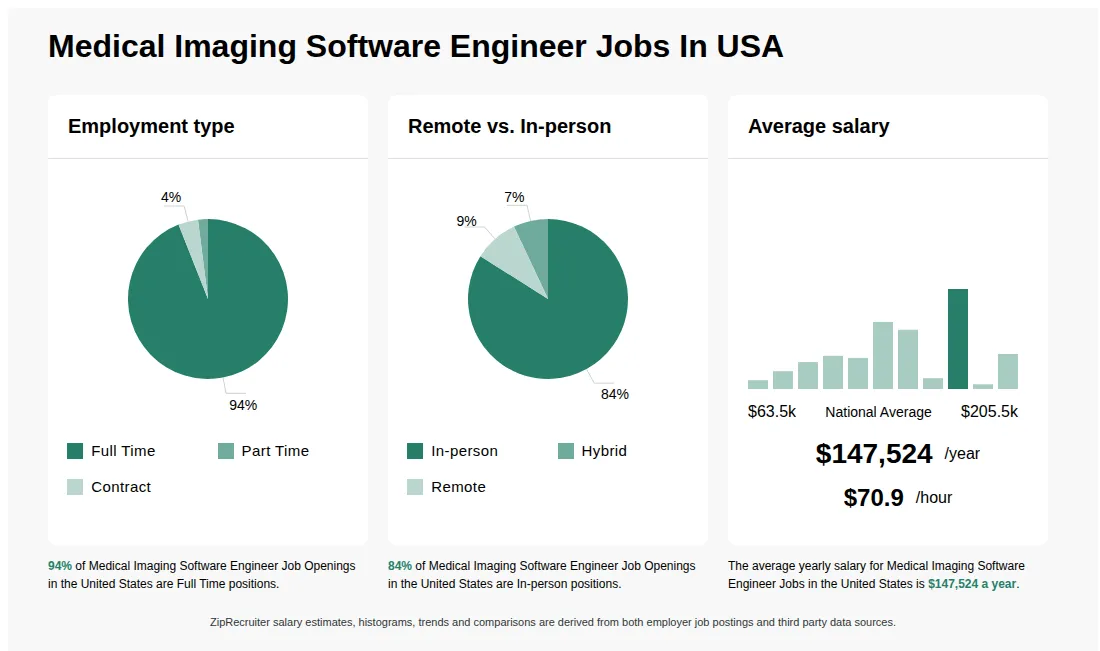
As of Jun 10, 2026, the average yearly pay for medical imaging software engineer in the United States is $147,524.00, according to ZipRecruiter salary data. Most workers in this role earn between $120,000.00 and $173,000.00 per year, depending on experience, location, and employer.

What are some typical challenges Medical Imaging Software Engineers face in their daily work?

Medical Imaging Software Engineers often work with large and complex datasets, requiring efficient data processing and management skills to ensure timely analysis and visualization. They must navigate strict regulatory standards for medical software, necessitating careful documentation, validation, and rigorous testing. Collaboration with radiologists and clinicians is essential to understand user needs and integrate clinical feedback into product development. Balancing technical innovation with compliance and ease of use is a common challenge but also provides opportunities to make a meaningful impact in healthcare.

What is a Medical Imaging Software Engineer job?

A Medical Imaging Software Engineer develops, optimizes, and maintains software for processing, analyzing, and visualizing medical images from modalities like MRI, CT, and ultrasound. They work with algorithms, image reconstruction techniques, and machine learning to improve diagnostic accuracy and workflow efficiency. Engineers in this field collaborate with radiologists, healthcare professionals, and regulatory teams to ensure compliance with medical standards. Their role requires expertise in programming languages such as Python, C++, or Java, alongside knowledge of medical imaging formats like DICOM.

What are the key skills and qualifications needed to thrive in the Medical Imaging Software Engineer position, and why are they important?

A Medical Imaging Software Engineer requires a solid background in computer science or software engineering, with expertise in image processing, programming languages such as C++ or Python, and a strong understanding of medical imaging modalities like MRI or CT. Familiarity with specialized tools such as DICOM, PACS, and libraries like ITK or VTK, as well as relevant certifications in healthcare technology, is highly valued. Excellent problem-solving, communication, and teamwork skills help these engineers collaborate effectively with medical professionals and multidisciplinary development teams. These skills are essential to develop high-quality, safe, and user-friendly imaging solutions that support accurate medical diagnoses and patient care.

More about Medical Imaging Software Engineer jobs
What cities are hiring for Medical Imaging Software Engineer jobs? Cities with the most Medical Imaging Software Engineer job openings:
What are the most commonly searched types of Medical Imaging Software Engineer jobs? The most popular types of Medical Imaging Software Engineer jobs are:
What states have the most Medical Imaging Software Engineer jobs? States with the most job openings for Medical Imaging Software Engineer jobs include:
Senior Software Engineer - VETi Platform

Senior Software Engineer - VETi Platform

Kodiak Sciences Inc

Palo Alto, CA • On-site

$144K - $189K/yr

Full-time

Posted 14 days ago


Job description

Description
Kodiak Sciences (Nasdaq: KOD) is advancing vision science by integrating retinal biology, optics, artificial intelligence, medical imaging, and next-generation wearable technologies.
Our VETi™ - Visual Engagement Technology and Imager - platform is an AI-enabled wearable system combining advanced LiDAR, Optical Coherence Tomography (OCT), embedded computing, machine learning, and AR/VR technologies. VETi is being developed for applications in retina care, digital health, identity security, cognitive science, and broader AI-enabled vision technologies.
We are looking for a Senior Software Engineer to help build the software foundation for Kodiak's VETi platform, from early prototypes through reliable engineering systems. This role is well suited for an engineer with strong software fundamentals who enjoys complex technical problems, works well across disciplines, and is excited to build software that connects closely with real-world hardware.
Responsibilities
  • Lead the design, development, and optimization of software for advanced wearable imaging and sensing systems - from prototypes through validation.
  • Build software for device control, imaging workflows, AR/VR interfaces, and health-monitoring applications.
  • Develop and integrate real-time signal-processing and image-processing pipelines.
  • Work with embedded computing platforms, sensors (LiDAR, OCT, MEMS-based systems), and hardware-accelerated processing (NPUs and similar).
  • Collaborate with hardware, firmware, optics, algorithms, machine learning, and systems engineering teams.
  • Develop and debug software at the application, hardware/software integration, and system levels on Linux and Windows.
  • Take research prototypes and turn them into reliable engineering software that powers next-generation medical imaging devices used in clinical and product validation.

Education / Qualifications
  • B.S., M.S., or Ph.D. in Computer Science, Electrical Engineering, Computer Engineering, or a related technical discipline, or equivalent practical experience.
  • 5+ years of professional software engineering experience developing complex systems.
  • Strong programming experience in C, C++, and Python.
  • Strong software architecture, debugging, and problem-solving skills.
  • Experience building software that interfaces with hardware, sensors, devices, imaging systems, or performance-sensitive systems.
  • Experience working in Linux and/or Windows environments.
  • Ability to collaborate across software, hardware, scientific, and engineering teams.

Additional Experience That Would Be Valuable
  • Experience with embedded systems, firmware, device software, or hardware/software integration.
  • Experience developing medical devices, imaging systems, AR/VR systems, robotics, or wearable technologies.
  • Experience with real-time signal processing, image processing, FFT pipelines, sensor data, or performance optimization.
  • Experience with GPUs, DSPs, NPUs, FPGAs, microcontrollers, or other hardware-accelerated compute platforms.
  • Experience integrating machine learning models into edge, device, or embedded systems.

Why Join the Kodiak Team
This role is for engineers who want their code to drive real-world physical systems - optics, sensors, and embedded computing - and shape the hardware itself. You will work at the intersection of software, hardware, medical imaging, optics, AR/VR, LiDAR, OCT, and AI. The platform is novel, the technical challenges are deep, and the work has the potential to shape a new class of wearable vision technologies.