1

Maximum Security Prison Jobs (NOW HIRING)

next page

Showing results 1-20

Maximum Security Prison information

See salary details

$28K

$67.7K

$162K

How much do maximum security prison jobs pay per year?

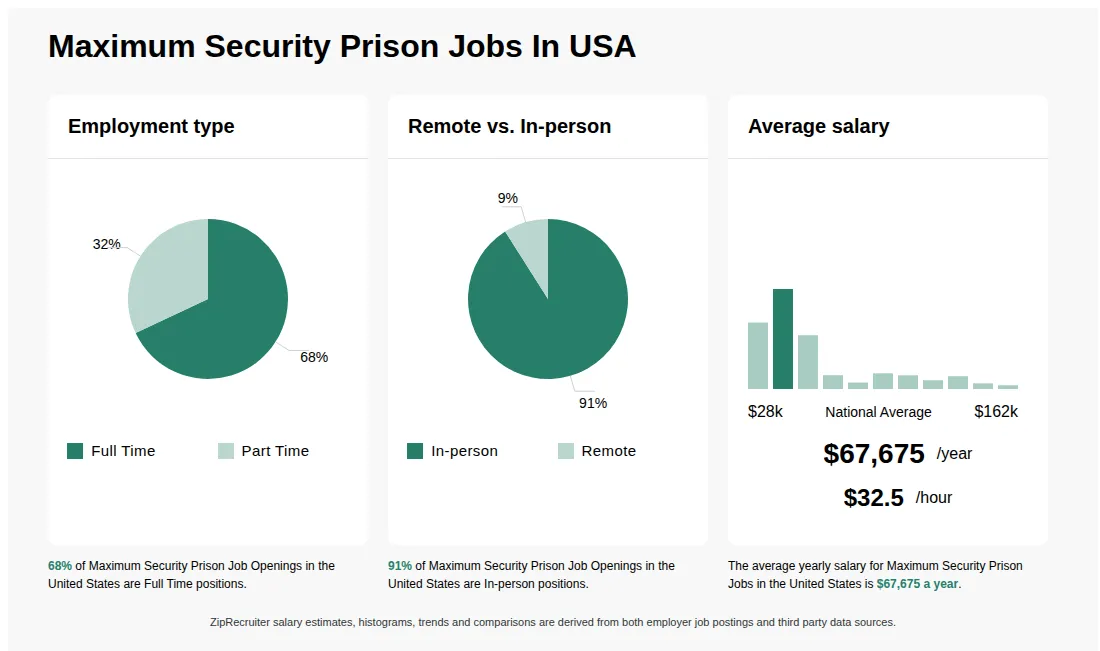
As of Jul 6, 2026, the average yearly pay for maximum security prison in the United States is $67,675.00, according to ZipRecruiter salary data. Most workers in this role earn between $43,000.00 and $81,500.00 per year, depending on experience, location, and employer.

What is the difference between Maximum Security Prison vs Correctional Officer?

AspectMaximum Security PrisonCorrectional Officer
CredentialsHigh school diploma, security training, background checkHigh school diploma, security training, background check
Work EnvironmentHigh-security facility with dangerous inmatesInside prison, supervising inmates
Industry UsageCorrectional facilities, law enforcementCorrectional facilities, law enforcement
Job RoleOversees inmate behavior, maintains securitySupervises inmates, enforces rules

While a Maximum Security Prison is a facility designed to house the most dangerous inmates, a Correctional Officer is a professional who works inside such prisons to maintain security and supervise inmates. The roles are interconnected, with correctional officers being essential staff within maximum security prisons.

What is the highest paying job in prison?

In prisons, the highest paying jobs are typically administrative or supervisory roles such as prison wardens or security directors, which require extensive experience, leadership skills, and often specialized certifications. These positions often come with higher salaries compared to other prison staff roles like guards or support staff.

What are some common challenges faced by correctional officers working in a maximum security prison, and how can these challenges be managed?

Correctional officers in maximum security prisons often face challenges such as managing high-risk inmates, maintaining strict security protocols, and responding to emergency situations. The work environment can be high-pressure and requires constant vigilance, effective communication, and teamwork to ensure safety for both staff and inmates. Officers can manage these challenges by participating in ongoing training, following established procedures, and relying on support from their colleagues and supervisors. Building strong situational awareness and stress management skills is also essential for success in this demanding role.

Can I become a correctional officer at 40?

Yes, many correctional agencies accept applicants up to age 40 or older, provided they meet other requirements such as background checks, physical fitness, and training. Age limits vary by jurisdiction, but experience and maturity can be advantageous in correctional officer roles.

What is a Maximum Security Prison job?

A Maximum Security Prison job involves working in a highly secure correctional facility that houses the most dangerous and high-risk inmates. Employees in these facilities include correctional officers, security personnel, medical staff, and administrative workers who ensure safety, enforce rules, and manage rehabilitation programs. These roles require strong discipline, situational awareness, and the ability to handle potentially dangerous situations. Training and certifications are often needed, and the work environment is highly structured to maintain order and security.

Can you make 100k as a correctional officer?

Correctional officers typically earn less than $100,000 annually, with salaries varying by location, experience, and rank. Advanced positions, specialized roles, or supervisory responsibilities may offer higher pay, but reaching a six-figure salary is uncommon in this field. Additional certifications and years of service can influence earning potential.

Can you make 6 figures as a correctional officer?

Correctional officers typically earn salaries below six figures, with most earning between $40,000 and $70,000 annually. Higher salaries may be available with experience, specialized roles, or working in high-cost areas, but reaching a six-figure income is uncommon in this profession.

What are the key skills and qualifications needed to thrive as a Maximum Security Prison Correctional Officer, and why are they important?

To thrive as a Maximum Security Prison Correctional Officer, you need strong observational skills, sound judgment, physical fitness, and a high school diploma or equivalent, with additional training provided by correctional institutions. Familiarity with security systems, surveillance technology, incident reporting software, and sometimes certifications in crisis intervention are typically required. Excellent communication, emotional resilience, and conflict de-escalation skills help officers effectively manage inmate interactions and high-stress situations. These skills are vital for maintaining safety, order, and security in a challenging correctional environment.

What is a maximum security prison?

A maximum security prison is a type of correctional facility designed to house the most dangerous and high-risk inmates. These prisons have strict security measures, including high walls, armed guards, surveillance systems, and limited inmate movement to prevent escapes and maintain order. Inmates in maximum security prisons typically have committed serious crimes or pose significant threats to staff, other inmates, or themselves. The environment is highly controlled, with limited privileges and frequent monitoring to ensure safety for everyone involved.
More about Maximum Security Prison jobs
What are the most commonly searched types of Maximum Security Prison jobs? The most popular types of Maximum Security Prison jobs are:
What job categories do people searching Maximum Security Prison jobs look for? The top searched job categories for Maximum Security Prison jobs are:
Physician / Family Practice / California / Permanent / Primary Care Physician Job

Physician / Family Practice / California / Permanent / Primary Care Physician Job

Kurz Solutions

Sacramento, CA

Full-time

Posted 16 days ago


Job description

MD/DO - Primary Care Physician - Corrections
Made famous by Johnny Cash
The Facility - Folsom State Prison
Folsom State Prison is located in Represa California and is one of the oldest correctional facilities in the state. Originally opened in the 1880's as one of the first maximum-security institutions, today the facility houses minimum and medium-security inmates. Until recently, Folsom only housed male offenders, now it has begun housing women in a separate stand-alone facility
People may recognize this prison as the subject of a Johnny Cash song entitled "Folsom Prison Blues ". This facility has also housed some of the most infamous inmates including, Suge Knight, Rick James, and Charles Manson. This facility is responsible for manufacturing the vast majority of California License plates. This institution has also been an on site filming location for several movies. Folsom Prison has a rich history and dates back to the late 1800's, it was also the first correctional facility ever to have electricity.
Physician's Role in Correctional Medicine
Physicians have a complicated role in correctional health care. It is "primary care" at a high and extensive level. Physicians in corrections have a captive audience of patients, literally and figuratively, that need a wide variety of medical care. Incarcerated individuals enter and stay in your practice with every possible medical condition. Many of these patients may have had little or no prior medical, dental or mental health care, other than emergency room visits. The correctional physician must be prepared for this population. Many of these patients may have current or past substance abuse issues. Many of these patients may have poor coping skills and even a mind-set to defy authority.
It goes without saying that the correctional doctor has a tremendous role in the provision of medical care. However, that role often goes far beyond seeing patients and giving care. Not only must the correctional physician manage health care, they may also have a significant administrative role in direct health care, in the system of health care, and in health care policy, procedures, and standards. A physician working in corrections must be aware of and balance interests of good solid medical practice, medical board requirements, court findings, the safety and security of the facility, the individuals in the facility, and the community, all while working in an environment not specifically created for the purpose of health care. A physician may have to take on multiple roles beyond direct one-on-one patient care while working in a correctional facility. Although many of these roles have similar practice experiences outside of corrections they can become co-occurring roles for a physician in corrections.
REQUIREMENTS (duties include but are not limited to)
  • Under the direction of the Institution/Facility CEO/CME or designee, the Temporary/Relief Primary Care Physician shall provide services as permitted within the scope of practice for Primary Care Physician services in accordance with Institution/Facility policies and procedures. Care delivery for Primary Care Telemedicine is remote via teleconferencing equipment and basic computer competency would be necessary.
  • Obligation is to assist CDCR/CCHCS in its exercise of its duty to provide and manage medical healthcare services for the patient/youth of the State of California; Primary Care Physicians shall provide high quality services, consistent with the terms and conditions under this Agreement and consistent with established and commonly accepted standards and principles of medical practice.
  • Primary Care Physicians shall adhere to the CDCR/CCHCS medical staff by-laws, rules, regulations, policies and procedures, and comply with universal infection control precautions.
QUALIFICATIONS
  • Must be a Doctor of Medicine (MD) or Doctor of Osteopathy (DO) and be Board Certified.
  • Minimum of twelve (12) continuous months of experience within the last thirty-six (36) months performing services similar in scope to those defined herein, in a public or private institution.
  • Must be licensed to practice medicine in the State of California as defined in the Medical Practice Act, Chapter 5, commencing with Section 2000 of the Business and Professions Code and possess a valid Physician license as issued by the Medical Board/Osteopathic Board of California.
  • Must have and maintain Advanced Cardiovascular Life Support (ACLS) certification.
  • Must have and maintain current Drug Enforcement Administration (DEA) Certification.
  • Specialty Services - In addition to the above requirements, Physicians who are providing care in a specialized area such as emergency medicine, surgery, etc., shall also have at least two (2) years of experience within the last three (3) years providing patient care within that setting and possess any required certificates.

KurzSolutions is committed to improving health outcomes by providing well-managed companies with the top healthcare talent in the market.