1

Machine Learning Engineer Jobs in Houston, TX (NOW HIRING)

Senior AI Engineer

Houston, TX · On-site

$99K - $137K/yr

Design, develop, and deploy advanced AI and machine learning models to solve complex business ... Mentor junior engineers and provide technical guidance on AI best practices, model development, and ...

Deep knowledge of supervised learning, unsupervised learning, feature engineering, model selection ... Familiar with machine learning curricula and common challenges such as understanding bias-variance ...

Deep knowledge of supervised learning, unsupervised learning, feature engineering, model selection ... Familiar with machine learning curricula and common challenges such as understanding bias-variance ...

Deep knowledge of supervised learning, unsupervised learning, feature engineering, model selection ... Familiar with machine learning curricula and common challenges such as understanding bias-variance ...

Deep knowledge of supervised learning, unsupervised learning, feature engineering, model selection ... Familiar with machine learning curricula and common challenges such as understanding bias-variance ...

next page

Showing results 1-20

Machine Learning Engineer information

See Houston, TX salary details

$30.1K

$123K

$184.8K

How much do machine learning engineer jobs pay per year?

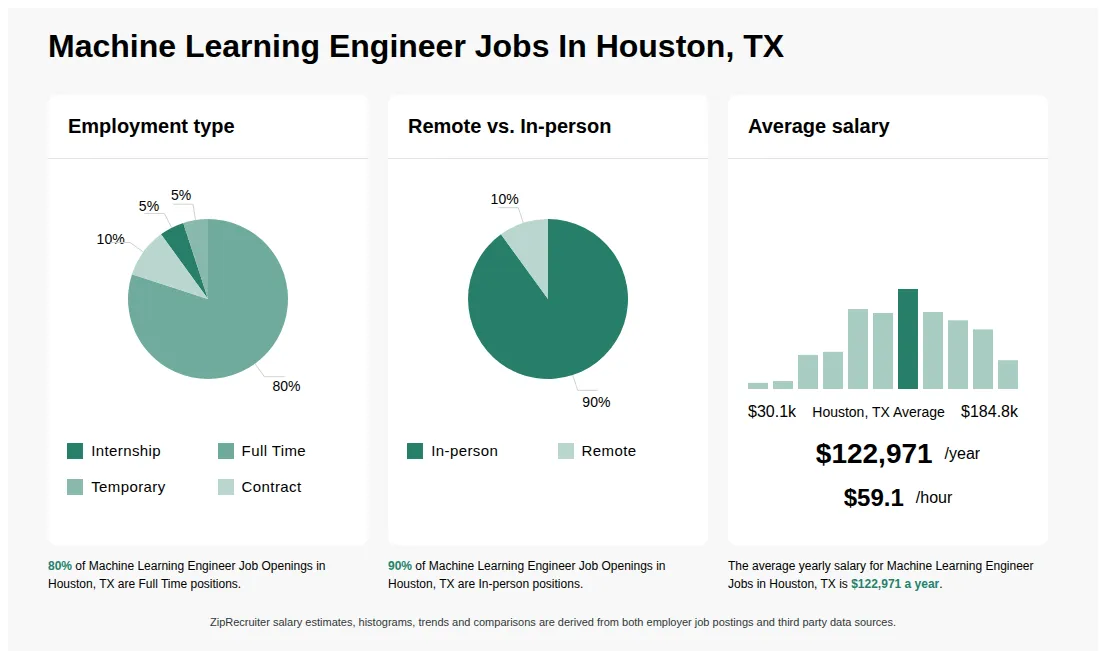
As of Jun 14, 2026, the average yearly pay for machine learning engineer in Houston, TX is $122,971.00, according to ZipRecruiter salary data. Most workers in this role earn between $96,900.00 and $148,000.00 per year, depending on experience, location, and employer.

Is ML full of coding?

Machine Learning Engineers typically do a significant amount of coding, especially in languages like Python or R, to develop algorithms, preprocess data, and build models. Strong programming skills are essential, along with knowledge of frameworks such as TensorFlow or PyTorch, but the role also involves data analysis, model evaluation, and collaboration with teams. Coding is a core component of the job, though some tasks may involve model deployment and optimization that require different skills.

What engineers make $500,000?

Senior machine learning engineers with extensive experience, advanced skills in deep learning and data science, and often working in high-paying industries such as finance or technology can earn $500,000 or more annually. Compensation typically includes base salary, bonuses, and stock options, especially at large tech companies or startups with significant funding.

What do machine learning engineers do?

Machine learning engineers develop algorithms and models that enable computers to learn from data and make predictions or decisions. They often work with large datasets, use programming languages like Python or Java, and utilize tools such as TensorFlow or PyTorch to build, test, and deploy machine learning systems in production environments.

What are Machine Learning Engineers?

Machine Learning Engineers are specialized software engineers who design, build, and deploy machine learning models and systems. They work at the intersection of software engineering and data science, transforming data-driven prototypes into scalable, production-ready solutions. Their responsibilities include data preprocessing, model selection, algorithm implementation, and optimizing models for performance and efficiency. Machine Learning Engineers often collaborate with data scientists, software developers, and other stakeholders to integrate AI technologies into products and services.

What are the key skills and qualifications needed to thrive as a Machine Learning Engineer, and why are they important?

To thrive as a Machine Learning Engineer, you need strong programming skills (particularly in Python), a solid background in mathematics and statistics, and a degree in computer science or a related field. Experience with machine learning frameworks (such as TensorFlow or PyTorch), data processing tools, and cloud platforms is typically required. Problem-solving ability, effective communication, and adaptability are crucial soft skills for collaborating with teams and translating complex models into practical solutions. These competencies ensure the development, deployment, and continual improvement of machine learning systems that drive business value.

Which 5 jobs will survive AI?

Machine Learning Engineers are likely to continue to be in demand as they develop, implement, and maintain AI systems, requiring specialized skills in programming, data analysis, and model optimization. Roles that involve complex problem-solving, creativity, and human interaction—such as healthcare professionals, educators, skilled tradespeople, and certain managerial positions—are also expected to persist despite AI advancements. These jobs typically require emotional intelligence, adaptability, and domain expertise that AI cannot easily replicate.

What Does a Machine Learning Engineer Do?

A machine learning engineer maintains production systems and often works with other engineers. In this career, you work with software development methodology, use modern software development tools, and use agile practices. You also play a role in software design and architecture, so you may occasionally work with a programmer. An engineer may help to predict how a model should perform or seek out regression issues by using different test types and algorithms. To fulfill your duties and responsibilities, you work on a computer and use an array of skills and programs to carry out these tests.

What are some common challenges faced by Machine Learning Engineers when deploying models to production?

Machine Learning Engineers often encounter challenges such as ensuring model scalability, maintaining data consistency between training and production environments, and monitoring model performance over time. Integrating models into existing software infrastructure may require collaboration with DevOps and software engineering teams to address issues like latency, version control, and resource allocation. Additionally, ongoing model maintenance is crucial to prevent model drift and ensure that predictions remain accurate as new data becomes available.

What is the difference between Machine Learning Engineer vs Data Scientist?

AspectMachine Learning EngineerData Scientist
CredentialsBachelor's or Master's in CS, Data Science, or related; experience with ML frameworksBachelor's or Master's in Statistics, Data Science, or related; strong analytical skills
Work EnvironmentDevelops scalable ML models, deploys algorithms into productionAnalyzes data, builds models, interprets data insights
Industry UsageTech companies, startups, AI-focused firmsFinance, healthcare, marketing, research organizations

While both roles work with data and machine learning, Machine Learning Engineers focus on building and deploying scalable ML models in production environments. Data Scientists primarily analyze data, create models, and generate insights. The roles often overlap but differ in their core responsibilities and focus areas.

What are the most commonly searched types of Machine Learning Engineer jobs in Houston, TX? The most popular types of Machine Learning Engineer jobs in Houston, TX are:
What cities near Houston, TX are hiring for Machine Learning Engineer jobs? Cities near Houston, TX with the most Machine Learning Engineer job openings:
Infographic showing various Machine Learning Engineer job openings in Houston, TX as of June 2026, with employment types broken down into 98% Full Time, and 2% Part Time. Highlights an 89% Physical, 4% Hybrid, and 7% Remote job distribution, with an average salary of $122,971 per year, or $59.1 per hour.
Senior Machine Learning Engineer - Agentic AI

Senior Machine Learning Engineer - Agentic AI

MD Anderson Cancer Center

Houston, TX • On-site

$99K - $137K/yr

Other

Medical, Retirement, PTO

Posted 25 days ago


MD Anderson Cancer Center rating

8.4

Company rating: 8.4 out of 10

Based on 164 frontline employees who took The Breakroom Quiz

33rd of 872 rated healthcare providers


Job description

As a Senior Machine Learning Engineer - Agentic AI within Data Impact & Governance, you will be at the forefront of designing and operating the platform capabilities that enable autonomous and semi-autonomous AI systems to function reliably across clinical, research, and operational domains.

This role offers a rare opportunity to build enterprise-wide agentic AI platforms in a regulated healthcare environment-where correctness, safety, governance, and auditability matter as much as innovation and scale. You will influence technical standards, platform architecture, and operational safeguards that shape how agentic AI is adopted across one of the world's leading cancer centers.

What's in it for you?

  • Outstanding Benefits: MD Anderson offers paid medical benefits, generous paid time off (PTO), and strong retirement plans, providing stability and long-term financial security.

  • Enterprise-Level Impact: Architect platform capabilities that support AI agents operating across complex health IT systems and enterprise workflows.

  • Technical Leadership: Shape standards, integration patterns, and guardrails governing agentic AI at organizational scale.

  • Career Growth & Visibility: Partner closely with enterprise architects, applied MLEs, data scientists, IT, and governance leaders on high-impact AI initiatives.

  • Responsible AI Innovation: Work in a mission-driven institution where responsible AI, safety, and trust are central to technology strategy.

  • Collaborative Culture: Join a highly skilled team that values intellectual rigor, mentorship, and cross-disciplinary collaboration.

The ideal candidate will have a healthcare background with at least 5 years of industry experience in data science and 3+ years as a Senior ML Engineer focused agentic AI systems

Summary

The Senior Machine Learning Engineer - Agentic AI designs, evolves, and operates enterprise-scale agentic AI platform capabilities that enable safe, scalable, and governed deployment of autonomous and semi-autonomous AI systems. The role focuses on platform architecture, interoperability, validation frameworks, and operational safeguards that allow internal and third-party agent systems to function reliably in production healthcare environments.

This position operates at the intersection of autonomous AI behavior, enterprise systems integration, and regulated healthcare operations-where subtle failures can have systemic and high-impact consequences.

Major Work Activities

Core Responsibilities

  • Lead the design, evolution, and operation of the enterprise agentic AI platform in collaboration with enterprise architects and platform ML engineers.

  • Build platform components that enable interoperability between first-party and third-party agents, including identity, state, memory, tool access, orchestration, auditability, and policy enforcement.

  • Define and document standardized integration patterns connecting agents with enterprise business systems, data platforms, APIs, and health IT systems.

  • Provide reusable platform services, reference implementations, and SDKs that reduce risk and accelerate delivery for applied teams.

  • Design and operate validation and de-risking frameworks, including simulation, sandboxing, shadow execution, canary releases, and continuous behavior monitoring.

  • Establish and enforce platform standards for agent development, including interfaces, execution contracts, evaluation hooks, safety constraints, and observability requirements.

  • Participate in platform governance, release coordination, and incident response, supporting investigation and remediation of agent-related failures.

  • Implement platform safeguards such as fallback mechanisms, rollback strategies, approval gates, rate limiting, audit trails, and kill-switch capabilities.

  • Partner with software engineering, security, IT, and health IT stakeholders to deploy agentic AI capabilities in secure enterprise environments.

  • Support responsible AI practices through traceability of prompts, policies, tools, models, agent actions, and documentation of known failure modes and limitations.

Competencies

Technical Expertise

  • Experience building AI or ML platforms that serve multiple downstream teams and production workloads.

  • Strong proficiency in Python and integration of modern ML frameworks (e.g., PyTorch) with large language models and agent systems.

  • Hands-on experience with agentic AI frameworks such as LangGraph, LangChain, AutoGen, CrewAI, Semantic Kernel, or equivalent.

  • Working knowledge of agentic AI protocols and interoperability standards (e.g., MCP, agent-to-agent communication, structured tool invocation).

  • Experience implementing planner-executor loops, hierarchical agents, and multi-agent coordination patterns.

  • Familiarity with workflow orchestration tools (Airflow, Prefect, Temporal) and distributed execution frameworks (Ray or equivalent).

  • Experience deploying containerized AI platforms using Kubernetes in enterprise cloud environments with lineage, auditability, and controlled promotion to production.

Analytical Expertise

  • Ability to reason at the systems and platform level, balancing safety, performance, flexibility, and usability.

  • Experience designing quantitative evaluation strategies for agentic systems, including success rates, latency, cost, recovery behavior, and safety metrics.

  • Strong understanding of enterprise data governance, security, and privacy requirements, including healthcare and health IT considerations.

  • Ability to identify systemic risks stemming from agent autonomy, non-determinism, tool access, and multi-agent interactions.

  • Experience analyzing failure modes caused by prompt drift, model updates, tool changes, and cross-system dependencies.

Oral & Written Communication

  • Collaborate effectively with architects, applied MLEs, data scientists, software engineers, and IT partners.

  • Produce clear documentation covering platform architecture, APIs, integration patterns, validation frameworks, and operational runbooks.

  • Communicate platform capabilities, risks, and limitations to leadership and partner teams.

  • Contribute to internal standards and shared practices that improve safety, scalability, and consistency of agentic AI development.

  • Provide hands-on technical guidance, mentorship, and troubleshooting support to platform adopters.

  • Present technical and non-technical concepts clearly in meetings and institutional forums.

Education Required: Bachelor's degree in Computer Science, Software Engineering, Data Science, Physics, Math & Statistics, or another related engineering discipline.

Preferred Education: Master's degree or PHD with a concentration in Science, engineering, or related field.

Experience Required: Five years of experience in machine learning engineering, data science, data engineering, and/or software engineering. With Master's degree, three years' experience required. With PhD, one year of experience required.

Preferred Experience:

  • Experience designing, deploying, and maintaining agentic AI systems that operate autonomously and collaboratively across distributed environments.

  • Experience in monitoring and troubleshooting autonomous agents post-deployment, including performance degradation, clinical incidents, model updates, or corrective actions.

  • Experience raising the technical bar for team members, such as establishing reproducibility practices, review standards, or shared patterns.

  • Experience technically evaluating third-party agentic AI platforms within clinical workflows.

The University of Texas MD Anderson Cancer Center offers excellent https://www.utsystem.edu/offices/employee-benefits/ut-retirement-program/voluntary-retirement-programs, tuition benefits, educational opportunities, and individual and team recognition.

This position may be responsible for maintaining the security and integrity of critical infrastructure, as defined in Section 113.001(2) of the Texas Business and Commerce Code and therefore may require routine reviews and screening. The ability to satisfy and maintain all requirements necessary to ensure the continued security and integrity of such infrastructure is a condition of hire and continued employment.

It is the policy of The University of Texas MD Anderson Cancer Center to provide equal employment opportunity without regard to race, color, religion, age, national origin, sex, gender, sexual orientation, gender identity/expression, disability, protected veteran status, genetic information, or any other basis protected by institutional policy or by federal, state or local laws unless such distinction is required by law. http://www.mdanderson.org/about-us/legal-and-policy/legal-statements/eeo-affirmative-action.html

Additional Information

  • Requisition ID: 178303

  • Employment Status: Full-Time

  • Employee Status: Regular

  • Work Week: Days

  • Minimum Salary: US Dollar (USD) 146,500

  • Midpoint Salary: US Dollar (USD) 183,000

  • Maximum Salary : US Dollar (USD) 219,500

  • FLSA: exempt and not eligible for overtime pay

  • Fund Type: Hard

  • Work Location: Remote (within Texas only)

  • Pivotal Position: Yes

  • Referral Bonus Available?: Yes

  • Relocation Assistance Available?: No

#LI-Remote


What MD Anderson Cancer Center employees say

Pay

Benefits

Hours and flexibility

Workplace

Get the full story on Breakroom