1

Loom Operator Jobs (NOW HIRING)

Operator I - Hoyt - 2nd Shift - M-Th

Lancaster, PA · On-site

$18.25 - $23.50/hr

If working on Loom, assist other Loom operators with setup. • Measure critical dimensions, make necessary machine adjustments and change out worn tooling. • Embrace change in the work environment ...

Operator I - Wiremation - 3rd Shift

Lancaster, PA · On-site

$17 - $22.25/hr

Able to operate a variety of products across various spiral loom machines to produce high-quality ... Level 2 Operator: * Able to complete all of Level 1 Operator responsibilities. * Mastery of a large ...

Operator

Woonsocket, RI

$16.75 - $22/hr

As the Operator, you will support multiple aspects of our composite manufacturing operation including winding, creeling, loom draw and weaving loom operation. You'll be participating in projects ...

Operator I - Wiremation - 2nd Shift

Lancaster, PA · On-site

$17 - $22.25/hr

Able to operate a variety of products across various spiral loom machines to produce high-quality ... Level 2 Operator: * Able to complete all of Level 1 Operator responsibilities. * Mastery of a large ...

Operator I - Wiremation - 3rd Shift

Lancaster, PA · On-site

$17 - $22.25/hr

Able to operate a variety of products across various spiral loom machines to produce high-quality ... Level 2 Operator: * Able to complete all of Level 1 Operator responsibilities. * Mastery of a large ...

next page

Showing results 1-20

Loom Operator information

What is a Loom Operator job?

A Loom Operator is responsible for setting up, running, and maintaining weaving machines in a textile manufacturing facility. Their duties include threading yarns, monitoring fabric quality, troubleshooting mechanical issues, and ensuring efficient machine operation. They must have good attention to detail and knowledge of textile materials. Loom Operators may also perform routine maintenance to prevent breakdowns and ensure smooth production.

What is the highest paying machine operator job?

Loom operators typically earn competitive wages, but the highest paying machine operator jobs are often in industries like oil and gas, aerospace, or manufacturing, where specialized skills and certifications are required. These roles may also involve working with complex machinery, overtime, or hazardous environments, which can increase pay rates.

What is someone who operates a loom called?

A person who operates a loom is called a loom operator. They are responsible for setting up, monitoring, and maintaining weaving machines in textile manufacturing environments, often requiring knowledge of machinery and safety procedures.

What are some common challenges faced by Loom Operators and how can they be addressed?

Loom Operators often face challenges such as machine jams, thread breakage, and maintaining consistent fabric quality during long shifts. Staying proactive with routine maintenance, conducting regular checks, and promptly addressing minor technical issues can help minimize downtime. It's important to communicate effectively with maintenance teams and supervisors to ensure any major problems are resolved quickly. Ongoing training and attention to detail are key to overcoming these challenges and ensuring smooth production.

What does a loom operator do?

A loom operator is responsible for operating and maintaining weaving machines to produce textiles. They set up the loom, monitor the weaving process, and make adjustments to ensure quality and efficiency. The role often requires knowledge of machinery, safety procedures, and attention to detail.

What are the key skills and qualifications needed to thrive in the Loom Operator position, and why are they important?

To thrive as a Loom Operator, you need mechanical aptitude, attention to detail, and a basic understanding of textile production, often with a high school diploma or equivalent. Experience with textile machinery, threading techniques, and knowledge of safety procedures or related certifications is highly valued. Strong problem-solving, time management, and teamwork skills help you excel in this position. These qualities ensure efficient machine operation, high-quality textile output, and a safe, productive work environment.

Is loom weaving difficult to learn?

Loom weaving as a skill can be learned with practice and patience, and many entry-level positions provide on-the-job training. It involves understanding how to operate the loom, select appropriate materials, and follow patterns, which can be mastered through hands-on experience and basic instruction. Some familiarity with textiles and attention to detail can help new loom operators become proficient more quickly.
More about Loom Operator jobs
What are the most commonly searched types of Loom Operator jobs? The most popular types of Loom Operator jobs are:
What states have the most Loom Operator jobs? States with the most job openings for Loom Operator jobs include:
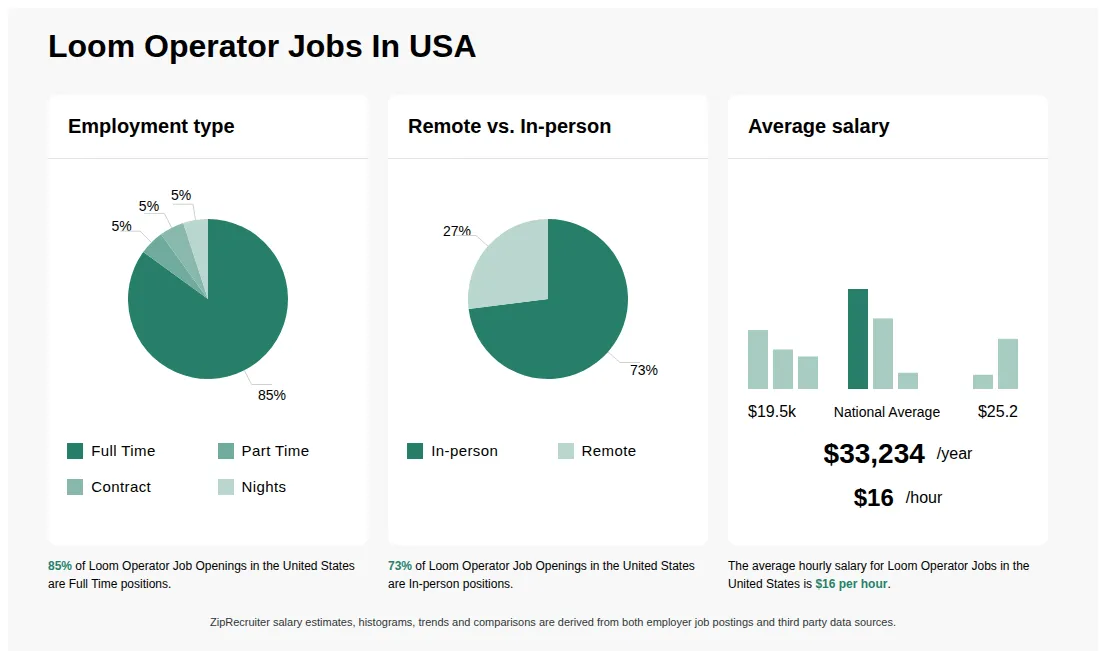
Infographic showing various Loom Operator job openings in the United States as of June 2026, with employment types broken down into 100% Full Time. Highlights an 100% In-person job distribution.

Operator I - Hoyt - 2nd Shift - M-Th

Fenner

Lancaster, PA • On-site

$18.25 - $23.50/hr

Full-time

Posted 16 days ago


Job description

2nd Shift - Monday - Thursday; 4:30pm - 3:00am
Basic Scope/Purpose: (The job's primary purpose or contribution to the department or
organization.)
The Operator - Hoyt position will manufacture quality Wire Cloth products by performing preset,
set-up and operation of Crimpers, Straighteners, Presses, Press Brakes, Shears, Welders, Roll
Mills, and Hot Melt Machines; and perform material handling duties.
Principal Accountabilities: (The job's essential or most important functions and
responsibilities. Reasonable accommodations may be made to enable individuals with
disabilities to perform the essential functions.)
Level 1 Operator:
• Identify safety violations or potential hazards to manager or safety team member.
• Attend safety training.
• Maintain a clean and organized workplace using the "6S" system (sort, set in order, shine,
standardize, sustain, & safety).
• Perform visual inspection to meet product quality requirements.
• Operate a Press Brake, Shear, Hot Melt Machine, or Roll Mill as "helper". Assist "main"
operator in shearing panels, bending edges, pouring polyamide, and rolling screens.
• Or Setup and Operate a Crimper, Straightener, Press, Loom, or Welder with assistance fromLevel 2 & 3 Operators. If working on Loom, assist other Loom operators with setup.
• Measure critical dimensions, make necessary machine adjustments and change out worn
tooling.
• Embrace change in the work environment to maintain internal and external customer
satisfaction.
• Adjust schedule to fluctuate work priorities as needed.
• Strive for continuous improvement of the Company's processes.
• Strive to perform standardized "best practices".
• Strive to maintain a positive work environment.
• Promote Fenner Precision Polymers Values and Behaviors at all times.
Level 2 Operator:
• Demonstrates and is able to maintain effectiveness in all Level 1 accountabilities.
• Operate a Press Brake, Shear, or Holt Melt Machine as "main" operator with minimal
assistance from Level 3 Operators. "Main" operator must be able to dictate correct setups
and machine settings to ensure quality products are being made. Provide "helper" with
directions and communicate what help is required.
• Or Setup and Operate a Crimper, Straightener, Press, Loom, or Welder with minimal
assistance from Level 3 Operators. If working on Loom, assist other Loom operators with
setup.
• Assist and train Level I Operators and aspiring level II operators if necessary.
Level 3 Operator:
• Preset, setup (in a timely manner), and able to be "main" operator on all Press Brakes,
Shears, and Hot Melt Machines.
• Or Setup and Operate a combination of Crimpers, Straighteners, Presses, Looms, or
Welders with no assistance. If working on Loom, assist other Loom operators with setup.
• Understanding, compliance, and active involvement in establishing ISO standard operating
procedures and work instructions.
• Participate in LEAN and World Class improvement projects.
• Assist and train Level I and II Operators.
Career Progression Opportunities:
There are III levels of Operators that associates can advance to. Expectations are outlined
above.
Education and/or Relative Experience: (The level of education and/or experience needed to
successfully accomplish the essential duties of this job.)
Level 1 Operator:
• High School Diploma or General Education Degree (GED), Minimum one to three
months related experience and/or training, or equivalent combination of education and
experience or demonstrates appropriate skill level to successfully Perform all duties of
Operator I job grade Level.
Level 2 Operator:
• Operator 1 with minimal assistance for 1 year. Once an operator reaches this level of
proficiency, even if the 1 year mark has not been met, training for Level III Operator tasks
may begin.
Level 3 Operator:
• Rotated through all of the machine cell and set up positions as an Operator II with
minimal assistance for 3 years.
Certificates, Licenses, Registrations (The licenses, certificates or registrations that are
required to perform the essential duties of this job.)
• None Required
Environmental, Health & Safety Accountabilities: (The level of safety accountability needed
to successfully accomplish the essential duties of this job.
• Learn and follow EHS policies, rules and work instructions
• Attend required EHS training
• Wear the required PPE at all times
• Take personal responsibility for keeping yourself and your co-workers and visitors free from
injury by participating in and/or conducting risk assessments, work place inspections,
corrective actions and safety observations
• Report incidents, near miss, unsafe conditions, unsafe acts and other hazards in the work
place. STOP WORK when imminent danger is present
• Maintain work area in a neat and orderly fashion and keep equipment in proper working
condition.
Equal Opportunity Employer/Protected Veterans/Individuals with Disabilities
This employer is required to notify all applicants of their rights pursuant to federal employment laws.
For further information, please review the Know Your Rights notice from the Department of Labor.