The Systems Administrator IV, Laboratory Systems (SoftGenomics), within Care Delivery Applications ... analysis, coordinate prevention plan execution) and addressing escalations as appropriate.
The Systems Administrator IV, Laboratory Systems (SoftGenomics), within Care Delivery Applications ... analysis, coordinate prevention plan execution) and addressing escalations as appropriate.

Computer Systems Analyst
Rockville, MD · On-site
$98K - $163K/yr
We are seeking a Computer Systems Analyst to support chemical safety within NCATS chemistry labs ... Work with internal stakeholders and external vendors to enhance laboratory operations and improve ...
Computer Systems Analyst
Rockville, MD · On-site
$98K - $163K/yr
We are seeking a Computer Systems Analyst to support chemical safety within NCATS chemistry labs ... Work with internal stakeholders and external vendors to enhance laboratory operations and improve ...

Computer Systems Analyst
Rockville, MD · On-site
$98K - $163K/yr
We are seeking a Computer Systems Analyst to support chemical safety within NCATS chemistry labs ... Work with internal stakeholders and external vendors to enhance laboratory operations and improve ...
Computer Systems Analyst
Rockville, MD · On-site
$98K - $163K/yr
We are seeking a Computer Systems Analyst to support chemical safety within NCATS chemistry labs ... Work with internal stakeholders and external vendors to enhance laboratory operations and improve ...
Computer Systems Analyst
Rockville, MD · On-site
$98K - $163K/yr
We are seeking a Computer Systems Analyst to support chemical safety within NCATS chemistry labs ... Work with internal stakeholders and external vendors to enhance laboratory operations and improve ...
Computer Systems Analyst
Rockville, MD · On-site
$98K - $163K/yr
We are seeking a Computer Systems Analyst to support chemical safety within NCATS chemistry labs ... Work with internal stakeholders and external vendors to enhance laboratory operations and improve ...
The Systems Administrator IV, Laboratory Systems (SoftGenomics), within Care Delivery Applications ... analysis, coordinate prevention plan execution) and addressing escalations as appropriate.
The Systems Administrator IV, Laboratory Systems (SoftGenomics), within Care Delivery Applications ... analysis, coordinate prevention plan execution) and addressing escalations as appropriate.
The Systems Administrator IV, Laboratory Systems (SoftGenomics), within Care Delivery Applications ... analysis, coordinate prevention plan execution) and addressing escalations as appropriate.
The Systems Administrator IV, Laboratory Systems (SoftGenomics), within Care Delivery Applications ... analysis, coordinate prevention plan execution) and addressing escalations as appropriate.
The Systems Administrator IV, Laboratory Systems (SoftGenomics), within Care Delivery Applications ... analysis, coordinate prevention plan execution) and addressing escalations as appropriate.
The Systems Administrator IV, Laboratory Systems (SoftGenomics), within Care Delivery Applications ... analysis, coordinate prevention plan execution) and addressing escalations as appropriate.
The Systems Administrator IV, Laboratory Systems (SoftGenomics), within Care Delivery Applications ... analysis, coordinate prevention plan execution) and addressing escalations as appropriate.
The Systems Administrator IV, Laboratory Systems (SoftGenomics), within Care Delivery Applications ... analysis, coordinate prevention plan execution) and addressing escalations as appropriate.
The Systems Administrator IV, Laboratory Systems (SoftGenomics), within Care Delivery Applications ... analysis, coordinate prevention plan execution) and addressing escalations as appropriate.
The Systems Administrator IV, Laboratory Systems (SoftGenomics), within Care Delivery Applications ... analysis, coordinate prevention plan execution) and addressing escalations as appropriate.

The GxP Laboratory Systems Administrator will be responsible for defining standard business ... Document analysis and/or testing related to infrastructure changes. (e.g., operating system patches ...
The GxP Laboratory Systems Administrator will be responsible for defining standard business ... Document analysis and/or testing related to infrastructure changes. (e.g., operating system patches ...

We also collaborate closely with other Groups across the Laboratory as well as with other laboratories both inside and outside the government. The Group is seeking a Systems Analyst (Assistant Staff ...
We also collaborate closely with other Groups across the Laboratory as well as with other laboratories both inside and outside the government. The Group is seeking a Systems Analyst (Assistant Staff ...
The GxP Laboratory Systems Administrator will be responsible for defining standard business ... Document analysis and/or testing related to infrastructure changes. (e.g., operating system patches ...
Quick apply
The GxP Laboratory Systems Administrator will be responsible for defining standard business ... Document analysis and/or testing related to infrastructure changes. (e.g., operating system patches ...

Support, maintain, and improve R&D laboratory systems and applications to ensure availability ... Familiarity with laboratory software platforms such as SCIEX OS, Analyst, Chromeleon, MassHunter ...
Support, maintain, and improve R&D laboratory systems and applications to ensure availability ... Familiarity with laboratory software platforms such as SCIEX OS, Analyst, Chromeleon, MassHunter ...
Systems Analyst
Lexington, MA · On-site
We also collaborate closely with other Groups across the Laboratory as well as with other laboratories both inside and outside the government. The Group is seeking a Systems Analyst (Assistant Staff ...
Systems Analyst
Lexington, MA · On-site
We also collaborate closely with other Groups across the Laboratory as well as with other laboratories both inside and outside the government. The Group is seeking a Systems Analyst (Assistant Staff ...
Systems Analyst
Lexington, MA · On-site
We also collaborate closely with other Groups across the Laboratory as well as with other laboratories both inside and outside the government. The Group is seeking a Systems Analyst (Assistant Staff ...
Systems Analyst
Lexington, MA · On-site
We also collaborate closely with other Groups across the Laboratory as well as with other laboratories both inside and outside the government. The Group is seeking a Systems Analyst (Assistant Staff ...
Location: ~San Francisco, CA~ Duration: 6 months Active maintenance of all laboratory systems to ... analytical skills and attention to detail
Quick apply
Location: ~San Francisco, CA~ Duration: 6 months Active maintenance of all laboratory systems to ... analytical skills and attention to detail
Support, maintain, and improve R&D laboratory systems and applications to ensure availability ... Familiarity with laboratory software platforms such as SCIEX OS, Analyst, Chromeleon, MassHunter ...
Support, maintain, and improve R&D laboratory systems and applications to ensure availability ... Familiarity with laboratory software platforms such as SCIEX OS, Analyst, Chromeleon, MassHunter ...
Systems Analyst
Lexington, MA · On-site
We also collaborate closely with other Groups across the Laboratory as well as with other laboratories both inside and outside the government. The Group is seeking a Systems Analyst (Technical Staff ...
Systems Analyst
Lexington, MA · On-site
We also collaborate closely with other Groups across the Laboratory as well as with other laboratories both inside and outside the government. The Group is seeking a Systems Analyst (Technical Staff ...
We also collaborate closely with other Groups across the Laboratory as well as with other laboratories both inside and outside the government. The Group is seeking a Systems Analyst (Technical Staff ...
We also collaborate closely with other Groups across the Laboratory as well as with other laboratories both inside and outside the government. The Group is seeking a Systems Analyst (Technical Staff ...
We also collaborate closely with other Groups across the Laboratory as well as with other laboratories both inside and outside the government. The Group is seeking a Systems Analyst (Technical Staff ...
We also collaborate closely with other Groups across the Laboratory as well as with other laboratories both inside and outside the government. The Group is seeking a Systems Analyst (Technical Staff ...
Laboratory Systems Analyst information
See salary details
$41.5K - $50.5K
5% of jobs
$50.5K - $59.6K
11% of jobs
$66.2K is the 25th percentile. Wages below this are outliers.
$59.6K - $68.6K
13% of jobs
$68.6K - $77.7K
15% of jobs
The median wage is $82.2K / yr.
$77.7K - $86.7K
14% of jobs
$86.7K - $95.8K
9% of jobs
$103.2K is the 75th percentile. Wages above this are outliers.
$95.8K - $104.8K
11% of jobs
$104.8K - $113.9K
7% of jobs
$113.9K - $122.9K
7% of jobs
$122.9K - $132K
4% of jobs
$132K - $141K
4% of jobs
$41.5K
$89.3K
$141K
How much do laboratory systems analyst jobs pay per year?
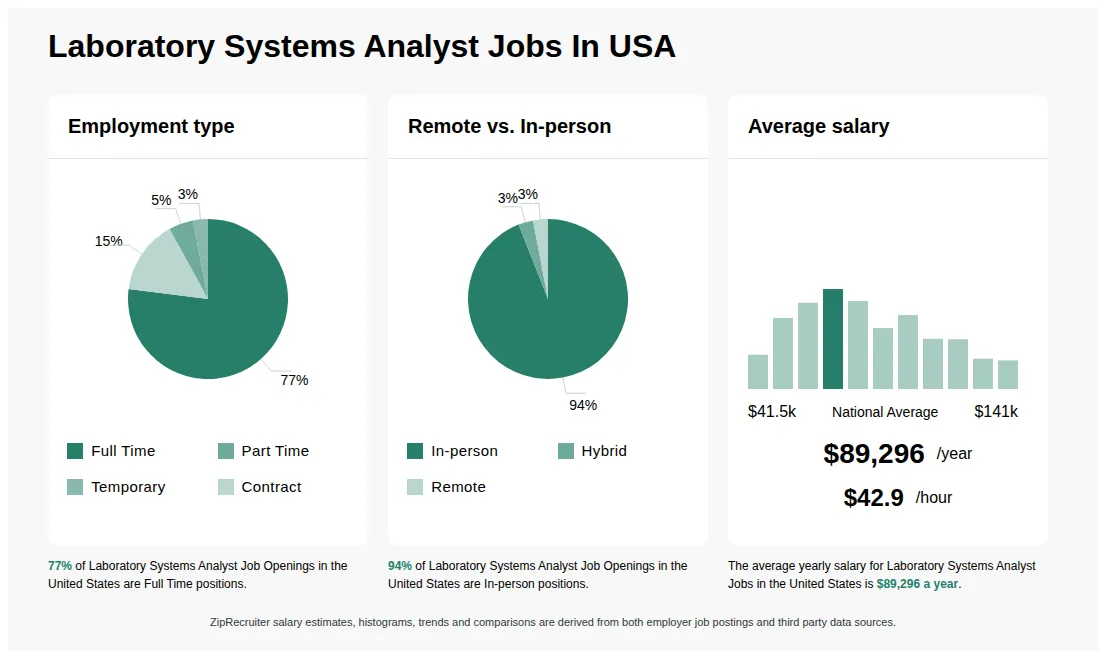
As of Sep 10, 2026, the average yearly pay for laboratory systems analyst in the United States is $89,296.00, according to ZipRecruiter salary data. Most workers in this role earn between $66,000.00 and $108,000.00 per year, depending on experience, location, and employer.
What does a Laboratory Systems Analyst do?
A Laboratory Systems Analyst is responsible for managing and optimizing the information systems and software used in laboratory environments. They ensure that laboratory information management systems (LIMS) function properly, integrate smoothly with lab equipment, and meet regulatory requirements. Their duties often include troubleshooting system issues, training laboratory staff, and collaborating with IT and laboratory personnel to improve data accuracy and workflow efficiency. Overall, they play a crucial role in ensuring the seamless operation of laboratory technology and data management.
How does a Laboratory Systems Analyst typically collaborate with laboratory staff and IT teams?
A Laboratory Systems Analyst plays a key role in bridging the gap between laboratory staff and IT professionals. They work closely with lab technicians and scientists to understand workflow needs and translate these into technical requirements for systems such as LIMS (Laboratory Information Management Systems). Regular collaboration involves troubleshooting system issues, training users on new features, and coordinating with IT to implement software updates or integrations. This role requires strong communication skills and a willingness to facilitate smooth operations between technical and non-technical team members.
What are the key skills and qualifications needed to thrive as a Laboratory Systems Analyst, and why are they important?
To thrive as a Laboratory Systems Analyst, you need a strong background in laboratory science or information technology, often supported by a bachelor’s degree in a related field. Familiarity with Laboratory Information Management Systems (LIMS), database management, and relevant certifications such as ASCP or vendor-specific credentials are highly valuable. Analytical thinking, problem-solving abilities, and effective communication skills help bridge the gap between IT and laboratory staff. These competencies ensure accurate data management, seamless lab operations, and compliance with regulatory standards.
What is the difference between Laboratory Systems Analyst vs Laboratory Technician?
| Aspect | Laboratory Systems Analyst | Laboratory Technician |
|---|---|---|
| Required Credentials | Bachelor's degree in IT, Computer Science, or related field; certifications in laboratory information systems (LIS) | High school diploma or associate degree; technical training in lab procedures |
| Work Environment | Office setting within laboratories; focus on system management and support | Laboratory bench work; sample processing and testing |
| Employer & Industry Usage | Hospitals, research labs, biotech companies | Clinical labs, diagnostic centers, research facilities |
| Common Search & Comparison Intent | Understanding roles related to lab information systems and data management | Hands-on lab work and sample analysis |
The Laboratory Systems Analyst primarily manages and supports laboratory information systems, requiring IT and certification credentials, working mainly in office environments. In contrast, Laboratory Technicians perform sample testing and lab procedures, focusing on hands-on work. Both roles are essential in laboratory settings but differ significantly in responsibilities and skill requirements.
What is a laboratory systems analyst?
A laboratory systems analyst is a professional who manages and maintains laboratory information systems (LIS) and related software to ensure accurate data collection, processing, and reporting. They often work with laboratory equipment, troubleshoot system issues, and may require knowledge of IT, data management, and certifications such as CLIA or CAP. The role typically involves collaboration with lab staff to optimize system performance and compliance with regulatory standards.
What cities are hiring for Laboratory Systems Analyst jobs?
Cities with the most Laboratory Systems Analyst job openings:
What states have the most Laboratory Systems Analyst jobs?
States with the most job openings for Laboratory Systems Analyst jobs include:
What are popular job titles related to Laboratory Systems Analyst jobs?
For Laboratory Systems Analyst jobs, the most frequently searched job titles are:

Systems Administrator IV, Laboratory Systems (SoftGenomics)
Greensboro, NC • On-site
Kaiser Permanente
• Health Care and Social Assistance • 10K+ employees10,000+ employees
Other
This job post has expired 1 day ago. Applications are no longer accepted.
Kaiser Permanente rating

8.2
Based on 929 frontline employees who took The Breakroom Quiz
Job description
Please note, this position is designated as flexible (aka hybrid), and the expectation is that the selected candidate will report to the assigned office in Greensboro, NC 3 days per week.
Technical Summary:
The Systems Administrator IV, Laboratory Systems (SoftGenomics), within Care Delivery Applications Services, Laboratory and Integration Services, serves as the senior technical individual contributor responsible for the architecture, implementation, integration, optimization, and long-term success of enterprise laboratory applications supporting molecular diagnostics, cytogenetics, biochemistry, and precision medicine. The position provides technical leadership across laboratory information systems, enterprise interfaces, workflow integration, and application lifecycle management while partnering with laboratory leadership, clinicians, vendors, and enterprise IT teams to deliver secure, scalable, and highly available technology solutions that improve clinical operations, laboratory efficiency, regulatory compliance, and patient care. The role supports strategic laboratory initiatives and enterprise growth through standardized, integrated laboratory technology solutions including SoftGenomics and SCC laboratory systems, Epic Genomics integration, HL7 interface design and validation, application lifecycle management, and enterprise system administration along with focus on cytogenetics and molecular diagnostics, translating laboratory requirements into system solutions, partnering with clinical stakeholders, and applying CAP, CLIA, and laboratory regulatory standards.
Job Summary:
In addition to the responsibilities listed below, this position leads the incident and problem management process by resolving complex issues (e.g., root cause analysis, coordinate prevention plan execution) and addressing escalations as appropriate.
Essential Responsibilities:
- Completes work assignments and supports business-specific projects by applying expertise in subject area; supporting the development of work plans to meet business priorities and deadlines; ensuring team follows all procedures and policies; coordinating and assigning resources to accomplish priorities and deadlines; collaborating cross-functionally to make effective business decisions; solving complex problems; escalating high priority issues or risks, as appropriate; and recognizing and capitalizing on improvement opportunities.
- Practices self-development and promotes learning in others by proactively providing information, resources, advice, and expertise with coworkers and customers; building relationships with cross-functional stakeholders; influencing others through technical explanations and examples; adapting to competing demands and new responsibilities; listening and responding to, seeking, and addressing performance feedback; providing feedback to others and managers; creating and executing plans to capitalize on strengths and develop weaknesses; supporting team collaboration; and adapting to and learning from change, difficulties, and feedback.
- Meets timelines to drive the delivery of appropriate, sustainable, and prompt solutions.
- Assists technical and project team members to resolve system problems and application-specific issues.
- Supports the stability, availability, and performance of enterprise systems (e.g., systems, applications, network, databases, storage, security) by performing complex systems analysis to identify problems, trends, and opportunities for improvement.
- Provides first and second level support for enterprise systems and systems in one or more additional IT domains by diagnosing, troubleshooting, and resolving complex incidents to minimize system issues.
- Escalates unresolved or critical issues, risks or problems to system engineers.
- Supports communications with product users and suppliers to share information, identify opportunities, resolve problems, prioritize customer requirements, and maintain continuous improvement through customer feedback.
- Plans and performs complex system configuration.
- Participates in installs, upgrades, or decommissions of designated systems, products, and infrastructure.
- Creates documentation of new and existing system configuration and procedural information, and ensures system configurations documentation is complete and accurate.
- Plans the implementation of hardware and software changes into environments and one or more additional IT production environments by performing impact analyses of system changes.
- Supports vendor support activities, as appropriate.
- Participates in and influences change management processes.
- Defines the maintenance, modification, and documentation of complex and advanced applications.
- Supports the development of guidelines to prevent and/or resolve recurring problems.
- Recommends and executes performance tuning and optimization activities.
Minimum Qualifications:
- Minimum three (3) years experience in application support.
- Minimum one (1) year in an informal leadership role working with IT or operational teams.
- Bachelors degree in Computer Science, Engineering, Social Science, Education, Business, Health Care or related field and Minimum six (6) years working in IT or operations. Additional equivalent work experience may be substituted for the degree requirement.
Additional Requirements:
What Kaiser Permanente employees say
Pay
Benefits
Hours and flexibility
Workplace
Get the full story on Breakroom

About Kaiser Permanente
Sourced by ZipRecruiter
Industry
Health care and social assistance, hospitals and arts, entertainment, and recreation
Company size
10,000+ Employees
Headquarters location
Oakland, CA, US