1

International Rescue Committee Irc Jobs (NOW HIRING)

next page

Showing results 1-20

International Rescue Committee Irc information

See salary details

$1.1K

$2.5K

$7.1K

How much do international rescue committee irc jobs pay per month?

As of May 29, 2026, the average monthly pay for international rescue committee irc in the United States is $2,546.33, according to ZipRecruiter salary data. Most workers in this role earn between $1,291.67 and $3,125.00 per month, depending on experience, location, and employer.

What is an International Rescue Committee (IRC) job?

An International Rescue Committee (IRC) job involves working for a global humanitarian organization that provides emergency relief, resettlement assistance, and long-term support to refugees and displaced communities. IRC employees work in various roles, including healthcare, education, social services, and advocacy, to help people affected by conflict and disaster rebuild their lives. Positions are available in field offices, refugee camps, and headquarters locations worldwide. Each role contributes to the IRC’s mission of responding to humanitarian crises and supporting sustainable development.

What are the key skills and qualifications needed to thrive in the International Rescue Committee Irc position, and why are they important?

To thrive in a position at the International Rescue Committee (IRC), you need a background in humanitarian aid, relevant field experience, and often a degree in international relations, social work, or a related discipline. Familiarity with donor compliance systems, project management tools, and languages relevant to deployment locations is highly valued, along with certifications such as Project Management Professional (PMP) or humanitarian response training. Strong interpersonal skills, resilience under stress, and cultural sensitivity make someone stand out in this globally focused environment. These skills and qualities are essential for effectively delivering aid, navigating complex field settings, and ensuring program success in challenging contexts.


What are some typical daily responsibilities for staff working at the International Rescue Committee (IRC)?

Staff at the IRC often engage in needs assessments, project planning, and direct service delivery such as organizing relief distributions or managing psychosocial support programs. Regular collaboration with local partners, coordination with other humanitarian agencies, and liaising with donors are common parts of the job, alongside documentation and reporting to ensure program accountability. Daily work may also include field visits, community engagement, and crisis response depending on the specific role and location. You'll be working in dynamic, sometimes unpredictable environments where flexibility and commitment are key. This hands-on experience provides valuable insights into global humanitarian operations and offers significant opportunities for professional development.

Is IRC a good place to work?

The International Rescue Committee (IRC) is known for its focus on humanitarian aid and emergency response, offering roles that involve collaboration, cultural sensitivity, and project management. Employees often work in a dynamic environment with opportunities for professional development and field experience. Job satisfaction can vary based on role, location, and individual expectations.
What cities are hiring for International Rescue Committee Irc jobs? Cities with the most International Rescue Committee Irc job openings:
What states have the most International Rescue Committee Irc jobs? States with the most job openings for International Rescue Committee Irc jobs include:
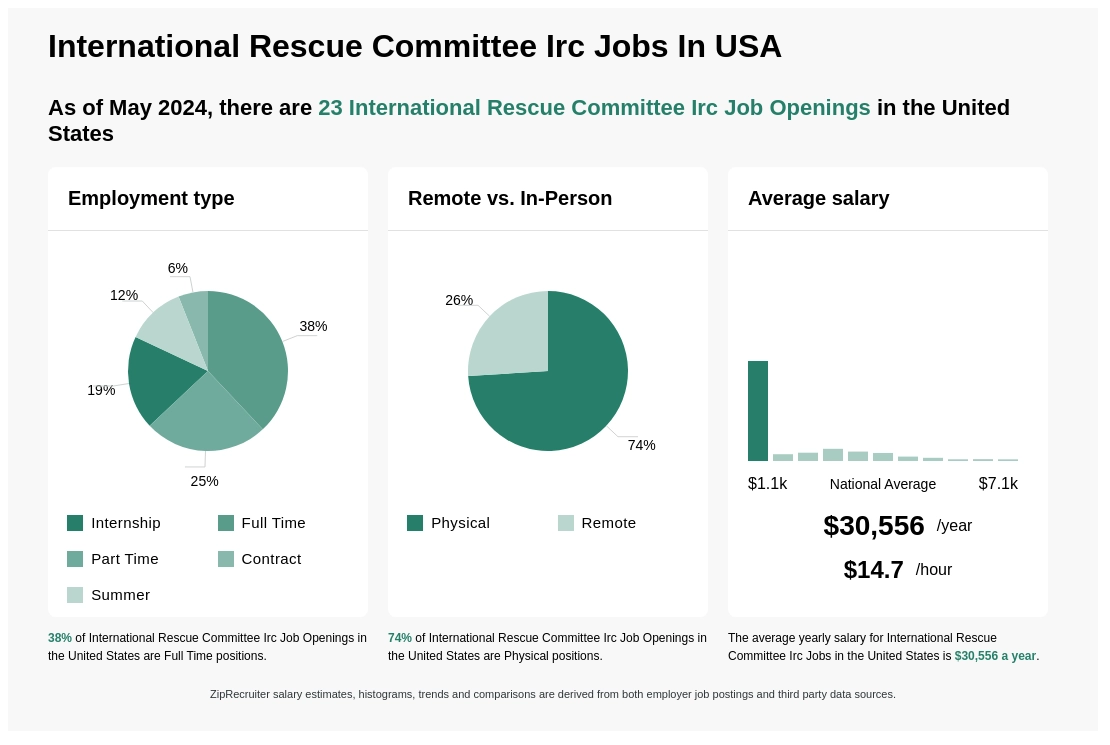
Infographic showing various International Rescue Committee Irc job openings in the United States as of May 2026, with employment types broken down into 97% Full Time, and 3% Part Time. Highlights an 72% Physical, 3% Hybrid, and 25% Remote job distribution, with an average salary of $30,556 per year, or $14.7 per hour.
Consultant for the Revision of the Alternative Care in Emergencies (ACE) Toolkit

Consultant for the Revision of the Alternative Care in Emergencies (ACE) Toolkit

International Rescue Committee

Remote

Part-time

Posted 16 days ago


International Rescue Committee rating

6.3

Company rating: 6.3 out of 10

Based on 6 frontline employees who took The Breakroom Quiz

446th of 665 rated non-profit organizations


Job description

The International Rescue Committee (IRC) responds to the world's worst humanitarian crises, helping to restore health, safety, education, economic wellbeing, and power to people devastated by conflict and disaster. Founded in 1933 at the call of Albert Einstein, the IRC is one of the world's largest international humanitarian non-governmental organizations (INGO), at work in more than 40 countries and 29 U.S. cities helping people to survive, reclaim control of their future and strengthen their communities. A force for humanity, IRC employees deliver lasting impact by restoring safety, dignity and hope to millions. If you're a solutions-driven, passionate change-maker, come join us in positively impacting the lives of millions of people world-wide for a better future.
Consultant for the Revision of the Alternative Care in Emergencies (ACE) Toolkit
  • Contract Type: Consultancy (Individual Contractor)

  • Lead Agency: International Rescue Committee (IRC)

  • In collaboration with: Alliance for Child Protection in Humanitarian Action (the Alliance); Unaccompanied and Separated Children Task Force (UASC TF)

  • Level of Effort: 40 working days

  • Period: May 2026 - September 2026 (approximately 4-5 months)

  • Location: Home-based, global scope with virtual engagement

1. Background
The International Rescue Committee (IRC) is a global humanitarian and development organization that responds to the world's most severe humanitarian crises. The IRC works to save lives, protect rights, and support recovery for people affected by conflict and disaster. As a global technical leader in child protection, the IRC delivers direct programming, strengthens national child protection systems, and contributes to global standard-setting, evidence generation, and learning. The IRC is a co-lead of the Alliance for Child Protection in Humanitarian Action and plays a central role in advancing inter-agency guidance, minimum standards, and tools to improve outcomes for children in humanitarian settings.
The Alliance for Child Protection in Humanitarian Action (the Alliance) is a global inter-agency network co-led by UNICEF and rotating NGOs, currently the International Rescue Committee (IRC) and Hurras. The Alliance brings together UN agencies, NGOs, governments, academics, and donors to strengthen the quality, consistency, and accountability of child protection responses in humanitarian contexts. Its work includes standard-setting and guidance development, capacity strengthening, learning, evidence generation, and advocacy. One of the Alliance's technical platforms is the Unaccompanied and Separated Children Task Force (UASC TF), which provides global leadership on responses for children deprived of parental care in emergencies. IRC currently co-leads UASC TF together with Save the Children.
The Alternative Care in Emergencies (ACE) Toolkit (2013), originally developed by the predecessor of the UASC TF: the Interagency Working Group on Unaccompanied and Separated Children (IAWG-UASC), has served for more than a decade as a foundational inter-agency resource guiding practitioners in planning, implementing, and monitoring emergency alternative care responses. Recent global developments - including protracted crises, mass displacement, increased mixed migration flows, scaling community-based protection systems, evolving data protection standards, digital case management, and strengthened global guidance on preventing family separation - have created an urgent need for a comprehensive update of the toolkit. In 2025, the UASC Task Force commissioned the Alternative Care Survey to gather practitioner and agency insights regarding gaps, relevance, and user needs related to the ACE Toolkit. Building on these inputs, IRC seeks a consultant to lead the technical revision of the ACE Toolkit.
2. Purpose of the Consultancy
To lead the revision of the Alternative Care in Emergencies Toolkit, ensuring that it:
  • Reflects current evidence, and best practices

  • Responds to findings from the ACE Survey 2025

  • Aligns with inter-agency guidance (e.g. CPMS, Guidelines for the Alternative Care of Children, child safeguarding standards, community-based child protection frameworks)

  • Integrates practitioner needs and contextual realities across diverse humanitarian settings

  • Remains accessible, operational, modular, and adaptable for field practitioners and government stakeholders

  • Streamline existing annexes towards potential consolidation and reduction.

3. Scope of Work
The consultant will be responsible for delivering a streamlined, technically robust version of the ACE Toolkit. Key tasks include:
3.1 Inception & Planning (5 days)
  • Review relevant materials, including:

  • The ACE Toolkit (2013)

  • ACE Survey 2025 results

  • Existing tools annexes and templates

  • Field Handbook on Unaccompanied and Separated Children (UASC), and Toolkit on Unaccompanied and Separated Children (UASC)

  • Latest global and inter-agency guidance including the UN Guidelines for the Alternative Care of Children, CPMS and key resources, such as those from the Alliance, UNICEF, UNHCR, GPC, key INGO guidance and academic publications

  • Develop an inception note with:

  • Annotated outline of revised toolkit

  • Methodology and revision approach

  • Identification of tools to retire, replace, or update

  • Workplan and timeline for 40 consultancy days

3.2 Revision of Core ACE Guidance (20 days)
  • Revise and, where necessary, rewrite and reorganize the ACE Toolkit, ensuring:

  • Up-to-date evidence, terminology, and standards

  • Integration of updated case management tools and practices (aligned with IM principles and BIP)

  • Practical, user-friendly structure with clear steps and flow diagrams

  • Stronger emphasis on:

  • Community-led and culturally grounded care models

  • Localization and capacity sharing

  • Integration with national child protection systems

  • Disability inclusion in alternative care, gender, and intersectionality

  • Safer digital practices, data protection, and interoperability

  • Safeguarding in emergency placements

  • Ensure alignment with survey feedback on language, accessibility, and usability.

3.3 Revision of Tools and Templates (5 days)
  • Review all existing tools in the original toolkit (over 60) and:

  • Propose to the ACE Task Team the tools that should be updates/removed/added. Based on the feedback received:

  • Update relevant ones

  • Remove outdated ones

  • Add new tools and templates based on practitioner requests

  • Ensure tools reflect current standards for assessment, monitoring, reunification, caregiver support, reporting, and safeguarding

  • Produce consistent formatting, instructions, and version control.

Consultation & Validation (5 days)
  • Collaborate closely with the UASC Task Force, most importantly the ACE Task Team, IRC technical leads and the Alliance leadership in reviewing the revised content and incorporating feedback based on consensus.

  • Participate in monthly technical review sessions of the ACE Task Team to present progress, gather feedback, and adjust content;

  • Organize a final consultation workshop

  • Incorporate broad inter-agency feedback from at least one wider consultation round (written or virtual workshop).

3.5 Finalization (5 days)
  • Produce a finalized ACE Toolkit, including:

  • Full narrative text

  • Updated tools annex

  • Implementation guidance and roll-out recommendations, including for capacity strengthening through the Alliance

  • Clear cross-referencing and user navigation

  • Provide a stand-alone Executive Summary and Quick Reference Guide.

  • Submit clean and tracked-change versions of all outputs.

4. Deliverables
Throughout deliverables should take into account feedback from the ACE TT and other relevant actors and sources:
Deliverable i
Inception Note & Annotated Outline
Description Detailed outline, methodology, workplan
Timeline 5 days
Deliverable ii
Draft Revised Toolkit (Full Text, First Draft)
Description Updated core content
Timeline 20 days
Deliverable iii
Updated Tools Annex (First Draft)
Description Revised and new tools/templates
Timeline 5 days
Deliverable iv
Validation Draft of Tools & Annexes
Description Incorporating inter-agency feedback
Timeline 5 days
Deliverable v
Final ACE Toolkit
Description Clean, formatted, fully integrated product.
Provide a final review of the toolkit after it is copy-edited.
Timeline 4 days
Deliverable vi
Executive summary, quick reference guide & dissemination roadmap
Timeline 1 day
5. Consultant Profile
Required:
  • Minimum 10 years' experience in child protection in humanitarian setting

  • Proven expertise and experience directly implementing alternative care and UASC programming in humanitarian contexts.

  • Proven experience working at global or inter-agency level, including engagement with UN agencies, NGOs, and coordination mechanisms.

  • Demonstrated authorship of technical guidance, toolkits, global standards, or policy documents

  • Strong familiarity with the ACE Toolkit, UN Guidelines for the Alternative Care of Children, Minimum Standards for Child Protection in Humanitarian Action (CPMS). UASC Handbook and toolkit, IM, BIP and data protection

  • Demonstrated experience in synthesizing diverse feedback cohesively

  • Excellent writing and facilitation skills

  • Ability to produce practical field guidance

  • Ability to integrate equity, disability inclusion, and adolescent-specific considerations into technical guidance.

  • Demonstrated ability to manage work independently, deliver to deadlines, and balance technical ambition with realistic scope and time constraints.

  • Ability to work collaboratively and respectfully within an inter-agency, consensus-driven environment.

Desirable:
  • Prior involvement in the ACE Toolkit or Alliance working groups

  • Experience working in multiple emergency contexts

  • Experience with participatory research or large-scale consultation processes

  • Knowledge of a second UN language.

6. Management & Coordination
  • The consultant will be contracted and managed bythe IRC

  • Core technical oversight will be provided by the UASC Task Force Co-Leads, ACE Technical Task Team,IRC

  • Additional consultation with UNICEF and other key stakeholders as required.

7. Payment Structure
Payment will be based on successful completion of deliverables, as agreed during the hiring process.
8. Ethical, Safeguarding & Data Protection Requirements
The consultant must adhere to:
  • IRC safeguarding policy

  • Data protection standards consistent with IRC, UNICEF, UNHCR

  • Do no harm principles, confidentiality, and safe handling of case examples

9. Application Process
Interested consultants should submit:
  • CV

  • Two samples of relevant technical writing

  • Proposed daily rate

  • Brief (1page) technical approach outlining methodology for toolkit revision

PROFESSIONAL STANDARDS
All International Rescue Committee workers must adhere to the core values and principles outlined in IRC Way - Standards for Professional Conduct. Our Standards are Integrity, Service, Equality and Accountability. In accordance with these values, the IRC operates and enforces policies on Safeguarding, Conflicts of Interest, Fiscal Integrity, and Reporting Wrongdoing and Protection from Retaliation. IRC is committed to take all necessary preventive measures and create an environment where people feel safe, and to take all necessary actions and corrective measures when harm occurs. IRC builds teams of professionals who promote critical reflection, power sharing, debate, and objectivity to deliver the best possible services to our clients.
Cookies: https://careers.rescue.org/us/en/cookiesettings
Equal Opportunity Employer: IRC is an Equal Opportunity Employer. IRC considers all applicants on the basis of merit without regard to race, sex, color, national origin, religion, sexual orientation, age, marital status, veteran status, disability or any other characteristic protected by applicable law.

International Rescue Committee logo

About International Rescue Committee

Sourced by ZipRecruiter

The International Rescue Committee (IRC) responds to the world's worst humanitarian crises and helps people to survive and rebuild their lives. At work in over 40 countries and 28 U.S. cities to restore safety, dignity and hope, the IRC leads the way from harm to home. Domestically, our 28 offices across the U.S. ensure new arrivals have food, shelter, and clothing, and work with refugees to help them gain self-sufficiency.

Industry

Non-profits

Company size

10,000+ Employees

Headquarters location

New York, NY, US

Year founded

1933