1

International Engineer Jobs (NOW HIRING)

This position involves collaboration with domestic and international engineering teams, integration with cross-functional vehicle programs, and direct contribution to technical execution. * We are ...

Our global team is a diverse group of experienced engineers, traders, and brokerage professionals ... The International Accounting Manager will partner closely with local entities and cross-functional ...

Our global team is a diverse group of experienced engineers, traders, and brokerage professionals ... The International Accounting Manager will partner closely with local entities and cross-functional ...

New

next page

Showing results 1-20

International Engineer information

See salary details

$39K

$101.8K

$137.5K

How much do international engineer jobs pay per year?

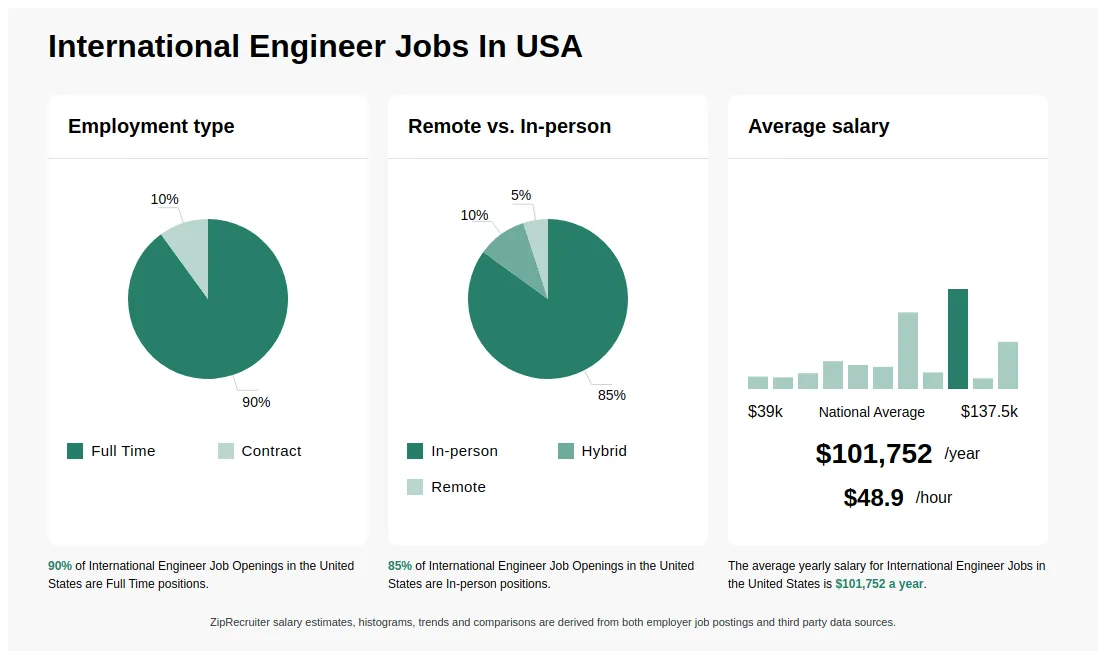
As of May 31, 2026, the average yearly pay for international engineer in the United States is $101,752.00, according to ZipRecruiter salary data. Most workers in this role earn between $84,000.00 and $116,500.00 per year, depending on experience, location, and employer.

What Does an International Engineer Do?

The job responsibilities of an international engineer involve performing engineering and design duties in a foreign country. In this career, you can work in a variety of engineering specialties, including manufacturing, civil, construction, a petroleum, or industrial design engineering. You may operate as a technical engineering consultant, working directly for a foreign-owned company or a global corporation. You may audit operations or oversee design efforts in an overseas plant, or you may help improve processes and practices for a manufacturing facility or oil and gas operation.


What are the key skills and qualifications needed to thrive as an International Engineer, and why are they important?

To thrive as an International Engineer, you need a strong background in engineering principles, a relevant engineering degree, and experience working on multinational projects. Proficiency with industry-standard design software (such as AutoCAD or SolidWorks), familiarity with international codes and standards, and, in some cases, professional engineering certification (like PE or equivalent) are commonly required. Strong cross-cultural communication, adaptability, and problem-solving skills help navigate diverse teams and global challenges. These competencies ensure effective collaboration, compliance with local regulations, and successful project delivery across different countries.

What are some common challenges faced by International Engineers when working on cross-border projects?

International Engineers often navigate challenges such as coordinating with teams across different time zones, adapting to diverse regulatory standards, and overcoming language or cultural barriers. Managing complex logistics and ensuring compliance with local laws can also require extra diligence. Successful International Engineers are proactive communicators and flexible problem-solvers, able to adjust their approach to fit the needs of global stakeholders and project requirements.

What is an International Engineer?

An International Engineer is a professional who applies engineering principles and practices to projects that span multiple countries or regions. They often work with global teams, adapt to different regulatory environments, and may travel or relocate to oversee projects abroad. Their role includes designing, implementing, and managing engineering solutions while considering cultural, legal, and logistical differences across countries. International Engineers typically have strong technical skills, language proficiency, and cross-cultural communication abilities. They play a crucial role in global companies looking to expand or maintain international operations.

What is the difference between International Engineer vs Mechanical Engineer?

AspectInternational EngineerMechanical Engineer
Required CredentialsBachelor's degree in engineering, often with international certifications or language skillsBachelor's degree in mechanical engineering, professional licensure varies by country
Work EnvironmentGlobal projects, multinational companies, often abroad or in diverse settingsDesign, analysis, manufacturing in industrial or corporate settings
Employer & Industry UsageInternational firms, engineering consultancies, multinational corporationsManufacturing, automotive, aerospace, energy sectors

International Engineers and Mechanical Engineers share foundational engineering skills, but International Engineers focus on global projects, cross-cultural communication, and international standards, while Mechanical Engineers concentrate on designing and analyzing mechanical systems within specific industries. Both roles require strong technical credentials, but their work environments and employer types differ significantly.

What cities are hiring for International Engineer jobs? Cities with the most International Engineer job openings:
What are the most commonly searched types of International Engineer jobs? The most popular types of International Engineer jobs are:
What states have the most International Engineer jobs? States with the most job openings for International Engineer jobs include:

Calibration Engineer

Superbeo

Chelsea, MI • On-site

Contractor

Posted 5 days ago


Job description

Job Title: Gasoline Engine Calibration Engineer
Job Location: Chelsea, MI
Job Duration: 3 Months, Contract to Hire
Job Summary:
  • We are seeking an experienced and technically strong Gasoline Engine Calibration Engineer to develop, test, and validate engine calibration features that deliver best-in-class fuel economy, drivability, and emissions compliance.
  • The engineer will take ownership of one or more assigned features and lead their development across all environmental conditions and program phases.
  • This position involves collaboration with domestic and international engineering teams, integration with cross-functional vehicle programs, and direct contribution to technical execution.
  • We are looking for a self-driven calibration engineer with prior hands-on experience who can take ownership of assigned features with minimal ramp-up.
  • The ideal candidate will be given direction and contacts, then take the initiative to connect with stakeholders, get into vehicles, assess calibration maturity, and begin execution independently.
  • The success in this role requires both technical depth and creative problem-solving to deliver high-quality, balanced calibrations.
Job Responsibilities:
  • Own the development and validation of assigned gasoline engine calibration features to meet emissions, fuel economy, and drivability targets across various markets.
  • Act as the feature lead within the engine application team for assigned calibrations, ensuring successful integration and performance across program milestones.
  • Take initiative to drive calibration feature development from early assessment through final validation — including coordinating with stakeholders, scheduling vehicle access, and proactively identifying gaps.
  • Deliver robust calibrations for assigned features across development phases, including testing in hot, cold, and high-altitude environments.
  • Analyze and interpret large datasets (dyno and vehicle), identify system-level issues, and propose calibration or hardware solutions.
  • Collaborate with engine controls, hardware development, emissions, and vehicle integration teams to ensure cross-functional alignment.
  • Work closely with global teams to develop calibration strategies that meet international compliance and market needs.
  • Blend technical precision with creative thinking to deliver calibration solutions that balance fuel economy, emissions, and drivability.
  • Work both independently and collaboratively across departments to meet vehicle-level objectives and milestones.
  • Actively seek help or escalate issues when needed, while maintaining ownership of the outcome.
  • Present risks, development status, and technical recommendations to engineering leadership.
  • Travel up to 4–6 weeks annually for system validation and launch support.
Qualifications:
  • Bachelor’s degree in Mechanical or Electrical Engineering (or a closely related field).
  • Minimum 3 years of experience in gasoline engine calibration with a proven track record of delivering production-ready calibrations.
  • Prior experience performing hands-on engine calibration with minimal supervision; ready to contribute without needing foundational training.
  • Demonstrated ability to independently execute calibration tasks once direction is given — including setting up meetings, assessing vehicle state, and resolving open items.
  • Strong technical knowledge of internal combustion engines, powertrain systems, and calibration methodologies.
  • Experience with calibration tools (e.g., INCA, ATI Vision) and data analysis tools (e.g., MDA).
  • Familiarity with emissions regulations (EPA, CARB, Euro) and OBD requirements.
  • Self-starter with a strong sense of ownership; able to operate independently, identify information gaps, and actively drive tasks to completion with minimal supervision.
  • Excellent problem-solving, organizational, and communication skills.
  • Ability to work effectively in cross-functional teams and deliver results under pressure.
  • Engine Knowledge - 3
  • Powertrain Calibration - 3
  • Vehicle testing - 3
Preferred Qualifications:
  • Master’s degree in Mechanical or Electrical Engineering from an ABET-accredited program.
  • 4+ years of industry experience in engine calibration or powertrain systems development.
  • Experience applying Design of Experiments (DOE) and calibration optimization techniques.
  • Proficient in Matlab/Simulink and simulation tools (e.g., GT-Power).
  • Familiarity with calibration tools such as PowerCal, CRETA, CANalyzer, or CANoe.
  • Experience working with international engineering teams and supporting global vehicle programs.
  • Exposure to hybrid or electrified powertrains is a plus.