1

Insect Jobs (NOW HIRING)

As a part of our Insect team, you'll be packaging and sending feeder insects to customers across the country. Your primary responsibilities will be packing insects into shipping-friendly containers ...

As an Insect Department team member, you'll assist with minimizing order delays or shortages, improving inefficient production processes, and increasing the quality of care for our critters. Your ...

As an Insect Department team member, you'll assist with packaging springtails and isopods for our customers' bioactive animal enclosures, feeding and maintaining springtails and isopods, and general ...

POSITION SPECIFICS The Pennsylvania State University is seeking a Full Professor in the Neurobiology of Insect Chemical Ecology in the Department of Entomology. This position is supported by the Huck ...

next page

Showing results 1-20

Insect information

See salary details

$10

$21

$39

How much do insect jobs pay per hour?

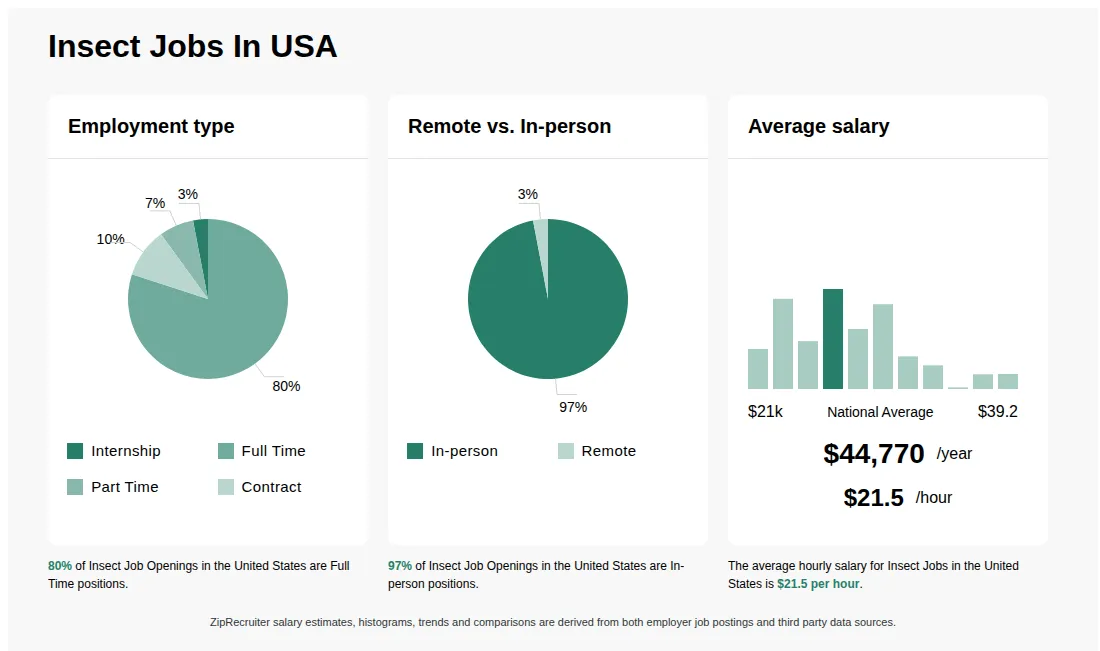
As of Aug 2, 2026, the average hourly pay for insect in the United States is $21.52, according to ZipRecruiter salary data. Most workers in this role earn between $15.38 and $25.00 per hour, depending on experience, location, and employer.

What are the key skills and qualifications needed to thrive as an Insect, and why are they important?

I'm sorry, but 'Insect' is not a real-world professional occupation, so I cannot provide a response.

What are insects?

Insects are small, six-legged creatures that belong to the class Insecta within the animal kingdom. They are characterized by having three main body parts (head, thorax, and abdomen), a pair of antennae, and usually one or two pairs of wings. Insects are the most diverse group of animals on Earth, with millions of species found in nearly every environment. They play essential roles in ecosystems, such as pollinating plants, decomposing organic matter, and serving as food for other animals.

What is the highest paying Entomologist job?

The highest paying entomologist roles are typically in government agencies, private industry, or research institutions, with senior positions such as lead entomologists or research directors earning salaries exceeding $100,000 annually. Specialized fields like forensic entomology or pest management consulting often offer higher compensation, especially with advanced degrees and extensive experience.

What are the common challenges faced by entomologists working in the field with insects?

Entomologists working with insects in the field often encounter challenges such as unpredictable weather, difficult terrain, and the need to locate and identify diverse insect species accurately. Additionally, they may have to manage delicate equipment or samples and ensure proper documentation for research purposes. Collaboration with other scientists, such as ecologists and botanists, is common to gain a comprehensive understanding of insect behavior and their ecological impact.

What profession works with insects?

Entomologists are scientists who study insects and often work in research, conservation, or pest control. They typically hold degrees in entomology or related fields and may work in laboratories, field environments, or academic settings.

What are 5 jobs in entomology?

Five common jobs in entomology include insect diagnostician, research scientist, pest management specialist, forensic entomologist, and agricultural entomologist. These roles often require knowledge of insect biology, fieldwork, laboratory skills, and sometimes advanced degrees in entomology or related fields.

What biology jobs pay over $100k?

In biology-related fields, roles such as biomedical scientists, pharmacologists, and biochemists often have salaries exceeding $100,000 annually, especially with advanced degrees and experience. Positions in research, pharmaceuticals, and healthcare industries typically offer higher compensation, often requiring specialized skills, certifications, or advanced education.

What is the difference between Insect vs Entomologist?

AspectInsectEntomologist
CredentialsNone requiredBachelor's or higher in entomology or related field
Work EnvironmentInsect habitats, laboratories, outdoor fieldsResearch labs, universities, pest control companies
Industry UsageCommonly used to refer to insects in generalSpecialist in insect study and research
Search IntentGeneral insect informationScientific research, pest management, academic purposes

Insect refers to the general category of insects, often used in everyday language. An entomologist is a trained scientist specializing in the study of insects, often involved in research, pest control, and academic work. While anyone can refer to insects as 'insects,' becoming an entomologist requires specific education and expertise.

More about Insect jobs
What cities are hiring for Insect jobs? Cities with the most Insect job openings:
What are the most commonly searched types of Insect jobs? The most popular types of Insect jobs are:
What states have the most Insect jobs? States with the most job openings for Insect jobs include:
Infographic showing various Insect job openings in the United States as of July 2026, with employment types broken down into 89% Full Time, 9% Part Time, 1% Temporary, and 1% Contract. Highlights an 97% Physical, 1% Hybrid, and 2% Remote job distribution, with an average salary of $44,770 per year, or $21.5 per hour.

$23.56/hr

Other

Posted 23 days ago


Job description

The Insect Production Worker performs routine, repetitive assignments involved in insect mass production, packaging, storing, sterilization, and delivering of insects, and is also involved in the cleaning, disinfection, and maintenance of work areas in support of the insect production program.
See Additional Information section for more clarification on cut-offs for applications.
Qualifications:To qualify, you must show you have had training and experience of sufficient scope and quality to provide you with the knowledge, skills and abilities to perform the duties of the position. Your answers to the vacancy specific questions must be supported by the work experience in your resume. For example, if you respond in the affirmative when questioned whether you have experience rearing insects, your resume must include this experience, mindful that experience may not be inferred by job title.
Experience refers to paid and unpaid experience, including volunteer work done through National Service programs (e.g., Peace Corps, AmeriCorps) and other organizations (e.g., professional, philanthropic, religious, spiritual, community, student, social). Volunteer work helps build critical competencies and can provide valuable training and experience that translates directly to paid employment. You will receive credit for all qualifying experience, including volunteer experience.Education:This position does not have an education qualification requirement.Employment Type: OTHER