
Information Security Analyst Position Responsibilities Information Security Analyst New York, NY (Hybrid role), look for Nearby candidates 12+ Months Contract . Responsibilities: Participate in ...
Information Security Analyst Position Responsibilities Information Security Analyst New York, NY (Hybrid role), look for Nearby candidates 12+ Months Contract . Responsibilities: Participate in ...

The Information Security Analyst supports the Bank's information security risk management and compliance program, with a focus on vendor risk, technology risk, third-party due diligence, access ...
The Information Security Analyst supports the Bank's information security risk management and compliance program, with a focus on vendor risk, technology risk, third-party due diligence, access ...
Information Security Analyst Contract: 6 Months Location: Indianapolis IN 46204 Job Mode: Hybrid (3 Days work from office, 2 days work from home) * To be effectively with wide range of information ...
Information Security Analyst Contract: 6 Months Location: Indianapolis IN 46204 Job Mode: Hybrid (3 Days work from office, 2 days work from home) * To be effectively with wide range of information ...

Information Security Analyst
Norfolk, VA · On-site
$60K - $75K/yr
Watershed is looking for an Information Security Analyst to plan, implement, upgrade, or monitor security measures for the protection of computer networks and information. May ensure appropriate ...
Quick apply
Information Security Analyst
Norfolk, VA · On-site
$60K - $75K/yr
Watershed is looking for an Information Security Analyst to plan, implement, upgrade, or monitor security measures for the protection of computer networks and information. May ensure appropriate ...

Information Security Analyst Apply now Job no: 502454 Work type: 12 Month Salaried Staff FT Location: Savannah Categories: Information Security As an information security analyst, you will monitor ...
Information Security Analyst Apply now Job no: 502454 Work type: 12 Month Salaried Staff FT Location: Savannah Categories: Information Security As an information security analyst, you will monitor ...
Information Security Analyst
Irving, TX · On-site
Information Security Analyst Location- Irving, TX The role will be in IAM Governance, supporting policy governance work. • Ability to self-drive • Ability to work in abstract environment • ...
Information Security Analyst
Irving, TX · On-site
Information Security Analyst Location- Irving, TX The role will be in IAM Governance, supporting policy governance work. • Ability to self-drive • Ability to work in abstract environment • ...

Information Security Analyst
Neenah, WI · On-site
As our Information Security Analyst, you'll be part of the team responsible for maintaining the security and integrity of all data and systems in our Community First enterprise environment. This is ...
Information Security Analyst
Neenah, WI · On-site
As our Information Security Analyst, you'll be part of the team responsible for maintaining the security and integrity of all data and systems in our Community First enterprise environment. This is ...

Information Security Analyst
Charlotte, NC · On-site
$53 - $57/hr
Information Security Analyst - IAM Strategic Enablement & Adoption Location: Charlotte, NC (Preferred) | Las Colinas, TX considered Work Authorization: Conversion Eligible About the Role We are ...
Information Security Analyst
Charlotte, NC · On-site
$53 - $57/hr
Information Security Analyst - IAM Strategic Enablement & Adoption Location: Charlotte, NC (Preferred) | Las Colinas, TX considered Work Authorization: Conversion Eligible About the Role We are ...

Information Security Analyst Location: Tallahassee, FL Duration: 1 Month Responsibilities : * Perform security gap assessment for the CMS platform and data environment. * Validate alignment with ...
Quick apply
Information Security Analyst Location: Tallahassee, FL Duration: 1 Month Responsibilities : * Perform security gap assessment for the CMS platform and data environment. * Validate alignment with ...

Information Security Analyst
Newark, DE · On-site
Information Security Analyst Location: NEWARK, DE Duration: 6 Months The Tier I Information Security Analyst is responsible for executing day-to-day tasks in the Security Operations Center 24x7.
Information Security Analyst
Newark, DE · On-site
Information Security Analyst Location: NEWARK, DE Duration: 6 Months The Tier I Information Security Analyst is responsible for executing day-to-day tasks in the Security Operations Center 24x7.

Information Security Analyst
Phoenix, AZ · On-site
We are seeking an experienced, talented, energetic, hands-on, and proactive Information Security Analyst to maintain and operate Deem's Information Security programs. You will be responsible for ...
Information Security Analyst
Phoenix, AZ · On-site
We are seeking an experienced, talented, energetic, hands-on, and proactive Information Security Analyst to maintain and operate Deem's Information Security programs. You will be responsible for ...

POSITION SUMMARY The Information Security Analyst supports the bank's Information Security Program in accordance with the FFIEC Information Security Handbook and applicable regulatory guidance.
POSITION SUMMARY The Information Security Analyst supports the bank's Information Security Program in accordance with the FFIEC Information Security Handbook and applicable regulatory guidance.

Information Security Analyst Location: Beaverton, Oregon (On-Site) Job Summary: We are seeking an experienced information security professional to support risk assessments, control validation, and ...
Information Security Analyst Location: Beaverton, Oregon (On-Site) Job Summary: We are seeking an experienced information security professional to support risk assessments, control validation, and ...
Information Security Analyst Charlotte NC (Hybrid role) Look for Nearby candidates Skills: Incident Response, Incident Handling, Investigations, SIEM and SOAR Comments: Job shift will be four 10-hour ...
Information Security Analyst Charlotte NC (Hybrid role) Look for Nearby candidates Skills: Incident Response, Incident Handling, Investigations, SIEM and SOAR Comments: Job shift will be four 10-hour ...

... Info Security Analyst Jersey City, NJ 5 Positions 6 Months Info Sec Analyst (Level 1) with good experience on Access and Account Provision + Level 1 Support (Phone/Email) for Information Security ...
... Info Security Analyst Jersey City, NJ 5 Positions 6 Months Info Sec Analyst (Level 1) with good experience on Access and Account Provision + Level 1 Support (Phone/Email) for Information Security ...

The Information Security Analyst position will be responsible for providing technical and business assistance for a wide variety of information security related matters. The Information Security ...
The Information Security Analyst position will be responsible for providing technical and business assistance for a wide variety of information security related matters. The Information Security ...

Information Security Analyst
Bellevue, WA · On-site
$48 - $63/hr
Information Security Analyst Position Description: Protingent Staffing has an exciting contract Information Security Analyst opportunity. Job Responsibilities: * Support the company's Incident ...
Information Security Analyst
Bellevue, WA · On-site
$48 - $63/hr
Information Security Analyst Position Description: Protingent Staffing has an exciting contract Information Security Analyst opportunity. Job Responsibilities: * Support the company's Incident ...

information security analyst
Los Angeles, CA · On-site
$60/hr
Information Security Analyst Location: Los Angeles CA / Hybrid Duration: 12 +months contract Hybrid role,3 days work from home Pay rate $60 per hr on W2 Summary This is a hands-on security position ...
information security analyst
Los Angeles, CA · On-site
$60/hr
Information Security Analyst Location: Los Angeles CA / Hybrid Duration: 12 +months contract Hybrid role,3 days work from home Pay rate $60 per hr on W2 Summary This is a hands-on security position ...

Information Security Analyst
Syracuse, NY · On-site
$87K - $92K/yr
Job Type Full-time Unionized Position Code Not Applicable The Information Security Analyst is a technical role within the Information Security (InfoSec) group of Information Technology Services (ITS ...
Information Security Analyst
Syracuse, NY · On-site
$87K - $92K/yr
Job Type Full-time Unionized Position Code Not Applicable The Information Security Analyst is a technical role within the Information Security (InfoSec) group of Information Technology Services (ITS ...
POSITION SUMMARY The Information Security Analyst supports the bank's Information Security Program in accordance with the FFIEC Information Security Handbook and applicable regulatory guidance.
POSITION SUMMARY The Information Security Analyst supports the bank's Information Security Program in accordance with the FFIEC Information Security Handbook and applicable regulatory guidance.
Information Security Analyst information
See salary details
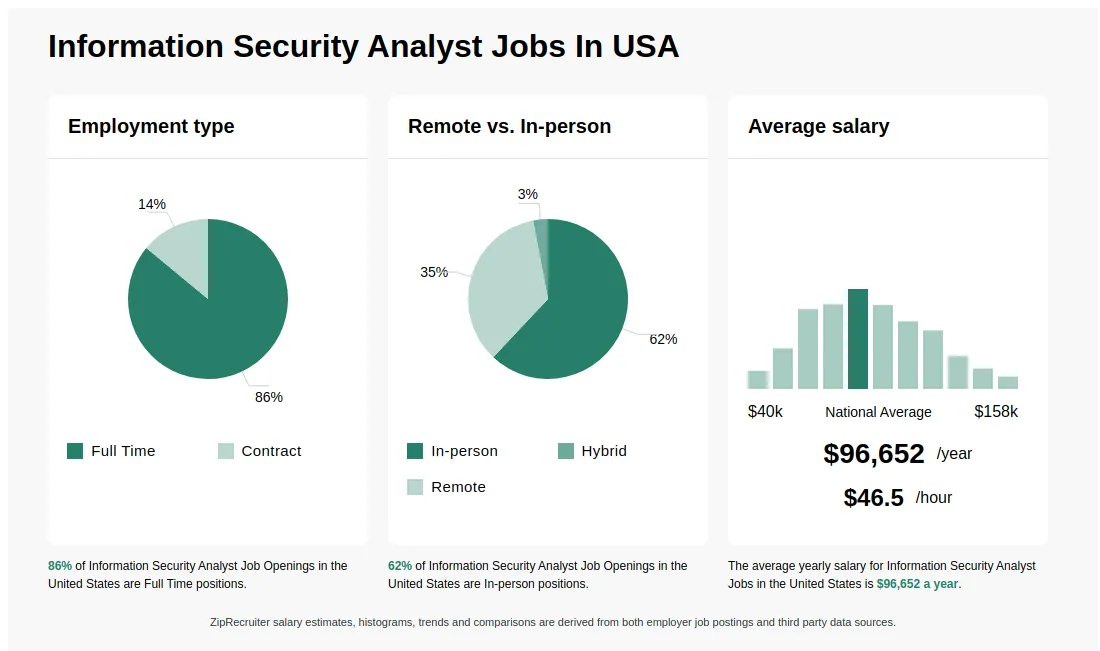
$40K - $50.7K
3% of jobs
$50.7K - $61.5K
6% of jobs
$61.5K - $72.2K
14% of jobs
$73.5K is the 25th percentile. Wages below this are outliers.
$72.2K - $82.9K
15% of jobs
The median wage is $90.6K / yr.
$82.9K - $93.6K
17% of jobs
$93.6K - $104.4K
14% of jobs
$110.5K is the 75th percentile. Wages above this are outliers.
$104.4K - $115.1K
12% of jobs
$115.1K - $125.8K
9% of jobs
$125.8K - $136.5K
5% of jobs
$136.5K - $147.3K
3% of jobs
$147.3K - $158K
2% of jobs
$40K
$96.7K
$158K
How much do information security analyst jobs pay per year?
As of Jul 22, 2026, the average yearly pay for information security analyst in the United States is $96,652.00, according to ZipRecruiter salary data. Most workers in this role earn between $73,500.00 and $114,500.00 per year, depending on experience, location, and employer.
Do cybersecurity analysts get paid well?
Cybersecurity analysts typically earn competitive salaries due to the high demand for their skills in protecting organizations from cyber threats. Entry-level positions may start lower, but with experience, certifications, and specialized knowledge, salaries can increase significantly, often exceeding the national average for IT roles.
What is the difference between Information Security Analyst vs Network Security Analyst?
| Aspect | Information Security Analyst | Network Security Analyst |
|---|---|---|
| Certifications | CompTIA Security+, CISSP, CEH | CompTIA Security+, Cisco CCNA Security, CISSP |
| Work Environment | Corporate IT departments, cybersecurity firms | Network operations centers, IT departments |
| Primary Focus | Overall security policies, threat detection, incident response | Network infrastructure security, firewall management, intrusion detection |
While both roles focus on cybersecurity, an Information Security Analyst has a broader scope, handling overall security strategies and incident response. A Network Security Analyst specializes in securing network infrastructure and managing network-specific threats. Both roles often require similar certifications and work environments, but their core responsibilities differ in scope and focus.
What does an Information Security Analyst do?
An Information Security Analyst is responsible for protecting an organization's computer systems and networks from cyber threats. They monitor networks for security breaches, investigate violations, and implement measures such as firewalls and encryption programs to safeguard sensitive information. Analysts also conduct security assessments, develop security policies, and educate staff about security best practices. Their work helps ensure the confidentiality, integrity, and availability of critical data.
How to Become an Information Security Analyst
Information security analysts create and implement an organization’s plan to defend against computer network security threats. The minimum requirement to become an information security analyst is a bachelor’s degree in computer science or management information systems. Focus your coursework in systems security, data management, cybersecurity, and software testing. You may find an internship as a way to gain experience and begin your career in cybersecurity.
What are the key skills and qualifications needed to thrive as an Information Security Analyst, and why are they important?
To thrive as an Information Security Analyst, you need a solid understanding of cybersecurity principles, risk management, and network security, typically backed by a degree in computer science or a related field. Familiarity with security information and event management (SIEM) tools, firewalls, intrusion detection systems, and certifications like CISSP or CompTIA Security+ are commonly required. Strong analytical thinking, problem-solving abilities, and effective communication skills help you identify threats and convey risks to stakeholders. These competencies are crucial for protecting organizational assets, ensuring regulatory compliance, and minimizing potential cyber threats.
What does a security information analyst do?
A security information analyst monitors and analyzes security data to identify and respond to potential threats and vulnerabilities. They use tools like SIEM systems, conduct risk assessments, and implement security measures to protect organizational information assets.
What are some common challenges Information Security Analysts face when responding to security incidents?
Information Security Analysts often encounter challenges such as quickly identifying the scope of a breach, coordinating with various teams, and managing the pressure to restore normal operations while preserving evidence for forensic analysis. They must communicate clearly with both technical and non-technical stakeholders and stay up to date with evolving threats. Handling multiple incidents simultaneously and ensuring compliance with regulatory requirements can also add complexity to the role.
Is 30 too late for cyber security?
Age is not a barrier to becoming an Information Security Analyst. Many professionals transition into cybersecurity later in life, and acquiring relevant skills, certifications like CompTIA Security+ or CISSP, and hands-on experience can help you enter the field regardless of age.
Can you make $200,000 in cyber security?
An experienced Information Security Analyst can potentially earn $200,000 or more annually, especially with advanced skills, certifications like CISSP or CISM, and in high-demand industries or senior roles. Salary levels vary based on location, experience, and the complexity of security responsibilities.
More about Information Security Analyst jobs
What cities are hiring for Information Security Analyst jobs? Cities with the most Information Security Analyst job openings:
What are the most commonly searched types of Information Security Analyst jobs? The most popular types of Information Security Analyst jobs are:
Who are the top companies hiring for Information Security Analyst jobs? The top employers for Information Security Analyst jobs are:
What states have the most Information Security Analyst jobs? States with the most job openings for Information Security Analyst jobs include:
What job categories do people searching Information Security Analyst jobs look for? The top searched job categories for Information Security Analyst jobs are:
What are popular job titles related to Information Security Analyst jobs? For Information Security Analyst jobs, the most frequently searched job titles are:
Job description
Position Title* Information Security Analyst Position Responsibilities
Information Security Analyst
New York, NY (Hybrid role), look for Nearby candidates
12+ Months Contract
.
Responsibilities:
Participate in developing and implementing application security governance processes.
Participate in the design and implementation of security controls and measures to protect applications from threats
Conduct regular reviews of application security controls to identify gaps and areas of improvements.
Develop and maintain Application Security reports and dashboards to track KRIs and KPIs
Analyze data from various security tools and system to identify trends and anomalies
Develop Requirement for new metrics- Coordinate responses to regulatory examiners, auditors, and risk management inquiries
Collaborate with cross function teams to define metrics and ensure data accuracy
Participate in developing communication strategy for application security teams and stakeholders
Qualifications:
Knowledge of SDLC and experience with secure coding practices
Strong analytical skills with key attention to details
Proficiency in data manipulation and visualization tools such as Jira, Excel, Tableau, Power BI
Strong analytical and problem-solving skills with attention to details
Knowledge of Cybersecurity framework- Working knowledge of industry standards and regulatory requirements for financial institutions (FFIEC guidance, OCC circulars, NIST standards, etc.)
Excellent communication skills with the ability to present complex information to senior management and non-technical audiences
Information Security Analyst
New York, NY (Hybrid role), look for Nearby candidates
12+ Months Contract
.
Responsibilities:
Participate in developing and implementing application security governance processes.
Participate in the design and implementation of security controls and measures to protect applications from threats
Conduct regular reviews of application security controls to identify gaps and areas of improvements.
Develop and maintain Application Security reports and dashboards to track KRIs and KPIs
Analyze data from various security tools and system to identify trends and anomalies
Develop Requirement for new metrics- Coordinate responses to regulatory examiners, auditors, and risk management inquiries
Collaborate with cross function teams to define metrics and ensure data accuracy
Participate in developing communication strategy for application security teams and stakeholders
Qualifications:
Knowledge of SDLC and experience with secure coding practices
Strong analytical skills with key attention to details
Proficiency in data manipulation and visualization tools such as Jira, Excel, Tableau, Power BI
Strong analytical and problem-solving skills with attention to details
Knowledge of Cybersecurity framework- Working knowledge of industry standards and regulatory requirements for financial institutions (FFIEC guidance, OCC circulars, NIST standards, etc.)
Excellent communication skills with the ability to present complex information to senior management and non-technical audiences

About Apex Informatics
Sourced by ZipRecruiter
Industry
It services
Company size
1 - 10 Employees
Headquarters location
Omaha, NE, US
Year founded
2014