1

Graduate Materials Science Jobs (NOW HIRING)

Materials Analyst, Microscopy

Phoenix, AZ · On-site

$26.25 - $32.50/hr

... graduate level. * B.S. or M.S. in Materials Science & Engineering or related field , or equivalent hands-on industry experience. * Hands-on experience operating Dual Beam FIB-SEM systems , OR strong ...

PhD in Polymer Science, Materials Science or related field required * 3+ years of post-graduate industry experience in polymer structural characterization, mechanical testing and rheology; Successful ...

next page

Showing results 1-20

Graduate Materials Science information

See salary details

$53K

$124K

$173K

How much do graduate materials science jobs pay per year?

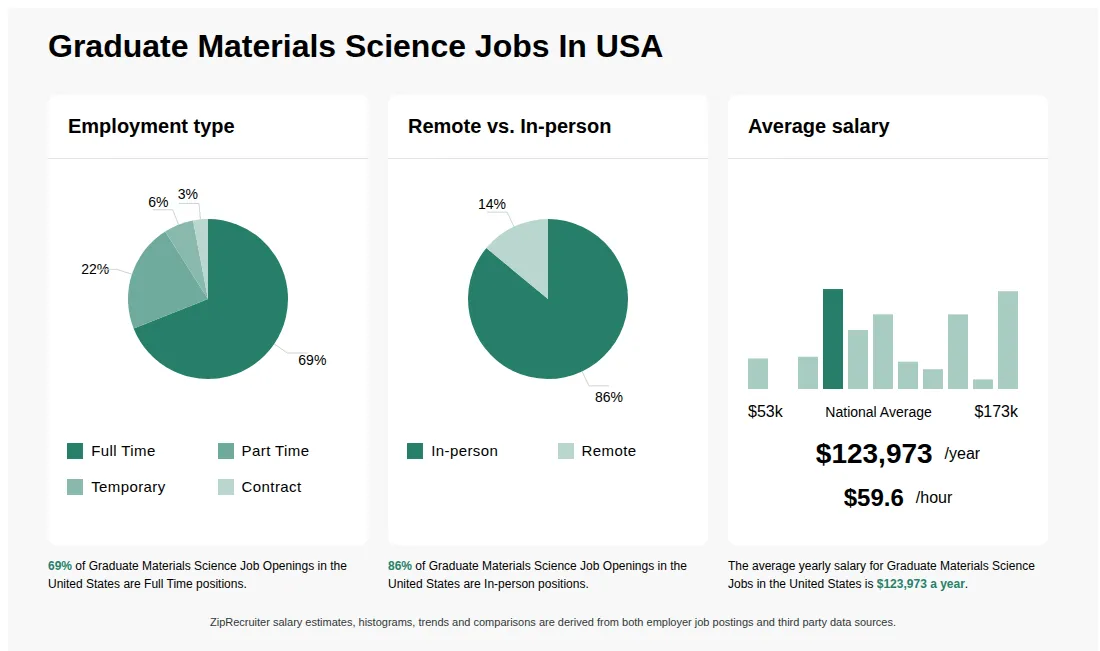
As of Jul 12, 2026, the average yearly pay for graduate materials science in the United States is $123,973.00, according to ZipRecruiter salary data. Most workers in this role earn between $93,500.00 and $167,000.00 per year, depending on experience, location, and employer.

What are the key skills and qualifications needed to thrive in the Graduate Materials Science position, and why are they important?

To thrive as a Graduate Materials Scientist, you typically need a degree in materials science, chemistry, or a related field, with strong analytical and laboratory skills. Familiarity with materials characterization tools (such as SEM, XRD, and spectroscopy), data analysis software, and laboratory safety certifications are often required. Strong problem-solving abilities, attention to detail, and effective teamwork and communication skills help you excel in this role. These qualities enable accurate experimental work, clear reporting, and productive collaboration, which are essential for driving innovation and ensuring quality in materials research.

What are the career opportunities in materials science?

Graduates in materials science can pursue careers in industries such as aerospace, automotive, electronics, energy, and healthcare, working as materials engineers, research scientists, quality assurance specialists, or product development engineers. These roles often require knowledge of materials properties, testing methods, and proficiency with tools like microscopy and spectroscopy, with opportunities for advancement in research, manufacturing, and management.

Is a master's in materials science worth it?

A master's in materials science can enhance job prospects for roles such as materials scientist or research engineer by providing specialized knowledge in materials properties, processing, and analysis. It often leads to higher-level positions, increased salary potential, and opportunities in industries like aerospace, electronics, and manufacturing.

What career progression can I expect as a Graduate Materials Scientist?

As a Graduate Materials Scientist, you can expect to begin in a junior or support role, assisting with experiments, data analysis, and reporting. Over time, with experience and further training, you may progress to lead projects, specialize in a particular area (such as polymers, metals, or nanomaterials), or take on supervisory responsibilities. Many organizations offer mentorship, professional development programs, and opportunities to collaborate with cross-functional teams, which can accelerate your career growth. With continued advancement, you could move into senior scientist, research management, or even product development roles within academia, industry, or government research institutions.


What can I do with a masters in materials science?

A master's in materials science prepares individuals for roles such as materials engineer, research scientist, or quality control specialist, often involving testing, analysis, and development of materials like metals, polymers, ceramics, and composites. Graduates can work in industries such as aerospace, automotive, electronics, or energy, utilizing skills in microscopy, spectroscopy, and computer-aided design. Certification and familiarity with laboratory equipment and safety protocols are also valuable in this field.

What is a Graduate Materials Science job?

A Graduate Materials Science job is an entry-level position for individuals with a degree in materials science or a related field. It typically involves research, development, and testing of materials to improve their properties and applications in industries like aerospace, electronics, or manufacturing. Responsibilities may include analyzing material structures, conducting experiments, and assisting in product development. These roles help graduates gain hands-on experience and apply theoretical knowledge in real-world settings.

What jobs can I get with a materials science degree?

A materials science degree qualifies graduates for roles such as materials engineer, research scientist, quality control analyst, and product development engineer. These positions often involve working with metals, polymers, ceramics, or composites, and may require knowledge of testing methods, CAD software, and laboratory techniques.
What cities are hiring for Graduate Materials Science jobs? Cities with the most Graduate Materials Science job openings:
What are the most commonly searched types of Graduate Materials Science jobs? The most popular types of Graduate Materials Science jobs are:
What states have the most Graduate Materials Science jobs? States with the most job openings for Graduate Materials Science jobs include:
Infographic showing various Graduate Materials Science job openings in the United States as of July 2026, with employment types broken down into 86% Full Time, and 14% Part Time. Highlights an 100% In-person job distribution, with an average salary of $123,973 per year, or $59.6 per hour.
Faculty Position in Materials Science and Engineering

Faculty Position in Materials Science and Engineering

University of Michigan

Ann Arbor, MI • On-site

Full-time

Re-posted 26 days ago


University Of Michigan rating

8.2

Company rating: 8.2 out of 10

Based on 141 frontline employees who took The Breakroom Quiz

120th of 552 rated colleges and universities


Job description

Description
The Department of Materials Science and Engineering (MSE), College of Engineering, University of Michigan, invites applicants for a tenure-track assistant professor faculty position in the area of materials for batteries and energy storage. Emphasis will be placed on applicants with a record of outstanding experimental and/or computational research accomplishments on the design, prediction, synthesis and/or characterization of materials for batteries and energy storage.
Qualifications
We seek individuals to carry out research and teaching in a highly collaborative environment, within MSE and across disciplines. The applicant must hold a Ph.D. degree in MSE, Mechanical Engineering, Chemical Engineering, Chemistry or a related field and should be passionate about teaching undergraduate and graduate courses within the field. We are especially interested in candidates who can contribute, through research, teaching, and/or service, to the diversity and excellence of the academic community.
Application Instructions
Candidates should provide a cover letter, a detailed curriculum vitae (CV) including a complete list of publications, a research plan (three pages maximum), a teaching statement (two pages maximum), a single-page diversity statement, two publications, and the names of four references to our website at
http://mse.engin.umich.edu/facultysearch
Review of applications will begin November 15, 2023. Applications received after that date will be considered until the position is filled.
Contact information:
E-mail: mse-search@umich.edu
Subject: Materials Science and Engineering (MSE) Faculty Search Chair
Department of Materials Science and Engineering
The University of Michigan
2300 Hayward Street
Ann Arbor, MI 48109-2136
The University of Michigan is an equal opportunity/affirmative action employer with an active dual-career assistance program.
Michigan Engineers are world-class educators, researchers, students and staff who strive to build a people-first future. As part of the nation's number one public research institution, Michigan Engineering's mission is to provide scientific and technological leadership to the people of the world, develop intellectually curious and socially conscious minds, create collaborative solutions to societal problems, and promote an inclusive and innovative community of service for the common good.
Our vision, mission and values are supported by a people-first engineering framework that guides our work. As Michigan Engineers, we strive to apply excellent engineering fundamentals, integrated expertise and equity-centered values to reimagine what engineering can be, close critical gaps, and elevate all people. Information about our vision, mission and values can be found at: http://strategicvision.engin.umich.edu/.
The University of Michigan has a storied legacy of commitment to Diversity, Equity and Inclusion (DEI). Michigan Engineering models that commitment in our research, culture and collaborations. We seek to recruit and retain a diverse workforce as a reflection of that commitment. Learn more about DEI at Michigan Engineering: https://www.engin.umich.edu/culture/diversity-equity-inclusion/
COVID-19 vaccinations, including one booster when eligible, are required for all University of Michigan students, faculty and staff across all campuses, including Michigan Medicine. This includes those working remotely. More information on this new policy is available on the U-M Health Response website or the UM-Dearborn and UM-Flint websites.

What University Of Michigan employees say

Pay

Benefits

Hours and flexibility

Workplace

Get the full story on Breakroom


University of Michigan logo

About University of Michigan

Sourced by ZipRecruiter

The University of Michigan (U-M), based in Ann Arbor, MI, US, is one of America's most esteemed institutions in higher education. Established in 1817, it presides in the industry of education and research, providing a range of services including undergraduate, graduate, and professional education programs. Complementing this is an extensive research activity that has significantly contributed to various fields, from healthcare to engineering, humanities to sports. Upholding its mission "to serve the people of Michigan and the world through preeminence in creating, communicating, preserving and applying knowledge, art, and academic values", U-M consistently ranks among the top universities globally, a testament to its tradition of excellence in learning and research, and a deep commitment to innovation and discovery.

Industry

Colleges, universities, and professional schools

Company size

10,000+ Employees

Headquarters location

Ann Arbor, MI, US

Year founded

1817

Social media