1

Graduate Materials Science Jobs (NOW HIRING)

next page

Showing results 1-20

Graduate Materials Science information

See salary details

$53K

$124K

$173K

How much do graduate materials science jobs pay per year?

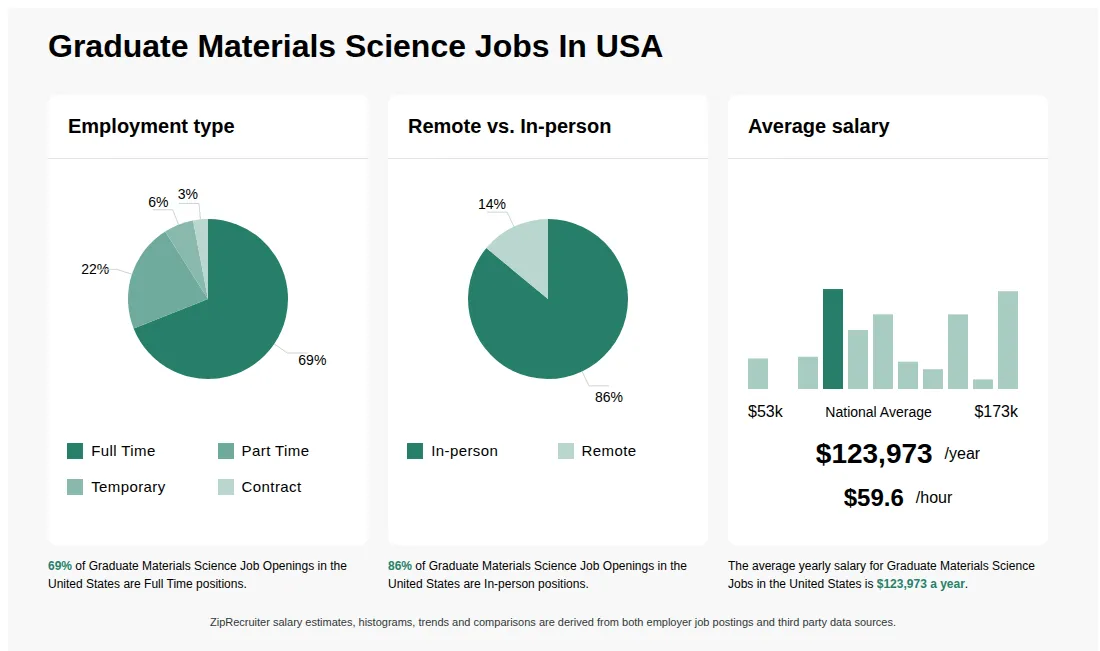
As of Aug 22, 2026, the average yearly pay for graduate materials science in the United States is $123,973.00, according to ZipRecruiter salary data. Most workers in this role earn between $93,500.00 and $167,000.00 per year, depending on experience, location, and employer.

What is a graduate materials science?

A Graduate Materials Science job is an entry-level position for individuals with a degree in materials science or a related field. It typically involves research, development, and testing of materials to improve their properties and applications in industries like aerospace, electronics, or manufacturing. Responsibilities may include analyzing material structures, conducting experiments, and assisting in product development. These roles help graduates gain hands-on experience and apply theoretical knowledge in real-world settings.

What are the key skills and qualifications needed to thrive in graduate materials science, and why are they important?

To thrive as a Graduate Materials Scientist, you typically need a degree in materials science, chemistry, or a related field, with strong analytical and laboratory skills. Familiarity with materials characterization tools (such as SEM, XRD, and spectroscopy), data analysis software, and laboratory safety certifications are often required. Strong problem-solving abilities, attention to detail, and effective teamwork and communication skills help you excel in this role. These qualities enable accurate experimental work, clear reporting, and productive collaboration, which are essential for driving innovation and ensuring quality in materials research.

What career progression can I expect as a graduate materials scientist?

As a Graduate Materials Scientist, you can expect to begin in a junior or support role, assisting with experiments, data analysis, and reporting. Over time, with experience and further training, you may progress to lead projects, specialize in a particular area (such as polymers, metals, or nanomaterials), or take on supervisory responsibilities. Many organizations offer mentorship, professional development programs, and opportunities to collaborate with cross-functional teams, which can accelerate your career growth. With continued advancement, you could move into senior scientist, research management, or even product development roles within academia, industry, or government research institutions.

Is a master's in materials science worth it?

A master's in materials science can enhance job prospects for roles such as materials engineer or research scientist by providing specialized knowledge in materials properties, processing, and testing. It often leads to higher-level positions, increased salary potential, and opportunities in industries like aerospace, automotive, and electronics.

Is material science in high demand?

Material science professionals, including graduate materials scientists, are in high demand across industries such as aerospace, automotive, electronics, and energy due to ongoing innovations and the need for advanced materials. Skills in research, characterization techniques, and knowledge of emerging materials like composites and nanomaterials increase employability in this field.

What can you do with a master's in materials science?

A master's in materials science prepares individuals for roles such as materials engineer, research scientist, or quality control specialist, often involving testing, analysis, and development of materials like metals, polymers, and ceramics. Graduates can work in industries such as aerospace, automotive, electronics, or energy, utilizing skills in microscopy, spectroscopy, and computer-aided design. Certification and familiarity with laboratory equipment and industry standards enhance employment prospects.

What jobs can I get with a graduate materials science degree?

A graduate in materials science can pursue roles such as materials engineer, research scientist, quality control analyst, or product development engineer. These positions often require knowledge of materials properties, testing methods, and proficiency with tools like CAD software and laboratory equipment.

What cities are hiring for Graduate Materials Science jobs?

Cities with the most Graduate Materials Science job openings:

What are the most commonly searched types of Graduate Materials Science jobs?

The most popular types of Graduate Materials Science jobs are:

What states have the most Graduate Materials Science jobs?

States with the most job openings for Graduate Materials Science jobs include:

What job categories do people searching Graduate Materials Science jobs look for?

The top searched job categories for Graduate Materials Science jobs are:

Infographic showing various Graduate Materials Science job openings in the United States as of August 2026, with employment types broken down into 1% As Needed, 82% Full Time, 13% Part Time, 1% Temporary, 2% Contract, and 1% Nights. Highlights an 92% Physical, 2% Hybrid, and 6% Remote job distribution, with an average salary of $123,973 per year, or $59.6 per hour.

Materials Science Ai Engineer

Cardinal Integrated Technologies Inc

Santa Clara, CA โ€ข On-site

Full-time

Re-posted 29 days ago


Job description

Job Summary:
Cardinal Integrated Technologies Inc is seeking a Materials Science AI Engineer to join their team in developing and supporting materials discovery and design. The ideal candidate will focus on building AI-based solutions and collaborating with scientists and engineers to integrate analytics into core R&D workflows.
Responsibilities:
โ€ข Design, develop and deploy multi-modal AI, ML, and hybrid physical-based models to solve ground-breaking material physics and design problems.
โ€ข Aggregate, process, transform and quality-control experimental and simulation data for modeling and analysis.
โ€ข Design, develop, and maintain data workflows to support materials informatics initiatives. Optimize data pipelines and model execution on parallel cloud systems (e.g., Azure, GCP, AWS).
โ€ข Collaborate with materials scientists, chemists, and software engineers to integrate analytics and predictive modeling into core R&D workflows.
โ€ข Document code, workflows, and best practices to support reproducible research.
โ€ข Apply AI and data analytics to optimize material synthesis and processing parameters in real-time, minimizing defects, improving consistency.
Qualifications:
Required:
โ€ข Strong proficiency in programming languages like Python and C++.
โ€ข Experience with machine learning and deep learning frameworks (e.g., PyTorch, TensorFlow).
โ€ข Experience with data cleansing, preprocessing, and feature engineering
โ€ข Graduate or undergraduate degree in Computer Science, Engineering, Applied Mathematics, or a related technical field.
โ€ข 2-4 years of work experience (depending on educational degree) in data science, AI, machine learning, or data engineering roles.
โ€ข A strong foundation in the principles of materials science is essential to understand the underlying science and set up meaningful problems for AI.
โ€ข Expert in Python and data science libraries (e.g., pandas, NumPy, scikit-learn, TensorFlow or PyTorch).
โ€ข Expertise in use of cloud-based compute environments and tools for parallel or distributed computing.
โ€ข Strong problem-solving and communication skills.
Preferred:
โ€ข Design, develop and deploy multi-modal AI, ML, and hybrid physical-based models to solve ground-breaking material physics and design problems
Company:
We are a company of IT professionals who passionately believe that good quality products & services are delivered by great resources. Founded in 2013, the company is headquartered in Monmouth Junction, USA, with a team of 201-500 employees. The company is currently Growth Stage.