Minimum 5 years of post-graduate experience in materials science; hands-on experience with battery research and development (including electrochemistry and lithium-ion or other battery technologies ...
Minimum 5 years of post-graduate experience in materials science; hands-on experience with battery research and development (including electrochemistry and lithium-ion or other battery technologies ...

... and graduate courses within the field. We seek candidates who will provide inspiration and ... Materials Science and Engineering (MSE) Faculty Search Chair Department of Materials Science and ...
... and graduate courses within the field. We seek candidates who will provide inspiration and ... Materials Science and Engineering (MSE) Faculty Search Chair Department of Materials Science and ...
... and graduate courses within the field. We seek candidates who will provide inspiration and ... Materials Science and Engineering (MSE) Faculty Search Chair Department of Materials Science and ...
... and graduate courses within the field. We seek candidates who will provide inspiration and ... Materials Science and Engineering (MSE) Faculty Search Chair Department of Materials Science and ...

We are looking for a talented Materials Science Engineering Technical Specialist to join our ... Post-graduate (Master's) degree relevant to this discipline area may be required for select roles.
We are looking for a talented Materials Science Engineering Technical Specialist to join our ... Post-graduate (Master's) degree relevant to this discipline area may be required for select roles.
We are looking for a talentedMaterials Science Engineering Technical Specialist to join ... Post-graduate (Master's) degree relevant to this discipline area may berequiredfor select roles.
We are looking for a talentedMaterials Science Engineering Technical Specialist to join ... Post-graduate (Master's) degree relevant to this discipline area may berequiredfor select roles.
We are looking for a talentedMaterials Science Engineering Technical Specialist to join ... Post-graduate (Master's) degree relevant to this discipline area may berequiredfor select roles.
We are looking for a talentedMaterials Science Engineering Technical Specialist to join ... Post-graduate (Master's) degree relevant to this discipline area may berequiredfor select roles.
We are looking for a talentedMaterials Science Engineering Technical Specialist to join ... Post-graduate (Master's) degree relevant to this discipline area may berequiredfor select roles.
We are looking for a talentedMaterials Science Engineering Technical Specialist to join ... Post-graduate (Master's) degree relevant to this discipline area may berequiredfor select roles.

Faculty Position in Materials Science and Engineering: Synthesis, Processing, and Characterization o
Knoxville, TN · On-site
Graduate courses aligned with the candidate's research expertise The ability to develop new ... D. in Materials Science and Engineering, Physics, Chemistry, or a closely related field is required.
Faculty Position in Materials Science and Engineering: Synthesis, Processing, and Characterization o
Knoxville, TN · On-site
Graduate courses aligned with the candidate's research expertise The ability to develop new ... D. in Materials Science and Engineering, Physics, Chemistry, or a closely related field is required.
We are looking for a talentedMaterials Science Engineering Technical Specialist to join ... Post-graduate (Master's) degree relevant to this discipline area may berequiredfor select roles.
We are looking for a talentedMaterials Science Engineering Technical Specialist to join ... Post-graduate (Master's) degree relevant to this discipline area may berequiredfor select roles.
We are looking for a talentedMaterials Science Engineering Technical Specialist to join ... Post-graduate (Master's) degree relevant to this discipline area may berequiredfor select roles.
We are looking for a talentedMaterials Science Engineering Technical Specialist to join ... Post-graduate (Master's) degree relevant to this discipline area may berequiredfor select roles.
We are looking for a talentedMaterials Science Engineering Technical Specialist to join ... Post-graduate (Master's) degree relevant to this discipline area may berequiredfor select roles.
We are looking for a talentedMaterials Science Engineering Technical Specialist to join ... Post-graduate (Master's) degree relevant to this discipline area may berequiredfor select roles.

Mentor graduate and undergraduate students QUALIFICATIONS: * Ph.D. in Materials Science and Engineering or a closely related field, with a dissertation emphasizing electron microscopy * Extensive ...
Mentor graduate and undergraduate students QUALIFICATIONS: * Ph.D. in Materials Science and Engineering or a closely related field, with a dissertation emphasizing electron microscopy * Extensive ...
We are looking for a talentedMaterials Science Engineering Technical Specialist to join ... Post-graduate (Master's) degree relevant to this discipline area may berequiredfor select roles.
We are looking for a talentedMaterials Science Engineering Technical Specialist to join ... Post-graduate (Master's) degree relevant to this discipline area may berequiredfor select roles.
We are looking for a talentedMaterials Science Engineering Technical Specialist to join ... Post-graduate (Master's) degree relevant to this discipline area may berequiredfor select roles.
We are looking for a talentedMaterials Science Engineering Technical Specialist to join ... Post-graduate (Master's) degree relevant to this discipline area may berequiredfor select roles.
We are looking for a talentedMaterials Science Engineering Technical Specialist to join ... Post-graduate (Master's) degree relevant to this discipline area may berequiredfor select roles.
We are looking for a talentedMaterials Science Engineering Technical Specialist to join ... Post-graduate (Master's) degree relevant to this discipline area may berequiredfor select roles.
We are looking for a talentedMaterials Science Engineering Technical Specialist to join ... Post-graduate (Master's) degree relevant to this discipline area may berequiredfor select roles.
We are looking for a talentedMaterials Science Engineering Technical Specialist to join ... Post-graduate (Master's) degree relevant to this discipline area may berequiredfor select roles.
We are looking for a talentedMaterials Science Engineering Technical Specialist to join ... Post-graduate (Master's) degree relevant to this discipline area may berequiredfor select roles.
We are looking for a talentedMaterials Science Engineering Technical Specialist to join ... Post-graduate (Master's) degree relevant to this discipline area may berequiredfor select roles.
We are looking for a talentedMaterials Science Engineering Technical Specialist to join ... Post-graduate (Master's) degree relevant to this discipline area may berequiredfor select roles.
We are looking for a talentedMaterials Science Engineering Technical Specialist to join ... Post-graduate (Master's) degree relevant to this discipline area may berequiredfor select roles.
... graduate study in 2021). MSE has 25 tenured and tenure-track core faculty members, 20 courtesy ... materials science. Further information can be found at the department website: The successful ...
... graduate study in 2021). MSE has 25 tenured and tenure-track core faculty members, 20 courtesy ... materials science. Further information can be found at the department website: The successful ...
## Assistant Professor, Materials Science and EngineeringApplylocations: Orlando, FL (Main Campus ... graduate) in the aforementioned areas of research. Establishing strong ties with industrial ...
## Assistant Professor, Materials Science and EngineeringApplylocations: Orlando, FL (Main Campus ... graduate) in the aforementioned areas of research. Establishing strong ties with industrial ...
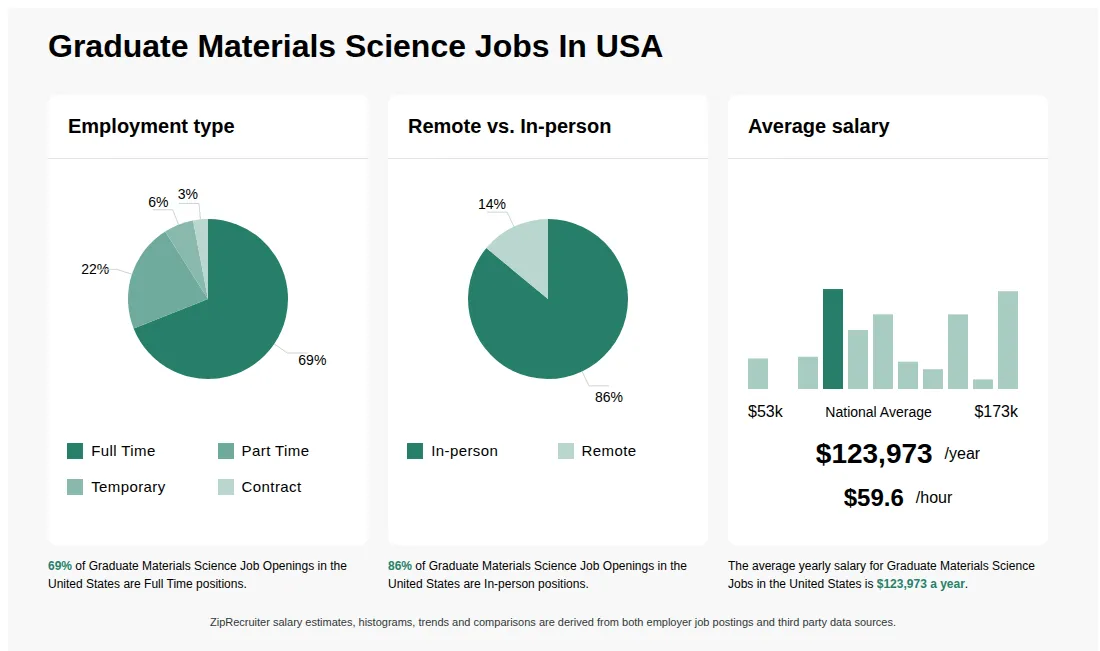
Graduate Materials Science information
See salary details
$53K - $63.9K
5% of jobs
$63.9K - $74.8K
0% of jobs
$74.8K - $85.7K
6% of jobs
$93.2K is the 25th percentile. Wages below this are outliers.
$85.7K - $96.6K
20% of jobs
$96.6K - $107.5K
11% of jobs
The median wage is $113K / yr.
$107.5K - $118.5K
15% of jobs
$118.5K - $129.4K
5% of jobs
$129.4K - $140.3K
3% of jobs
$147.3K is the 75th percentile. Wages above this are outliers.
$140.3K - $151.2K
15% of jobs
$151.2K - $162.1K
1% of jobs
$162.1K - $173K
19% of jobs
$53K
$124K
$173K
How much do graduate materials science jobs pay per year?
As of Sep 12, 2026, the average yearly pay for graduate materials science in the United States is $123,973.00, according to ZipRecruiter salary data. Most workers in this role earn between $93,500.00 and $167,000.00 per year, depending on experience, location, and employer.
What is a graduate materials science?
A Graduate Materials Science job is an entry-level position for individuals with a degree in materials science or a related field. It typically involves research, development, and testing of materials to improve their properties and applications in industries like aerospace, electronics, or manufacturing. Responsibilities may include analyzing material structures, conducting experiments, and assisting in product development. These roles help graduates gain hands-on experience and apply theoretical knowledge in real-world settings.
What are the key skills and qualifications needed to thrive in graduate materials science, and why are they important?
To thrive as a Graduate Materials Scientist, you typically need a degree in materials science, chemistry, or a related field, with strong analytical and laboratory skills. Familiarity with materials characterization tools (such as SEM, XRD, and spectroscopy), data analysis software, and laboratory safety certifications are often required. Strong problem-solving abilities, attention to detail, and effective teamwork and communication skills help you excel in this role. These qualities enable accurate experimental work, clear reporting, and productive collaboration, which are essential for driving innovation and ensuring quality in materials research.
What career progression can I expect as a graduate materials scientist?
As a Graduate Materials Scientist, you can expect to begin in a junior or support role, assisting with experiments, data analysis, and reporting. Over time, with experience and further training, you may progress to lead projects, specialize in a particular area (such as polymers, metals, or nanomaterials), or take on supervisory responsibilities. Many organizations offer mentorship, professional development programs, and opportunities to collaborate with cross-functional teams, which can accelerate your career growth. With continued advancement, you could move into senior scientist, research management, or even product development roles within academia, industry, or government research institutions.
Is a master's in materials science worth it?
A master's in materials science can enhance job prospects for roles such as materials engineer or research scientist by providing specialized knowledge in materials properties, processing, and testing. It often leads to higher-level positions, increased salary potential, and opportunities in industries like aerospace, automotive, and electronics.
Is material science in high demand?
Material science professionals, including graduate materials scientists, are in high demand across industries such as aerospace, automotive, electronics, and energy due to ongoing innovations and the need for advanced materials. Skills in research, characterization techniques, and knowledge of emerging materials like composites and nanomaterials increase employability in this field.
What can you do with a master's in materials science?
A master's in materials science prepares individuals for roles such as materials engineer, research scientist, or quality control specialist, often involving testing, analysis, and development of materials like metals, polymers, and ceramics. Graduates can work in industries such as aerospace, automotive, electronics, or energy, utilizing skills in microscopy, spectroscopy, and computer-aided design. Certification and familiarity with laboratory equipment and industry standards enhance employment prospects.
What jobs can I get with a graduate materials science degree?
A graduate in materials science can pursue roles such as materials engineer, research scientist, quality control analyst, or product development engineer. These positions often require knowledge of materials properties, testing methods, and proficiency with tools like CAD software and laboratory equipment.
More about Graduate Materials Science jobs
What cities are hiring for Graduate Materials Science jobs?
Cities with the most Graduate Materials Science job openings:
What are the most commonly searched types of Graduate Materials Science jobs?
The most popular types of Graduate Materials Science jobs are:
What states have the most Graduate Materials Science jobs?
States with the most job openings for Graduate Materials Science jobs include:
What job categories do people searching Graduate Materials Science jobs look for?
The top searched job categories for Graduate Materials Science jobs are:

Manager, Materials Science (Ph.D.)
Phoenix, AZ
Exponent Inc.
• IT Services • 11 - 50 employees11 - 50 employees
Full-time
Retirement
Re-posted 26 days ago
Key responsibilities
Support investigations involving battery failure analysis, safety assessments, and performance evaluations across industries.
Design, coordinate, and interpret experiments using techniques such as battery pack teardowns, CT scanning, SEM, EDS, FTIR, and electrochemical methods, and prepare technical reports.
Manage small teams and technical projects, collaborate with multidisciplinary teams, and support business development efforts.
Job description
About Exponent
Exponent is the only premium engineering and scientific consulting firm with the depth and breadth of expertise to solve our clients' most profoundly unique, unprecedented, and urgent challenges.
We are committed to engaging multidisciplinary teams of science, engineering, and regulatory experts to empower our clients with solutions that create a safer, healthier, more sustainable world. For over five decades, we've connected the lessons of past failures with tomorrow's solutions to advise clients as they innovate technologically complex products and processes, ensure the safety and health of their users, and address the challenges of sustainability.
Join our team of experts with degrees from top programs at over 500 universities and extensive experience spanning a variety of industries. At Exponent, you'll contribute to the diverse pool of ideas, talents, backgrounds, and experiences that drives our collaborative teamwork and breakthrough insights. Plus, we help you grow your career through mentoring, sponsorship, and a culture of learning. Thanks for your interest in joining our team!
Key statistics:
- 950+ Consultants
- 640+ Ph.D.s
- 90+ Disciplines
- 30+ Offices globally
We are seeking a talented and motivated Manager to join our Materials Science & Electrochemistry team in Phoenix, AZ. In this role, you will contribute to multidisciplinary teams that address complex challenges involving battery failure analysis, safety hazard assessments, and electrochemical performance studies across a wide range of industries, including energy storage, transportation, consumer electronics, and medical devices. You will support technical investigations and laboratory testing, analyze data, and help deliver high-quality, client-focused solutions.
This is an excellent opportunity for a technically strong scientist or engineer who is looking to apply their experience to an exciting career in consulting. As a Manager at Exponent, you will build and maintain strong relationships with clients, support business development efforts, lead small teams, and grow your consulting practice. You will work closely with senior staff and subject matter experts across Exponent's practices and offices.
You will be responsible forApplying expertise in Materials Science to support investigations involving battery failure analysis, safety assessments and performance evaluations across industries while leveraging experience in battery R&D to solve real-world electrochemistry and materials challenges.
Designing and coordinating experiments, interpreting data, preparing high-quality technical reports and presenting findings to both technical and non-technical audiences.
Coordinating laboratory testing and analysis using techniques such as battery pack teardowns, CT scanning, SEM, EDS, FTIR, and electrochemical methods.
Supporting project planning and execution to ensure timely and successful outcomes, collaborating with multidisciplinary teams to deliver scientifically rigorous solutions, and mentoring junior staff by providing guidance and fostering a collaborative environment.
Participating in occasional travel for client meetings, site inspections, or lab work.
- Ph.D. in Materials Science, Materials Science & Engineering, Chemical Engineering, Chemistry, or a related field.
- Minimum 5 years of post-graduate experience in materials science; hands-on experience with battery research and development (including electrochemistry and lithium-ion or other battery technologies) is highly desirable.
- Prior consulting experience required.
- Specialized knowledge of electrochemistry, battery chemistry, cell design, assembly, and characterization; experience in failure analysis preferred.
- Demonstrated strong drive and commitment to professional work product and growth.
- Proficiency in materials characterization techniques such as CT scanning, SEM, and electrochemical methods (e.g., EIS, cyclic voltammetry), with strong analytical and problem-solving skills to interpret complex data.
- Experience managing small teams and coordinating technical projects, timelines, and deliverables.
- Proven track record in business development, client engagement, or securing funding/grants.
- Excellent verbal and written communication skills with ability to convey technical concepts to diverse audiences, including engineering, business, and legal stakeholders.
- Entrepreneurial mindset with ability to attract new and repeat clients or funding.
Applicants are encouraged to submit a CV with publications (feel free to include publications that are in review or pending) [not restricted to 1 page].
Life @ ExponentTo learn more about life at Exponent and our impact, please visit the following links:https://www.exponent.com/careers/life-exponenthttps://www.exponent.com/company/our-impact
Attracting, inspiring, developing, and rewarding exceptional people with diverse backgrounds and expertise are central to our corporate culture. Our diverse team allows us to provide better value to our clients and enjoy an enriched work environment.
Our firm is committed to offering a variety of programs and resources to support health and well-being. We believe that providing competitive benefits as well as compensation and recognition programs empowers our staff to do work that makes a difference.
Work EnvironmentAt Exponent, we have found that in-person interactions deepen employee engagement and are crucial for development, for realizing the full potential of our talented and diverse teams, and for building a more inclusive workplace where all have a sense of belonging. In our offices, you can expect a supportive culture and a collaborative, dynamic, multi-disciplinary work environment. Our consultants engage in-person in the office unless they are traveling for client work or other business activities.
We value the rich lives our colleagues enjoy outside of work and understand that work/life balance is critical to our employees and their well-being. Consultants have the autonomy to balance their work and personal schedules so you can meet with clients, visit inspection sites, attend conferences, and make time for priorities outside of work, too. It is this flexible, agile work style and working hours that allow our teams to drive innovation and results in their own ways, while meeting the needs of clients. #LI-Onsite
CompensationOur consultants are rewarded for their technical and business contributions and have an opportunity to plan for future success and career growth. Exponent's total compensation plan is consistent with its expectations of the quality and quantity of work performed and with the professional standards set by Exponent. At the Manager level and above total compensation includes base salary, annual bonus, and 401(k) employer contribution of 7% of base salary.
The base salary range for this position is dependent on experience and capabilities which will be assessed during the interview process.
Benefits you will enjoyAccess benefits information on our Life@Exponent page: https://www.exponent.com/careers/life-exponent
Exponent is a proud equal opportunity employer. All qualified applicants will receive consideration for employment without regard to race, color, religion, sex, national origin, veteran status, disability, sexual orientation, gender identity, or any other protected status.
If you need assistance or accommodation due to a disability, you may email us at HR-Accommodations@exponent.com.
Job LocationsUS-AZ-PhoenixEmployment Type: FULL_TIME
About Exponent Partners
Sourced by ZipRecruiter
Industry
It services
Company size
11 - 50 Employees
Headquarters location
San Francisco, CA, US
Year founded
2005